

- What the question means: It is not a trap, it is your chance to connect your strengths to their problem and reduce hiring risk.
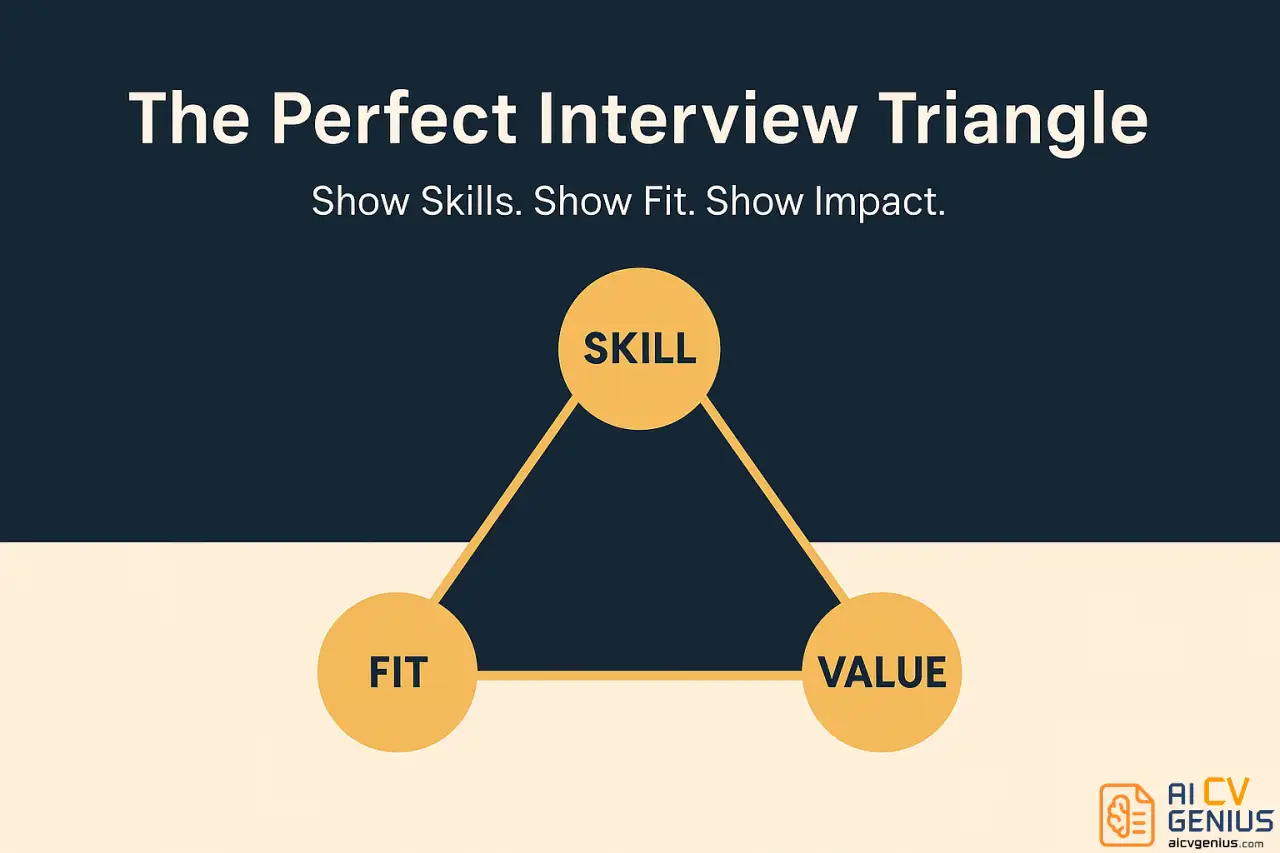
- What interviewers are checking: Solution fit, team fit, and motivation fit are the three signals your answer must hit.
- The formula to use: Lead with Alignment to their need, prove Ability with one focused story plus a metric, finish with Ambition tied to their goals.
- How to make it land: Research the real pain point behind the job description, avoid generic trait lists, keep it 60 to 90 seconds, and end with a confident forward-looking close.
- Delivery and recovery: Speak calmly with clear pacing, and if you blank out, pause to frame your answer or ask which part of the role they care about most.
Introduction: Decoding “Why Should We Hire You?”
The Interview Moment That Isn’t a Trap, It’s an Invitation
The interview has been going well. You have built a good rapport. Then, the hiring manager leans back, notebook open, and asks the single most direct question of the entire process:
“So… why should we hire you?”
In an instant, your mind floods. Do you list your skills? Do you talk about your passion? Do you repeat your resume? This question feels like a spotlight, a final exam, and a trap all in one. Many candidates freeze, ramble, or fall back on generic clichés (“I’m a hard worker,” “I’m a great team player”).
Here is the secret: This question is not a trap. It is an invitation.
It is the single greatest opportunity the interviewer gives you. They are not asking, “Why are you better than everyone else?” They are not asking you to be arrogant. They are handing you the microphone and asking you, in the simplest terms possible, to connect the dots for them. It is your chance to move from “a qualified candidate” to “the person for this job.” It is your chance to provide the perfect, concise closing argument for your candidacy.
Decoding the Interviewer’s Psychology: What “Why You?” Really Means
When a hiring manager asks this question, they are not trying to make you sweat. They are managing risk. Hiring is the single most expensive and high-stakes decision a manager makes. A bad hire can cost thousands, tank team morale, and derail projects. This question is their final gut check.
They are looking for three specific signals:
- Solution Fit (Can You Do the Job?): Have you understood our problem? Can you prove you are the solution? They want to see that you have not just read the job description, but that you have diagnosed the underlying need for the role.
- Team Fit (Will We Enjoy Working With You?): Are you confident without being arrogant? Are you self-aware? Will you add to the team’s culture or clash with it? They are picturing you in a stressful Tuesday morning meeting.
- Motivation Fit (Will You Want to Do the Job?): Are you genuinely interested in this company and this role, or are you just looking for any job? They want to hire someone who is motivated by the mission, not just the paycheck.
This question is your one-shot opportunity to address all three points. It is a test of self-awareness, clarity, and, most importantly, alignment.
Crafting Your Answer: The Triple-A Formula
The Core Strategy: Don’t Sell Yourself. Align Yourself.
The biggest mistake candidates make is trying to “sell themselves.” They list every skill they have, every tool they have ever used. This approach is desperate, unfocused, and all about “me, me, me.”
The best answers do not sell; they align. They shift the perspective from “Here is why I’m great” to “Here is how I can solve your specific problem.” This shift turns pressure into purpose.
Think of it like a consultant’s pitch. A bad consultant says, “I’m a certified expert in 10 software platforms and have an MBA.” A good consultant says, “You are losing 20% of your customers at checkout. I have a three-step process for fixing that.” This is the mindset you must adopt.
Weak Answer (Selling):
“You should hire me because I’m a hardworking, detail-oriented project manager with 10 years of experience. I’m great with people, I know how to use Asana, and I’m a fast learner.”
(Generic, all about “me,” full of clichés).
Strong Answer (Aligning):
“From our conversation, it sounds like your biggest challenge is managing multiple creative projects without a clear system. My core strength is bringing order to that exact kind of chaos. At my last role, I built and implemented a new Asana workflow that reduced late projects by 40%. I can bring that same process-driven clarity here.”
(Specific, focused on their problem, and backed by proof).
Step 1 – Become a “Problem Detective”
You cannot align with a problem you do not understand. Before you craft your answer, you must research the role like a detective. Your goal is to find the pain point behind the job description.
A job description is not a list of tasks; it is a list of problems the company needs solved. “Manage social media” means “Our brand engagement is low.” “Analyze sales data” means “We don’t know why our sales are down.” “Coordinate departments” means “Our teams are siloed and not communicating.”
Look for clues:
- What words are repeated? If they say “fast-paced” three times, they are worried about hiring someone who is slow.
- What is the first “Responsibility” listed? This is usually their biggest headache.
- What is the company’s recent news? Are they launching a new product? Expanding to a new market? This is the context for the role.
Once you have a hypothesis (e.g., “They need someone to build a reporting system from scratch, not just maintain one”), you can use the interview to confirm it. Ask questions like, “What does success look like in the first 90 days for this role?” Their answer will tell you their exact pain point.
Use tools in the Career Resources section to decode job postings. Each one tells a story of what the team truly values. Once you know the problem, you can position yourself as the perfect solution.
Step 2 – Craft Your Answer with the “Triple-A Formula” (Alignment, Ability, Ambition)
A great answer should be no longer than 60-90 seconds. It needs structure. Here is a simple, three-part formula that works for any industry:
- ⭐ 1. Alignment (The “You” Part): Start by acknowledging their need or problem. This shows you were listening and that you are customer-focused.
- ⭐ 2. Ability (The “Me” Part): Connect their problem to your one specific, relevant strength or experience. This is your proof.
- ⭐ 3. Ambition (The “Us” Part): End by connecting your strength to their future. Show your enthusiasm for this role and how you will grow with them.
Let’s blend it into a story:
“From our discussion, I understand you are looking for someone who can not just manage client accounts, but also act as a true strategic partner. [Alignment] My core strength for the past five years has been exactly that: I do not just process requests; I analyze them. At my last agency, I dug into a client’s analytics and found they were targeting the wrong audience, a problem they didn’t even know they had. I presented a new strategy, and it led to a 20% increase in their qualified leads. [Ability] I am ready to bring that same proactive, analytical partnership to your team and help you grow this portfolio. [Ambition]”
This structure is powerful. It starts with “you” (their problem), bridges to “me” (my proof), and ends with “us” (our future).
Step 3 – Make Your Proof Point Concrete with Metrics
Talk is cheap. The “Ability” part of your answer must contain a concrete proof point. This is what separates a good answer from a great one. You must “show, don’t tell.”
Do not say: “I’m good at marketing.”
Say: “I launched an email campaign that grew our subscriber list from 500 to 10,000 in six months.”
Metrics add weight and credibility. They turn your opinion into a fact.
What if I don’t have metrics?
You do. You just need to find them. Think about:
- Volume: How much? (e.g., “Managed 50+ client accounts,” “Wrote 10 articles per week”)
- Frequency: How often? (e.g., “Processed daily sales reports,” “Managed the weekly newsletter”)
- Scale: What size? (e.g., “Managed a $100k budget,” “Presented to a 20-person executive team”)
- Efficiency: How much faster/better? (e.g., “Cut customer wait time by 50%,” “Automated a manual report, saving 10 hours per week”)
A single, sharp metric is your evidence. It is what makes your claim undeniable.
Step 4 – Close With Confident, Forward-Looking Energy
The end of your answer is as important as the beginning. You have made your case. Now, land the plane with confidence. Do not trail off, look away, or add a weak “so… yeah.”
Your closing line should sound like a firm, friendly handshake. It should be a short, forward-looking statement that summarizes your “Ambition” and shows your enthusiasm.
Strong Closing Lines:
- ✅ “Ultimately, I believe my experience in [Your Skill] aligns perfectly with this role, and I am excited for the opportunity to help you [Their Goal].”
- ✅ “I’m confident I can make an impact here from day one and help take this team to the next level.”
- ✅ “This role feels like the ideal next step to leverage my skills, and I am ready to bring that energy and focus to your team.”
Always end on this positive, energetic, and future-focused note. Optimism and confidence are contagious.
Examples and Common Mistakes
The 5 Mistakes That Instantly Kill Your Answer
How you answer is just as important as what you say. Avoid these common pitfalls:
- ❌ 1. The “Generic List”: “I’m hardworking, organized, a great communicator, and a team player.” These are clichés. They are meaningless. Instead of claiming a trait, prove it with a mini-story (e.g., “I’m organized” becomes “I reorganized our shared drive, which saved my team 5 hours a week”).
- ❌ 2. The “Arrogant Comparison”: “I’m the best candidate you’ll find,” or “I have more experience than anyone else.” This shows arrogance, not confidence. The interviewer has met the other candidates; you have not. Focus on your fit, not your superiority.
- ❌ 3. The “Resume Recital”: “Well, as you can see on my resume, I worked at X, then Y, then Z…” They have read your resume. They want the synthesis. Tell them what it means, do not just read it back to them.
- ❌ 4. The “Desperate Plea”: “I really need this job,” or “I’ll do anything.” This shifts the power dynamic and signals desperation, not value.
- ❌ 5. The “Rambler”: Talking for 3-4 minutes without a clear point. This demonstrates a lack of clarity and self-awareness. Keep it to 90 seconds. Practice it.
Confidence is not loud. It is clarity wrapped in calm.
Example Answers: The “Triple-A Formula” in Action
Here is how to adapt the Alignment + Ability + Ambition formula for any role.
Example #1 – Entry-Level Candidate (e.g., for a Marketing Coordinator role)
️Alignment (Their Problem): “I know for this coordinator role, you need someone who is not just organized, but also genuinely proactive – someone who can learn fast and start contributing without needing constant oversight.”
Ability (My Proof): “While I don’t have 10 years of experience, I am built for this. In my internship, I saw our team was struggling with tracking media mentions. I took the initiative to learn a free tool, built a tracking dashboard, and presented it to my manager. They adopted it, and it’s what they still use today. I am coachable, but I also have the drive to find and fix problems myself.”
Ambition (Our Future): “I am ready to bring that same “no-task-is-too-small” energy here, and I am eager to learn the foundations of marketing from a great team.”
Example #2 – Mid-Level Professional (e.g., for a Logistics Manager role)
️Alignment (Their Problem): “From our conversation, it is clear you are not just looking for a logistics manager; you are looking for someone to spot and fix the inefficiencies in your supply chain that are costing you money.”
Ability (My Proof): “My strength is in exactly that – proactive systems-thinking. At my last company, I noticed our carrier costs were 15% higher than the industry average. I led an audit, re-negotiated contracts with two new vendors, and implemented a new tracking system. By the end of the year, we had saved $220,000.”
Ambition (Our Future): “I am excited to bring that same analytical, cost-saving mindset to your operations and help you scale efficiently.”
Example #3 – Career Changer (e.g., from Teacher to Customer Success Manager)
️Alignment (Their Problem): “I understand you need a CSM who can do more than just answer support tickets. You need someone who can proactively onboard, educate, and retain users, effectively becoming a teacher for your product.”
Ability (My Proof): “You should hire me because I am a seasoned educator. For five years, my job was to take a complex subject – like 9th-grade algebra – and make it simple, engaging, and clear for a tough audience. I managed 150 ‘users’ a day, handled their ‘support tickets’ in real-time, and my ‘retention rate’ was 98%. I am an expert in empathy, communication, and documentation.”
Ambition (Our Future): “I am passionate about moving from education to tech, and I am ready to apply my proven skills in communication and retention to your customer base.”
Example #4 – Senior or Leadership Role (e.g., for a Head of Sales role)
️Alignment (Their Problem): “My understanding is that you are not just looking for a sales leader to maintain the status quo. You are looking for a strategic builder who can scale the team and create a repeatable, predictable revenue model.”
Ability (My Proof): “That is exactly what I did at my last company. I inherited a team of 5 reps with no formal process. Over 18 months, I grew it to 15, built the entire sales playbook from scratch, and implemented a new CRM framework. This resulted in a 300% increase in predictable revenue and cut our sales cycle by 20%.”
Ambition (Our Future): “You have an amazing product, but it seems like you are at an inflection point. I am not just a manager; I am a builder, and I am ready to build your sales engine.”
Refining Your Delivery
Crafting Your Signature Answer
Take 10 minutes and write down the answers to these three questions:
- ✅ 1. Their Problem: What is the one thing this role is hired to fix? (e.g., “They need organization.”)
- ✅ 2. Your Proof: What is your one story or metric that proves you can fix it? (e.g., “The time I organized the shared drive and saved 10 hours/week.”)
- ✅ 3. Your “Why”: What one thing excites you about this company? (e.g., “I love their mission to help small businesses.”)
Now, write one line connecting them. That is your answer. Practice it. Say it out loud. Record yourself. Time yourself. But never memorize it word-for-word. You want to sound prepared, not robotic.
If you need inspiration, look at how we build concise, impactful headlines in Resume Templates Finder – every layout is designed to summarize “who you are” in a single glance.
Understand Interview Psychology: Variations on the Same Question
Recruiters do not always use the same words. Be prepared to deploy your “Triple-A” answer for any of these variations:
- “What makes you the best candidate for this role?”
- “What makes you unique?”
- “Why do you think you are a good fit for this position?”
- “We are talking to a lot of strong candidates. Why should we choose you?”
They are all the same question. They are all invitations to align your value with their problem. Do not get flustered. Stick to your formula: Alignment, Ability, Ambition.
The Body Language Blueprint: How to Say It
How you say your answer matters as much as what you say. Your non-verbal cues must match your confident words.
- ✅ Posture: Sit up straight but not stiff. Lean in slightly (about 10 degrees) when you deliver your answer. This shows engagement and confidence.
- ✅ Eye Contact: Maintain firm, friendly eye contact. Do not stare aggressively, but do not look down at your lap or at the ceiling. Connect with the interviewer.
- ✅ Pace: Do not rush. This is the most common mistake. Rushing signals panic. Speak calmly, clearly, and deliberately. Use pauses for emphasis.
- ✅ Tone: Let your tone smile. Your voice should have a positive, energetic, and collaborative feel. You should sound like a problem-solver, not a robot.
Calm, measured delivery is the ultimate sign of confidence.

How to Pivot if You Blank Out (The “Graceful Recovery”)
Even with preparation, your mind can go blank. It is okay. How you recover is more important than the freeze itself.
Do not panic. Smile, take a breath, and use one of these phrases:
- “That’s a great question, and I want to give it the thought it deserves. Give me just one second to frame my answer.” (This shows you are thoughtful, not panicked.)
- “To make sure I give you the most relevant answer, could you clarify which part of the role you are most focused on?” (This buys you time and helps you target your answer.)
Then, just anchor your answer in your core formula. “What is their problem? What is my proof?” Confidence is not never freezing; it is recovering smoothly.
Summary and FAQ
Summary – The 60-Second Answer Formula
Here’s your cheat sheet for answering “Why should we hire you?” in one confident, 60-second breath:
| Part (15 sec) | Purpose | Example Phrase |
|---|---|---|
| 1. Alignment | Acknowledge THEIR problem. | “I understand you need someone who can [Their #1 Problem].” |
| 2. Ability | Provide YOUR proof (with a metric). | “My core strength is [Your Skill]. In my last role, I [Your Proof + Metric].” |
| 3. Ambition | Connect to OUR future. | “I am excited to bring that same [Skill] to your team and help you [Their Goal].” |
In-Depth FAQ: Your “Why Should We Hire You?” Questions
[/accordion-Note: This text is now part of the accordion item] They are very different.
- “Tell me about yourself” is a broad opening. It’s your 2-minute origin story: “I am a [X] with [Y] years of experience. I’ve specialized in [Z]. What I love about my work is [Passion]. Now I am looking to bring that to a company like yours.”
- “Why should we hire you?” is a sharp, specific closing argument. It comes later in the interview. It is your 60-second pitch that directly links your single best skill to their single biggest problem.
Do not use the same answer for both.
Weak: “I’m a really fast learner.”
Strong: “My main strength is learning speed. At my last job, I was hired with no coding experience and taught myself Python on weekends. Within 6 months, I had written three scripts that automated our entire reporting process.”
Final Thoughts – The Answer Is Not About You
The best answer to “Why should we hire you?” is, paradoxically, not about you. It is about them. It is about their problems, their goals, and their team.
Frame your entire story as a bridge. Your skills are on one side, and their goals are on the other. Your answer is the bridge that connects the two. Show them you have already built that bridge. Show them you are not just a candidate; you are the partner they have been looking for.
Say it calmly. Say it clearly. Then, stop talking. Let your silence echo with confidence. That is the moment they stop interviewing you and start imagining you on the team.
You’ll find more frameworks for storytelling and interview psychology in our Career Resources hub.