
- Strategy before writing: Decode the job description into 3 to 5 repeated priorities, find the right name or title, and pick one specific “Why them” hook you can reference.
- Make the opening earn 10 seconds: Lead with one relevant win and the problem you solve, not a generic “I’m applying” line.
- Prove, don’t claim: Replace fluffy traits with numbers, outcomes, and one concrete example that matches their keywords.
- Keep it clean and consistent: One page, standard font and margins, simple layout, and visual match with your resume header.
- Pre flight before send: Do AI plus aloud plus backward proofreading, Ctrl+F for wrong company names, verify contact info, and send a correctly named PDF that looks good on phone.
You’ve spent an hour crafting the perfect cover letter. You told your story, quantified your wins, and made a compelling case. You hit “send.” Five minutes later, a cold dread washes over you. You check your sent folder. You spelled the company’s name wrong. That nightmare scenario is just one of many preventable mistakes that sink applications daily. When your cover letter checklist 2026 isn’t foolproof, even a “great” letter is a rejection waiting to happen.
The hard truth is that hiring managers are not just reading your cover letter for content. They are scanning it for signals. Signals of professionalism, attention to detail, and genuine interest. A generic greeting, a sloppy typo, or a rambling paragraph sends a clear signal: “I don’t care enough to get this right.”
This isn’t just about avoiding errors. It’s about executing a final quality check that proves you are a high-caliber professional. A simple, methodical checklist is the five-minute “pre-flight inspection” that saves your entire application from crashing and burning.
Why a Cover Letter Checklist Is Your Secret Weapon
Let’s be honest: most people skip this. They write, they skim, they send. But hiring managers can spot a rushed job from a mile away. Your cover letter is the first sample of your professional work product they will ever see. If that sample is sloppy, why would they trust you with their clients, their code, or their company’s brand?
A study by ResumeLab found that 83% of recruiters agree a great cover letter can secure an interview even if the resume is lacking. The reverse is also true: a bad cover letter guarantees your resume won’t even be read. The difference between “interview” and “delete” often comes down to the 1% of details that a checklist catches.
This checklist is not a chore. It is your five-minute safety net that protects your one hour of hard work. It’s your tool for ensuring you show up as the polished, meticulous, and thoughtful candidate they are desperately trying to find.
Part 1: The Strategy Check (Before You Write)
The worst cover letter mistakes happen before a single word is typed. Writing without a strategy is like building a house without a blueprint. You’ll end up with a generic document that impresses no one.
1. Have You Decoded the Job Description?
Do not just read the job description. Dissect it. What is the core problem this role is meant to solve? Are they losing clients? Is their system disorganized? Are they trying to grow into a new market?
Print it out. Highlight the 3-5 key skills or outcomes they mention repeatedly. These are your keywords. Your entire cover letter must be an answer to this core problem, using their language. If they say “stakeholder management” three times, you must use the phrase “stakeholder management.”
2. Do You Have a Name? (No, “To Whom It May Concern” Is Not Okay)
“To Whom It May Concern” or “Dear Hiring Manager” is the fastest way to get your letter deleted. It screams “mass application” and “I didn’t try.” In 2026, there is no excuse for this.
- ✅ How to find it: Check LinkedIn for the company. Search for “[Department Name] Manager” (e.g., “Marketing Manager” or “Director of Engineering”). Check the job posting again – sometimes the name is buried.
- ✅ If you’re guessing: It’s better to use a title than a generic greeting. “Dear Director of Marketing” is far better than “Dear Sir or Madam.”
- ✅ Final check: Spell their name correctly. Verify their gender and title. Addressing a “Ms. Johnson” as “Mr. Johnson” is an instant rejection.
3. Have You Found Your “Why Them” Hook?
Your cover letter must prove you want this job, not just a job. You need one specific, genuine detail about the company that you can connect to.
Go beyond their “About Us” page. Spend 10 minutes and find:
- ✅ A recent product launch (“I was impressed by the launch of…”)
- ✅ A recent news article or press release (“I read about your expansion into…”)
- ✅ A quote from their CEO (“The CEO’s recent podcast on [Topic]…”)
- ✅ A core company value (“Your commitment to [Value] resonates with me…”)
This one detail will be the foundation of your opening paragraph and will instantly separate you from 90% of other applicants.
Part 2: The Content & Quality Check (The Narrative)
You’ve done your research. You’ve written your draft. Now, read it back with the cold, critical eye of a hiring manager who has 50 more to read.
4. Does Your Opening Paragraph Hook Them in 10 Seconds?
Your first sentence is the most important. If it’s boring, they will stop reading. Do not waste it.
Weak Opening (Boring):
“I am writing to express my strong interest in the Project Manager position I saw advertised on LinkedIn.”
(Delete. They know. That’s why they’re reading it.)
Strong Opening (Hooks them):
“For the past three years, I’ve specialized in helping SaaS teams cut their project delivery time. In my last role, I led a cross-functional team that launched a new product 30% faster than any previous release. I believe I can bring that same efficiency to your team.”
One is a passive plea. The other is a confident pitch. Be the pitch.
5. Are You Proving vs. Telling? (The “Show Your Work” Test)
Scan your letter for “fluff” words – generic claims with no evidence. Replace every single one with a number, a result, or a specific example.
| Weak “Telling” (❌) | Strong “Proving” (✅) |
|---|---|
| “I’m a strong communicator.” | “I presented weekly progress to C-suite executives and unified three departments…” |
| “I have leadership experience.” | “I led a team of 8 to launch a project that came in 15% under budget.” |
| “I’m a creative problem-solver.” | “When our vendor failed, I sourced an alternative in 24 hours, saving the project…” |
6. Is It About Them or You? (The “You” vs. “I” Ratio)
This is a subtle but critical test. Read your letter and see how many sentences start with “I.” (“I am looking for…”, “I want a role where I can…”, “I feel my skills…”).
A good cover letter focuses on their needs. Flip your sentences to be about them.
Weak (About “I”):
“I am looking for a challenging role where I can grow my skills in digital marketing.”
Strong (About “You”):
“Your job description emphasizes a need for digital marketing growth, and I am excited to bring my experience in doubling organic traffic to help you achieve that.”
You’re not there for a growth opportunity. You’re there to solve their problem.
7. What is the Tone? (Confident or Desperate?)
Your language choices create a subconscious impression. Read your letter for tone.
Weak Tone (Desperate/Uncertain):
“I think I would be a good fit…”, “I’m pretty sure I have the skills…”, “I hope you will consider me…”
Strong Tone (Confident/Professional):
“I am confident I can deliver…”, “My experience directly aligns with…”, “I am excited to discuss how…”
Be professional. Be confident. Be the person they want to hire.
Part 3: The Presentation & Formatting Check
Your content can be brilliant, but if it’s presented in a sloppy, unreadable package, it won’t get read. Presentation is part of the product.
8. Is It One Page? (No, Really.)
A cover letter should never be more than one page. No exceptions. Three to four short paragraphs (250-400 words) is the sweet spot. Anything longer signals you can’t be concise, which is a major red flag for any professional role.
9. Is the Formatting Clean and Professional?
This is not the time to show off your collection of wingding fonts.
- ✅ Font: Use a standard, professional font (Calibri, Arial, Garamond, Times New Roman) in 10.5-12pt.
- ✅ Spacing: Use 1.0 or 1.15 line spacing, with a full space between paragraphs.
- ✅ Margins: 1-inch margins all around.
- ✅ Format: Use standard business letter format (Your contact info, Date, Their contact info, Salutation, Body, Closing).
Avoid fancy templates with colors, columns, or text boxes. They are often unreadable by Applicant Tracking Systems (ATS) and look amateurish.
10. Does It Match Your Resume?
This is a pro-level detail. Your cover letter and resume are a package. They should look like they belong together. Use the same font and the same header (with your name and contact info) on both documents. This creates a cohesive, professional brand identity.
Part 4: The Final Pre-Flight Check (Before Hitting Send)
You’re 99% done. This final 1% is what separates the candidates who get interviews from the ones who get “nightmare” stories.
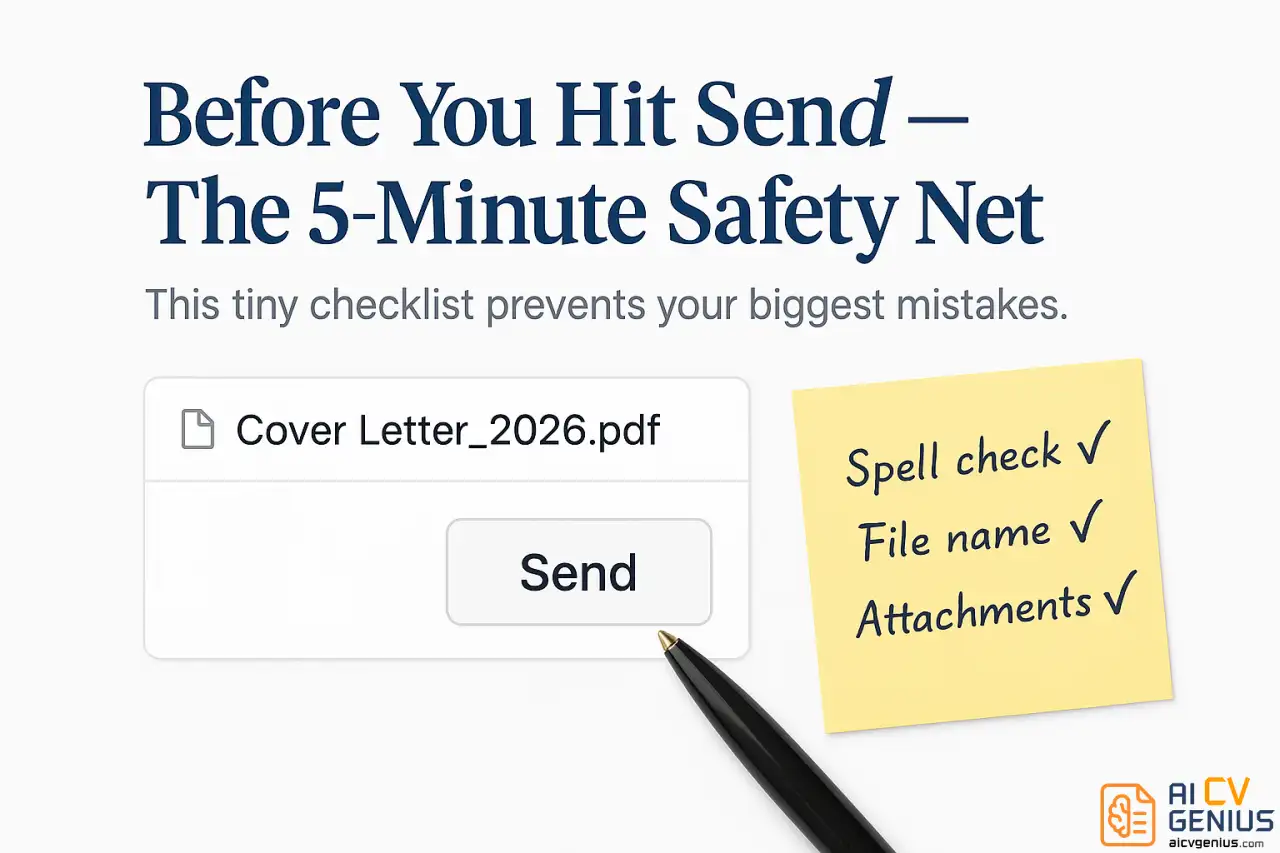
11. Did You Do the 3-Layer Proofread?
Do not just rely on spell-check. It won’t catch “your” vs. “you’re.”
- Layer 1: The AI Read: Run it through a tool like Grammarly. Fix all the clear technical errors.
- Layer 2: The Aloud Read: Read your entire letter out loud. Your ears will catch awkward phrasing, run-on sentences, and missing words that your eyes skip over.
- Layer 3: The Backward Read: Read the letter one word at a time, starting from the last word and moving to the first. This disconnects your brain from the meaning and forces it to see each word individually, making it a highly effective way to catch spelling errors.
12. Did You Run the “Copy-Paste Fail” Check?
This is the most common and most fatal error. Use `Ctrl+F` (or `Cmd+F`) to find all instances of the company name. Check the spelling. Then, do another search for the last company you applied to. If you find their name anywhere, you just saved your application.
13. Is Your Contact Info Correct?
It sounds stupid, but it happens. Is that your correct phone number?
Is your email firstname.lastname@email.com and not partyking99@hotmail.com? Is your LinkedIn link correct?
14. Is It a PDF Named Correctly?
Unless the application specifically asks for a `.doc` or `.txt` file, you must always send a PDF. A PDF locks in your formatting, ensuring the hiring manager sees exactly what you see.
Do not name it `CoverLetter_Final_v2.pdf`. This is a test of your organizational skills.
Correct Naming: FirstName-LastName-CoverLetter.pdf
Even Better: FirstName-LastName-CoverLetter-CompanyName.pdf
15. Did You Do the “Phone Test”?
Email the final PDF to yourself. Open it on your phone. Does it look okay? Is the font readable? Many recruiters will first open your application on their mobile device. If it’s a mess, they may not bother opening it on a desktop.
Your Complete Cover Letter Checklist (Printable)
Use this table. Check off every single box. Every time.
| Phase | Checkpoint | Status |
|---|---|---|
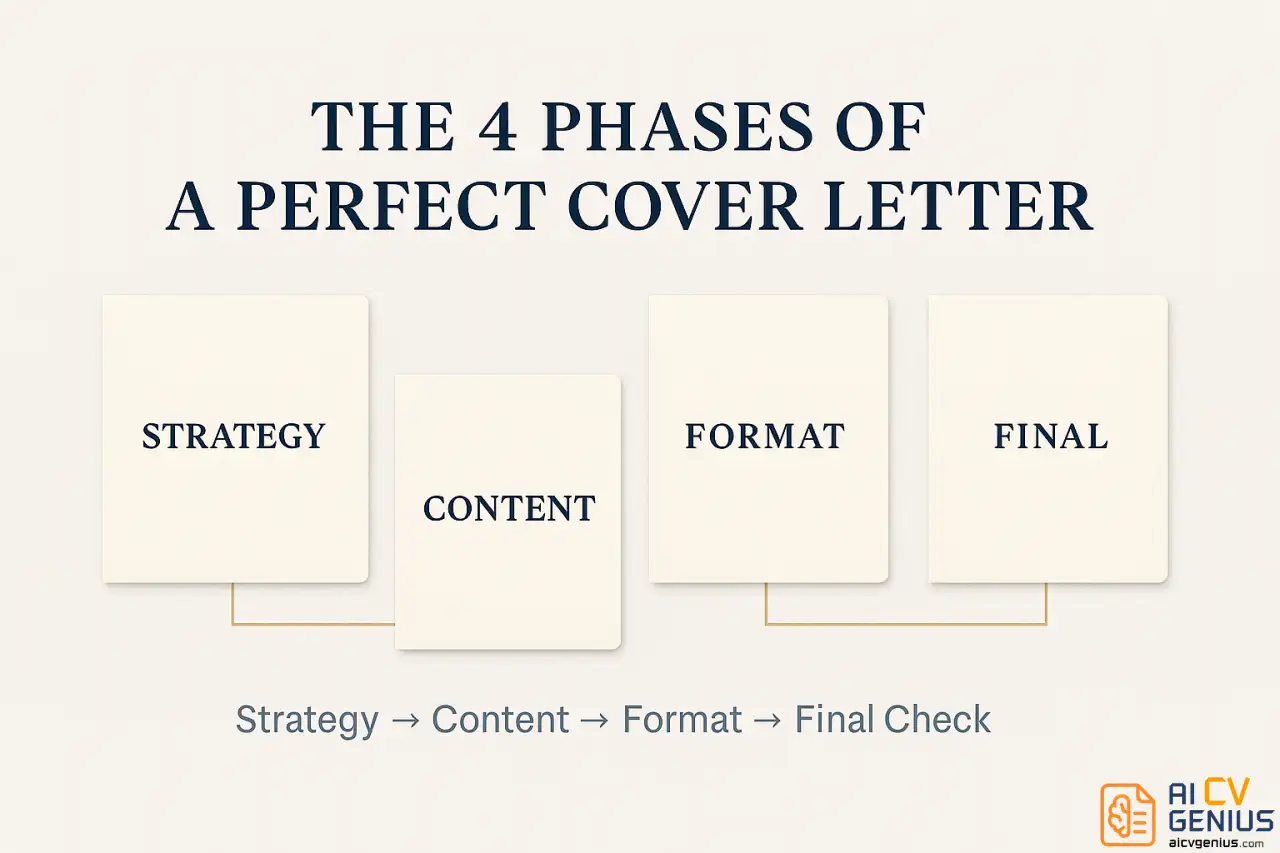
| Strategy | Decoded job description for core problem & keywords | ☐ |
| Strategy | Found hiring manager’s name (or best alternative) | ☐ |
| Strategy | Found one specific “Why Them” company hook | ☐ |
| Content | Opening paragraph is a strong, confident hook | ☐ |
| Content | All claims are “Proven” with data/examples, not just “Told” | ☐ |
| Content | Focuses on their needs, not just my wants (“You” > “I”) | ☐ |
| Content | Tone is confident and professional, not desperate | ☐ |
| Format | One page. Period. | ☐ |
| Format | Clean, professional font (10-12pt) and margins | ☐ |
| Format | Header and font match resume design | ☐ |
| Final Check | Proofread (AI + Aloud + Backward) | ☐ |
| Final Check | Checked spelling of Company Name & Manager Name | ☐ |
| Final Check | Ran `Ctrl+F` for wrong company names | ☐ |
| Final Check | Contact info (Phone, Email, LinkedIn) is correct | ☐ |
| Final Check | Saved as PDF with professional file name | ☐ |
| Final Check | Emailed to self and checked on mobile phone | ☐ |
If you can check all 16 boxes, you are ready to send with confidence.
Frequently Asked Questions (From an Expert’s POV)
Your Five-Minute Safety Net
Here’s what separates candidates who get interviews from those who don’t: the ones who get hired know that this cover letter checklist 2026 isn’t about arbitrary rules – it’s about signaling professionalism. It’s the tangible difference between “I threw this together in five minutes” and “I am a serious professional who cares enough to get the details right.”
You’ve already done the hard work of building your career and writing the letter. Don’t let a preventable, 1% mistake undo 99% of your effort. Take the extra five minutes. Go through the checklist. Send your application with the confidence that you’ve given them your absolute best.
Ready to make your whole application package stand out? Explore our complete guide to improving your resume and browse our career resources to create documents that actually get interviews.