
- Core idea: A paralegal cover letter is your first legal brief, it must prove precision, structure, and professionalism fast.
- Structure: Use a clean legal format (Header, Salutation, Strong opening, Evidence body, Why this firm, Confident close) and keep it one page.
- Opening and body: Start specific to the role and firm, then show impact with numbers, context, and outcomes instead of listing duties.
- Tailoring: Name relevant tools and case work, weave job-description keywords naturally, and add one concrete reason you chose that firm.
- Non-negotiables: Proofread aggressively, avoid generic lines and name mistakes, and submit a professional PDF filename.
Why Your Paralegal Cover Letter Is Your First Legal Brief
In the legal profession, precision is not a preference; it is the entire framework. Every word, every comma, and every citation carries evidentiary weight. Your paralegal cover letter is the very first document you submit to a potential employer that showcases your unique voice and analytical mind. It is your opening argument, your first client brief, and your primary opportunity to prove that you possess the meticulous attention to detail, logical reasoning, and persuasive communication skills that define an exceptional paralegal. This is the core principle of how to write a cover letter that wins, and for aspiring legal professionals, the stakes are significantly higher.
A polished letter demonstrates something crucial that a resume cannot: you understand how to present a case. You show, long before any interview, that you can build a logical argument, support it with evidence (your experience), and present it in a format that is professional, compelling, and easy for a busy attorney to digest.
Hiring managers, partners, and senior attorneys are perpetually pressed for time. They don’t just read applications; they scan them, often with the same critical eye they use for discovery documents. This is not unlike the process described in the 6-seconds-resume-rule; your cover letter gets a similarly brief window to make a compelling impression. A clear, concise, and powerful letter signals professionalism, respect for their time, and a mind that thinks in an organized fashion. Conversely, a vague, generic, or error-filled letter raises immediate red flags about your diligence and capability.
Think of it this way: law firms value three core attributes in a paralegal above all else:
- ✅ Reliability: Can you be trusted to manage critical deadlines, handle highly sensitive information (maintaining attorney-client privilege), and produce flawless work?
- ✅ Efficiency: Can you manage a high-volume caseload, leverage legal tech to streamline processes, and anticipate the needs of your attorneys to save the firm time and money?
- ✅ Adaptability: Can you handle the intense pressure of litigation, pivot when a case strategy changes, and communicate with flawless professionalism with clients, opposing counsel, and court staff?
Your resume lists your qualifications. Your cover letter proves you possess these attributes. It’s your first chance to move from a list of facts to a compelling narrative of your professional value.
The Anatomy of a Professional Paralegal Cover Letter
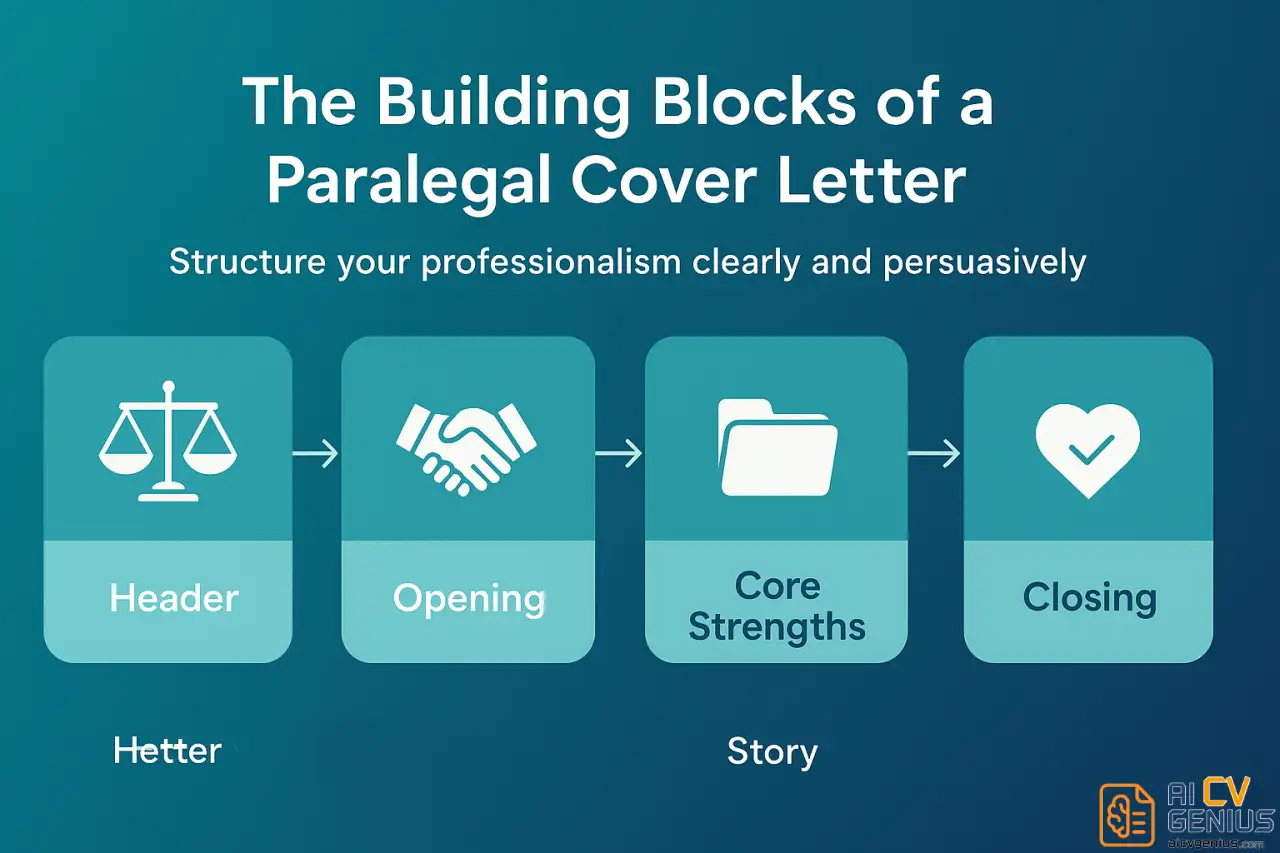
Legal writing is built on structure and precedent. Your cover letter must follow this same logical convention. While its content must be deeply personalized, its architecture should be professional, familiar, and immaculate. This structure is not just about aesthetics; it’s about readability and demonstrating your understanding of professional correspondence.
| Section | Purpose & In-Depth Action |
|---|---|
| Header | Mirror professional legal correspondence. Include your full name, phone number, email, and LinkedIn profile URL. Below this, add the date, followed by the firm’s contact information (Hiring Manager’s Name, Title, Firm Name, Address). Precision here is non-negotiable. |
| Salutation | Address the specific hiring attorney or recruiting manager by name (e.g., “Dear Ms. Richards,” or “Dear Mr. Chen,”). This demonstrates research and initiative. Avoid the cold, generic “To Whom It May Concern” at all costs; it signals a lack of effort. |
| Opening Paragraph | State your purpose clearly: the exact position you are applying for (e.g., “Senior Litigation Paralegal”). Immediately connect your single most relevant qualification (e.g., “my 5 years of experience in complex commercial litigation”) to the firm’s specific needs or practice area. Hook them instantly. |
| Body Paragraph(s) | This is your “evidence” section. Use 1-2 paragraphs to provide specific, quantified examples of your skills and achievements. Do not just list duties; showcase impact. This is where you connect your past accomplishments to the future value you will bring to their team. |
| “Why This Firm” Paragraph | Demonstrate your research. This paragraph answers: “Why us?” Mention a specific practice area, a recent case they won, their reputation for mentorship, or a value stated on their website. This proves you are applying thoughtfully, not just spamming applications. |
| Closing Paragraph | Reiterate your strong, genuine interest in the firm and the role. Confidently state your enthusiasm for discussing your qualifications and provide a clear call to action. (e.g., “I am eager to discuss how my case management skills and research abilities can be an asset to your team.”) |
| Sign-off | Use a professional closing (“Sincerely,” or “Respectfully,”) followed by your typed full name. If submitting as a hard copy, leave space for your physical signature. |
Crafting the Opening: Your “Statement of Purpose”
The first paragraph of your cover letter is the most critical. You have seconds to convince a busy attorney to keep reading. Do not waste this space with filler phrases like “I am writing to express my interest…” or “I saw your ad on…” Get straight to the point and deliver immediate value.
Your opening must accomplish three things instantly:
- Identify the exact role you are applying for.
- State your most compelling, relevant qualification.
- Connect that qualification directly to the firm.
Compare these examples:
WEAK OPENING:
“Dear Hiring Manager,
I am writing to apply for the Paralegal position I saw advertised on LinkedIn. I have worked as a paralegal for two years and believe my skills would be a good fit for your firm. I am very organized and a hard worker.”
Why it fails: It’s generic (“Hiring Manager”), passive (“I am writing to apply”), and uses weak, subjective language (“good fit,” “very organized”). It presents no compelling evidence.
STRONG OPENING (from original):
“Dear Ms. Richards,
I am writing to apply for the Paralegal position at Kensington & Cole LLP. With two years of experience assisting attorneys in complex litigation preparation and in-depth legal research, I have developed a meticulous attention to detail and a strong ability to manage high-volume caseloads effectively.”
Why it succeeds: It’s specific (“Ms. Richards,” “Kensington & Cole LLP”). It immediately identifies key, high-value skills (“complex litigation preparation,” “in-depth legal research”) and connects them to core paralegal attributes (“meticulous attention to detail,” “manage high-volume caseloads”). It is factual, confident, and professional.
Crafting the Body Paragraphs: Presenting Your “Evidence”
If your opening paragraph is the “Statement of Purpose,” your body paragraphs are the “Affidavit of Facts.” This is where you must prove the claims you made in your opening. The single biggest mistake candidates make is simply listing their job duties. Attorneys don’t care what you were responsible for; they care what you accomplished.
Beyond “Responsible For”: How to Quantify Your Impact
Listing duties is passive. Quantifying impact is active and persuasive. This is a common error that kills your resume, and it’s even more fatal in a cover letter where space is at a premium. Transform your duties into achievements by adding numbers, context, and results.
BEFORE (Duty-Focused):
“I was responsible for document review, legal research, and coordinating with clients.”
AFTER (Impact-Focused):
“In my role at Carter & Associates, I supported a team of three attorneys in a high-volume litigation practice. I streamlined our e-discovery process by implementing a new tagging protocol, which reduced document review time by an estimated 20%. Additionally, I served as the primary point of contact for over 40 clients, ensuring timely communication and accurate preparation for depositions.”
The “After” example is a compelling piece of evidence. It provides scale (“three attorneys,” “40 clients”), specific action (“implementing a new tagging protocol”), and a measurable result (“reduced… by 20%”).
Showcasing Your Technical & Hard Skills (The “How”)
Law firms are businesses. Your technical proficiency directly translates to firm efficiency and profitability. Weave your hard skills into your achievement stories. Don’t just list software; explain how you used it to create value.
- ✅ Legal Research & Writing: Go beyond “Conducted research.” Specify: “Conducted complex statutory research on Westlaw and LexisNexis to support a motion for summary judgment,” or “Drafted initial pleadings, motions, and discovery requests for attorney review, ensuring 100% accuracy and compliance with local court rules.”
- ✅ Case & Document Management: Name the tools. “Managed the complete case lifecycle for 30+ active files using Clio,” or “Oversaw e-discovery production in Relativity for a multi-party suit, indexing and preparing over 75,000 documents.”
- ✅ Trial Preparation: “Assisted in trial preparation by summarizing 50+ depositions, preparing exhibit lists, and coordinating all witness scheduling and logistics for a two-week federal trial.”
Demonstrating Essential Soft Skills (The “Human” Evidence)
Technical skill wins motions; emotional intelligence and soft skills keep a legal team functioning under pressure. These skills are often the deciding factor between two equally qualified candidates. You must provide evidence of them, not just claim them.
| Instead of saying | Show it |
|---|---|
| “I have strong communication skills.” | “Served as the primary liaison between senior partners, clients, and opposing counsel, de-escalating client concerns and ensuring all parties were informed of case milestones.” |
| “I work well under pressure.” | “Successfully managed simultaneous urgent filing deadlines for three separate cases, coordinating with attorneys and court clerks to ensure timely and accurate submission for all motions.” |
| “I am highly organized and detail-oriented.” | “Maintained a perfect record of compliance and confidentiality across all client files, successfully passing multiple internal audits for information security and file management.” |
Professional composure, unwavering discretion, and proactive problem-solving are among the most valued – and hardest to find – skills in the legal field. Use your cover letter to prove you have them.
Handling Special Cases: From Entry-Level to Career-Changer
Not everyone has a linear career path. Your cover letter is the perfect instrument to frame your unique story and turn potential weaknesses into strengths.
The “Entry Level Paralegal Cover Letter with No Experience”
If you are new to the field, do not panic. An entry level paralegal cover letter with no experience is not about what you’ve done, but what you can do. Your focus must shift from professional experience to education, transferable skills, and raw intellectual curiosity.
Here is what you leverage:
- ✅ Paralegal Certificate & Coursework: Be specific. “My paralegal certificate program included specialized coursework in E-Discovery and Civil Procedure, where I drafted a mock motion for summary judgment that was recognized by faculty for its thorough research.”
- ✅ Internships & Legal Clinic Work: This is your “experience.” Even if unpaid, it’s invaluable. “During my internship at the District Clerk’s Office, I learned firsthand the critical importance of precision in filing, communication, and compliance – skills I am eager to bring to your legal team.”
- ✅ Transferable Skills from Other Jobs: Did you work in retail? You have client service and cash-handling (detail-oriented) skills. Were you an administrative assistant? You have scheduling, compliance, and document management skills. Frame them in a legal context. “My three years as an executive assistant honed my ability to manage complex schedules and handle confidential documents with absolute discretion, preparing me to support a fast-paced legal team.”
The Career-Change Paralegal: Bridging the Gap
If you are transitioning from another industry (e.g., finance, healthcare, tech), your cover letter must answer the “Why law?” question head-on. You must build a logical bridge from your past career to your new one. This is a narrative you must control. For more on this, see our guide to the career change CV.
Example Bridge Statement:
“While my five years in healthcare administration centered on regulatory compliance and patient data management, I found my passion lay in the legal and ethical frameworks that protected that data. My recent paralegal certification, combined with my practical experience in HIPAA compliance and complex record-keeping, has prepared me to transition seamlessly into your firm’s renowned healthcare law practice.”
This statement shows your move is a logical evolution, not a random leap. It connects your past expertise directly to the firm’s specific needs.
The Legal Assistant Cover Letter
The same structure applies if you’re applying for a legal assistant role. A legal assistant cover letter template should also highlight multitasking, complex scheduling, client communication, and billing/intake processes. Employers want candidates who are proactive, anticipate needs, and prevent administrative mistakes before they happen. Your cover letter must prove you are the organizational backbone that allows attorneys to focus on practicing law.
Full Paralegal Cover Letter Samples (Putting It All Together)
Seeing the theory in practice is essential. Here are two distinct paralegal cover letter example scenarios.
Sample 1: The Experienced Litigation Paralegal
[Your Name]
[Your Phone Number] | [Your Email] | [Your LinkedIn Profile URL][Date]
Mr. David Jennings
Hiring Partner
Brighton Legal Group
[Firm Address]Re: Senior Litigation Paralegal Position
Dear Mr. Jennings,
I am writing to apply for the Senior Litigation Paralegal role at Brighton Legal Group. With over five years of experience managing discovery and trial preparation for complex commercial litigation cases at Carter & Associates, I have a proven track record of supporting attorneys from initial filing through to verdict, and I am eager to bring my expertise to your esteemed team.
During my tenure at Carter & Associates, I directly assisted in preparing discovery materials for 20+ active litigation cases simultaneously. I am highly adept at conducting thorough legal research, drafting pleadings, and managing confidential records with absolute discretion. By redesigning our internal exhibit tracking system, I reduced document turnaround time by 25% and ensured 100% accuracy in trial binders. Beyond these technical skills, I pride myself on maintaining composure under pressure and supporting attorneys through clear, proactive communication and consistent follow-up.
Brighton Legal Group’s reputation for tenacious advocacy in high-stakes commercial disputes is precisely what draws me to your firm. My hands-on experience in managing multi-million dollar case files aligns perfectly with the demands of this role, and your firm’s commitment to mentorship is ideal for my career goals.
I am excited by the opportunity to contribute my organizational precision and enthusiasm for client service to your firm. Thank you for your time and consideration. I look forward to discussing my qualifications with you soon.
Sincerely,
[Your Typed Name]
Sample 2: The “Entry Level Paralegal with No Experience” (Career Changer)
[Your Name]
[Your Phone Number] | [Your Email] | [Your LinkedIn Profile URL][Date]
Ms. Sarah Chen
Recruiting Manager
Ellis & Grant PLLC
[Firm Address]Re: Entry-Level Paralegal Position (Family Law)
Dear Ms. Chen,
I am writing to apply for the Entry-Level Paralegal position at Ellis & Grant PLLC. I have recently completed an ABA-approved paralegal certificate program with a 4.0 GPA, specializing in Family Law, and am pivoting from a 4-year career in high-level administration. My proven skills in managing sensitive client data and complex scheduling, combined with my legal training, make me a uniquely prepared candidate to support your family law practice.
As an Executive Assistant at a financial services firm, I was entrusted with managing confidential client portfolios, scheduling multi-party international meetings, and ensuring all documentation was 100% compliant with SEC regulations. This experience ingrained in me a meticulous attention to detail and an unwavering professional discretion. During my paralegal internship with the Legal Aid Society, I applied this diligence directly, assisting attorneys by drafting initial petitions, organizing discovery documents, and observing client intake for sensitive domestic cases.
I have been following Ellis & Grant’s compassionate approach to family law, particularly your work in mediation and collaborative divorce. My training in alternative dispute resolution and my background in empathetic client communication align perfectly with your firm’s philosophy. I am eager to bring my organizational skills and strong work ethic to a team I so deeply respect.
Thank you for considering my application. I am confident I can quickly become a valuable asset to your team and look forward to the possibility of an interview.
Sincerely,
[Your Typed Name]
Mastering the Finer Points: Tailoring, Tone, and ATS
A great cover letter is more than just good content; it’s a perfectly presented package. The final details separate the amateurs from the professionals.
Tailoring Your Letter: Researching the “Court” (The Firm)
Never send a one-size-fits-all cover letter. It’s the modern equivalent of a form letter and will be discarded. You must customize each letter by referencing the firm’s specific practice area – corporate, litigation, family law, or intellectual property. Spend five minutes on the firm’s website. Find their “About” page, look at their attorney bios, or read their “News” section.
A simple, tailored line like, “Your firm’s recent victory in the [Case Name] environmental compliance case aligns perfectly with my background in regulatory research and public policy,” demonstrates genuine preparation and interest. This single sentence can be the reason you get an interview.
Integrating Keywords for ATS and Human Reviewers
Many large firms use Applicant Tracking Systems (ATS) to screen applications before a human ever sees them. This is why an ATS-friendly resume and cover letter are no longer optional. These systems scan for keywords and phrases from the job description.
Your job is to naturally weave these terms – such as “case management,” “legal research,” “trial preparation,” “e-discovery,” or “client intake” – into your achievement stories. Do not “stuff” them robotically. A human will (hopefully) read it next. The goal is to sound like a qualified professional who speaks the language of the profession, not a robot trying to pass a test.
The Unforgivable Errors: Formatting & Final Proofreading
In law, a typo in a brief can have disastrous consequences. In a cover letter, it kills your application. There is zero tolerance for sloppiness. Your letter must be flawless.
- ✅ Formatting: Use a clean, professional font (Inter, Lato, Georgia, or Times New Roman). Set margins to 1 inch on all sides. Use single spacing with a blank line between paragraphs. Do not use walls of text; keep paragraphs to 4-6 lines.
- ✅ File Name: Save and submit your letter as a PDF. Name it professionally:
"Paralegal_CoverLetter_YourName.pdf". - ❌ The Ultimate Mistake: Getting the firm’s name or the attorney’s name wrong. This is an instant rejection. Proofread it three times.
- ❌ Overusing Jargon: Don’t use complex legal terms just to sound smart, especially if you misuse them. Clarity and precision are more impressive than “legalese.”
- ❌ Length: Your cover letter must be one page. No exceptions. It is a brief, not a memorandum.
Read your letter out loud. This forces your brain to slow down and catch errors your eyes would otherwise skim over. Then, have someone else read it. A fresh set of eyes is invaluable.
Frequently Asked Questions (Your Final Objections)
Your Final Argument: Closing with Confidence
A great paralegal cover letter should read like a well-prepared case: clear, structured, supported by evidence, and persuasive. It is your first, and perhaps only, chance to demonstrate the analytical, detail-oriented, and professional mind that a resume can only hint at.
Whether you are a seasoned professional with a decade of trial experience or just entering the legal field, your tone, precision, and attention to detail will speak louder than any single credential. Treat this letter with the seriousness of a legal filing. Present your argument with calm confidence – and let your words win the case before the interview even begins.