
- Core message: A career break cover letter works when it reframes the gap as growth and keeps the tone honest, calm, and forward-looking.
- Best structure: Open by naming the role and acknowledging the break briefly, then use 1–2 body paragraphs to connect transferable skills to the job, and close with readiness plus a clear CTA.
- How to frame the break: Share the reason at a high level if needed, avoid over-explaining, and translate what you did into skills the employer needs.
- What to include: One adaptable template, language choices that signal confidence, and real scenario rewrites like caregiving, travel, study, and volunteering.
- What to avoid: Apologizing, ignoring the gap, oversharing personal details, vague “I learned a lot” lines, and making the letter about your journey instead of their needs.
Introduction: The Career Break Narrative
Understanding the Fear Behind a Career Break
There’s a quiet anxiety that many people share before writing a career break cover letter. You’ve grown, adapted, maybe even changed completely – yet there’s still that voice whispering: “Will they see me as outdated?” The truth is, hiring managers don’t mind the break as much as you think. What they’re looking for is honesty, clarity, and the ability to connect your past to your present.
If your career paused for caregiving, health, study, relocation, or burnout recovery, it’s okay. What matters is how you tell that story. A good cover letter turns hesitation into momentum. Let’s walk through how to build yours – step by step, without pretending or apologizing.
Reframing the Narrative: From Gap to Growth
Instead of describing the gap as “time away from work,” describe it as “time spent developing perspective.” The shift in language changes everything. Employers hire humans – not timelines. You’re not defined by when you worked, but by how you grew during the pauses in between.
Think of your break as a bridge: one side represents who you were professionally before the pause, the other side represents the evolved, perhaps more resilient or focused, individual you’ve become. Your cover letter simply helps the employer cross that bridge with you, understanding the journey and recognizing the value gained along the way.
“Your story isn’t about what you paused – it’s about what you gained while you paused.”
That perspective makes your return feel stronger and more authentic. It’s the foundation of all strong career break cover letter examples. It transforms a perceived vulnerability into a unique selling point.
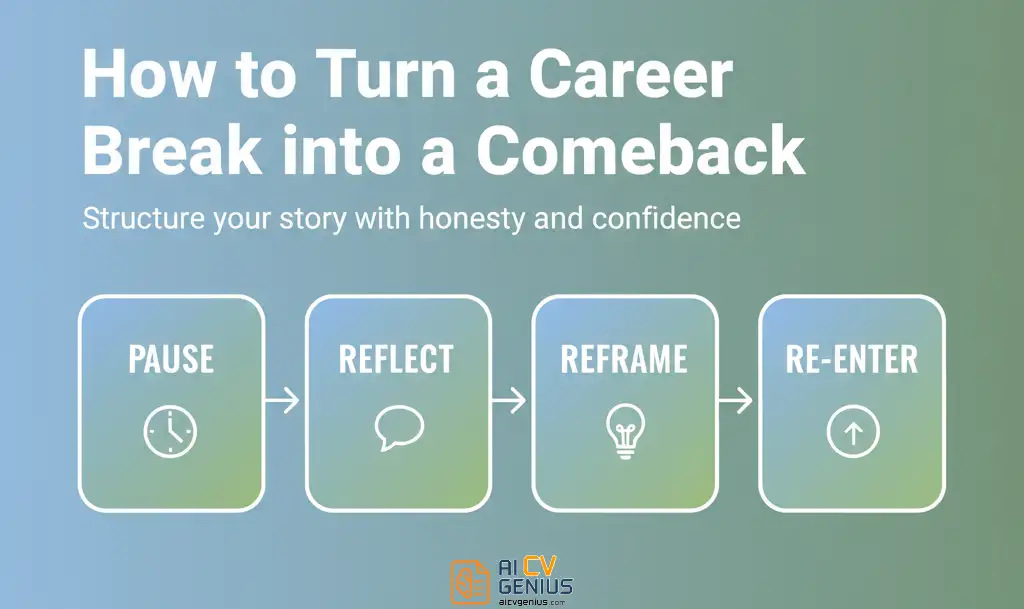
Structuring the Letter: From Honesty to Confidence
A clear, human structure can turn uncertainty into impact. This framework ensures your message flows logically, addresses the break naturally, and keeps the focus firmly on your future contributions. It works across industries, levels, and job types.
1. Header and Greeting: Professional Foundation
Start with your contact information (Name, Phone, Email, City/State, LinkedIn URL if applicable). Follow with the date and the recipient’s details (Hiring Manager Name/Title, Company Name, Address). A personalized greeting (“Dear Ms. Thompson,”) is always preferable to a generic one (“Dear Hiring Manager,”). Research to find the name; it shows initiative.
2. Opening Paragraph: Acknowledge the Break Naturally
State the position you’re applying for and where you found it. Then, briefly and confidently mention your recent career break and your enthusiasm for re-entering the field. Frame it positively.
| Section | Goal | Example Line |
|---|---|---|
| Opening | Introduce yourself and acknowledge the gap naturally | “After dedicating two years to caregiving responsibilities, I am eager and well-prepared to re-engage my expertise in the HR field. I am writing to express my strong interest in the HR Generalist position advertised on LinkedIn.” |
3. Middle Paragraphs (1-2): Connect Break Skills to Job Requirements
This is crucial. Show how skills honed or perspectives gained during your break are relevant to the role. Focus on transferable skills. If you studied, mention new knowledge. If you volunteered, highlight leadership or project coordination. Connect your pre-break experience too, emphasizing how the combination makes you a unique asset.
| Section | Goal | Example Line |
|---|---|---|
| Middle | Show transferable skills gained during the gap and connect past experience | “While managing complex care schedules and coordinating with healthcare providers during my break, I further refined my organizational and communication skills – abilities I consistently applied in my previous role leading cross-functional project teams at [Previous Company]. For instance, coordinating community programs during this period improved my stakeholder management and problem-solving capabilities, directly relevant to the client-facing aspects of this role.” |
4. Closing Paragraph: Express Enthusiasm and Readiness
Reiterate your strong interest in the specific role and company. Briefly summarize your key value proposition (combining past experience with new perspectives). Express confidence in your ability to contribute quickly and meaningfully. Include a clear call to action, inviting discussion.
| Section | Goal | Example Line |
|---|---|---|
| Closing | Express enthusiasm and readiness to rejoin, call to action | “I am excited about the opportunity to bring my evolved perspective, combined with my proven [mention key skill, e.g., project management] abilities, to [Company Name]. I am eager to discuss how I can make a meaningful contribution to your team and welcome an interview at your convenience.” |
Strategy: Framing Your Experience
The Power of Self-Awareness: Translating Life into Professional Value
Employers appreciate self-awareness more than uninterrupted career trajectories. When you discuss your break, maintain a factual yet forward-looking tone. Avoid lengthy explanations or justifications. Instead, skillfully tie each personal experience or activity during the break back to a concrete professional strength relevant to the target role. This demonstrates reflection and an understanding of how diverse experiences contribute to professional competence.
Here’s how to frame common break scenarios:
- ✅ Caregiving: Emphasize enhanced empathy, exceptional time management under pressure, complex scheduling, resource coordination, and unwavering responsibility. Example: “Coordinated multi-disciplinary care plans, honing my ability to manage complex logistics and communicate effectively under stress.”
- ✅ Travel: Highlight increased adaptability, cross-cultural communication skills, independent problem-solving in unfamiliar environments, and budget management. Example: “Navigating diverse cultural contexts during my travels significantly strengthened my adaptability and ability to communicate effectively across different perspectives.”
- ✅ Study/Upskilling: Mention discipline, renewed curiosity, specific new technical knowledge or certifications gained, and a proactive approach to professional development. Example: “Completed certifications in [Specific Area, e.g., Project Management with Agile methodologies], deepening my expertise in [Relevant Skill].”
- ✅ Volunteering: Showcase collaboration within diverse teams, leadership roles undertaken, community impact achieved, event planning, or fundraising experience. Example: “Led a team of 10 volunteers for a community outreach program, successfully increasing participation by 30% through improved communication strategies.”
This strategic approach shows employers that your break wasn’t unproductive downtime – it was a period of active personal and professional evolution, yielding valuable, transferable skills.
How to Write With Purpose: Actionable Tips
Here’s how to apply the principles of how to write a career break cover letter in practical terms. The secret lies in achieving a delicate balance: being honest about the break but strategic in its presentation, personal enough to connect but professional enough to command respect.
Tip 1: Start with clarity, not apology
Integrate the mention of your break naturally into the opening paragraph. Acknowledge it factually, frame it briefly (e.g., “After a planned period focused on [reason], I am now…”), and immediately pivot to your skills and enthusiasm for the role. Avoid apologetic language (“Unfortunately, I had to take time off…”) as it undermines your confidence.
Tip 2: Focus relentlessly on transferable skills
Every experience – from managing a household budget to organizing a local event or learning a new language – cultivates valuable skills. Your task is to translate these life skills into the precise language of the professional world, explicitly connecting them to the requirements outlined in the job description.
- “Managed a complex household budget across fluctuating incomes” → “Developed strong financial planning, resource allocation, and prioritization skills under variable conditions.”
- “Organized and led community park clean-up projects” → “Gained hands-on experience in project coordination, volunteer management, and stakeholder communication.”
- “Independently planned and executed a six-month international trip across multiple countries” → “Demonstrated exceptional planning ability, adaptability to new environments, and resourceful problem-solving skills in navigating logistical challenges.”
Tip 3: Maintain a positive and forward-facing tone
Language shapes perception. Replace passive or negative framing (“I had to take a break due to burnout”) with active, growth-oriented phrasing (“I took dedicated time to refocus my career goals and build personal resilience, returning with renewed energy”). Small shifts in wording build trust and project confidence, showing you own your story rather than being defined by it.
Examples, Templates, and Pitfalls
Example Template: Turning Gaps into Growth
This adaptable template provides a concise structure that balances honesty with professionalism. Customize it based on your specific break reason and target role.
[Your Name]
[Your Contact Information][Date]
[Hiring Manager Name & Title]
[Company Name & Address]Dear [Mr./Ms./Mx. Last Name],
Following a [duration, e.g., two-year] career break dedicated to [brief, positive reason, e.g., pursuing further education in X, focusing on family care responsibilities], I am now eager to re-enter the [industry/field] field with renewed focus and enhanced perspective. I am writing to express my strong interest in the [Position Title] position at [Company Name], advertised on [Platform].
During my time away from formal employment, I actively engaged in [mention activities like study, volunteering, relevant projects, e.g., completing a certification in Y, managing Z project for a local non-profit]. These experiences significantly strengthened my ability to [mention 1-2 relevant transferable skills, e.g., manage complex projects under tight deadlines, communicate effectively with diverse stakeholders] and deepened my appreciation for [mention connection to industry or company focus, e.g., efficient operational processes].
Prior to my break, I successfully [summarize your last key achievement or responsibility relevant to the new role, quantifying if possible, e.g., led a team of 5 to increase client retention by 15% at Previous Company]. I am confident that the combination of my established professional background and the valuable insights gained during my recent break uniquely equips me to make immediate and meaningful contributions to [Company Name]’s goals in [mention specific area, e.g., enhancing customer engagement].
Thank you for considering my application. My attached resume provides further detail on my qualifications. I am enthusiastic about the possibility of joining your team and look forward to discussing how my skills and refreshed perspective can bring value to [Company Name].
Sincerely,
[Your Typed Name]
This balanced format effectively addresses the break while keeping the primary focus on your qualifications and readiness. It’s an ideal structure for communicating confidence when returning to work after a career break.
Common Pitfalls: What Not to Do in Your Letter
Avoid these common mistakes that can inadvertently undermine your application:
| ❌ Mistake | ✅ Fix |
|---|---|
| Over-apologizing or sounding defensive about the gap: Using phrases like “Unfortunately, I had to…” or “I know my break might seem long, but…” | Frame the break factually and positively as a period of growth, learning, or necessary focus. Own it confidently. |
| Ignoring the break entirely: Hoping the recruiter won’t notice the gap between dates on your resume. | Address it briefly and proactively in the cover letter. Transparency builds trust; avoidance raises questions. |
| Over-sharing personal details: Providing excessive information about health issues, family matters, or personal struggles. | Keep the explanation concise and professional. Focus on the transferable skills gained, not the intricate details of the situation. |
| Making it all about your personal journey: Focusing too much on your self-discovery without connecting it back to the employer’s needs. | Always bridge your experiences (even personal ones) back to relevant professional skills and how they benefit the target role or company. |
| Using vague language about skills gained: Saying you “learned a lot” or “grew personally.” | Be specific. Name the skills (e.g., resilience, time management, cross-cultural communication) and ideally provide a micro-example. |
Choosing Your Words Carefully: Language That Conveys Confidence
Language carries energy and shapes perception. Opt for active, positive, and forward-looking verbs that convey momentum and confidence. Your letter should sound like someone stepping forward with purpose, not glancing back with uncertainty.
- ✅ Action-Driven Verbs: Use words like “Developed,” “Managed,” “Coordinated,” “Led,” “Collaborated,” “Learned,” “Achieved,” “Enhanced,” “Built.”
- ✅ Growth-Oriented Framing: Instead of “paused” or “stopped,” consider phrases like “dedicated time to,” “focused on,” “pursued,” “developed.”
- ✅ Avoid Passive or Negative Language: Steer clear of words like “struggled,” “had to,” “was forced to.” Focus on agency and positive outcomes.
- ✅ Conciseness is Key: Keep paragraphs relatively short – 3 to 5 lines maximum is ideal for readability. Get straight to the point.
When in doubt, read your letter aloud. Does it sound like a story of progress, resilience, and readiness? If so, you’re likely on the right track. The language should reflect someone who has integrated their experiences and is prepared for the next professional chapter.
Real Stories, Real Success: Examples of Reframing Breaks Effectively
Real-world examples can inspire confidence and provide practical models. Here are a few anonymized scenarios illustrating how individuals successfully reframed their career breaks:
- Parental Break Reframe: A marketing manager took a five-year break for childcare. Her cover letter didn’t dwell on parenting duties but highlighted project coordination skills gained through leading school fundraising campaigns (managing budgets, volunteers, and communications). She successfully transitioned into a Community Manager role, leveraging her organizational and interpersonal skills.
- Travel Break Reframe: A software engineer who backpacked internationally for a year emphasized enhanced adaptability, cross-cultural communication, and remote problem-solving skills developed while navigating unfamiliar environments. This narrative resonated with a global tech startup looking for flexible, independent thinkers.
- Caregiving Break Reframe: A registered nurse who paused her career for elder care framed the experience not as a gap, but as intensive, real-world training in patient advocacy, empathy, and complex care coordination. She returned to lead a patient care coordination team, leveraging her deepened understanding of patient needs.
- Study Break Reframe: An administrative assistant who took a year off to complete a data analytics certification focused her cover letter on her newly acquired technical skills (SQL, Tableau) and her renewed analytical perspective, successfully pivoting into a Junior Data Analyst role.
Each individual used their career break cover letter not to defend the gap, but to celebrate the unique growth and skills acquired during that time, directly linking them to the requirements of their target roles.
Advanced Strategies and Mindset
Highlighting Emotional Intelligence Gained
Employers increasingly value Emotional Intelligence (EQ) – the ability to understand and manage your own emotions and recognize and influence the emotions of others. Career breaks, particularly those involving caregiving, personal challenges, or significant life changes, often cultivate deep wells of EQ, including resilience, empathy, patience, and perspective. Don’t shy away from subtly highlighting this growth.
Use gentle confidence – words that show self-awareness and empathy, not excuses. For example:
“Navigating the complexities of coordinating care for my parents taught me invaluable lessons in patience, active listening, and finding effective solutions under pressure – perspectives that have significantly enhanced my leadership style and approach to team collaboration.”
That’s emotional intelligence demonstrated through reflection. It builds trust immediately by showing maturity and depth beyond technical skills.
Aligning Your Narrative With the Company’s Values and Needs
Don’t just focus on your personal journey; explicitly connect it to the company’s mission, values, or the specific challenges outlined in the job description. Research the company thoroughly – read their “About Us” page, recent press releases, or employee testimonials on LinkedIn. Then, align your narrative strategically.
For instance:
- If the company values innovation and adaptability, mention how navigating uncertainty during your break strengthened your creative problem-solving skills.
- If they emphasize community involvement, share relevant volunteering experiences or skills gained through community projects during your break.
- If the role requires strong organizational skills, explain how managing complex personal responsibilities (like coordinating care or relocating) honed your ability to prioritize and execute effectively.
Use one short paragraph (often the third paragraph) to explicitly bridge your unique story – including the insights from your break – with their specific needs or culture. This demonstrates thoughtful application and genuine interest, making your connection feel intentional rather than coincidental.
Synergy: Combining Your Resume and Cover Letter Strategy
Your cover letter and resume should work in tandem, reinforcing a consistent narrative. Use your resume for timeline clarity and concise skill listing; use your cover letter for emotional context, storytelling, and explicitly addressing the career break.
On your resume, you can handle the gap simply and factually within the Experience section or a brief dedicated note.
Example Resume Entry:
Professional Development & Family Care | City, State | 2021 – 2023
– Completed [Certification Name] focused on [Skill Area].
– Managed complex scheduling and coordination for family care responsibilities.
– Volunteered with [Organization Name], contributing to [Specific Project/Outcome].
This provides context without dwelling on details. The cover letter then adds the warmth, connects the skills gained back to professional relevance, and explains your enthusiasm for returning.
Need help designing a resume that complements this storytelling approach? Explore clean, professional layouts in AI CV Genius resume templates that pair perfectly with narrative-driven cover letters.
Embracing Your Journey: Confidence Is the Real Comeback
You’ve already demonstrated courage by navigating your career break and deciding to re-enter the workforce. Now, let your written words reflect that inherent strength and resilience. The objective isn’t to obscure or apologize for your break – it’s to confidently articulate how you’ve utilized that time productively and emerged ready for the next challenge.
Remember, confidence doesn’t stem from having a flawless, uninterrupted career path; it comes from owning your unique journey, understanding the perspectives gained, and knowing how to apply them moving forward.
“The best career stories aren’t seamless – they’re honest, evolving, and deeply human. Embrace yours.”
Quick Recap: Key Steps Checklist
Before sending your letter, review these essential steps:
| Step | Focus | Outcome |
|---|---|---|
| 1 | Reframe Your Story: Position the break as growth, not a gap. | Turns potential employer concerns into opportunities to showcase resilience and perspective. |
| 2 | Connect Transferable Skills: Explicitly link skills gained/honed during the break to job requirements. | Shows ongoing value development and relevance despite time away from formal work. |
| 3 | Use Confident, Positive Language: Employ active voice and forward-looking phrasing. Avoid apologies. | Projects readiness, self-awareness, and enthusiasm for re-engagement. |
| 4 | Align with Company Values/Needs: Demonstrate research and connect your unique journey to their specific context. | Creates emotional alignment and shows genuine interest beyond just needing a job. |
| 5 | End with Energy and Clarity: Reiterate enthusiasm, summarize value, and include a clear call to action. | Leaves a lasting positive impression and encourages the next step (interview). |
Conclusion and FAQ
FAQ: Addressing Common Concerns
Final Thoughts: Owning Your Narrative
Your story, including its pauses and pivots, matters. A career break cover letter isn’t an explanation or an apology – it’s a declaration of who you’ve become through your experiences. You’re not returning to the workforce empty-handed; you’re re-entering with unique insights, often heightened empathy, and a valuable perspective shaped by time away. These are assets, not liabilities, and they are precisely what forward-thinking employers increasingly value.
Craft your letter with honesty, strategic focus, and quiet confidence. Let it show that your journey, breaks included, has prepared you perfectly for this next step.