
- What a nurse cover letter does: It adds the human context behind your resume and proves patient-centered care, teamwork, and resilience.
- Why it matters now: Hiring is still strict because patient outcomes depend on quality, so a strong letter can be the differentiator.
- What to weave in: Clinical skills, Licensure and certifications, Soft skills with brief proof, And measurable impact when possible.
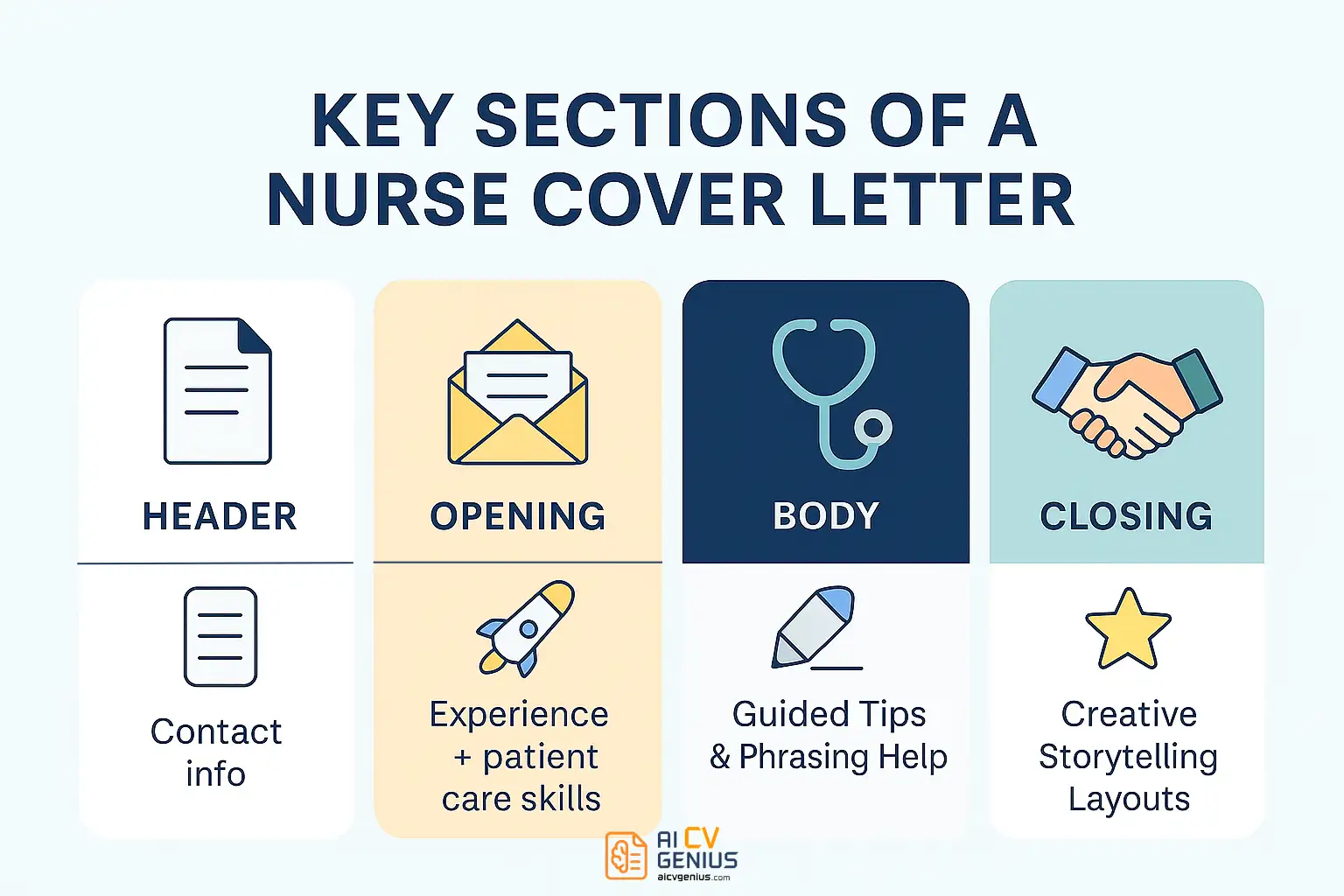
- Structure to follow: Professional header, Personalized greeting, A role-specific hook, 1 to 2 evidence paragraphs, Then a confident close.
- How to tailor and avoid mistakes: Adjust focus by role level, Use job keywords naturally for ATS, Skip generic templates, Quantify results, And proofread hard.
Introduction: More Than a Formality – Your Voice in Healthcare
Nursing transcends mere profession; it embodies a profound calling rooted in compassion and competence. Whether you are a newly graduated nurse embarking on your inaugural hospital rotation or a seasoned Registered Nurse (RN) seeking a specialized role, your nurse cover letter represents a critical opportunity to articulate far more than just qualifications listed on a resume. Resumes present the cold, hard facts – experience, certifications, education. Cover letters, however, provide the essential human context: the heart, the empathy, the personality behind the credentials. While healthcare employers meticulously verify your certifications and clinical skills, they are equally invested in understanding your unwavering dedication to patient-centered care, your capacity for seamless teamwork, and your resilience when navigating the inherent pressures of the field. This comprehensive guide will meticulously deconstruct the process of crafting a truly compelling nurse cover letter, offering multiple illustrative examples and strategic insights for tailoring your narrative to diverse nursing roles and settings.
The Strategic Imperative: Why a Cover Letter Matters More Than Ever for Nurses
The healthcare landscape is undergoing unprecedented growth, with registered nursing consistently identified as one of the most critical and in-demand professions globally. Hospitals, outpatient clinics, long-term care facilities, and community health organizations continually grapple with staffing shortages. Yet, paradoxically, the selection process remains intensely rigorous. Why? Because the quality of patient care – and indeed, patient lives – depends directly on the caliber of nursing professionals hired. A resume, while essential, provides only a static snapshot of your past accomplishments. In contrast, a thoughtfully composed cover letter offers a dynamic narrative. It allows you to articulate the intrinsic motivations driving your choice of nursing as a career, illustrate how you navigate complex interactions with patients and their families, showcase your collaborative spirit, and align your personal values with the institution’s mission and culture. In a field where demonstrable compassion holds weight equal to technical proficiency, this written articulation of empathy, critical thinking, and unwavering professionalism frequently becomes the decisive factor tipping the scales in your favor during the competitive hiring process.
Showcasing Your Core Competencies: Essential Skills to Weave In
An exceptional nurse cover letter artfully balances demonstrable technical expertise with finely honed soft skills. Hiring managers and nursing directors are searching for tangible proof that you can perform complex clinical tasks accurately and efficiently under pressure, all while consistently treating patients and their families with profound dignity, respect, and cultural sensitivity. Strategically integrating examples that illustrate the following skill categories will significantly strengthen your narrative:
- Clinical Proficiency: Go beyond simply listing tasks. Provide context or specific examples related to: medication administration (e.g., managing complex regimens, ensuring patient safety protocols), intravenous (IV) therapy (e.g., insertion proficiency, monitoring), advanced wound care techniques, adept utilization of Electronic Health Record (EHR) systems (mentioning specific platforms like Epic or Cerner is beneficial), patient assessment, and executing care plans.
- Credentials and Certifications: Clearly state your core qualifications like RN licensure and degree (e.g., Bachelor of Science in Nursing – BSN, Associate Degree in Nursing – ADN). Prominently feature essential life support certifications: BLS (Basic Life Support) and ACLS (Advanced Cardiac Life Support). Crucially, highlight any specialized training or certifications directly relevant to the target role, such as PALS (Pediatric Advanced Life Support), CCRN (Critical Care Registered Nurse), OCN (Oncology Certified Nurse), or CPN (Certified Pediatric Nurse).
- Interpersonal & Soft Skills: These are non-negotiable in nursing. Demonstrate through brief anecdotes or specific phrasing: profound empathy and active listening, clear and compassionate communication (with patients, families, and interdisciplinary teams), cultural competency and sensitivity, effective teamwork and collaboration, emerging or established leadership potential (e.g., precepting, charge nurse duties), critical thinking, and robust problem-solving abilities, especially in fast-paced or emergent situations.
- Quantifiable Achievements & Impact: Whenever possible, translate your contributions into measurable outcomes. Even estimates are powerful. Consider examples such as: contributing to a reduction in patient readmission rates through enhanced discharge teaching (mention % if known), successfully mentoring junior nurses or nursing students (mention # mentored), leading or participating in quality improvement initiatives or process enhancements (describe the improvement), or receiving formal commendations or awards for patient care or teamwork.
Architecting Your Narrative: Standard Structure of a Nurse Cover Letter
A well-structured cover letter guides the reader logically and ensures your key messages land effectively. Adhere to a professional, clean format, ideally contained within one page.
1. Header: Professional Contact Information
Include your full name, phone number, professional email address, city and state (full address optional), and potentially a link to your LinkedIn profile if it’s updated and relevant. Below your details, include the date and the recipient’s information: Hiring Manager’s Name (if known, otherwise use title like “Nurse Recruiter” or “Director of Nursing”), their title, the Hospital/Clinic Name, and its address. Ensure this formatting mirrors your resume header for brand consistency.
2. Greeting: The Power of Personalization
Invest time to find the specific name of the hiring manager or nurse recruiter. Addressing the letter directly (e.g., “Dear Ms. Evans,” “Dear Mr. Patel,”) demonstrates initiative and respect, significantly outperforming generic salutations like “To Whom It May Concern” or “Dear Hiring Manager.” If a name is truly undiscoverable, “Dear Nurse Recruitment Team,” or “Dear Hiring Committee,” is a professional alternative.
3. Opening Paragraph: State Your Purpose and Passion
Begin concisely. Clearly state the specific position you are applying for (e.g., “Registered Nurse – Medical/Surgical Unit,” “Pediatric Nurse Practitioner”). Immediately follow with a compelling statement connecting your core nursing philosophy, key experience level, or passion directly to the institution’s mission, values, or a specific aspect of the role that excites you. This creates an immediate hook and establishes relevance.
4. Body Paragraphs (1-2): Provide Evidence of Skills and Impact
This is the heart of your letter. Select 2-3 key qualifications or experiences from your resume that directly align with the job description’s requirements. Elaborate on these points, providing specific examples or brief anecdotes that illustrate your skills in action. Focus on impact and outcomes. How did your actions benefit patients, improve processes, or support the team? Quantify achievements whenever possible. Weave in examples demonstrating both clinical competence and crucial soft skills (empathy, communication, teamwork). Explicitly mention key certifications relevant to the role.
5. Closing Paragraph: Reiterate Enthusiasm and Call to Action
Concisely summarize your strong interest in the position and the institution. Briefly reiterate why you believe you are an excellent fit, perhaps mentioning one key strength again. Express genuine enthusiasm for the opportunity to contribute to their team and patient care goals. Politely and confidently invite them to contact you for an interview to discuss your qualifications further. Thank them for their time and consideration. End with a professional closing like “Sincerely,” followed by your typed name.
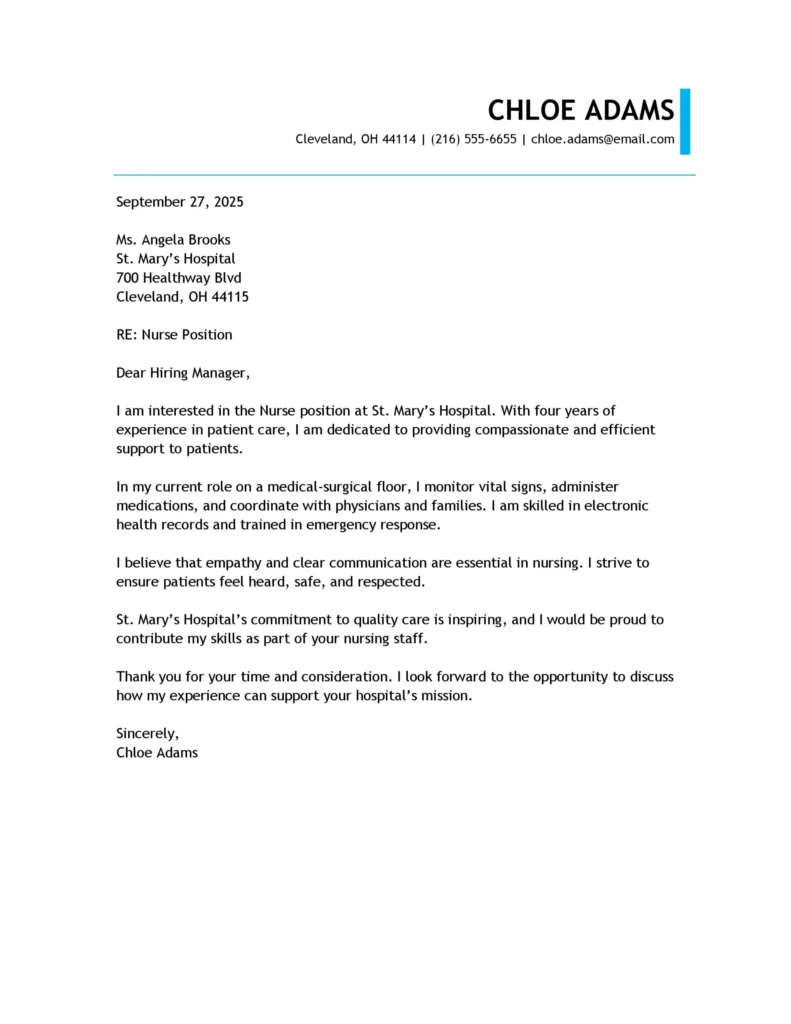
Illustrative Example: Sample Nurse Cover Letter
[Your Name], RN, BSN
[Your Phone Number] | [Your Email Address] | [Your LinkedIn URL (Optional)]
[City, State][Date]
Ms. Sarah Chen
Nurse Recruiter
[Hospital Name]
[Hospital Address]
[City, State, ZIP]Dear Ms. Chen,
I am writing with genuine enthusiasm to apply for the Registered Nurse position within the Oncology Unit at [Hospital Name], as advertised on [Platform, e.g., LinkedIn]. Holding a Bachelor of Science in Nursing (BSN), an active RN license in [State], and three years of dedicated experience providing compassionate care in acute settings, I possess the clinical expertise and patient-centered values that resonate deeply with [Hospital Name]’s renowned commitment to holistic patient well-being and its Magnet Recognition status.
During my tenure at [Previous Hospital]’s Medical/Surgical unit, I consistently managed a demanding caseload, averaging 5-6 complex patients per shift, while collaborating seamlessly within multidisciplinary teams to develop and execute comprehensive care plans. My proficiency includes administering chemotherapy (with appropriate certification), managing central lines, providing palliative care support, and utilizing the Epic EHR system for meticulous documentation. I am certified in both BLS and ACLS, enabling me to respond swiftly and effectively in critical situations. Notably, I initiated a patient education initiative focused on symptom management for post-operative patients, which contributed to a documented 15% reduction in unit readmission rates over six months.
What particularly draws me to [Hospital Name]’s Oncology Unit is your institution’s patient-centered philosophy and strong investment in evidence-based practice and continuous nursing professional development, as highlighted on your careers page. I am eager to contribute my specialized clinical knowledge, strong empathetic communication skills honed through supporting patients and families during challenging diagnoses, and unwavering dedication to collaborative teamwork to your esteemed nursing staff.
Thank you sincerely for considering my application. My resume provides further detail on my qualifications and accomplishments. I would welcome the opportunity to discuss in an interview how my background, skills, and commitment to compassionate oncology care can significantly support your team and patient care objectives.
Sincerely,
[Your Typed Name]
Tailoring Your Narrative: Examples for Different Nursing Roles
Adapt your cover letter’s focus based on the specific requirements and nuances of the role:
Entry-Level Nurse / New Graduate
Lacking extensive paid experience? Emphasize enthusiasm, foundational knowledge, and learning agility. Highlight significant clinical rotations, preceptorships, academic achievements (strong GPA, relevant projects), volunteer work, and transferable soft skills.
Example Snippet:
“During my final clinical rotation in the Pediatrics unit at [Clinical Site Hospital], I gained invaluable hands-on experience in assessing pediatric patients, administering medications accurately using the ‘rights’ of medication administration, and building trusting relationships with anxious young patients and their parents through clear, age-appropriate communication and play therapy techniques. I am eager to apply this foundational knowledge and my passion for pediatric care within your dedicated team.”
Experienced Nurse (General)
Focus on quantifiable achievements, leadership potential or experience, mentorship activities, and contributions to quality improvement or patient safety initiatives. Showcase progression and expertise.
Example Snippet:
“As a senior staff nurse on the telemetry unit at [Previous Hospital] for the past five years, I consistently precepted and mentored an average of six new graduate nurses annually. Furthermore, I led a unit-based council initiative to revise our shift handoff communication protocol using the SBAR framework, which resulted in a 12% improvement in patient satisfaction scores related to communication within one year.”
Specialized Nurse (e.g., ICU, Pediatrics, Oncology, ER)
Highlight specific technical skills, advanced certifications, experience with specialized equipment or procedures, and your ability to handle high-acuity patients or specific patient populations. Demonstrate deep expertise in the specialty area.
Example Snippet (ICU):
“My three years of dedicated experience in the Surgical Intensive Care Unit at [Previous Hospital] have equipped me with advanced skills in managing ventilated patients, titrating critical drips, interpreting complex hemodynamic monitoring data, and providing compassionate, evidence-based care to critically ill patients and their families during high-pressure situations. My CCRN certification further validates my expertise in critical care nursing.”
Travel Nurse
Emphasize adaptability, rapid learning ability, proficiency with various EHR systems, flexibility, strong communication skills, and experience quickly integrating into diverse hospital cultures and team dynamics while maintaining high standards of care.
Example Snippet:
“Over the past two years as a travel nurse completing assignments across three different states and five hospital systems (including Level I Trauma Centers), I have consistently demonstrated the ability to rapidly adapt to new unit protocols, diverse patient populations, and various EHR systems (Cerner, Epic, Meditech), ensuring seamless continuity of high-quality patient care from day one of each assignment.”
From Application to Offer: Real Candidate Success Stories
Concrete examples illustrate the power of a tailored cover letter:
Case 1: The New Graduate Who Showcased Potential
Sarah, a recent BSN graduate with limited paid experience, targeted a competitive residency program. Her cover letter didn’t dwell on what she lacked. Instead, it vividly described her capstone project on improving patient handoffs, highlighted positive feedback from preceptors during challenging clinical rotations (mentioning specific skills learned), and emphasized her volunteer work at a community health fair, demonstrating initiative and passion for community health – aligning with the hospital’s mission. Her enthusiasm and clear articulation of learned skills secured her an interview over candidates with seemingly stronger resumes.
Case 2: The Experienced RN Who Demonstrated Leadership
James, an RN with 8 years of experience, applied for an internal Charge Nurse position. His cover letter went beyond listing his years of service. He specifically detailed instances where he took informal leadership roles: mentoring six junior nurses over two years, volunteering to lead a unit-based committee on reducing medication errors (mentioning a specific % reduction achieved), and successfully de-escalating conflicts between staff members during high-stress shifts. This focus on demonstrated leadership behaviors and measurable impact, rather than just clinical duties, directly addressed the core requirements of the promotion and secured him the role.
Case 3: The Travel Nurse Who Proved Flexibility
Mei sought a challenging travel nurse assignment in a high-acuity ICU across the country. Her cover letter emphasized her adaptability. She mentioned specific examples: successfully onboarding to three different EHR systems (Epic, Cerner, Meditech) within the first week of previous assignments, adapting care plans based on diverse patient cultural needs encountered in urban vs. rural settings, and receiving positive feedback from charge nurses at multiple facilities regarding her quick integration and teamwork. This focus on proven adaptability and cross-cultural competency convinced recruiters she could transition smoothly and contribute effectively from day one.
Crafting with Care: Do’s & Don’ts for Nurse Cover Letters
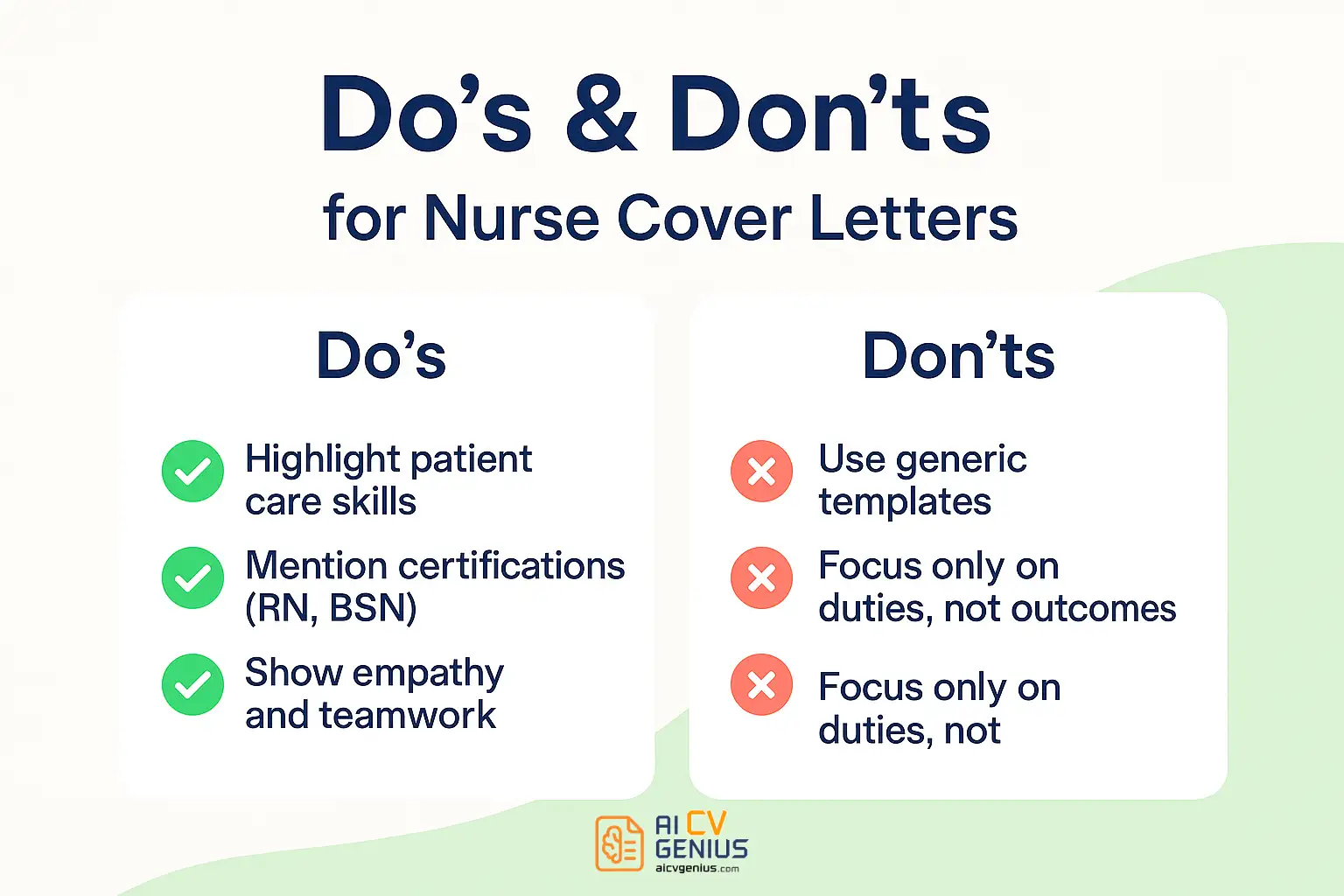
| Do ✅ | Don’t ❌ |
|---|---|
| Personalize extensively: Research the hospital’s mission, values, recent awards (e.g., Magnet status), or specific unit culture. Reference these specifics to show genuine interest. | Use generic templates verbatim: Sending a non-customized letter signals low effort and lack of genuine interest. |
| Quantify achievements: Use numbers, percentages, or specific examples to demonstrate impact (e.g., “Reduced falls by X%,” “Managed Y patients per shift”). | Simply list duties: Avoid merely repeating job description tasks. Focus on accomplishments and outcomes. |
| Highlight relevant certifications prominently: Mention RN, BSN/ADN, BLS/ACLS, and specialty certifications early or in context. | Bury critical qualifications: Ensure essential licenses and certifications are easily visible. |
| Showcase soft skills with brief examples: Instead of saying “good communicator,” describe a situation where your communication resolved an issue or comforted a family. | Make vague claims about soft skills: Statements like “I am empathetic” are weak without supporting evidence or context. |
| Maintain a professional yet warm tone: Reflect the compassion inherent in nursing while adhering to professional communication standards. | Be overly casual or overly formal/robotic: Strike a balance that feels authentic and respectful. |
| Proofread meticulously: Errors in grammar or spelling undermine perceived attention to detail – critical in nursing. Read it aloud or use proofreading tools. | Submit without proofreading: Typos suggest carelessness, which is a major red flag in healthcare. |
| Keep it concise (one page): Respect the reader’s time. Focus on the most impactful and relevant information. | Write multiple pages: Brevity is valued. Stick to a clear, focused one-page letter. |
Final Review: Checklist Before Sending
Before hitting “send” or “upload,” perform a final quality check:
- ✅ Does the header contain accurate contact information for both you and the employer?
- ✅ Is the greeting personalized to the correct individual (name and title)?
- ✅ Does the opening paragraph clearly state the position and your core motivation/alignment?
- ✅ Do the body paragraphs provide specific, relevant examples of your skills and achievements?
- ✅ Have you quantified impact where possible (%, #, specific outcomes)?
- ✅ Have you mentioned key certifications (RN, BLS/ACLS, specialty certs)?
- ✅ Does the letter explicitly address key requirements from the job description?
- ✅ Is the tone professional, confident, and appropriately empathetic?
- ✅ Does the closing paragraph reiterate enthusiasm and include a clear call to action?
- ✅ Is the letter strictly one page and formatted cleanly (consistent font, adequate white space)?
- ✅ Has the letter been meticulously proofread for any typos or grammatical errors?
- ✅ Does the file name follow a professional convention (e.g., YourName_Nurse_CoverLetter.pdf)?
Frequently Asked Questions (FAQ)
Final Thoughts: Your Narrative of Care
A nurse cover letter serves as far more than a simple introduction – it stands as compelling testimony to your compassion, unwavering professionalism, and clinical competence. By artfully blending technical skills with poignant personal stories of patient impact, meticulously aligning your values with those of the prospective employer, and consciously avoiding common pitfalls, you craft a document that deeply resonates with both nurse recruiters and hiring managers. Nurses are entrusted with the profound responsibility of human lives. Your cover letter must inherently reflect that same exceptional level of care, meticulous attention to detail, and unwavering ethical responsibility. Employing the right strategic approach, your carefully chosen words can construct the vital bridge leading from resume submission to coveted interview, and ultimately, from application to the fulfilling next chapter in your dedicated nursing career.