
- Core purpose: Turn your code into a clear impact story that proves communication, collaboration, and role fit.
- Best structure: Use 3 to 4 tight paragraphs, Hook, Proof with outcomes, Close with a confident ask.
- Proof standard: Show specific problems, actions, and measurable results, plus the tech stack only where it supports the outcome.
- Tailoring rule: Adjust the angle for junior, senior, career changer, and startup vs enterprise so the letter answers their risks.
- Common traps: Avoid generic templates, resume copy paste, buzzwords without context, vague verbs, and sloppy formatting.
Introduction: Beyond Code – Crafting Your Narrative
Applying for a software engineering job in today’s market is a paradox: while the demand for skilled developers remains exceptionally high, the competition is equally fierce. A polished resume, a strong GitHub profile, and a compelling portfolio are essential table stakes, but often they aren’t enough to secure that crucial first interview. This is where a strategically crafted software engineer cover letter example becomes your narrative advantage. It’s the space where you demonstrate not only your technical prowess but, perhaps more importantly, your ability to communicate complex ideas clearly, collaborate effectively within a team, and apply critical thinking to solve real-world problems – qualities that code alone cannot fully convey.
If your resume serves as the detailed technical blueprint of your career – outlining languages, frameworks, and projects – then your cover letter functions as the compelling executive summary that persuades stakeholders (hiring managers and recruiters) to invest their time in reading the full plan. It’s your unique opportunity to articulate the underlying motivation driving your work, explicitly connect your specific technical skills to the company’s mission and challenges, and reveal the personality and problem-solving approach behind the lines of code. In essence, it transforms your application from a list of qualifications into a persuasive human story.
The Strategic Value Proposition: Why Software Engineers Still Need a Cover Letter
Within the software engineering community, a recurring debate questions the necessity of cover letters. Many developers reasonably argue that their code, showcased on GitHub, or their portfolio of live projects should stand as sufficient evidence of their capabilities. While these technical artifacts are undeniably critical, relying solely on them overlooks a fundamental aspect of the hiring process: human connection and contextual understanding. Discerning hiring managers and experienced recruiters seek more than just technical proficiency; they are evaluating potential colleagues. A well-crafted cover letter remains a vital tool for several strategic reasons:
- Demonstrates Crucial Communication Skills: Modern software development is inherently collaborative. Success hinges on clear communication – whether writing concise documentation, providing constructive code reviews, articulating technical decisions to non-technical stakeholders, or collaborating effectively across distributed teams (product managers, designers, QA). Your cover letter serves as immediate, tangible proof of your written communication clarity and professionalism.
- Provides Essential Context and Narrative: A GitHub commit history shows activity, but it doesn’t explain the why behind a project, the specific business problem it solved, the technical challenges overcome, or the measurable impact it delivered for users or the organization. The cover letter provides this crucial narrative layer, transforming technical tasks into compelling stories of problem-solving and value creation.
- Signals Genuine Motivation and Alignment: Recruiters are inundated with applications. They need to quickly discern which candidates are genuinely interested in this specific role at this particular company, versus those simply mass-applying. A tailored cover letter, referencing the company’s product, mission, technology stack, or recent achievements, demonstrates thoughtful research and targeted motivation – a powerful differentiator.
- Differentiates You Beyond Technical Skills: In a pool of candidates with similar technical qualifications (e.g., proficiency in React, Python, AWS), your cover letter allows you to highlight unique perspectives, soft skills (like leadership, mentorship, or adaptability), and cultural fit – factors that often become decisive in final hiring decisions.
While it’s true some companies or specific roles might deprioritize cover letters, submitting a thoughtful, tailored one consistently signals a higher level of professionalism, diligence, and genuine interest. It’s an investment that significantly increases your chances of standing out. If you’re refining your application materials, ensuring visual consistency between your letter and resume is also key. Consider exploring updated Resume Templates to maintain a polished, cohesive professional brand.
Architecting Your Argument: Structure of an Effective Software Engineer Cover Letter
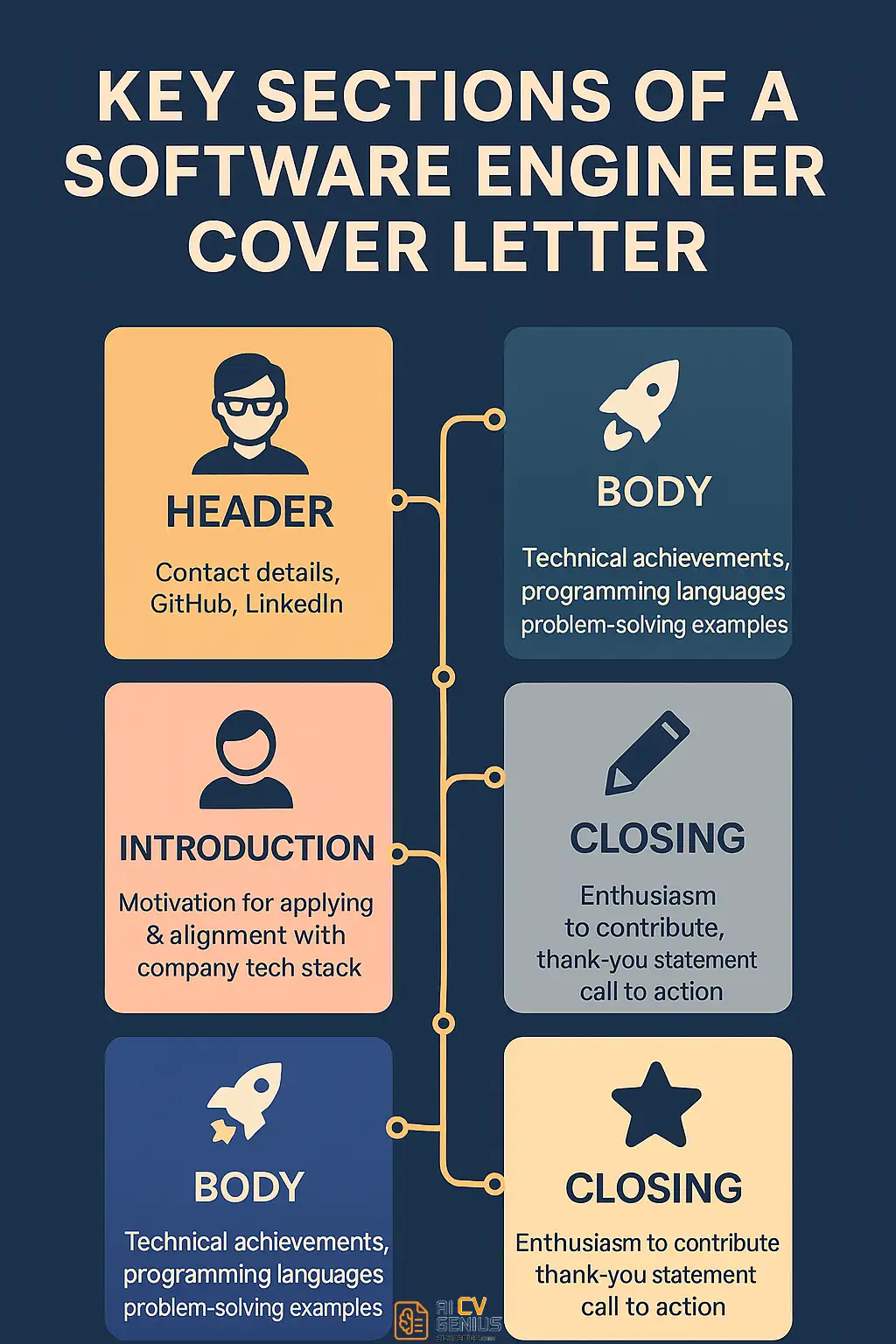
Your cover letter should mirror the principles of good software design: clean, modular, efficient, and user-friendly (for the recruiter). Adherence to a standard one-page limit is crucial. Here’s a proven structure optimized for technical roles:
1. Header: Establishing Identity and Access Points
Include your essential professional coordinates: full name, professional email address, primary phone number. Critically for engineers, add direct links to your professional online presence: GitHub profile (ensure it’s curated and showcases your best work), LinkedIn profile (ensure it’s updated and aligns with your resume), and optionally, a personal portfolio website URL demonstrating projects or case studies. Below your details, clearly state the date and the recipient’s information (Company Name, Hiring Manager Name/Title if known, Company Address). Consistent formatting with your resume header creates a unified brand.
2. Greeting: Addressing the Stakeholder Appropriately
Invest the effort to identify the specific hiring manager or engineering lead responsible for the role. LinkedIn, the company’s team page, or even a polite inquiry to HR can often yield this information. Addressing the letter directly (“Dear Ms. Evans,” or “Dear Dr. Chen,”) demonstrates diligence and personalization, making a significantly stronger impact than impersonal defaults. In the tech industry, where collaboration is key, showing you can identify the right contact person matters. If a specific name is genuinely unattainable after reasonable effort, “Dear Hiring Team,” or “Dear Engineering Hiring Manager,” is a professional and acceptable alternative, far superior to the outdated “To Whom It May Concern.”
3. Introduction: The Hook and Thesis Statement
Your opening paragraph must immediately capture attention and establish relevance. State the specific position you are applying for (e.g., “Senior Backend Engineer,” “Frontend Developer Intern”). Crucially, immediately follow this by connecting your core expertise or passion directly to something specific about the company – their product’s impact, their technical challenges, their engineering culture, or their mission.
Example:
“As a backend engineer deeply passionate about building scalable, distributed systems, I have been closely following [Company Name]’s innovative work in leveraging real-time data analytics for supply chain optimization. I am writing to express my enthusiastic interest in the Senior Backend Engineer position advertised on [Platform], where I believe my extensive experience with Kafka, Kubernetes, and Golang aligns perfectly with the technical challenges outlined in the job description and your company’s mission to enhance global logistics efficiency.”
This approach instantly signals targeted interest, technical alignment, and thoughtful research, compelling the reader to invest further.
4. Body Paragraphs (1-2): Providing Evidence and Quantifying Impact
This is the core of your technical argument. Select two or three of your most significant and relevant achievements from previous roles or projects. For each, concisely describe the situation or challenge, the specific actions you took (emphasizing your technical contributions and problem-solving approach), and, most importantly, the measurable results or impact achieved. Use metrics whenever possible – quantification transforms claims into credible proof.
| Instead of | Try |
|---|---|
| “Worked on optimizing database performance.” | “Identified and resolved critical performance bottlenecks in our primary PostgreSQL database by refactoring complex queries and implementing strategic indexing, resulting in a 20% reduction in average server response times and a significant improvement in application stability during peak loads.” |
| “Improved frontend code.” | “Led the migration of a legacy AngularJS frontend to React, incorporating modern best practices like component-based architecture and lazy loading, which resulted in a 35% improvement in Lighthouse performance scores and a more maintainable codebase.” |
| “Helped junior developers.” | “Actively mentored three junior engineers through pair programming sessions and constructive code reviews, contributing to a 25% reduction in their average onboarding time and fostering a collaborative team environment focused on code quality.” |
Explicitly connect these achievements to the specific requirements and technologies mentioned in the job description. If the role requires AWS experience, highlight a project where you successfully deployed services on AWS. If they emphasize DevOps practices, detail your contributions to CI/CD pipelines or infrastructure automation (e.g., using Terraform, Jenkins).
5. Closing Paragraph: Call to Action and Professional Sign-off
Conclude your letter with renewed enthusiasm and a clear, professional call to action. Briefly reiterate your strong interest in the role and the company. Express your eagerness to discuss how your specific skills and experience can contribute to their team’s success.
Example:
“My proven ability to architect and deliver high-performance backend systems, combined with my collaborative spirit and commitment to code quality, aligns strongly with the requirements for the Software Engineer role and [Company Name]’s innovative culture. I am excited about the possibility of contributing to your team and would welcome the opportunity to discuss my qualifications further in an interview.”
End with a standard professional closing (“Sincerely,” or “Best regards,”) followed by your typed full name.
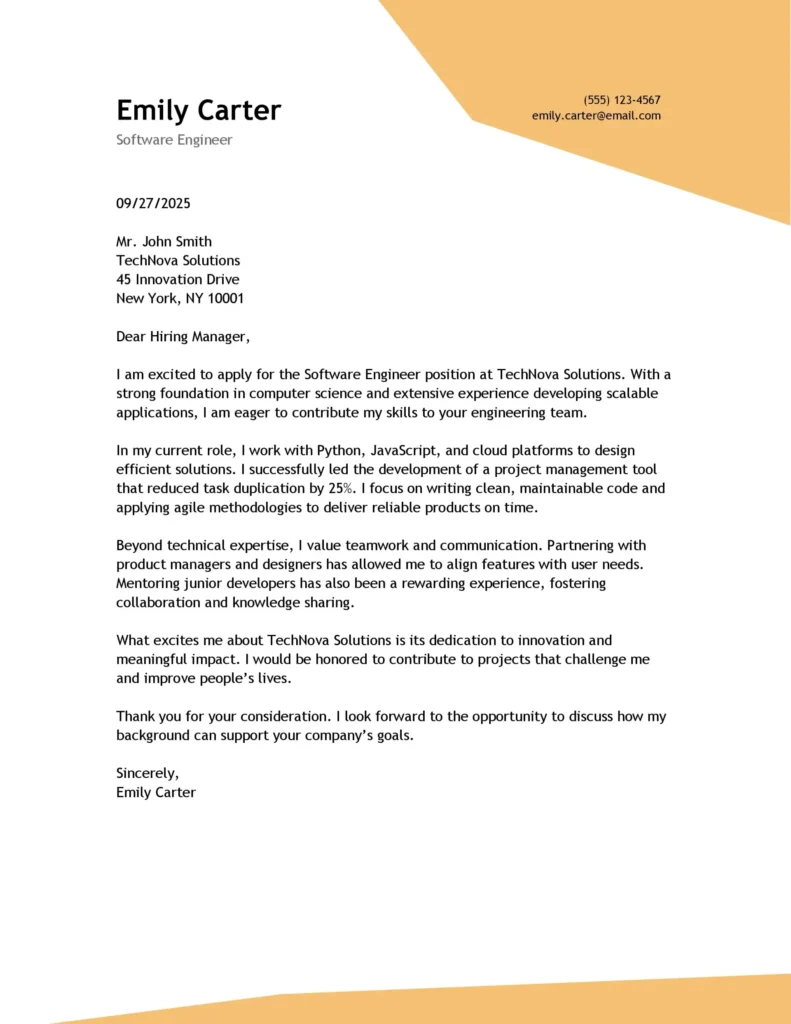
Full Example: Software Engineer Cover Letter (Integrated)
[Your Name]
[Your Phone] | [Your Email] | [Your GitHub URL] | [Your LinkedIn URL] | [Your Portfolio URL (Optional)][Date]
Ms. Anya Sharma
Engineering Manager
Innovate Solutions Inc.
[Company Address]Dear Ms. Sharma,
As a software engineer deeply passionate about designing systems that are both highly scalable and intuitively user-friendly, I have been actively following Innovate Solutions Inc.’s pioneering work on AI-driven collaboration platforms, particularly your recent advancements mentioned in [Specific source, e.g., TechCrunch article]. I am profoundly impressed by your team’s ability to blend cutting-edge innovation with practical application. I am writing to express my enthusiastic interest in the Software Engineer position advertised on [Platform], where I believe my skills and experience align perfectly with your mission to build tools that empower global teams.
During my previous role at BrightCode Technologies, I led the backend development for a complex data visualization platform serving thousands of concurrent e-commerce clients. By architecting and implementing GraphQL APIs and optimizing database interactions (PostgreSQL), I directly contributed to a 40% reduction in average API loading times and decreased critical system errors by 25% within the first year. Beyond the core technical contributions, I prioritized establishing comprehensive documentation using Swagger/OpenAPI and actively mentored two new hires through code reviews and pair programming, helping them become productive contributors approximately 30% faster than previous onboarding benchmarks.
I was particularly drawn to the job description’s emphasis on leveraging AWS Lambda for serverless functions and containerized services for deployment consistency. My recent project involved architecting and deploying a microservices-based application using Docker, Kubernetes, and Terraform on AWS, achieving significant cost savings and improved deployment velocity. I am confident in my ability to apply this hands-on cloud and DevOps expertise effectively within your engineering team’s established workflows.
Thank you sincerely for considering my application. I am excited about the potential to contribute my skills and collaborative spirit to Innovate Solutions Inc. and would welcome the opportunity to discuss in detail how my experience can help support your team’s ambitious goals and upcoming product releases.
Best regards,
Daniel Nguyen
Tailoring Your Narrative: Scenarios for Different Software Engineer Profiles
Your cover letter’s emphasis should shift based on your experience level and the type of company you’re targeting:
Junior Developer / Entry-Level
Focus: Highlight enthusiasm, eagerness to learn, strong foundational knowledge (data structures, algorithms), and tangible projects from academics, bootcamps, personal repositories, or hackathons. Frame projects using the STAR method (Situation, Task, Action, Result) even if the scale is small. Emphasize relevant coursework, strong GPA (if applicable), contributions to open-source projects, and transferable soft skills like teamwork (from group projects) and problem-solving. Show potential and coachability.
Mid-Level / Senior Engineer
Focus: Emphasize demonstrated impact, technical leadership, system design capabilities, scalability expertise, and contributions to business outcomes. Highlight specific, complex projects you led or significantly contributed to, quantifying results related to performance improvements, cost savings, revenue generation, reliability enhancements, or customer satisfaction. Mention mentorship of junior engineers, contributions to architectural decisions, or experience driving technical strategy. Align your expertise directly with the company’s tech stack and challenges.
No Professional Experience / Career Changer
Focus: Showcase passion, initiative, and self-directed learning through personal projects, significant open-source contributions, relevant certifications (e.g., AWS Certified Developer), or freelance work (even small gigs). Emphasize transferable skills from your previous career – problem-solving, analytical thinking, project management, client communication – and explicitly connect them to software engineering principles. Clearly articulate why you are making the transition and what steps you’ve taken to acquire the necessary technical skills.
Targeting a Startup vs. a Large Enterprise
Startup Focus: Highlight adaptability, versatility (“wearing multiple hats”), rapid prototyping skills, ability to work autonomously, comfort with ambiguity, and passion for the startup’s specific mission or product. Emphasize quick learning and contribution across different parts of the stack.
Enterprise Focus: Emphasize reliability, experience with large-scale systems, understanding of process and compliance (e.g., security, testing protocols), ability to collaborate effectively across large, potentially siloed teams, and experience navigating complex organizational structures. Highlight stability and long-term contribution potential.
Key Strategies for Writing a Strong Software Engineer Cover Letter
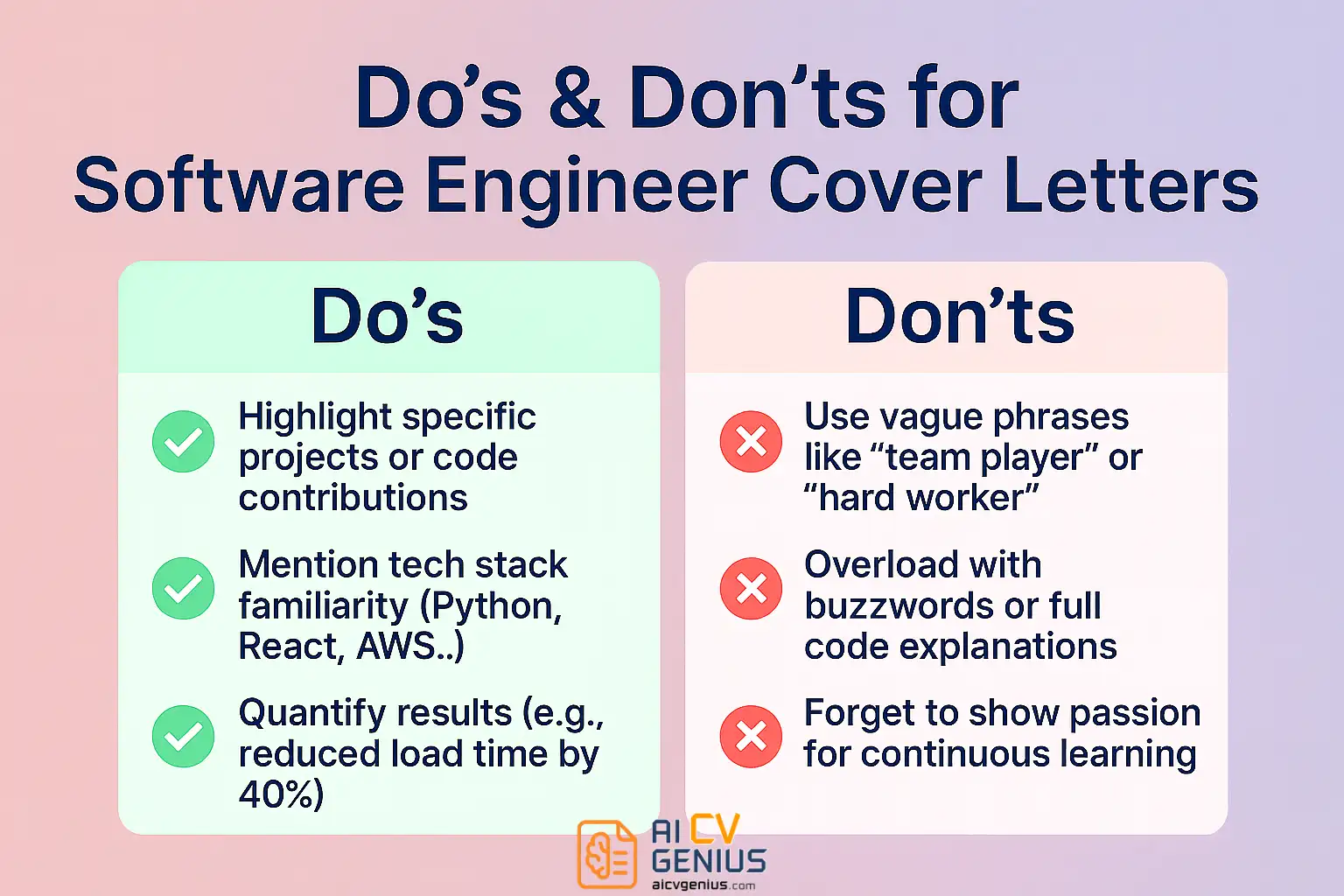
- Quantify Achievements Relentlessly: Use concrete metrics (%, $, #, time saved, performance improvement) whenever possible to substantiate your impact. Numbers transform claims into proof.
- Tailor Explicitly to the Company and Role: Reference the company’s specific products, technology stack, recent news, or stated values. Align your highlighted skills and experiences directly with the keywords and requirements in the job description. Generic letters get ignored.
- Maintain Conciseness and Clarity: Keep your letter strictly to one page (ideally 300–400 words). Use clear, direct language. Avoid excessive technical jargon unless it’s specifically relevant and used accurately. Focus on impact and relevance.
- Proofread Meticulously: Typos, grammatical errors, or formatting inconsistencies can undermine your credibility, especially in a field demanding precision. Read it aloud or use grammar tools to catch mistakes. Ask a peer to review if possible.
- Ensure Clean, Professional Formatting: Stick to standard business letter format. Use professional, readable fonts (e.g., Inter, Lato, Calibri, Georgia) in a consistent size (10.5-12pt). Ensure ample white space for readability.
Critical Errors: Common Mistakes to Avoid
Steer clear of these frequent pitfalls that can derail your application:
- ❌ Sending a Generic, Untailored Letter: The single most common and damaging mistake. Recruiters can spot generic templates instantly.
- ❌ Simply Repeating Resume Content Verbatim: The cover letter must add context, narrative, and specific alignment – not just rehash bullet points without elaboration or impact.
- ❌ Overloading with Technical Buzzwords Without Context: Listing technologies without explaining how you used them or what results you achieved is ineffective. Focus on application and outcome.
- ❌ Being Too Vague About Contributions: Phrases like “involved in,” “assisted with,” or “worked on” obscure your specific role and impact. Use strong action verbs and clearly define your contribution.
- ❌ Focusing Only on What You Want: While mentioning your career goals is fine, the primary focus should be on what value you bring to the employer. Frame your aspirations in the context of their needs.
- ❌ Typos, Grammatical Errors, or Sloppy Formatting: These signal a lack of attention to detail – a critical flaw for any engineer.
Strategic Considerations: Pros & Cons of Writing a Cover Letter as a Software Engineer
Understanding the trade-offs helps prioritize your effort:
| Pros ✅ | Cons ❌ |
|---|---|
| Demonstrates essential communication, collaboration, and critical thinking skills beyond code. | Requires significant time and effort to research and customize effectively for each application. |
| Personalizes your application, making it more memorable and establishing a human connection. | Some high-volume recruiters or automated systems might deprioritize reading it during initial screening phases. |
| Provides crucial context and narrative depth to projects listed on GitHub or a portfolio. | Can be challenging to articulate complex technical achievements concisely and engagingly without jargon. |
| Signals genuine interest, professionalism, and diligence – key differentiators in competitive pools. | A poorly written, generic, or error-filled letter can actively harm your candidacy more than submitting none. |
Conclusion: In the competitive tech landscape, the strategic advantages offered by a well-crafted, tailored cover letter almost always outweigh the time investment, particularly for roles beyond entry-level.
FAQs: Software Engineer Cover Letter Specifics
Final Thoughts: Your Code Opens Doors, Your Words Keep Them Open
Crafting an effective software engineer cover letter example isn’t merely about listing technical skills; it’s about strategic communication. Your resume demonstrates that you can code, but your cover letter articulates why your coding matters – how it solves problems, drives value, and aligns with the company’s specific goals and mission. This powerful combination of technical proof and narrative persuasion is what ultimately secures interviews in today’s demanding tech landscape.
Ensure your cover letter visually and thematically aligns with a resume optimized for modern Applicant Tracking Systems. Explore our curated Cover Letter Templates for more industry-specific examples and effective structures. For insights into tailoring your application based on company research, resources like Indeed for job descriptions and Glassdoor for company culture reviews can be invaluable. Mastering the blend of thorough preparation and authentic personalization is the key to differentiating yourself in the highly competitive tech job market.