
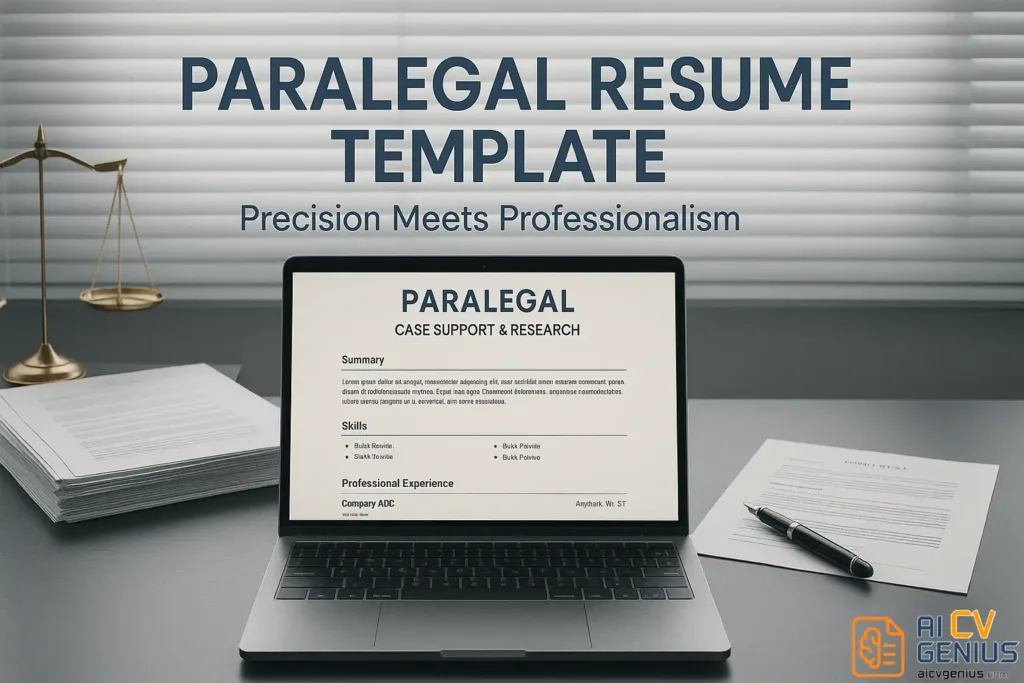
- Core goal: Your paralegal resume should feel like professional evidence, precise, organized, and calm under pressure, because firms read it as a risk check.
- What employers scan for: Accuracy, confidentiality, case management, legal research, legal tech (E-filing, DMS, Clio or MyCase, Relativity), and clear communication.
- ATS rules: Use a clean single-column layout, standard headings, and job-specific keywords. Avoid tables, graphics, and complex columns that break parsing.
- How to write experience: Replace duties with proof using Action + Task + Result, then quantify (Cases handled, documents drafted, deadlines met, efficiency gains, dollar values when relevant).
- Best structure: Header, 3 to 5 sentence summary, grouped skills, reverse-chronological experience, then education and certifications (NALA CP, NFPA RP, ABA certificate) with dates.
In the intricate machinery of the legal world, behind every successful attorney stands a paralegal – the indispensable force transforming complex cases into organized, actionable strategies. From meticulously preparing deposition summaries and researching critical precedents to managing voluminous client files and ensuring court deadlines are met, paralegals are the operational backbone, ensuring the legal engine runs with precision and reliability. Your resume, therefore, must mirror this essential balance: showcasing unwavering precision, exceptional organizational prowess, and a quiet, confident authority that instills trust.
This comprehensive guide is designed to help you construct a standout paralegal resume. It’s not merely about listing credentials; it’s about crafting a narrative that demonstrates not just what legal knowledge you possess, but how you operate – methodically, clearly, with ethical integrity, and maintaining composure under the immense pressure inherent in legal practice. We’ll delve into showcasing your value in a way that resonates with hiring partners, legal recruiters, and corporate counsel.
The Hiring View: What Firms Want & How to Pass ATS Filters
When a hiring partner, senior paralegal, or legal HR specialist reviews your resume, they’re performing more than a skills check; they’re conducting a risk assessment. Law firms operate in high-stakes environments where errors can have significant financial and reputational consequences. Corporate legal departments need individuals who can navigate complex compliance landscapes and support internal counsel efficiently. They need absolute assurance of your competence, discretion, and reliability.
In their brief initial scan (often under 10 seconds), they are subconsciously seeking answers to critical questions:
- Accuracy & Attention to Detail: Is this resume meticulously proofread? Are there inconsistencies? Minor errors suggest potential carelessness in handling sensitive legal documents. Keywords: “document review,” “proofreading,” “quality control,” “data accuracy.”
- Confidentiality & Ethics: Does the candidate understand the paramount importance of discretion? While hard to demonstrate directly on a resume, a professional tone and careful wording contribute to this perception. Keywords: “confidential information,” “ethical standards,” “compliance.”
- Organizational & Case Management Skills: Can this person handle multiple complex cases simultaneously without dropping the ball? Evidence of managing high volumes or complex workflows is crucial. Keywords: “case management software,” “docketing,” “file organization,” “deadline tracking,” “e-discovery platforms.”
- Research & Analytical Abilities: Can they effectively locate relevant case law, statutes, and factual information? Specificity about research tools and successful outcomes is key. Keywords: “legal research,” “LexisNexis,” “Westlaw,” “factual investigation,” “statutory analysis.”
- Technical Proficiency: Are they adept with essential legal software beyond basic office suites? Familiarity with e-filing systems, case management platforms, and document management systems is often required. Keywords: “e-filing (PACER, state systems),” “Clio,” “MyCase,” “Adobe Acrobat Pro,” “document management systems (DMS).”
- Communication & Interpersonal Skills: Can they interact professionally with attorneys, clients, court staff, and opposing counsel? While primarily assessed in interviews, concise writing and clear structure on the resume provide initial clues. Keywords: “client communication,” “liaison,” “drafting correspondence,” “team collaboration.”
Before your resume reaches human eyes, especially in larger firms or corporations, it will almost certainly be processed by an Applicant Tracking System (ATS). These systems scan for keywords and specific formatting patterns to rank candidates based on relevance to the job description. To pass, you must align keywords (“Relativity,” “e-discovery”), use standard headings (“Professional Experience”), and use a clean, single-column format. Avoid tables, columns, or graphics that can confuse the parser.
Structuring Your Paralegal Resume: Section by Section
A paralegal’s resume should embody the very qualities required for the job: meticulous organization, logical flow, and absolute clarity. The standard format preferred in the legal field is reverse-chronological, showcasing your most recent and relevant experience first.
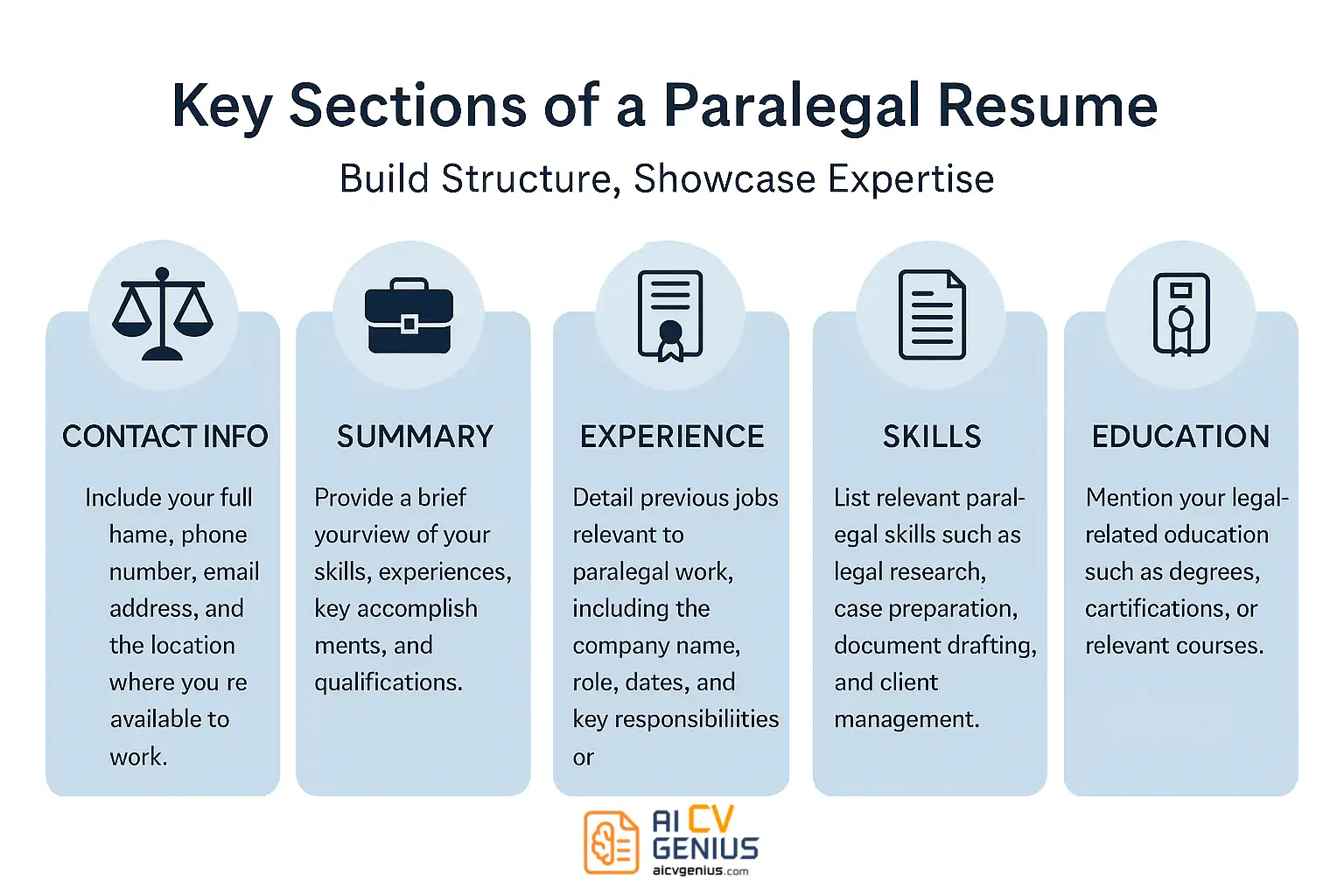
1. Contact Information: Professional and Accessible
Position this clearly at the top. Include:
- Full Name (slightly larger font)
- Professional Title (e.g., “Certified Paralegal,” “Litigation Paralegal,” “Corporate Paralegal”)
- City, State
- Professional Email Address (avoid casual addresses)
- Phone Number
- LinkedIn Profile URL (ensure your profile is updated and professional)
Example:
Jessica Chen
Certified Paralegal | Litigation Specialist
San Francisco, CA | (555) 123-4567 | jessica.chen.legal@email.com | linkedin.com/in/jessicachenparalegal
2. Professional Summary: Your Opening Statement
This concise 3-5 sentence paragraph is your executive brief. It must immediately convey your experience level, areas of specialization, core competencies, and career objective (implicitly or explicitly). Tailor it for each application, highlighting qualifications most relevant to the specific job description. In law, every word counts – make your summary impactful and evidence-based.
Weak Summary (Vague, lacks specifics and impact):
“Experienced paralegal looking for a challenging role in a reputable firm. Hardworking and detail-oriented with good research skills.”
Strong Summary (Experienced Litigation Paralegal):
“Detail-oriented and NALA-Certified Paralegal with 7+ years of comprehensive experience in complex civil litigation within fast-paced law firm environments. Expertise spans all phases of discovery, trial preparation, and case management, utilizing Relativity and Clio. Proven ability to conduct in-depth legal research (Westlaw, LexisNexis), draft precise court documents, and manage high-volume case files (80+ active cases) while maintaining strict confidentiality and meeting critical deadlines.”
Strong Summary (Entry-Level/Career Changer with Certificate):
“Highly motivated and organized individual with a recently completed ABA-approved Paralegal Certificate and a Bachelor’s degree in Political Science. Eager to apply strong research, writing, and administrative skills gained through academic projects and previous administrative roles to a Paralegal position specializing in [Target Area, e.g., Family Law]. Proficient in Microsoft Office Suite and foundational legal research databases, with a commitment to accuracy and ethical practice.”
This section works because it conveys credibility (certification, years), specific skills (discovery, drafting, research tools), quantifiable achievements (case volume), and calm professionalism – exactly what law firms prioritize.
3. Highlight Your Core Legal Skills: Demonstrating Competence
Your skill set provides concrete evidence of your capabilities. Create a dedicated “Skills” or “Areas of Expertise” section. Group skills logically to mirror a structured legal mind and improve scannability. Blend technical competencies (software, procedures) with essential soft skills demonstrated through legal work (communication, organization). Align keywords here directly with the job description.
Example Skill Categories:
| Legal Research & Writing | Westlaw, LexisNexis, Statutory Analysis, Case Law Research, Legal Memorandum Drafting, Citation Checking (Bluebook), Proofreading Legal Documents |
| Litigation & Case Management | Discovery Process (Interrogatories, RFPs, RFAs), Deposition Preparation & Summaries, Trial Preparation (Exhibit Management, Witness Coordination), E-filing (PACER, State Systems), Docketing & Deadline Management, Case Management Software (Clio, MyCase, Filevine) |
| Corporate & Transactional Support | Corporate Filings, Due Diligence, Contract Review & Management, Minute Book Maintenance, Entity Formation |
| Administrative & Technical Skills | Microsoft Office Suite (Advanced Word, Excel, PowerPoint), Adobe Acrobat Pro (Redaction, Bates Stamping), Document Management Systems (DMS), Legal Billing Software (Timeslips, Juris), E-discovery Platforms (Relativity, Concordance – Specify if applicable) |
| Client & Communication Skills | Client Intake & Communication, Professional Correspondence, Interdepartmental Liaison, Maintaining Confidentiality, Time Management & Prioritization |
Be specific. Instead of just “Research,” list the databases you master. Instead of “Software,” name the specific platforms relevant to the practice area.
4. Professional Experience: Proving Your Impact with Evidence
This is the most critical section. Do not simply list duties. Frame your responsibilities as achievements using the Action Verb + Specific Task/Skill + Measurable Result/Outcome formula. This transforms passive descriptions into compelling evidence of your value and aligns perfectly with how legal professionals think – focusing on results and impact.
Compare:
❌ Weak (Duty-Focused):
- Responsible for managing case files.
- Prepared legal documents.
- Did legal research.
- Talked to clients.
✅ Strong (Impact-Focused):
- Managed a caseload of over 80 complex litigation files simultaneously for a high-volume corporate law practice, ensuring 100% compliance with court deadlines and internal protocols through meticulous docketing.
- Drafted and finalized over 200+ legal documents, including pleadings, motions, and discovery requests for multiple federal court hearings, reducing attorney preparation time by an estimated 25% through accuracy and completeness.
- Conducted comprehensive legal research using Westlaw and LexisNexis, identifying key precedents that directly supported the successful defense strategy in three high-value ($1M+) contract disputes.
- Served as the primary liaison between attorneys and 50+ corporate clients for case status updates and document collection, consistently maintaining professionalism and strict confidentiality, resulting in positive client feedback scores.
- Assisted in all phases of trial preparation for five major cases, including organizing and managing over 1,000+ exhibits electronically and coordinating schedules for 20+ witnesses.
- Streamlined the firm’s document review process for discovery by implementing standardized tagging protocols in Relativity, increasing review efficiency by 15%.
Quantify whenever possible (number of cases, documents drafted, percentage improvements, monetary values involved). Even entry-level or internship experience can be framed powerfully by describing how your support contributed to the team’s or firm’s success (e.g., “Assisted senior paralegals by organizing discovery documents, enabling faster case progression”).
5. Education & Certifications: Validating Your Credentials
In the legal field, formal credentials carry significant weight. This section should be clear, concise, and prominently placed, often before or immediately after the Experience section depending on your level. Certifications, especially nationally recognized ones, instantly boost credibility.
Education:
- List degrees in reverse chronological order.
- Include Degree Name, Major, University Name, City, State, Graduation Year.
- Mention honors (Cum Laude, Dean’s List) or relevant minors.
Certifications & Training:
- List relevant certifications first, especially those sought by employers (NALA CP, NFPA RP, state-specific certifications).
- Include the full name of the certification, the issuing body, and the year obtained or expiration date.
- Add ABA-approved Paralegal Certificate programs here.
- Include significant continuing legal education (CLE) or specialized training (e.g., eDiscovery, Data Privacy, specific practice area workshops).
Example:
Certifications
- Certified Paralegal (CP) | National Association of Legal Assistants (NALA) | 2019
- Advanced Certification in Trial Practice | NALA | 2021
Education
- Paralegal Certificate (ABA-Approved Program) | University of [City] Extension | [City, State] | 2017
- Bachelor of Arts in Political Science | [University Name] | [City, State] | 2016
- Minor in Communication Studies
Don’t bury these credentials. They are often key filtering criteria for hiring managers and ATS systems in law offices and corporate legal teams.
6. Choose the Right Resume Format: Strategic Presentation
While the reverse-chronological format is the standard and generally preferred in the legal field for its clarity and emphasis on experience, other formats can be considered in specific situations:
- Reverse-Chronological: Best for paralegals with a consistent work history and clear career progression within the legal field. This is the safest and most expected format.
- Combination (Hybrid): Suitable for experienced paralegals changing practice areas (e.g., moving from family law to corporate law) or those returning after a gap. It allows you to lead with a strong skills/summary section highlighting transferable expertise before detailing the chronological work history.
- Functional: Generally discouraged in the legal profession. This format focuses heavily on skills while downplaying or obscuring work history and dates, which can raise red flags for recruiters who prioritize stability and clear timelines. Use with extreme caution, if at all.
For most paralegals, sticking to the reverse-chronological format, perhaps slightly enhanced with a robust summary and skills section (making it a mild hybrid), is the most effective strategy. You can browse adaptable, professional layouts in our Resume Templates Finder, ensuring they remain clean and ATS-friendly.
7. Add a Dedicated Technical Skills Section (Optional but Increasingly Powerful)
Modern legal practice is heavily reliant on technology. While you should list key software within your main Skills section, creating a separate, concise “Technical Proficiencies” or “Legal Technology” subsection can make your resume feel current and highlight specialized expertise, especially if the role emphasizes tech skills (e.g., e-discovery paralegal, legal operations).
Example:
Technical Proficiencies
- Legal Research: Westlaw Edge, Lexis Advance, Bloomberg Law
- Case Management: Clio Manage, MyCase, Filevine, PracticePanther
- E-Discovery: Relativity (Certified User), Concordance, Logikcull
- Document Management: NetDocuments, iManage, SharePoint
- Office Productivity: Microsoft Office Suite (Expert: Word Track Changes, Excel Pivot Tables, PowerPoint), Adobe Acrobat Pro (Redaction, Bates Stamping), G Suite
- Billing & Timekeeping: Timeslips, Juris, QuickBooks
This demonstrates to employers that you can integrate seamlessly into their digital workflows, potentially reducing training time and increasing immediate productivity.
8. Showcase Soft Skills Subtly Through Evidence
Law firms and legal departments are high-pressure environments. Soft skills like composure, ethical judgment, critical thinking, communication, and teamwork are essential but notoriously difficult to “list” effectively. Instead of claiming these traits with adjectives (“excellent communicator,” “strong team player”), demonstrate them through your achievement-oriented bullet points.
Example showing multiple soft skills:
“Collaborated with a 5-member litigation team during intensive trial preparation for a complex IP case, meticulously managing and organizing over 2,000+ digital exhibits under extremely tight deadlines, ensuring seamless access for attorneys during court proceedings.”
This single bullet point implicitly demonstrates:
- Teamwork/Collaboration: “Collaborated with a 5-member…”
- Organization & Attention to Detail: “meticulously managing and organizing over 2,000+ digital exhibits…”
- Time Management/Grace Under Pressure: “…under extremely tight deadlines…”
- Reliability & Contribution to Success: “…ensuring seamless access for attorneys…”
Let your actions and results speak to your character and interpersonal abilities. This approach is far more credible and persuasive than simply listing generic soft skills.
9. Proofread Like a Lawyer: Zero Tolerance for Errors
In the legal field, precision is non-negotiable. A single typo or grammatical error on your resume can signal a lack of attention to detail, potentially disqualifying you immediately. Proofread relentlessly.
- Multiple Passes: Read through slowly several times, focusing on different aspects each time (spelling, grammar, punctuation, formatting consistency).
- Read Aloud: This helps catch awkward phrasing or missing words.
- Print It Out: Errors are often easier to spot on paper than on screen.
- Use Tools: Utilize spell-check and grammar tools (like Grammarly), but don’t rely on them solely; they miss context.
- Get a Second Opinion: Ask a trusted colleague, mentor, or career advisor with strong language skills to review it.
Treat your resume like a final court filing – it must be flawless. If you want AI assistance without sacrificing your professional tone, explore vetted tools and resources listed in our Career Resources.
Example Resume Summary + Skills Layout (Visual Flow)
Here’s a potential structural flow for the top half of your resume, emphasizing immediate impact:
- Header: Name, Professional Title, Contact Info, LinkedIn URL
- Professional Summary: 3–5 impactful sentences summarizing expertise, key skills, and career focus. Tailored to the job.
- Skills / Areas of Expertise:
- Categorized list (e.g., Litigation Support, Legal Research, Case Management, Technical Proficiencies).
- Use concise bullet points for specific skills and software.
- Professional Experience: (Starts here and continues)
- Reverse chronological order.
- Job Title, Firm/Company Name, Location, Dates.
- 3-5 achievement-focused bullet points per role with metrics.
- Education & Certifications: Listed clearly with dates/years.
- Optional Extras: Professional Memberships (NALA, NFPA, Local Bar Association Paralegal Division), Publications/Presentations (if applicable), Volunteer Work (if relevant).
This structure ensures recruiters see your most compelling qualifications within the first few seconds of scanning.
Pros & Cons of Using Resume Templates for Paralegals
Templates can streamline the process, but choose carefully:
| Pros ✅ | Cons ❌ |
|---|---|
| Ensures Professional Formatting & Consistency: Provides a clean, structured layout preferred by legal employers. | Risk of Generic Appearance: Overly common templates might make your resume blend in if content isn’t highly personalized. |
| Saves Time on Design: Allows you to focus on crafting compelling content rather than struggling with layout. | Some Templates Hinder ATS Compatibility: Overly designed templates with graphics, tables, or columns can confuse ATS parsers. Prioritize simple, text-based designs. |
| Maintains Formal Tone & Structure: Helps reinforce the professional image required in the legal field. | Limited Customization Flexibility: Some templates might restrict adding or rearranging sections to best suit your unique background. |
| Often ATS-Optimized (If Chosen Well): Many professional templates are designed with ATS best practices in mind. | May Not Suit Boutique Firms Seeking Personality: Very conservative templates might feel too impersonal for smaller, specialized firms. Balance professionalism with subtle indicators of fit. |
Recommendation: Use a template as a starting point. Choose a clean, modern, single-column or simple two-column design known for ATS compatibility. Invest most of your effort in tailoring the content – summary, skills, and achievements – to each specific application. The template provides the frame; your content provides the substance.
Final Touches: The Tone of Professional Authority and Discretion
Your resume’s language should mirror the communication style valued in legal settings: calm, factual, precise, and conveying quiet confidence. Avoid hyperbole, overly casual language, or emotional appeals. Every sentence should serve a clear purpose and contribute to your image as a reliable, competent professional.
- Use Active Voice: “Managed case files” instead of “Case files were managed.”
- Be Specific: Instead of “Handled documents,” say “Drafted motions” or “Organized discovery responses.”
- Maintain Formality: Avoid contractions, slang, or overly familiar phrasing.
- Focus on Facts and Evidence: Let your achievements and credentials speak for themselves.
The perfect paralegal resume doesn’t just look professional – it sounds like it belongs in a law office or a corporate legal department. That disciplined, authoritative, yet understated tone is a crucial part of your professional brand.
The Complete Paralegal Resume Example (Putting It All Together)
Theory is one thing; practice is another. Let’s apply every strategy we’ve discussed to build a complete resume for our fictional candidate, Jessica Chen, a Certified Litigation Paralegal.
JESSICA CHEN, CP
Certified Paralegal | Litigation Specialist
San Francisco, CA 94105 | (555) 123-4567 | jessica.chen.legal@email.com | linkedin.com/in/jessicachenparalegal
PROFESSIONAL SUMMARY
Detail-oriented and NALA-Certified Paralegal with 7+ years of comprehensive experience in complex civil litigation. Expertise in managing all phases of discovery, trial preparation, and case management for high-volume dockets (80+ active cases). Proven ability to conduct in-depth legal research (Westlaw/LexisNexis), draft precise court documents, and streamline workflows using Clio and Relativity, reducing attorney prep time by 25%.
AREAS OF EXPERTISE
|
|
|
PROFESSIONAL EXPERIENCE
Senior Litigation Paralegal | Morrison & Foerster LLP | San Francisco, CA (2019 – Present)
- Managed a complex caseload of 80+ active litigation files, ensuring 100% compliance with all court deadlines and discovery schedules through meticulous docketing in Clio.
- Drafted and finalized over 200 pleadings, motions, and discovery requests for federal court hearings, reducing attorney preparation time by an estimated 25%.
- Conducted comprehensive legal research on Westlaw, identifying key precedents that supported the successful defense strategy in three high-value ($1M+) contract disputes.
- Streamlined the firm’s document review process by implementing standardized tagging protocols in Relativity, increasing review efficiency by 15%.
Paralegal | Wilson Sonsini Goodrich & Rosati | Palo Alto, CA (2017 – 2019)
- Assisted in all phases of trial preparation for five major IP litigation cases, including organizing and managing over 1,000+ digital exhibits.
- Served as the primary liaison for document collection and status updates for 50+ corporate clients, maintaining strict professionalism and confidentiality.
- Prepared deposition summaries and assisted with witness coordination for 20+ key depositions.
CERTIFICATIONS & EDUCATION
- Certified Paralegal (CP) | National Association of Legal Assistants (NALA) (2019)
- Paralegal Certificate (ABA-Approved) | University of California, Berkeley Extension (2017)
- Bachelor of Arts in Political Science (Cum Laude) | University of California, Davis (2016)
PROFESSIONAL MEMBERSHIPS
- National Association of Legal Assistants (NALA)
- San Francisco Paralegal Association
Final Thoughts & FAQs
Final Thoughts: Your Resume as Professional Evidence
As a paralegal, your resume isn’t just a summary of your past; it’s the primary piece of evidence supporting your claim to future opportunities. You’re not merely applying for a job; you’re presenting a case for your competence, reliability, and value. Focus on demonstrating these qualities through structure, precision, and quantifiable results.
When you combine sharp presentation with substantive, tailored content, you send an unmistakable message to discerning legal employers: “I am thorough, dependable, ethically grounded, and already thinking two steps ahead.” That quiet demonstration of discipline and foresight is your most compelling argument.
Explore ready-made, ATS-friendly legal resume designs in our Resume Templates Guides, or deepen your application strategy by reviewing articles on professional communication and interview preparation in the Blog.