
- Main message: Your past career is not a handicap, it is the proof layer that can make an IT pivot feel credible and intentional.
- What IT hiring managers look for: A clear why, transferable skills tied to the role, and visible commitment through courses, certs, and projects.
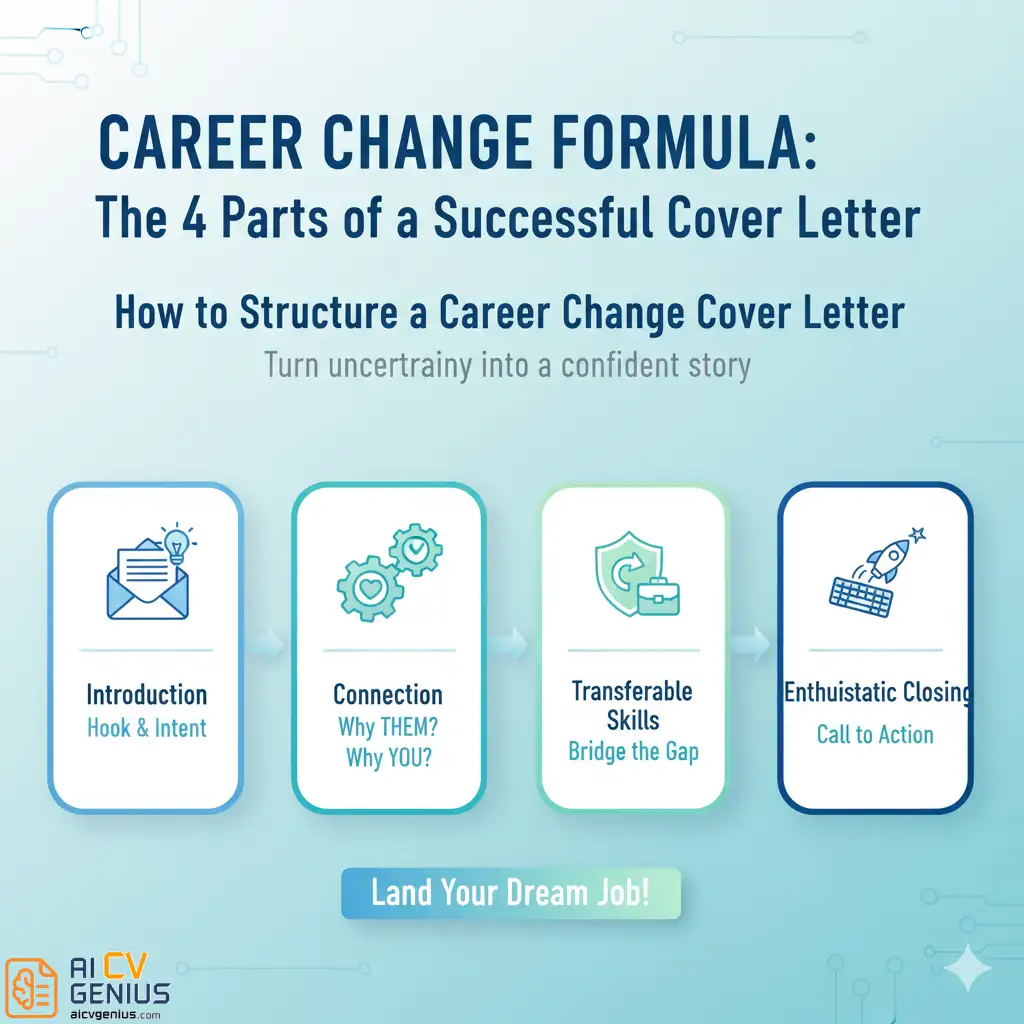
- Cover letter structure: Open with the role and excitement, explain your why, bridge 2 to 3 transferable skills with results, then show proactive learning and close with confidence.
- How to make it believable: Use one or two concrete mini-stories, name relevant tools you are learning, and tailor examples by target role like IT support, QA, web dev, or data.
- ATS and polish: Keep it one page, use clean formatting, avoid keyword stuffing, and pair the letter with an IT-ready resume that puts skills, projects, and certifications near the top.
The Truth About Switching Careers to IT: Your Past is Your Power
Breaking into the Information Technology (IT) sector can feel like trying to enter a fortress if your background isn’t strictly technical. The jargon seems dense, the skills demanding, and the competition fierce. Yet, in 2026, this perception is increasingly outdated. Thousands of professionals from diverse fields – marketing, finance, healthcare, education – are successfully transitioning into fulfilling IT careers every single month. Why?
Because the tech industry has evolved. It now recognizes that mindset, adaptability, critical thinking, and diverse perspectives are just as valuable, if not more so, than pure coding proficiency acquired over decades. Your career change cover letter and resume aren’t just procedural documents; they are your strategic narrative tools. They represent your opportunity to showcase not just technical aptitude acquired through recent learning, but also the invaluable curiosity, logical reasoning, resilience, and courage cultivated throughout your entire professional journey. This isn’t merely about listing past jobs; it’s about articulating why you are making this deliberate move and how your unique blend of experiences positions you for success in this dynamic field.
“You’re not late to the tech revolution – you’re arriving precisely on time, equipped with a wealth of experiences that lifelong tech insiders simply don’t possess.”
This guide will deconstruct how to craft that compelling narrative, focusing on transforming perceived disadvantages into unique strengths and building a bridge between your past accomplishments and your future potential in IT.
Decoding the IT Hiring Manager’s Mindset: Beyond the Code
When IT recruiters, technical leads, or hiring managers review a career-change application, they are performing a multifaceted evaluation that goes far beyond checking for specific programming languages or years spent in a similar role. They are assessing potential, predicting adaptability, and gauging cultural fit. Specifically, they are scanning for compelling evidence of three core attributes:
- ✅ A Clear and Compelling Rationale for the Transition: They need to understand the why behind your decision. Is it driven by genuine interest, a logical evolution of your skills, or simply a desire for higher pay? A narrative rooted in curiosity, passion for problem-solving, or a desire to leverage technology for greater impact resonates far more strongly than one based purely on circumstance. Your cover letter is the prime space to articulate this motivation authentically.
- ✅ Demonstrable Transferable Skills Bridging Past and Future: This is where strategic reframing is crucial. Identify skills from your previous roles – project management, customer communication, analytical thinking, process optimization, stakeholder management – and explicitly connect them to the requirements of the target IT role. Show, don’t just tell, how your experience in a seemingly unrelated field has equipped you with foundational competencies vital in tech.
- ✅ Tangible Evidence of Commitment and Proactive Learning: Making a career change requires effort. Hiring managers want to see proof that you’ve invested time and energy into acquiring relevant knowledge and skills. This includes mentioning specific online courses (Coursera, Udemy, Google Certificates), personal projects (GitHub repositories, personal websites, small apps), industry certifications (CompTIA, AWS, Azure basics), or even volunteer IT work. This demonstrates initiative and mitigates concerns about your learning curve.
Crucially, you don’t need to position yourself as a direct competitor to seasoned developers or engineers with decades of experience. Your unique value proposition lies in the combination of your established professional skills and your newly acquired technical knowledge. Frame your application to highlight that your foundation is solid, your learning trajectory is steep, and your diverse background brings a fresh, valuable perspective to their team.
Architecting Your Narrative: Structure for a Career Change IT Cover Letter
A well-structured cover letter guides the reader logically, making your transition story clear and persuasive. Think of it as designing an intuitive user interface for your career change.
| Section | Purpose & Content Guidance |
|---|---|
| Header & Greeting | Standard professional format: Your contact info, date, recipient details. Personalize the greeting (“Dear [Hiring Manager Name],”) whenever possible. |
| Opening Paragraph: Enthusiasm & Intent | Clearly state the specific IT role you’re applying for and where you saw it advertised. Immediately express genuine enthusiasm for this transition and the company. Briefly acknowledge your background and frame the pivot positively. |
| Connection Paragraph: The ‘Why’ | Explain your motivation for moving into IT. Share a brief, authentic story or insight that sparked your interest – perhaps a specific project, a realization about technology’s impact, or a desire to apply your problem-solving skills in a new domain. Connect this ‘why’ to the company’s mission or the specific role’s challenges. |
| Transferable Skills Paragraph(s): Bridging the Gap | This is the core. Select 2-3 key transferable skills from your previous career (e.g., project management, data analysis, client communication, process improvement) that directly align with the IT job description. Provide specific, concise examples demonstrating these skills in action, ideally with quantifiable results. Explicitly state how these skills are relevant to the target IT role. |
| Proactive Learning Paragraph: Demonstrating Commitment | Showcase your recent efforts to acquire IT-specific knowledge. Mention relevant certifications (CompTIA, Google IT Support), online courses (Coursera, Udemy), personal projects (GitHub links, website builds), or technical tools you’ve started learning (Python basics, SQL, specific software). Frame this as evidence of your dedication and rapid learning ability. |
| Closing Paragraph: Confidence & Call to Action | Reiterate your strong interest and confidence in your ability to contribute quickly despite the career change. Briefly summarize your unique value proposition (e.g., “combining proven project leadership with newly acquired technical skills”). Express gratitude and politely request an interview or further discussion. |
| Professional Closing | Use “Sincerely,” followed by your typed name. |
This structure allows you to address the career change proactively while keeping the focus on your future value to the employer.
Sample Cover Letter: Transitioning to IT Support
This example demonstrates how to blend past experience with new skills and motivation.
[Your Name]
[Your Contact Information][Date]
[Hiring Manager Name & Title]
[Company Name & Address]Dear [Mr./Ms./Mx. Last Name or Hiring Manager],
I am writing with immense enthusiasm to express my interest in the Junior IT Support Specialist position at Horizon Tech, as advertised on [Platform]. After five years excelling in client-facing project coordination and customer service roles, I have developed the robust problem-solving, clear communication, and adaptability skills essential for thriving in fast-paced technical support environments. My recent completion of Google’s IT Support Professional Certificate has solidified my passion for leveraging technology to empower users and streamline operations.
In my previous role at [Previous Company], I consistently served as the go-to resource for troubleshooting software issues and improving team workflows. For instance, I independently identified recurring data entry errors and built small automation scripts in Python to simplify tracking, reducing manual processing time by approximately 15%. These experiences confirmed my enjoyment of logical puzzle-solving and my ability to translate technical concepts into user-friendly solutions – skills directly applicable to providing effective IT support.
My background managing cross-functional projects has provided me with a unique perspective on understanding both end-user needs and broader operational goals. I am confident this blend of client empathy and systematic thinking will enable me to quickly become a valuable member of your IT team, contributing to smoother operations and enhanced user satisfaction.
Thank you for considering my application. I have attached my resume for further detail and would appreciate the opportunity to discuss how my transition into IT can bring fresh energy, proven reliability, and a strong commitment to learning to Horizon Tech.
Sincerely,
Jordan Lee
This letter is concise (under 300 words), confident without being arrogant, and genuinely human. It successfully connects the dots between past roles and future potential, addressing the career change directly and positively.
Tailoring Your Narrative: Adapting the Example for Different IT Roles
The core structure remains the same, but the specific skills and examples you highlight must change based on the target role. Always analyze the job description first, identifying the top 3-4 required competencies.
- Target Role: Software Tester / QA Analyst
- Replace “IT Support” with “Software Tester” or “QA Analyst”.
- Emphasize: Attention to detail, systematic thinking, documentation skills (from reports, procedures), communication (reporting bugs clearly).
- Transferable Skill Example: “My experience meticulously reviewing contracts for errors at [Previous Company] developed the keen attention to detail essential for effective software testing.”
- Learning Example: Mention courses on testing methodologies (ISTQB basics) or experience with bug tracking tools (Jira basics).
- Target Role: Junior Web Developer
- Replace “IT Support” with “Junior Web Developer”.
- Emphasize: Problem-solving, creativity (from design, marketing), project management (meeting deadlines), logical thinking.
- Transferable Skill Example: “Managing marketing campaigns required constant iteration and A/B testing, honing the analytical and adaptive mindset needed for web development.”
- Learning Example: Mention specific languages/frameworks learned (HTML, CSS, JavaScript, React basics), link to GitHub projects or a personal portfolio website.
- Target Role: Data Analyst
- Replace “IT Support” with “Data Analyst” or “Junior Data Analyst”.
- Emphasize: Analytical thinking (from finance, research, operations), attention to detail, communication (presenting findings), proficiency with relevant tools (Excel advanced features).
- Transferable Skill Example: “My background in financial analysis involved identifying trends and presenting complex data to stakeholders, skills directly applicable to data storytelling in an analyst role.”
- Learning Example: Mention courses in SQL, Python (Pandas), data visualization tools (Tableau, Power BI basics), or relevant statistical concepts.
Remember, tailoring isn’t just changing the job title; it’s about strategically selecting and framing your experiences to resonate with the specific demands of the new role.
Key Skills and Assets for Your Transition
Almost every professional role develops skills valuable in IT. Understanding how to identify, frame, and present these assets is crucial for a successful transition.
Identifying Your Arsenal: Key Transferable Skills for IT
Reflect on your past experiences and identify concrete examples of:
| Skill From Your Past Career | How It Applies Directly to IT Roles |
|---|---|
| Project Management / Coordination | Managing timelines, resources, deliverables, stakeholder communication, risk assessment (vital for IT projects, support coordination, development sprints). |
| Customer Service / Client Relations | Understanding user needs, active listening, empathetic problem resolution, clear communication, managing expectations (essential for helpdesk, support, UX, business analysis). |
| Financial Analysis / Operations Management | Process optimization, logical systems thinking, data analysis, identifying inefficiencies, budget awareness (relevant for systems analysis, data analytics, IT operations). |
| Marketing / Content Creation / Design | Understanding digital tools, creative problem-solving, user experience (UX) awareness, data interpretation (A/B testing), communication strategy (valuable for web dev, UX/UI, digital transformation roles). |
| Education / Training / Teaching | Explaining complex concepts simply, creating clear documentation, user training, patience, adapting communication styles (useful for IT support, training roles, technical writing). |
| Research / Data Entry / Administration | Attention to detail, accuracy, data organization, following procedures meticulously, identifying patterns (foundational for QA testing, data analysis, database administration). |
The key is not just listing the skill, but briefly illustrating how you used it and what the positive outcome was.
Addressing the Elephant in the Room: No Direct IT Experience
Honesty combined with proactivity is the most effective strategy. Acknowledge your transition openly but immediately pivot to demonstrate the concrete steps you’ve taken to bridge the knowledge gap. Employers respect initiative far more than inflated claims.
Effective Phrasing Examples:
“While my professional background is primarily in [Previous Field], I have proactively immersed myself in building foundational IT knowledge over the past year. I am currently completing a CompTIA A+ certification to solidify my understanding of hardware, software, and networking principles. Concurrently, I’ve applied these learnings by building a small personal website using HTML and CSS, which has reinforced my appreciation for logical structure and user-centric design.”
“Recognizing the need for hands-on experience, I recently completed [Online Course, e.g., IBM Data Science Professional Certificate on Coursera], where I developed proficiency in Python for data manipulation and visualization. To apply these skills practically, I undertook a personal project analyzing [Dataset, e.g., public city transportation data] to identify usage patterns, which strengthened my analytical and problem-solving abilities.”
This approach transforms potential “inexperience” into tangible evidence of motivation, discipline, and rapid learning – qualities highly valued in the ever-evolving tech landscape.
Striking the Right Tone: Balancing Confidence and Humility
As a career changer, projecting confidence without arrogance is crucial. You don’t need to pretend to be an IT expert overnight. Instead, focus your confidence on your proven transferable skills and your demonstrable ability to learn quickly. Frame your lack of deep technical expertise not as a deficit, but as an opportunity for growth within their organization.
“In the IT field, your demonstrated willingness and capacity to learn continuously is often the most valuable transferable skill of all.”
Phrasing that balances confidence and humility:
- “I am confident that my proven ability to [Transferable Skill, e.g., manage complex projects] combined with my dedicated effort in learning [New IT Skill, e.g., SQL fundamentals] will allow me to quickly become a productive member of your team.”
- “While I recognize I have much to learn in [Specific Technical Area], my track record of mastering new systems rapidly in my previous roles gives me confidence in my ability to quickly get up to speed.”
- “I am eager to apply my foundational knowledge of [IT Concept] and contribute my perspective gained from [Previous Industry] while continuing to develop my technical expertise under experienced mentorship.”
This tone shows self-awareness, respect for the field’s complexity, and a proactive commitment to growth.
Crafting Your Message: Writing Techniques That Work
The way you express your transition story is just as important as the content itself. These techniques will help you communicate effectively and authentically.
Speaking Their Language: Incorporating Specific Tools and Keywords
Even if your proficiency is basic, mentioning specific IT tools, software, or concepts demonstrates awareness and helps your application pass initial ATS (Applicant Tracking System) scans. Review the job description carefully and incorporate relevant keywords naturally within your cover letter and resume.
Examples of keywords/tools to mention (if applicable and genuinely learned/used):
- For IT Support: “Ticketing systems (e.g., Zendesk, Jira Service Desk basics),” “Active Directory fundamentals,” “Network troubleshooting concepts,” “Remote desktop support,” “Hardware/software installation.”
- For Web Development: “HTML,” “CSS,” “JavaScript basics,” “Version control (Git fundamentals),” “Frameworks (React, Angular, Vue – mention if learning),” “Responsive design principles.”
- For Data Analysis: “SQL basics,” “Excel (Pivot Tables, VLOOKUP),” “Data visualization tools (Tableau, Power BI – mention if learning),” “Python (Pandas library basics),” “Statistical concepts.”
- For QA/Testing: “Bug tracking software (Jira, Bugzilla basics),” “Test case writing,” “Manual testing principles,” “Automation concepts (Selenium basics – mention if learning).”
Even stating “familiarity with” or “currently learning” is better than omitting relevant terms entirely. It signals your trajectory and alignment with industry standards.
Maintaining Authenticity: Keeping the Tone Human, Not Robotic
Many career changers, nervous about their transition, adopt an overly formal or stiff tone in their cover letters, hoping to sound professional. However, authenticity often resonates more strongly, especially in tech cultures that value personality and collaboration. Avoid clichés and corporate jargon; write in a clear, direct, and genuinely enthusiastic voice.
Examples of replacing clichés with authentic statements:
- Cliché: “I am a highly motivated and results-oriented fast learner passionate about technology.” (Generic and unproven)
- Authentic: “After automating a repetitive reporting task at my previous job using basic Python scripts, I discovered a genuine enjoyment for using technology to solve practical problems. This sparked my decision to pursue a career in IT, and I am eager to apply this problem-solving mindset at [Company Name].” (Specific, shows initiative, connects passion to action)
- Cliché: “My strong communication skills would be an asset to your team.” (Unsubstantiated claim)
- Authentic: “My experience presenting complex financial data to non-technical stakeholders has taught me how to translate technical details into clear, actionable insights – a skill I believe is crucial for effective IT support.” (Connects past skill to future role with a specific example)
Write like you speak (professionally, of course). Let your genuine interest and personality shine through. Hiring managers connect with real people, not just keywords.
Common Pitfalls: Mistakes to Avoid in Your IT Career Change Cover Letter
Steer clear of these common errors that can undermine your application:
| ❌ Mistake | ✅ Fix |
|---|---|
| Sounding Apologetic or Defensive: Over-explaining or justifying your lack of direct IT experience. | Frame your transition confidently. Focus on transferable skills, proactive learning, and future potential. Own your unique path. |
| Using Generic Templates Without Customization: Sending the same cover letter to multiple companies. | Tailor each letter. Mention the specific company name, reference their mission or values, and align your skills explicitly with their job description. |
| Making it Too Long or Rambling: Exceeding one page or including irrelevant details about past roles. | Keep it concise and focused, ideally under 300-400 words. Every sentence should serve the purpose of bridging your past to their future needs. Respect the reader’s time. |
| Focusing Only on Technical Skills (or Lack Thereof): Ignoring the crucial role of soft skills like communication, teamwork, and problem-solving. | Highlight a balanced mix. Emphasize how your non-technical strengths complement your developing IT knowledge and make you a well-rounded candidate. |
| Typos and Grammatical Errors: Submitting a letter with careless mistakes. | Proofread meticulously. Use grammar/spell-check tools, read it aloud, and consider asking a trusted friend or mentor to review it. Errors signal a lack of attention to detail – critical in IT. |
Effective Phrasing: Example Sentences That Resonate
Incorporate phrases that convey motivation, adaptability, and relevant skills naturally:
- ✅ “My background in [Previous Field, e.g., customer service] has provided me with a strong foundation in understanding user needs and communicating technical solutions clearly, which I am eager to apply in an IT support context.”
- ✅ “I’ve always been drawn to troubleshooting and improving systems, which led me to proactively pursue [Certification/Course] and solidify my interest in transitioning to IT.”
- ✅ “I am excited by the opportunity to leverage my analytical skills, honed through years of [Previous Task, e.g., financial modeling], to contribute to data-driven decision-making in your Business Intelligence team.”
- ✅ “Transitioning to IT feels like a natural evolution, allowing me to combine my passion for logical problem-solving with my commitment to enhancing operational efficiency.”
- ✅ “My experience managing [Type of Project] has equipped me with the organizational rigor and cross-functional communication abilities necessary to succeed in coordinating IT projects effectively.”
These phrases connect past experiences to future aspirations in a credible and engaging way.
Showcasing Your Learning Journey: Mentioning Courses & Certifications Effectively
Simply listing certifications isn’t enough; briefly explain the value gained or skills developed. Frame them as proactive steps demonstrating your commitment.
Examples:
“My recent completion of the Google IT Support Professional Certificate provided me with foundational knowledge in system administration, network troubleshooting, and security best practices, reinforcing my readiness for a hands-on support role.”
“Through self-study and online courses on platforms like Coursera and Udemy, I have developed practical skills in Python and SQL, focusing on data manipulation and querying techniques relevant to entry-level data analysis.”
“To validate my understanding of cloud fundamentals, I am actively preparing for the AWS Certified Cloud Practitioner exam, demonstrating my commitment to staying current with industry-standard technologies.”
Optionally, pair these statements with links to relevant personal projects on GitHub or a portfolio site. This provides tangible proof of your learning application and gives recruiters something concrete to explore.

The Human Element: Beyond Technical Skills
While technical knowledge is important, your human skills and ability to connect through storytelling are what will make you memorable and relatable.
Beyond the Code: Emphasizing the Critical Role of Soft Skills in IT
The stereotype of the anti-social IT worker is long outdated. Modern IT roles are highly collaborative and user-centric. Success depends heavily on soft skills: clear communication, empathy, teamwork, patience, and the ability to translate technical jargon into plain language. As a career changer, your well-developed soft skills are often your biggest competitive advantage. Strategically highlight one or two key soft skills in your cover letter, illustrating them with a brief example:
- Communication: “My experience presenting complex project updates to diverse stakeholder groups has honed my ability to communicate technical information clearly and effectively, ensuring alignment across teams.”
- Empathy (especially for Support/UX roles): “Years spent resolving client issues in [Previous Field] taught me the importance of active listening and empathetic problem-solving – skills I believe are paramount in providing outstanding user support.”
- Teamwork/Collaboration: “I thrive in collaborative environments and consistently contributed to team goals at [Previous Company] by proactively sharing knowledge and assisting colleagues during critical deadlines.”
Balancing mentions of technical learning with demonstrations of strong soft skills presents you as a well-rounded, adaptable professional ready to integrate seamlessly into their team.
Building Connection Through Narrative: Use Storytelling to Build Trust
Facts list qualifications; stories build connection. Recruiters remember narratives better than bullet points. Weave a brief, authentic micro-story into your cover letter that illustrates your motivation or a key skill in action. This humanizes your application and makes you more memorable.
Examples of micro-stories:
“My interest in IT truly ignited when I volunteered to help my previous non-profit employer troubleshoot their network issues. Successfully restoring connectivity and seeing the immediate positive impact on operations solidified my desire to pursue a career focused on leveraging technology for efficiency.”
“While working in marketing analytics, I frequently encountered limitations with standard reporting tools. This pushed me to start learning SQL on my own time, ultimately allowing me to build custom queries that uncovered key customer insights previously missed. That experience of turning data into actionable strategy is what excites me most about the Data Analyst role at your company.”
These short, genuine moments demonstrate initiative, problem-solving, and passion far more effectively than generic statements.
Polishing Your Complete Application
Your cover letter works in tandem with your resume and overall presentation. These final elements ensure your application is as strong as possible.
Polishing Your IT Resume Alongside Your Cover Letter
Your cover letter works in tandem with your resume. While the cover letter provides narrative depth and motivation, your resume must be structured to quickly demonstrate your value to IT recruiters, even with a non-traditional background.
Key Resume Adjustments for Career Changers:
- Lead with a Skills-Based Summary: Instead of a traditional objective statement, start with a brief professional summary highlighting your career transition, key transferable skills, and recently acquired IT competencies. Example: “Customer-focused professional transitioning into IT Support with proven problem-solving abilities, strong technical aptitude, and foundational knowledge through CompTIA A+ and Google IT Support certifications. Experienced in managing high-volume client interactions and resolving complex issues efficiently.”
- Create a ‘Technical Skills’ Section: Prominently display newly acquired IT skills near the top: operating systems (Windows, Linux), networking basics (TCP/IP, DNS), software/tools (Active Directory, ticketing systems), scripting languages (Python basics), hardware knowledge, and any relevant certifications. This immediately signals your technical readiness.
- Reframe Previous Roles: In your work experience section, highlight responsibilities and achievements that align with IT functions. Instead of generic job duties, emphasize: troubleshooting, process optimization, data analysis, system usage, technical communication, project coordination, or training peers on software tools. Use action verbs and quantify results whenever possible.
- Add a ‘Projects & Certifications’ Section: Dedicate space to showcase personal tech projects (e.g., “Built a personal website using HTML/CSS,” “Configured a home network lab with pfSense firewall,” “Automated data entry tasks using Python scripts”). List all relevant certifications prominently (CompTIA A+, Network+, Security+, Google IT Support, Microsoft Azure Fundamentals, etc.).
- Optimize for ATS: Ensure your resume includes keywords from the job description, uses standard section headings (e.g., “Experience,” “Skills,” “Education”), and is saved as a simple, ATS-friendly format (PDF or Word). Avoid excessive formatting, images, or unconventional layouts that might confuse applicant tracking systems.
Your resume should function as a scannable, keyword-rich snapshot of your qualifications, while your cover letter provides the compelling story and emotional connection.
Real Story: From Administrative Assistant to IT Analyst
Rachel worked as an administrative assistant for six years, primarily managing schedules, coordinating meetings, and preparing reports. However, she often found herself naturally gravitating towards fixing colleagues’ computer issues, optimizing spreadsheet formulas, and identifying inefficiencies in digital workflows.
Recognizing this pattern, she started dedicating her weekends to learning Python and SQL through online courses. When an entry-level IT Analyst role opened internally, she applied. Her cover letter didn’t hide her admin background. Instead, it highlighted her proven organizational skills, her knack for improving processes (with a specific example of streamlining report generation using Excel macros), and her recent Python/SQL learning. She framed her transition as a natural evolution towards leveraging her analytical mindset more formally.
Her hiring manager later shared, “We had candidates with more direct IT experience, but Rachel’s cover letter showed exceptional clarity, initiative, and a practical understanding of how technology impacts everyday work. We didn’t hire her solely for the technical skills she already had – we hired her for her demonstrated ability to think critically and learn quickly.”
“Curiosity and initiative create opportunities – often long before formal credentials do.”
Rachel’s story underscores that a compelling narrative focused on transferable skills and proactive learning can be more persuasive than a simple list of technical qualifications.
Final Polish: Formatting for Readability and Professionalism
Even the best content can be undermined by poor presentation. Ensure your cover letter looks clean, professional, and is easy to scan quickly.
- ✅ Length: Keep it concise – strictly one page, aiming for 250–400 words. Respect the reader’s time.
- ✅ Font: Use a standard, professional font like Arial, Calibri, Inter, or Roboto, size 10.5–12 points. Consistency is key.
- ✅ Spacing: Use single spacing within paragraphs and a double space between paragraphs and sections. Ensure adequate white space (margins of ~1 inch).
- ✅ File Format: Always save and submit as a PDF to preserve formatting perfectly across all devices.
- ✅ File Naming: Use a clear, professional file name: “FirstName_LastName_CoverLetter_[CompanyName].pdf”.
- ✅ Personalization: Address the letter to a specific person (Hiring Manager name) whenever possible. Research on LinkedIn or the company website. “Dear Hiring Manager” is acceptable if the name isn’t available.
- ✅ Proofread Meticulously: Typos and grammatical errors are unprofessional and suggest a lack of attention to detail. Proofread it aloud, use spell-check/grammar tools, and consider asking someone else to review it.
A polished format signals professionalism and makes your compelling content easier to absorb.
The Complete Career Change Resume Example (IT Support)
Here is a full, practical resume example for “Jordan Lee,” the candidate from the cover letter sample. It demonstrates how to reframe past experience and highlight new skills. It is formatted using the requested HTML/inline-CSS style (with no subheadings inside the example) for direct use in the Classic Editor.
JORDAN LEE
IT Support Specialist
New York, NY 10001 | (555) 555-1212 | jordan.lee.tech@email.com | linkedin.com/in/jordanleetech
PROFESSIONAL SUMMARY
Proactive and client-focused professional transitioning from project coordination to IT Support. Combines 5+ years of experience in high-pressure customer service and process optimization with newly acquired technical knowledge certified by the Google IT Support Professional Certificate. Proven ability to troubleshoot complex issues, communicate technical concepts to non-technical users, and learn new systems quickly. Eager to apply a strong problem-solving mindset to enhance user satisfaction and support operational goals.
TECHNICAL SKILLS
|
|
PROFESSIONAL EXPERIENCE
Senior Project Coordinator | Alpha Marketing Solutions | New York, NY (2020 – Present)
- Served as the primary technical point of contact for a 15-person team, troubleshooting software issues related to CRM and project management tools, and escalating to IT as needed.
- Developed and documented new digital workflows, training 10+ new hires on software best practices and reducing onboarding time by 20%.
- Identified data entry inefficiencies and automated a repetitive reporting task using a basic Python script, reducing manual data processing by 15% weekly.
- Managed communications for 5+ cross-functional projects, translating client requirements into technical specifications for the design and web teams.
Client Services Specialist | Global Logistics Inc. | New York, NY (2018 – 2020)
- Resolved 50+ client inquiries daily via phone and email, consistently maintaining a 95% positive feedback score for communication and problem-solving.
- Mastered a proprietary logistics tracking system within two weeks and trained three colleagues on its advanced functions.
- Created and maintained a knowledge base of common issues and solutions, reducing average ticket resolution time for the team.
CERTIFICATIONS & EDUCATION
- Google IT Support Professional Certificate | Coursera (2025)
- CompTIA A+ Certification | (In Progress, expected 2026)
- Bachelor of Arts in Communications | New York University | New York, NY (2018)
Final Thoughts: Your Bridge to the Future
Your career change cover letter serves as your essential translation guide – it skillfully connects the professional you have been with the IT professional you are becoming. It doesn’t need to sound flawless or boast encyclopedic technical knowledge; it needs to sound intentional, authentic, and driven. Showcase that you aren’t merely escaping your past career – you are strategically carrying forward its most valuable lessons, now reshaped and enhanced for the dynamic world of technology.
Frame your journey not as a detour, but as a deliberate evolution. Because ultimately, in the rapidly changing landscape of IT, progress isn’t solely defined by where you started or how long you’ve been coding. It’s fundamentally about demonstrating your capacity to keep moving forward – thoughtfully, confidently, resiliently, and always embracing the next learning opportunity.