

- What the interviewer is really asking: Alignment between your goals and what the company can realistically offer.
- Answer structure that sounds grounded: Start with this role, then deeper expertise, then broader impact.
- Make it fit the job: Describe growth that follows the role’s path and focuses on contribution, not titles.
- Avoid common mistakes: Stay specific, skip unrealistic leaps, and don’t make it all about you.
- If you are unsure about 5 years: Emphasize learning, adaptability, and a clear 60–90 second direction.
There are certain interview questions that seem simple on the surface, yet they carry disproportionate weight.
“Where do you see yourself in five years?” is perhaps the most famous one.
It is a conversational minefield. Answer with too much ambition, and you risk sounding arrogant or untethered from reality. Answer with too much modesty, and you can appear unmotivated or lacking direction. And the worst answer, “I don’t know,” suggests you have not thought about your own career, so why should they?
This question is not a riddle. It is a strategic inquiry into your motivation and self-awareness. This guide will help you craft an answer that is simultaneously ambitious, realistic, and perfectly aligned with the role you are seeking.
Understanding the “5-Year” Question
What Interviewers Really Want to Know
This question is not about your psychic abilities. It is a sophisticated test of alignment.
The recruiter is trying to discover:
- ✅ Ambition & Motivation: Do you have a drive to grow, or are you just looking for a placeholder job?
- ✅ Alignment: Do your personal growth goals match the opportunities this company can realistically provide? (This is a huge factor in long-term retention.)
- ✅ Realism: Are your goals grounded? Do you understand what it actually takes to get there?
They are evaluating fit and consistency. If you are applying for a junior data analyst role but say your five-year plan is to be CEO, it shows a fundamental misunderstanding of the career path.
But if you say, “I plan to master the data analytics stack and eventually grow into a senior analyst role where I can mentor others,” you sound focused, motivated, and like a solid investment.
The Psychology Behind a Good Answer
This question helps interviewers assess your long-term thinking. They want to hire people who see this job as a career, not just a paycheck.
A calm, thoughtful answer that connects your growth to their needs signals maturity, stability, and a high potential for return on their investment in you.
Crafting Your Answer: Structure & Examples
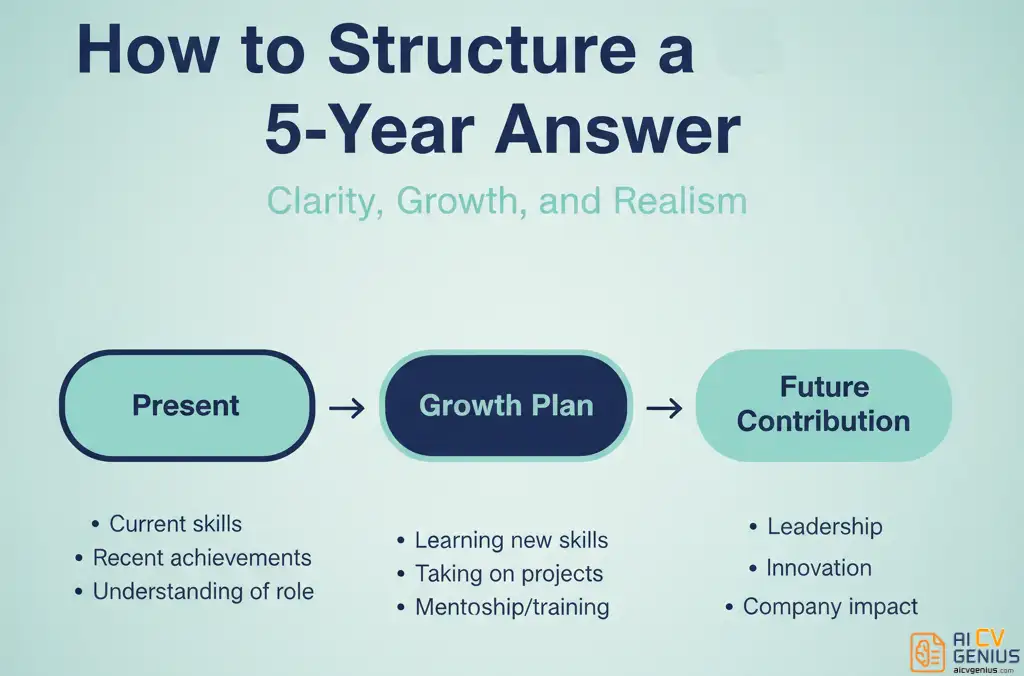
The Ideal Structure of a “5-Year” Answer
A great answer feels natural but is built on a solid structure.
- ✅ 1. Anchor in the Present: Start by reaffirming your excitement for this role. Show that you are not just seeing it as a stepping stone.
- ✅ 2. Define Your Growth: Talk about the skills you want to master and the expertise you want to gain (e.g., “I want to become a true expert in…”).
- ✅ 3. Connect to Impact: Explain how you will apply that growth to make a tangible contribution to the company (e.g., “I hope to eventually… lead complex projects / mentor new hires / improve a process.”).
This formula can be simplified to:
This Role → Deeper Expertise → Broader Impact.
Example Framework in Action
“My immediate focus is to excel in this marketing coordinator role and truly master our campaign analytics.
From there, I am eager to take on more strategic responsibility, perhaps managing larger campaigns or even helping mentor interns.
My five-year goal is to have grown into a senior role where I am using my deep understanding of our data to help guide the broader creative strategy.”
This answer works because it shows commitment to the current role, a clear path for growth, and an ambition that directly benefits the company.
Tailor Your Answer to the Role
Your answer must reflect the logical career path for the job you are applying for.
Here are examples by category:
| Job Type | Sample Direction |
|---|---|
| Administrative | “My goal is to become an indispensable part of the operations team, eventually taking on more complex projects like office management or executive-level support.” |
| Marketing | “I want to evolve from content creation to owning the full strategy for a product line, ideally managing integrated campaigns from concept to execution.” |
| IT / Tech | “I aim to deepen my technical expertise to a subject-matter expert level, possibly moving toward a lead developer role where I can architect solutions and mentor junior devs.” |
| Customer Service | “I want to become a senior advocate for our customers, perhaps moving into a team lead position or a quality assurance role to help train new representatives.” |
| Design / Creative | “I hope to grow from executing design briefs to helping define the creative direction, working with cross-functional teams to build and maintain our brand identity.” |
| Project Management | “In five years, I’d like to be managing larger, more complex, end-to-end projects and helping to refine the PM processes for the entire department.” |
Examples of Great “5-Year” Answers
Example 1 – Entry-Level Candidate
“For the next couple of years, my primary goal is to absorb as much as I can, learn from the senior team members, and become truly proficient in this role.
Within five years, I hope I’ve earned the trust to be able to take on my own projects independently and perhaps even help train the next wave of new hires.”
Example 2 – Marketing Professional
“My short-term goal is to become a true expert in our digital marketing stack and how it serves our specific customer.
In five years, I’d like to be in a more strategic position, using that expertise to analyze market trends and identify new opportunities for the brand.”
Example 3 – Career Switcher
“Since I am transitioning from teaching into HR, my immediate focus is on mastering the core functions of people operations and understanding the business.
In five years, I aim to be leveraging my background in education to help design and implement new training and development programs for the company.”
Example 4 – Managerial Path
“My five-year plan is to grow with the company. After proving my ability to deliver results, I would be excited by the opportunity to move into a leadership role, where I can focus on coaching others, removing obstacles, and helping a team succeed.”
Handling Nuances & Common Pitfalls
Common Mistakes to Avoid
- ❌ Being too vague: “I just want to be growing and learning” is a meaningless platitude.
- ❌ Being overly specific or unrealistic: “I plan to be Vice President of this division” can sound naive or arrogant.
- ❌ Being too self-focused: “I want to earn a six-figure salary” or “I want to move up quickly” makes it about you, not them.
- ❌ Dodging the question: “I haven’t really thought that far ahead” is a major red flag that signals a lack of career direction.
When You’re Not Sure of Your Future
It is perfectly acceptable not to have a rigid roadmap. In this case, frame your answer around learning and adaptability rather than specific titles.
“While I don’t have a specific title in mind, I know that my five-year goal is to be in a role where I have become a true expert in my field. I am drawn to environments where I can take on new challenges and my growth is tied to the value I can bring. I know this company values that, which is why I’m so excited about this role.”
This answer is honest but still demonstrates drive and a commitment to growth.
How to Adjust Your Tone by Personality
✅ Ambitious but grounded: Focus on mastery and expertise, not just titles.
✅ Collaborative type: Emphasize team growth and mentoring others.
✅ Creative type: Mention innovation and finding new ways to solve problems.
✅ Analytical type: Focus on process improvement and making a measurable impact.
The best answer sounds like an authentic, confident version of you.

Practice and Refine
Write down 2-3 bullet points for your answer. Then, practice saying it out loud. Do not memorize it. Rehearse it until it feels like a conversation, not a script.
Your answer should sound natural and genuine, which only comes from being comfortable with your own story.
Final Analysis, Resources & FAQs
Pros & Cons of Discussing a 5-Year Plan
| Pros | Cons |
|---|---|
| ✅ Demonstrates foresight and self-awareness. | ❌ An overly detailed plan can sound rigid and inflexible. |
| ✅ Builds trust by showing a commitment to growth. | ❌ A generic answer sounds forgettable and uninspired. |
| ✅ Helps the interviewer visualize your future at the company. | ❌ Can backfire if your stated goals do not align with the company’s path. |
Final Thoughts
“Where do you see yourself in five years?” is not a trap. It is an opportunity to articulate your ambition and demonstrate that you are a smart, long-term investment.
Your answer does not need to predict the future. It just needs to show that you have a clear vision for your own growth – and that you see that growth happening with them.
For deeper interview preparation, explore:
- STAR Method Interview Examples – for storytelling and behavioral questions.
- Career Resources – to explore interview and resume-building guides.
- Blog – for mindset and personal growth articles.