
- Core idea: A resume promises, a portfolio proves, so showing real artifacts shifts you from claims to trust.
- Who needs it: Not just designers, developers, marketers, PMs, analysts, students, and career changers all win by showing evidence.
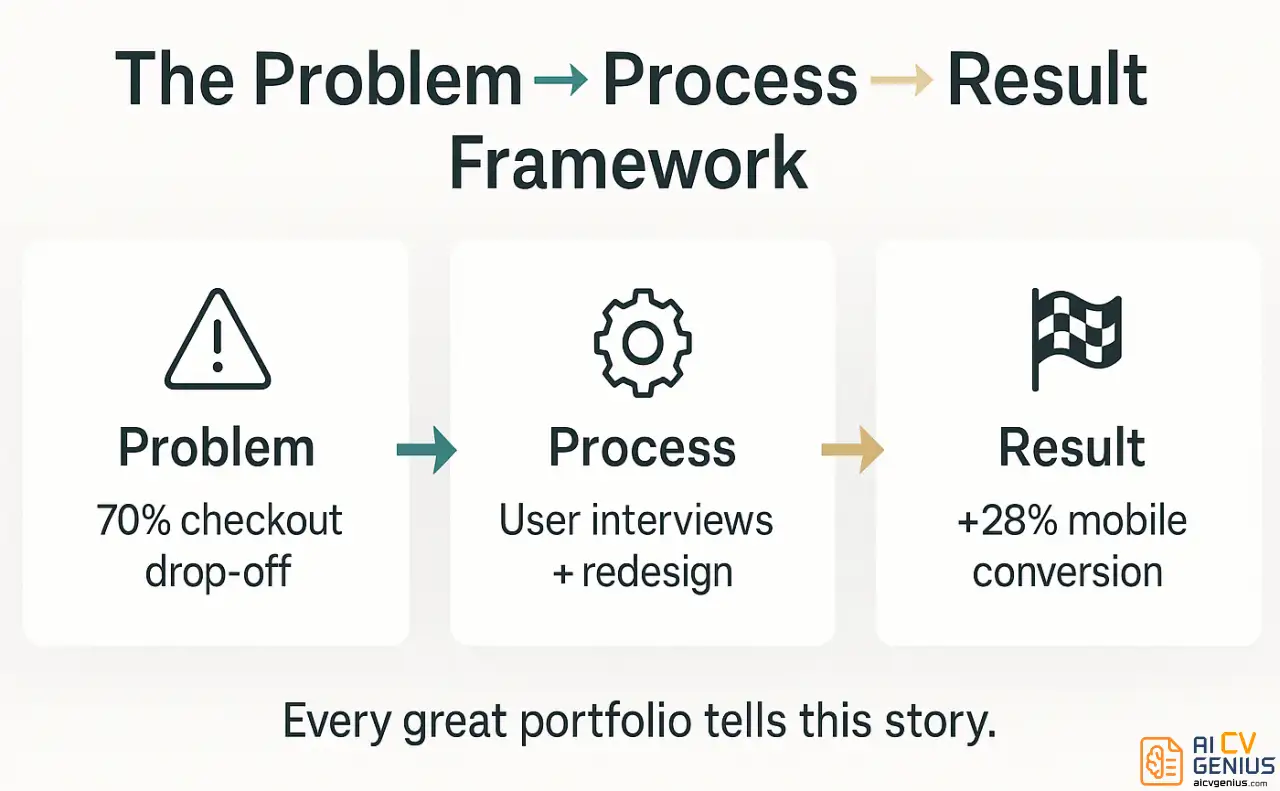
- What great portfolios do: Curate 3 to 5 projects, tell the story with Problem, Process, Result, and tie each to measurable impact.
- How to build fast: Pick a platform, create case study pages, add About and Contact, then optimize for mobile and speed.
- How to use it in hiring: Put the link in your resume header, optionally link specific projects, and avoid mistakes like no context, broken links, stale work, or NDA leaks.
You’re in an interview. You state, “In my last role, I increased user engagement by 40%.” The hiring manager nods politely, having already heard similar claims from five other candidates. Then, you say, “May I show you how?” You turn your screen and walk them through the actual campaign – the ‘before’ screenshot, the user feedback that sparked the idea, the A/B test you ran, and the final analytics dashboard showing the 40% lift. The entire energy in the room shifts. They lean in. They ask questions. You’re no longer just an applicant; you’re a problem-solver they can see in action.
That is the profound, game-changing difference between a resume and a portfolio.
Your resume makes promises. Your portfolio proves them. In a job market saturated with inflated claims and keyword-stuffed resumes, providing tangible proof is the ultimate competitive advantage.
This guide to resume portfolio examples is not just about showing you what to do; it’s about explaining why this approach works and how you can apply it, whether you’re a developer, a designer, a marketer, a project manager, or even a career changer.
The best portfolios are not digital junk drawers of everything you’ve ever done. They are meticulously curated, narrative-driven sales presentations.
They don’t just show your work; they tell a compelling story about your process, your critical thinking, your impact, and ultimately, why you are the safest and best hire.
Forget theory. This guide provides practical, step-by-step strategies and real-world examples to help you build a portfolio that doesn’t just get you remembered – it gets you hired.
What Is a Resume Portfolio (And Why It’s No Longer Optional)
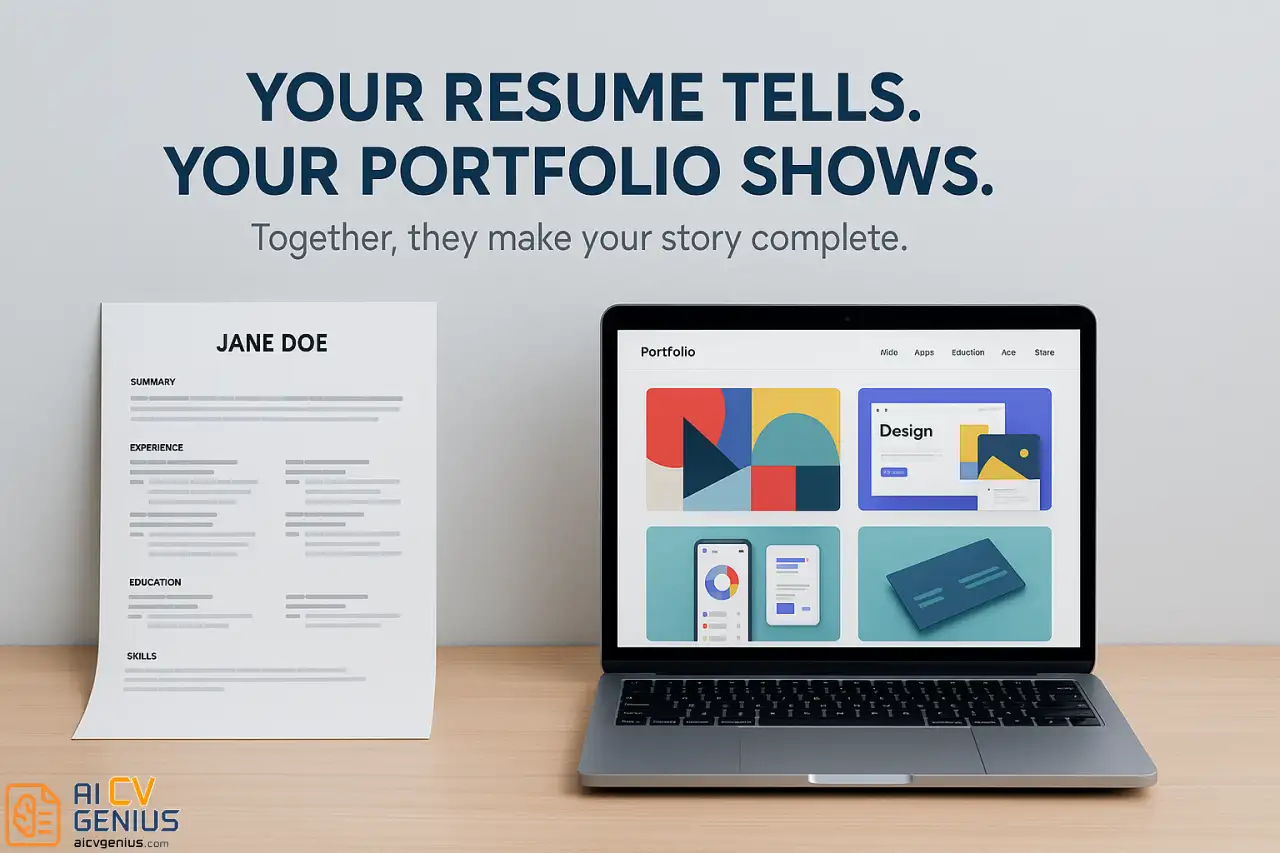
A resume portfolio is a curated, dynamic collection of your best work samples, case studies, and projects, designed to provide tangible proof of the skills and accomplishments listed on your resume. Think of it this way: your resume is the one-page advertisement, but your portfolio is the in-depth product demo. The resume gets a recruiter’s attention; the portfolio earns a hiring manager’s trust.
In the past, portfolios were considered mandatory only for “creative” roles like graphic design or photography. This is a dangerously outdated assumption. Today, in any role where the output of your work can be shown, demonstrated, or explained, a portfolio provides a massive, undeniable advantage. It transforms abstract claims (“strong leadership skills”) into concrete evidence (“Here is the project plan, communication dashboard, and post-mortem from the team project I led”).
Who Benefits Most From a Resume Portfolio? (Hint: Probably You)
While the format varies, the strategic advantage applies across numerous fields. If you fall into one of these categories, a portfolio is no longer optional – it’s essential.
- ✅ Developers & Tech Professionals: To show live projects, clean code on GitHub, system architecture diagrams, and problem-solving processes. Recruiters want to see how you build, not just what languages you list.
- ✅ Designers (UX/UI, Graphic, Product): To display visual work, wireframes, user research, prototypes, and the story behind your design choices.
- ✅ Writers, Content Creators & Marketers: To prove writing skill with published articles, demonstrate strategy with case studies, and show impact with campaign results (e.g., “This blog post series generated 50K views and 2K new leads”).
- ✅ Project/Program Managers: To showcase project plans, risk assessment registers, stakeholder communication templates, and post-project reports. It proves you’re organized and methodological.
- ✅ Data Analysts/Scientists: To present interactive dashboards (e.g., in Tableau Public), reports, data visualizations, and walkthroughs of your analysis (e.g., in a Jupyter Notebook).
- ✅ Students & Entry-Level Candidates: To demonstrate potential and passion through school projects, volunteer campaigns, and spec work. It’s the ultimate proof that you can do the job, even without “real world” experience.
- ✅ Career Changers: This is perhaps the most critical group. A portfolio is your bridge. It allows you to prove your new skills and show how your “irrelevant” past experience directly translates.
The common thread is evidence. If your job involves creating anything – code, designs, words, strategies, plans, or analyses – you need a portfolio to show it. This guide on how to make a resume portfolio will give you the framework.
5 Powerful Resume Portfolio Examples That Win Interviews
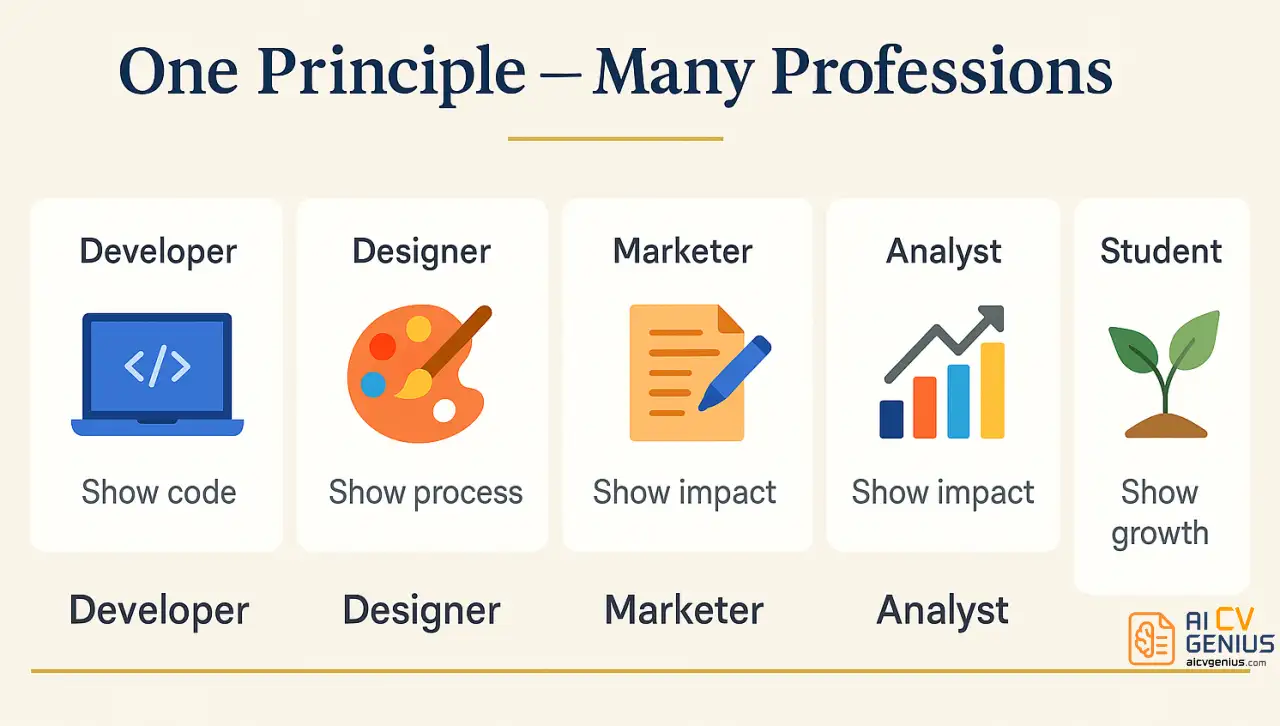
Let’s dissect five resume portfolio examples from different fields. We’ll analyze why they are effective and what principles you can steal for your own.
Example 1: The Software Developer Portfolio
The Candidate: Sarah, a frontend developer with 2 years of experience.
Platform: A simple, clean personal website (built with Gatsby) that links prominently to her GitHub profile.
️The Portfolio: Her homepage features three “Capstone Projects.” Each project has its own page with:
- A Live Demo Link: The user can immediately interact with the running application.
- A GitHub Repo Link: The technical recruiter can inspect her code quality, commit history, and documentation.
- A “Project Deep Dive” Case Study: This is the key. She uses the Problem-Process-Result framework.
- Problem: “My local rock-climbing gym was using a paper-based system to track climbing routes. This was inefficient and offered no data for the setters.”
- Process: “I built a full-stack MERN (Mongo, Express, React, Node.js) application from scratch. I interviewed 5 climbers and 2 route-setters to define user stories. I designed the component architecture in Figma, built the REST API, and deployed the app on Heroku.”
- Result: “The app is now in beta testing at the gym, tracking over 200 routes. Setters can now see which routes are ‘most popular’ based on user logs, helping them design better-balanced walls.”
✅What Makes This Work:
- It Shows, Doesn’t Just Tell: The live demo is immediate, undeniable proof of skill.
- It Caters to Two Audiences: The live demo impresses the non-technical hiring manager, while the GitHub repo satisfies the technical lead.
- The Case Study Shows Thinking: The “Problem-Process-Result” format proves she’s not just a “code monkey.” She understands user needs and builds solutions, not just features.
️Key Takeaway: A developer portfolio must show working code and clean code. But the magic ingredient is the case study that explains your thought process.
Example 2: The UX/UI Designer Portfolio
The Candidate: Marcus, a UX/UI designer.
Platform: A highly visual, grid-based website (built on Squarespace).
️The Portfolio: Marcus showcases 4-5 major projects. When a recruiter clicks one (e.g., “E-commerce Checkout Redesign”), they don’t just see the final beautiful screen. They see a long, scrollable case study that includes:
- The Challenge & My Role: “The client’s mobile checkout had a 70% cart abandonment rate. My role was Lead UX/UI Designer.”
- Research & Discovery: Photos of user personas, journey maps, and key insights from user interviews (“Users felt ‘tricked’ by hidden shipping fees.”).
- Ideation & Design: Low-fidelity wireframes (sketches), high-fidelity prototypes (Figma), and user testing feedback (“Testing revealed confusion around the ‘Apply Coupon’ button.”).
- The Solution: A side-by-side “Before” and “After” GIF of the flow, and a link to the interactive Figma prototype.
- The Impact: “The new, transparent one-page checkout flow reduced abandonment by 30% and increased mobile conversions by 12% in the first quarter.”
✅What Makes This Work:
- It’s a Masterclass in Storytelling: The recruiter goes on a journey from a messy problem to a beautiful, effective solution.
- It Highlights Process, Not Just Polish: Showing sketches and wireframes proves he follows a rigorous design process. It builds trust.
- It’s Data-Driven: Using metrics (70% abandonment, 30% reduction) elevates him from a “pixel-pusher” to a “business-problem-solver.”
️Key Takeaway: For designers, your portfolio is the interview. Show your thinking, your research, and your impact. The final design is just the punchline.
Example 3: The Content Writer & Marketer Portfolio
The Candidate: Jessica, a B2B SaaS content marketer.
Platform: A clean, professional WordPress website with a “Portfolio” section.
️The Portfolio: Her portfolio is not a list of links. It’s organized by skill and impact.
- Category 1: SEO & Organic Growth. Project: “The Ultimate Guide to X.” Context: “This 3,500-word pillar page was created to capture the top-of-funnel keyword ‘…'” Result: “Ranked #1 on Google in 4 months, generating over 10,000 organic visits/month and 200+ new leads.”
- Category 2: Lead Generation & Nurturing. Project: “XYZ Product Launch.” Context: “Wrote a 5-part email nurture sequence for a new product launch.” Result: “The sequence had a 35% open rate and a 4.5% click-to-conversion rate, resulting in $50K in new pipeline.”
- Category 3: Thought Leadership. Project: “Ghostwritten Article for CEO.” Context: “Ghostwrote this article on [Topic] for our CEO, placed in [Industry Publication].” Result: “Article was shared 1,000+ times on LinkedIn, establishing our CEO as a key voice in the space.”
✅What Makes This Work:
- It’s Organized by Business Goal: She organizes by “SEO,” “Lead Gen,” etc. This shows she understands why content is created, not just what it is.
- It’s Packed with Metrics: Every single example is tied to a business metric (traffic, leads, pipeline, shares).
- It Shows Range: She includes long-form blogs, short-form email, and persuasive thought leadership.
️Key Takeaway: A writer’s portfolio must prove their writing works. Connect your words to tangible business results. Show the strategy, not just the final article.
Example 4: The Student / Entry-Level Portfolio
The Candidate: David, a recent marketing graduate with no “real” corporate experience.
Platform: A simple, free Wix website.
️The Portfolio: David proves potential by creating experience.
- Project 1: Class Project (Framed as Pro Work). Title: “Building a Go-To-Market Strategy for a Fictional SaaS App.” Case Study: “For my capstone marketing class, our team was tasked with…” He includes the full presentation deck, the market research, and the sample ad creative.
- Project 2: Volunteer Work (Treated as a Real Job). Title: “Nonprofit Social Media Campaign.” Context: “I volunteered to run the ‘Paws & Claws’ animal shelter’s Instagram for 3 months.” Process: “Analyzed their old posts, created a content calendar, and ran a ‘Pet of the Week’ adoption campaign.” Result: “Grew their following from 250 to 1,100, and 12 dogs were adopted directly from the campaign.”
- Project 3: Spec Work (To Show a Skill). Title: “An Unsolicited SEO Audit for a Local Coffee Shop.” Context: “I love ‘The Daily Grind’ coffee shop, but their website gets no traffic. I did a 5-page SEO audit to show how they could improve.” (He includes the audit as a PDF).
✅What Makes This Work:
- It Shows Incredible Initiative: He didn’t wait for experience; he created it. The spec project alone is a huge green flag for a hiring manager.
- It Proves Real-World Skills: The nonprofit project has real metrics. This is now more valuable than many “intern” experiences.
- It’s Professionally Framed: He treats his schoolwork like a professional case study, showing he’s ready for a real-world environment.
️Key Takeaway: This is the perfect resume portfolio for students. Don’t say you’re “passionate” or a “hard worker.” Prove it by doing the work, even if unpaid. If you’re changing careers, this advice is doubly true. Check out our guide on how to position yourself during a career change.
Example 5: The Career Changer Portfolio
The Candidate: Rachel, transitioning from K-12 Teacher to Corporate Instructional Designer.
Platform: A clean WordPress website using a simple theme.
️The Portfolio: Her portfolio is a “translation” tool, showing how her old skills apply to the new role.
- The “About Me” Page is Key: It tells her story. “For 8 years as a high school English teacher, my job wasn’t just teaching Shakespeare. It was designing engaging learning experiences, managing 150+ stakeholders (students and parents), and creating measurable assessments. I’m now leveraging that deep experience in pedagogy and curriculum design as an Instructional Designer.”
- Project 1: “The Translation.” Title: “High School Curriculum vs. Corporate Learning Module.” She shows a lesson plan she built as a teacher side-by-side with a corporate-style module she built in Articulate Storyline, showing how the learning objectives (ADDIE model) are identical.
- Project 2: “The New Skill.” Title: “E-Learning Module: New Hire Onboarding.” A spec project she built from scratch in Articulate 360, complete with quizzes and interactive elements, to prove she mastered the industry-standard tools.
✅What Makes This Work:
- It Connects the Dots: She doesn’t make the recruiter guess how teaching translates. She explicitly shows them, side-by-side.
- It Addresses the “Tools” Gap: She proves she can use the specific software (Articulate) that the new job requires.
- The Narrative is Confident: Her “About” page reframes her as an experienced learning expert, not an entry-level beginner.
️Key Takeaway: For career changers, your portfolio is your single most powerful tool. It builds a bridge from your past to your future and proves you’re ready for the new role on day one.
How to Build Your Own Resume Portfolio (A Step-by-Step Guide)
Inspired by the examples? Good. Now let’s build yours. This is a practical, step-by-step process that works for any industry.
Step 1: Choose Your Platform (The “Where”)
Your platform choice sends a signal. Choose one that aligns with your industry and technical comfort.
| Platform | Best For | Cost | Ease of Use | Strategic Note |
|---|---|---|---|---|
| GitHub Pages | Developers, Data Scientists | Free | Requires coding (Markdown/HTML) | Using it is a demonstration of your technical skill. |
| Behance / Dribbble | Designers, Visual Artists | Free | Very Easy | Great for community and exposure, but less customizable. |
| WordPress.org | Writers, Marketers, Generalists | Low Cost ($5-15/mo) | Moderate (Steeper learning curve) | The most powerful and customizable long-term option. You own it. |
| Wix / Squarespace | Non-technical users, Creatives | Medium Cost ($15-25/mo) | Very Easy (Drag & Drop) | Fastest way to a beautiful, custom-looking site. |
| Notion | All Fields (Quick & Easy) | Free | Very Easy | Incredible for a clean, fast, “no-code” portfolio. Highly recommended. |
| Medium / Substack | Writers, Thought Leaders | Free | Very Easy | Choose a simple, professional template. Don’t let flashy design distract from your work. The goal is clarity and speed. |
Step 2: Curate Your Projects (The “What”)
This is the most important strategic step.
Do not show everything. Your portfolio is a curated gallery, not a storage unit. Quality over quantity, always.
The “Rule of 3-5”: Select your best 3-5 projects. That’s it. A recruiter will only look at 1-2. Make sure they are your strongest.
How to choose what to include in your resume portfolio:
- ✅ Most Relevant: Pick projects that use the exact skills the job you want is asking for.
- ✅ Most Impressive Results: Pick the project that has the best, most quantifiable outcome (e.g., the “30% conversion lift”).
- ✅ Most Comprehensive Process: Pick the project that best shows how you think – one with research, challenges, and a smart solution.
- ✅ Most Recent: Prioritize work from the last 2-3 years. If your best work is older, present it as a “foundational case study.”
If you have no projects, create them now (see the Student Example). Volunteer for a nonprofit, do a spec project, or find a small business and offer to help for free. A portfolio with 2 projects is infinitely better than one with zero.
Step 3: Structure Your Portfolio (The “How”)
Don’t make recruiters hunt for information. A clear structure is non-negotiable. Every good portfolio needs these four pages:
1. Homepage (Your Lobby)
- A clear, bold headline: This is your “Professional Thesis.” Instead of a generic label, state your mission.
- Instead of: “I am a Product Designer.”
- Try: “I am a Product Designer who believes complex technology should feel simple and intuitive.”
- Your “best of” reel: Visual links to your 3-5 curated projects.
- A clear call-to-action button: “View My Work” or “Get In Touch.”
2. Work / Projects Page (The Gallery)
- A grid of all your curated projects (3-5+).
- Each project should have a clear image, a strong title, and a 1-sentence description.
- Clicking a project must lead to its unique Case Study page.
3. About Page (Your Story & Proof)
- This is not your resume summary. This is your professional narrative.
- Expand on your “Thesis”: Explain why you do what you do. What’s your philosophy? Your process?
- Add Testimonials (Social Proof): Let others build trust for you. Include 2-3 genuine quotes from former managers, clients, or colleagues. Pro-Tip: Don’t just ask for a “testimonial”; ask specific questions like, “What was the biggest challenge we solved together?”
- A professional headshot.
- A clear link to download your resume (as a PDF).
4. Contact Page (The Exit)
- A simple, clean page.
- A link to your LinkedIn profile.
- Your professional email address (written out, so they can copy it).
- A simple “Get In Touch” contact form (optional).
Step 4: Write Case Studies, Not Just Descriptions (The “Why”)
This is the step that separates amateurs from professionals. Do not just post a screenshot and a link. You must tell the story behind the work. For each of your 3-5 curated projects, create a dedicated page that follows this structure:
1. The Challenge (The “Hook”)
What was the problem you were given? What was the business goal? Why was it hard?
(e.g., “Our e-commerce client had a 70% cart abandonment rate on mobile, losing an estimated $20k per day.”)
2. Your Role (The “Context”)
What was your specific responsibility? Were you the lead, part of a team, the sole creator?
(e.g., “As the lead UX researcher and designer, I was tasked with diagnosing the problem and redesigning the mobile checkout flow.”)
3. The Process (The “Work”)
This is the most important part. Show your thinking. What steps did you take? (e.g., User interviews, competitive analysis, wireframing, A/B testing, coding, etc.)
Show visuals of the process: Messy sketches, whiteboard photos, user flow diagrams, early-stage wireframes. This builds enormous trust.
(e.g., “I started by interviewing 10 users… which revealed the hidden ‘shipping fee’ was the main drop-off point. I then wireframed three new flows in Figma, and user testing showed Flow B was the clear winner…”)
4. The Outcome (The “Proof”)
What was the final result? Show the beautiful “after” screenshot or live demo. Most importantly, what was the impact? Use metrics!
(e.g., “The new single-page, transparent checkout flow launched in Q3. In its first 30 days, mobile cart abandonment dropped from 70% to 45%, and overall mobile conversions increased by 28%.”)
Step 5: Optimize and Connect (The “Launch”)
Your portfolio is useless if no one sees it.
- Optimize: Make sure your site is fast. Compress your images. Make sure it looks perfect on a mobile phone (many recruiters will look at it on their phone first).
- Connect: Put your portfolio link everywhere. It must be in your resume header, your LinkedIn profile (both in the “Website” link and in a “Featured” post), and your email signature.
How to Link Your Portfolio on Your Resume (The Right Way)
This seems simple, but many get it wrong. Here’s how to link portfolio in resume so that recruiters actually click it.
Best Placement: The Header (Non-Negotiable)
Your portfolio link belongs in your contact information header, right next to your email and LinkedIn. It should be treated as an equal, primary piece of contact info.
Good Example:
JANE SMITH
UX Designer
(555) 123-4567 | jane.smith@email.com | linkedin.com/in/janesmith | janesmithdesign.com
Bad Example (Don’t Do This):
(Buried at the bottom of the resume) “Check out my work here: “
Pro Tip: Get a custom domain. A domain like `yourname.com` or `yournamecreative.com` costs about $12 a year and is a 10x improvement in professionalism over a generic `wixsite.com` or `wordpress.com` URL.
Optional: Mention in Your Resume Summary
You can also reference it in your summary to draw extra attention:
“Senior Content Marketer with 8+ years of experience in B2B SaaS. Proven track record of doubling organic traffic and increasing MQLs by 40%. View my full portfolio of case studies and writing samples at [yourportfolio.com].“
This explicitly tells them what they will find (case studies), making them more likely to click.
Advanced Tactic: Link Specific Projects in Experience Bullets
For a PDF or digital resume, you can hyperlink your bullet points to the specific case study. This is a power move.
Before:
- Led the redesign of the company’s mobile app, resulting in a 28% increase in conversions.
After:
- Led the redesign of the company’s mobile app, resulting in a 28% increase in conversions.
This takes the recruiter directly from your claim to your proof, which is incredibly persuasive.
The 7 Deadly Sins: Common Portfolio Mistakes to Avoid
You’ve done 90% of the work, don’t fail at the finish line. Avoid these common, amateur mistakes:
- ❌ 1. The “Junk Drawer” (No Curation): Showing 20 projects, including your first “Hello World” app from 2018. It shows you can’t tell the difference between good work and bad work. Stick to your best 3-5.
- ❌ 2. The “Mystery Box” (No Context): Just posting a screenshot or a link with no explanation. This is the #1 mistake. Recruiters won’t guess. You must include the case study (Problem/Process/Result).
- ❌ 3. The “Broken Link” (Instant Rejection): You link `janesmith.com` on your resume, but the link is broken or leads to a 404 error. This makes you look sloppy and careless. Test every link, every time.
- ❌ 4. The “Stale Portfolio” (Outdated Work): Your newest project is from 2021. This signals you’re not actively engaged in your field. Add something new – even a small spec project – every 6 months.
- ❌ 5. The “Mobile Disaster” (Unresponsive Design): The recruiter clicks your link on their phone, and the site is a jumbled, unreadable mess. They will not “check it later on desktop.” You’ve lost them.
- ❌ 6. The “Fort Knox” (Password Protected): You password-protect your work but forget to put the password on your resume. This adds friction, and recruiters will just give up. If you must use a password, put it clearly on your resume header.
- ❌ 7. The “Missing CTA” (No Contact Info): They love your work… but your contact page is missing or your email is buried. Make it braindead simple for them to contact you.
Looking for more ways to stand out? Explore our career resources for additional strategies.
Portfolio vs. Resume: How They Work Together (The 1-2 Punch)
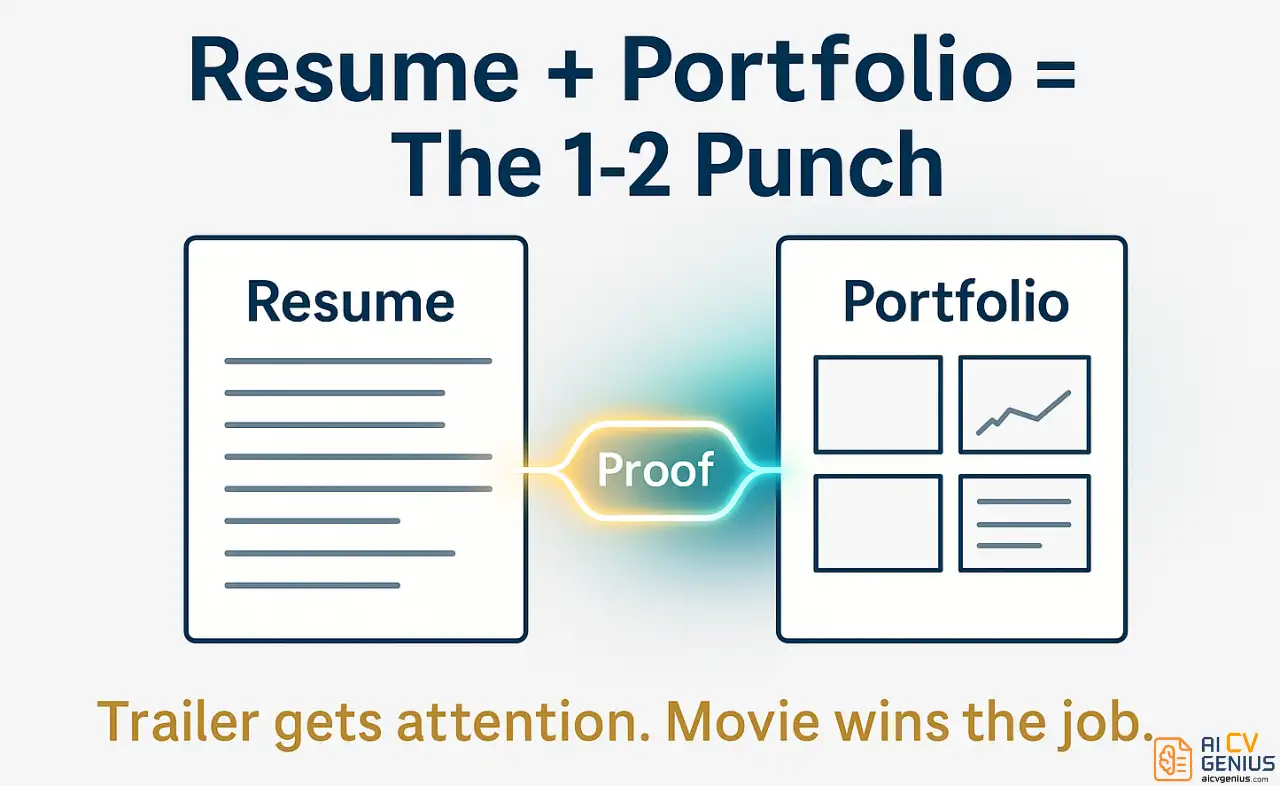
It’s crucial to understand that one does not replace the other. They are a team, and they serve very different purposes.
Your Resume is the “What” and “Why”:
- Purpose: To get past the 6-second scan and the ATS (Applicant Tracking System).
- Format: Text-based, rigid, 1-2 pages, optimized for keywords.
- Answers: “What did you do?” (e.g., “Managed ad budget”) and “Why did it matter?” (e.g., “Resulting in 150% ROI”).
- Audience: ATS bots and time-crunched recruiters.
Your Portfolio is the “How”:
- Purpose: To prove how you did it and win over the hiring manager.
- Format: Visual, narrative, interactive, unlimited space, optimized for storytelling.
- Answers: “How did you actually get a 150% ROI? Show me the ad creative, the targeting strategy, and the analytics dashboard.”
- Audience: The hiring manager, the team lead, and senior stakeholders.
Your resume is the trailer. Your portfolio is the movie. You need a great trailer to get them into the theater, but you need a great movie to win the Oscar (get the job). When a hiring manager has two resumes with identical claims, the one with the portfolio link proving those claims wins. Every single time.
For more on building a strong foundation, check out our guide on how to improve your CV before layering on portfolio elements.
Advanced FAQ: Your Toughest Portfolio Questions Answered
- For HR: Show a (redacted) “New Hire Onboarding Deck” you created, a “Sample Employee Handbook” you wrote, or a case study on “How We Reduced Time-to-Hire by 20%” (showing the process flow).
- For Operations/Finance: Show a (redacted) “Sample Budget Forecast Spreadsheet” (with fake numbers), a “Process Improvement Flowchart” (showing the ‘before’ and ‘after’ of a system you fixed), or a “Data Dashboard” you built to track KPIs.
Your “portfolio” is a collection of case studies and artifacts that prove your strategic thinking.
- Create a “Sanitized” Case Study: Write about the project in detail. “Worked with a Fortune 500 fintech client to redesign their internal compliance dashboard.”
- Redact & Replace: Replace the company’s logo with a generic one (e.g., “FinTech Client”). Replace all proprietary data and text with “lorem ipsum” text or blurred-out boxes.
- Focus on Process: Show the wireframes, the user flows, the strategy documents. These are your work and often don’t contain proprietary data.
A case study that says “Confidential Client” but clearly explains the problem, your process, and the (anonymized) result (e.g., “Increased user compliance by 40%”) is 100% effective. It shows you’re a professional who respects confidentiality.
- In the case study, have a “My Role” section (see Example 2).
- Be explicit: “I was part of a 4-person team. My specific responsibilities included user research and wireframing, while my colleague [Title] handled the final visual design and another [Title] handled the backend code.”
- Focus your case study only on the parts you did. “Here is a deep dive into the user research process I led…”
Hiring managers know 99% of real work is collaborative. Showing you’re an honest team player is a positive signal, not a negative one. Claiming team work as your own is a fireable offense.
is more relevant to the job you want than your paid work (e.g., a career changer).
Final Thoughts: Stop Telling, Start Showing
Your resume opens the door. Your portfolio is what you do once you’re in the room. In a competitive market, a portfolio is the single best tool you have to separate yourself from the stack of candidates who all claim to have the same skills. The best resume portfolio examples are not just “pretty”; they are strategic, narrative-driven arguments for why you are the best person for the job. They are built on a simple, powerful foundation:
- Curation: Showing only your best, most relevant work.
- Context: Telling the story behind each project with a clear Problem, Process, and Result.
- Proof: Backing up every claim on your resume with tangible, viewable evidence.
Start simple. You don’t need a perfect, 10-project masterpiece by tomorrow. Pick one project. Just one. Write a case study for it. Put it on a simple, free Notion page. Add that one link to your resume. You are now ahead of 90% of your competition. The candidates who land the best interviews aren’t always the most talented; they are the ones who make their talent the easiest to see and believe.
Ready to build a resume that pairs perfectly with your new portfolio? Explore our resume templates and guides to create a complete application package that stands out.