
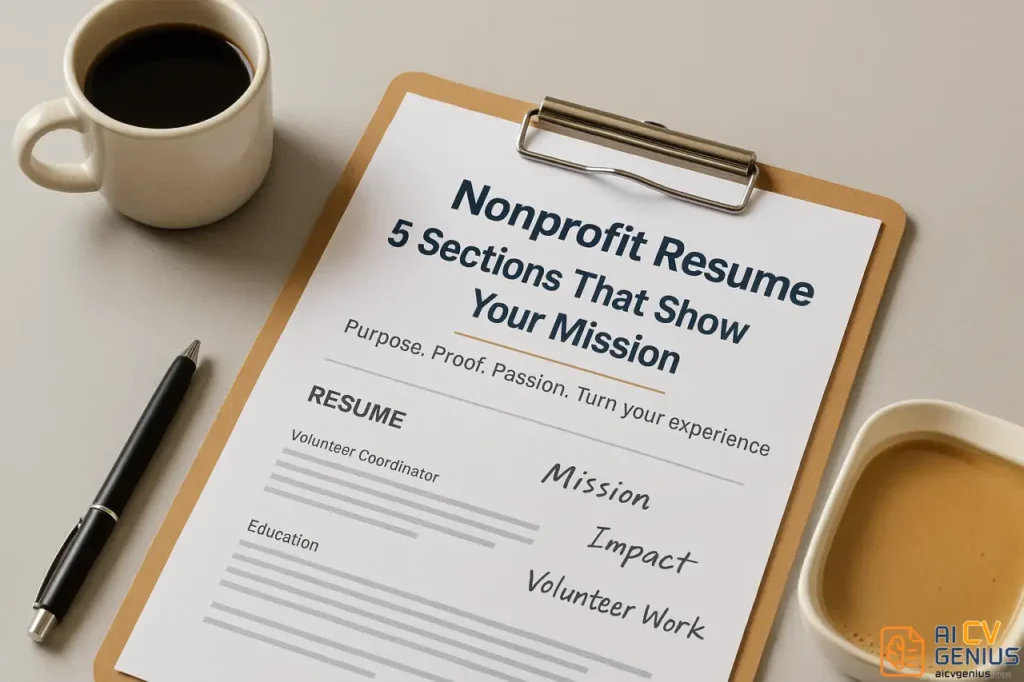
- What nonprofit hiring wants: Mission fit plus scrappy execution, not corporate growth language or ROI talk.
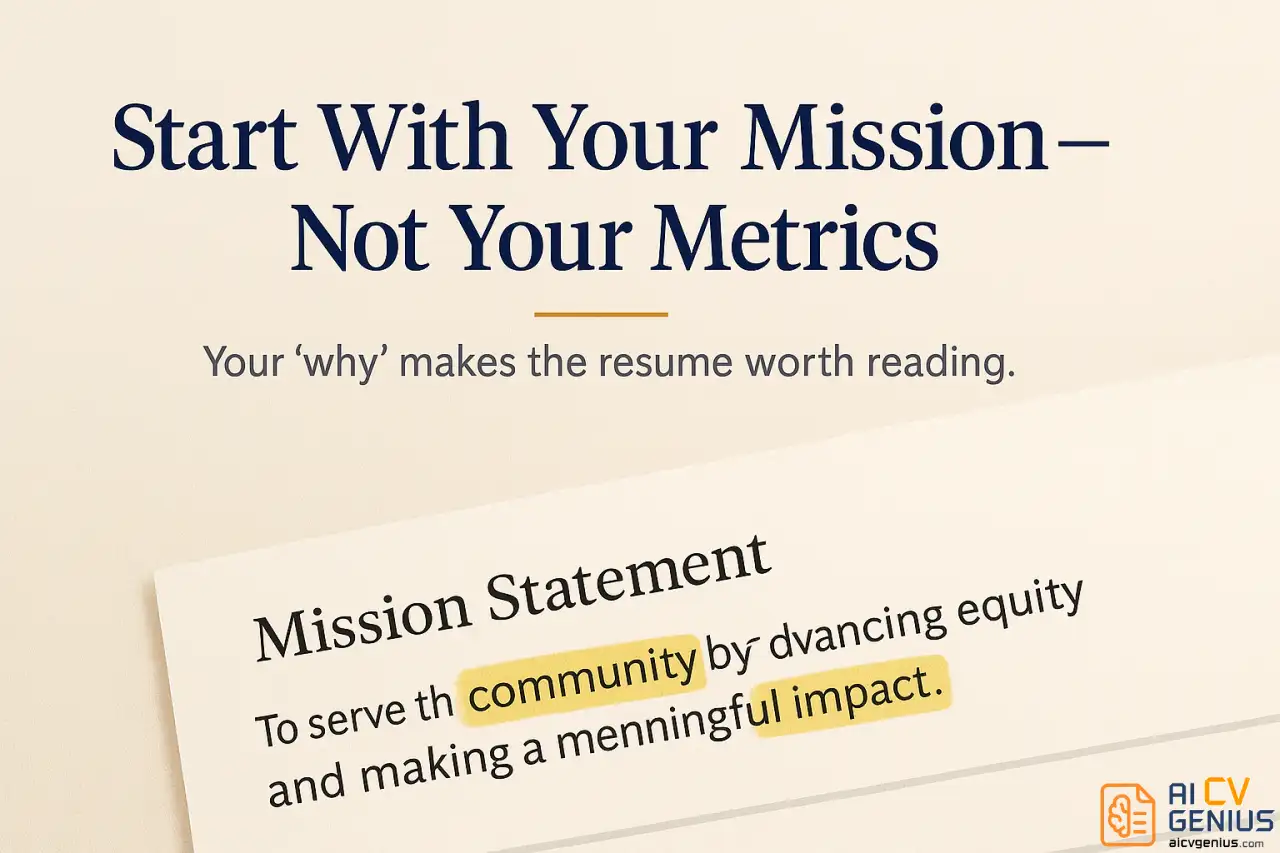
- How to open strong: Write a mission statement summary that links your role, your value, and why you care about their cause.
- How to rewrite experience: Quantify impact in people served, funds raised, volunteers managed, reach, and stewardship, then translate corporate terms into mission terms.
- What proves you mean it: Volunteer or community leadership formatted like real work, showing outcomes and responsibility.
- How to stay readable: Use a clean single column template, build a nonprofit skills matrix, add relevant certifications, and avoid flashy designs that break ATS.
You’ve updated your job titles. You’ve listed your skills. You’ve run the spell check. But as you look at your resume, you feel a disconnect. It’s a perfect summary of what you did, but it says nothing about why you did it. And now you’re applying for a role where “why” is the only thing that matters.
Welcome to the unique challenge of nonprofit hiring. When your resume lands on the desk of a hiring manager at a mission-driven organization, they aren’t just looking for a qualified candidate. They’re looking for an advocate, a believer, a partner in the cause. Your nonprofit resume template can’t just be a list of achievements; it must be a narrative of your purpose.
Corporate resumes are built to impress. Nonprofit resumes are built to connect. They aren’t just filling a position; they’re vetting for shared values. They need to know you’re not just running from a high-stress corporate job, but that you are consciously running toward their mission. This guide will show you how to translate your experience into their language – the language of impact, community, and purpose.
The “Why” vs. “What”: Why Nonprofit Resumes Are Fundamentally Different
The core difference between a corporate and nonprofit resume is the definition of success.
• Corporate Success = Growth. Success is measured in market share, revenue, and efficiency.
• Nonprofit Success = Mission. Success is measured in lives changed, communities served, and resources stewarded.
A for-profit hiring manager asks, “Can this person make us money?”
A nonprofit hiring manager asks, “Does this person truly care about our mission, and can they help us achieve it with limited resources?”
This means your entire framing must change. The skills might be identical – project management, marketing, data analysis – but the context is everything.
If your last job involved managing a marketing campaign that generated $500K in sales, a corporate employer celebrates the revenue. A nonprofit employer sees that and wonders, “Can this person use that skill to raise $50k for our after-school program? Do they understand that our ‘marketing budget’ is basically zero and will require scrappiness and creativity?”
Your resume’s job is to answer that question. It must prove you are not just a high-performer, but a mission-driven one.
Section 1: The “Mission Statement” Summary (Not a Generic Objective)
Most resume advice tells you to use a “Professional Summary.” For a nonprofit application, this section is your “Mission Statement.” It’s a 3-4 line thesis that connects your past experience to their future goals. It must answer three questions:
1. Who are you professionally?
2. What is your unique value?
3. Why are you here? (i.e., your connection to the mission)
This is the first – and sometimes only – thing a hiring manager will read. It must be powerful.
Nonprofit Resume Summary Examples: Before and After
Example 1: The Career Changer (Marketing)
❌ BEFORE (Corporate): “Results-driven marketing manager with 8+ years of experience in B2B SaaS. Proven track record of increasing MQLs and driving revenue growth through multi-channel campaigns.”
✅ AFTER (Nonprofit-Ready): “Mission-driven marketing professional with 8+ years of experience translating complex ideas into compelling stories. Eager to apply B2B strategic planning skills to advance community-focused causes, specifically in environmental advocacy. Proven ability to build engagement and mobilize support with creativity and limited resources.”
Example 2: The Program Manager
❌ BEFORE (Vague): “Experienced professional looking for a challenging role in a nonprofit organization. Hard-working, detail-oriented, and a great team player.”
✅ AFTER (Specific & Mission-Driven): “Program Manager with 6+ years of experience designing and scaling high-impact educational programs. Proven ability to manage complex logistics, build community partnerships, and steward grant funding. Deeply committed to educational equity and seeking to apply my program development skills to serve first-generation college students.”
Example 3: The Fundraiser
❌ BEFORE (Corporate Sales): “Top-performing sales executive with a history of exceeding quota by 150%. Skilled in new business development, client relations, and closing six-figure deals.”
✅ AFTER (Nonprofit-Ready): “Development professional with 5+ years of experience in high-stakes relationship management and strategic outreach. Adept at identifying new funding opportunities and cultivating long-term partnerships. Eager to transition my corporate sales and negotiation skills to secure major gifts that support refugee resettlement programs.”
Common Summary Mistakes to Avoid
- ❌ The “All About Me” Objective: “Looking for an opportunity to gain experience in the nonprofit sector.” This is a fatal flaw. It tells the hiring manager you want to take something (experience) rather than give something (your skills).
- ❌ Corporate Jargon Overload: “Synergizing core competencies to maximize ROI.” This language is alienating and signals you haven’t done your homework on nonprofit culture.
- ❌ Vague “Passion”: “Passionate about helping people.” This is too generic. What people? How? Your passion must be specific: “Passionate about… food justice for urban communities,” or “Passionate about… animal welfare legislation.”
Section 2: Quantifying the Unquantifiable: Impact-Driven Experience
Your work experience section is where you provide the evidence for your mission statement. The formula for each bullet point must change.
• Corporate Formula: Action Verb + Task + Quantifiable Result (Profit)
• Nonprofit Formula: Action Verb + Task + Quantifiable Result (Impact) + Connection to Mission
Every bullet point must be filtered through the lens of “mission.” How did your work help people, serve the community, or advance the cause? Numbers are still critical, but they must be impact-focused numbers.
Impact-Focused Numbers to Use
- ✅ People Served: “Launched a new literacy program serving 85 students in its first six months.”
- ✅ Funds Raised/Managed: “Wrote and secured $350K in grant funding for youth programs.”
- ✅ Volunteers Managed: “Recruited, trained, and coordinated 40+ volunteers, resulting in 600 hours of service monthly.”
- ✅ Growth/Reach: “Expanded program reach to 3 new counties, increasing community access by 150%.”
- ✅ Efficiency/Stewardship: “Re-negotiated vendor contracts, reallocating $20K (15%) from overhead to direct program services.”
The Corporate-to-Nonprofit Translation Dictionary
If you’re coming from the private sector, your experience is highly valuable, but you must act as the translator. Do not make the hiring manager guess how your skills apply.
| If You Did This (Corporate) | Reframe It Like This (Nonprofit) |
|---|---|
| Managed a $500K marketing budget to drive sales. | “Managed a $500K communications budget, ensuring 90% was allocated to high-impact community outreach.” |
| Led a sales team that increased revenue by 20%. | “Led a development team that expanded our donor base by 20%, securing funding for two new initiatives.” |
| Managed a complex software project for a client. | “Managed a complex grant-funded project, coordinating 3 partner organizations and delivering on time and under budget.” |
| Handled customer service for 50+ key accounts. | “Managed relationships with 50+ key stakeholders (donors, partners, community leaders) ensuring high retention.” |
| Recruited and onboarded 15 new employees. | “Developed a recruitment and onboarding process for 15 new staff and volunteers, improving time-to-productivity.” |
The key is to replace “profit-focused” words (like sales, revenue, customers, ROI) with “mission-focused” words (like development, funding, stakeholders, community, impact).
Section 3: Proof of Passion: Your Volunteer & Community Leadership
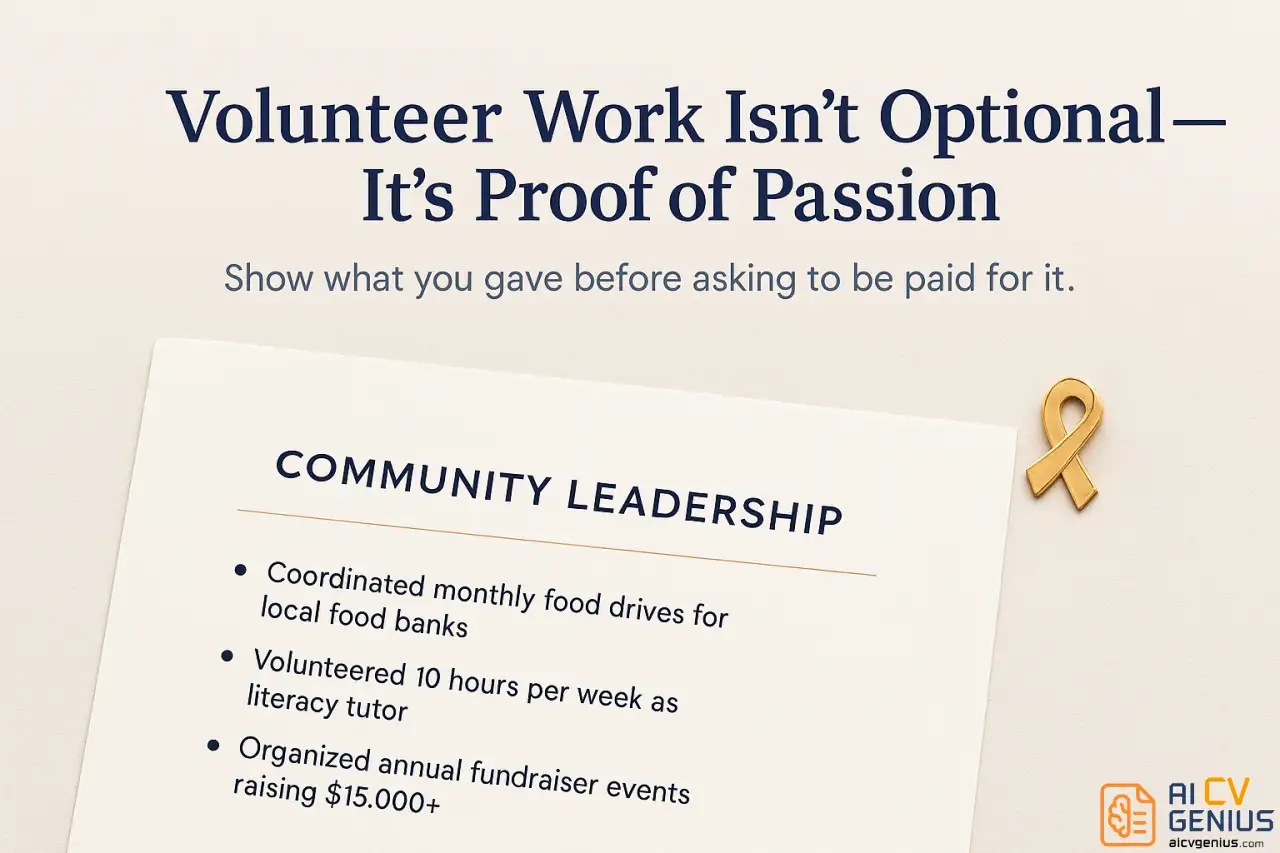
On a corporate resume, your “Volunteer Work” section is a small, optional footnote at the bottom. On a nonprofit resume template, it is a core, non-negotiable section that provides critical evidence.
Why? Because it de-risks your application.
• For career changers, it proves your “passion” is real and not just a buzzword. It shows you’ve been doing this work (or similar work) for free, simply because you care.
• For industry veterans, it shows your commitment extends beyond your 9-to-5 job and that you are a true leader in the community.
If your volunteer experience is substantial (e.g., you led a committee, managed a project, or served on a board), it should be formatted exactly like a paid job under a section titled “Community Leadership” or “Volunteer Experience.”
How to Format Volunteer Experience
Do not just list the organization. Show your accomplishments.
Fundraising Committee Chair (Volunteer), City Animal Shelter | Jan 2022 – Present
• Led a team of 8 volunteers to plan and execute the annual “Paws for a Cause” gala, our primary fundraising event.
• Secured $45K in corporate sponsorships and in-kind donations, exceeding our goal by 30%.
• Implemented a new mobile-bidding system that increased auction revenue by 50% year-over-year.
This entry is stronger than many people’s paid job descriptions. It shows leadership, fundraising, and technical skills – all in a volunteer capacity. This is what nonprofit employers want to see.
Section 4: The Nonprofit Skills Matrix
Nonprofit employers look for “scrappy” people – those who can wear multiple hats and thrive with limited resources. Your skills section should reflect this blend of practical hard skills and mission-critical soft skills.
Essential Hard Skills (The “What”)
Organize them by function to show your breadth of knowledge. These are keywords the ATS (Applicant Tracking System) will be scanning for.
- Fundraising & Development: Grant Writing, Donor Cultivation, Major Gifts, Capital Campaigns, Event Planning, Prospect Research
- Program Management: Program Design & Evaluation, Logic Models, Community Outreach, Case Management, Stakeholder Engagement
- Operations & Finance: Nonprofit Budgeting, Grant Management, Financial Reporting, Operations Management, Stewardship
- Tech & Data: Salesforce Nonprofit Cloud, Bloomerang, DonorPerfect, Raiser’s Edge, Asana, Mailchimp, Data Analysis
Mission-Critical Soft Skills (The “How”)
In a nonprofit, how you do your job is as important as what you do.
- Relationship Building: Essential for donors, volunteers, partners, and clients.
- Cultural Competency: Demonstrates you can work respectfully with diverse populations.
- Empathy & Active Listening: Required for understanding the needs of the community you serve.
- Adaptability & Resilience: Proves you can handle the “wearing many hats” culture and limited resources.
- Resourcefulness: Shows you can make a big impact with a small budget.
Pro Tip: Don’t just list these soft skills. Weave them into your experience bullet points.
Instead of: “Managed volunteers.”
Try: “Built a dedicated corps of 50+ volunteers through empathetic leadership and clear communication, increasing retention by 40%.”
Section 5: Education, Certifications & Training
List your degrees in reverse chronological order. Your GPA is irrelevant unless you graduated in the last 1-2 years. What is relevant are professional certifications that show your commitment to the sector.
Certifications That Signal Serious Intent
If you are changing careers, investing in one of these can be a powerful signal to employers.
- Certified Nonprofit Professional (CNP): A well-respected, comprehensive credential in nonprofit management.
- Certified Fund Raising Executive (CFRE): The gold standard for experienced fundraising professionals.
- Grant Professional Certified (GPC): Validates your expertise in the full grant lifecycle.
- Certificate in Volunteer Administration (CVA): Excellent for roles in volunteer management.
- Project Management Professional (PMP): Highly valued for managing complex, grant-funded projects.
Also, include any training in areas like DEI (Diversity, Equity, and Inclusion), Trauma-Informed Care, or Mental Health First Aid, as these are highly relevant.
Complete Nonprofit Resume Template (Putting It All Together)
Here’s a complete template designed for a career changer moving from corporate project management to a nonprofit program manager role. Notice the language.
MARIA GARCIA
Seattle, WA | (206) 555-0123 | maria.garcia@email.com | linkedin.com/in/mariagarciaMISSION-DRIVEN SUMMARY
Program management professional with 7+ years of experience leading complex projects and cross-functional teams. Eager to transition my corporate project management skills to the nonprofit sector, applying my expertise in budget stewardship and stakeholder engagement to support communities facing homelessness. Proven ability to manage grant-funded initiatives and build strong partnerships.PROFESSIONAL EXPERIENCE
Senior Project Manager, TechSolutions Inc. | Seattle, WA | January 2020 – Present
• Led the full lifecycle of 5+ complex software projects, each with budgets over $500K, delivering on time and within scope.• Coordinated a cross-functional team of 15 engineers, designers, and analysts, fostering a collaborative and high-performance culture.
• Managed relationships and communications with 20+ high-level corporate stakeholders, ensuring alignment and managing expectations.
• Identified and mitigated project risks, preventing potential budget overruns and saving an estimated $80K.
Project Coordinator, BizOptimize LLC | Seattle, WA | March 2018 – December 2019
• Supported 3 Project Managers in daily operations, including scheduling, reporting, and resource allocation.• Developed a new tracking system in Asana that improved reporting efficiency for the entire department by 30%.
• Coordinated client onboarding and training sessions, ensuring a smooth transition to new software.
COMMUNITY LEADERSHIP & VOLUNTEER EXPERIENCE
Volunteer Grant Writer, Housing Forward Alliance | Seattle, WA | June 2022 – Present (10-15 hrs/week)
• Researched and identified 20+ new foundation and corporate grant opportunities.• Wrote and co-authored 8 grant proposals, directly contributing to securing $75K in new funding for housing assistance programs.
• Collaborate with program staff to gather data and stories for compelling grant narratives.
Volunteer Meal Coordinator, Safe Harbor Shelter | Seattle, WA | January 2021 – May 2022
• Managed the weekly dinner service schedule for 30+ volunteers, ensuring all shifts were covered.• Coordinated with local businesses to secure in-kind food donations, saving the shelter an estimated $5K.
SKILLS
• Program & Project Management: Agile & Scrum Methodologies, Asana, Trello, Stakeholder Engagement, Risk Management
• Fundraising & Grants: Grant Writing, Prospect Research, Donor Communications, Budget Stewardship
• Community & Team: Volunteer Coordination, Cross-Functional Leadership, Cultural Competency, Public Speaking
• Technical Skills: Salesforce (Nonprofit Cloud), Microsoft Office Suite, Data Analysis, G Suite
EDUCATION & CERTIFICATIONS
Project Management Professional (PMP) | Project Management Institute | 2021
Bachelor of Arts in Communication | University of Washington | 2018
• Relevant Coursework: Public Policy, Intercultural Communication
Frequently Asked Questions (From a Nonprofit Hiring Manager’s POV)
Your Resume Is Your First Act of Stewardship
When you apply to a nonprofit, your resume is more than a list of jobs. It’s your first demonstration of stewardship. It shows the hiring manager whether you’re in it for the right reasons, whether you understand the work, and whether you have the “scrappy” resourcefulness to contribute to something bigger than yourself.
The sections we’ve covered – your “mission statement” summary, your impact-focused experience, your “proof of passion” volunteer work, and your skills matrix – all work together to tell a cohesive story. They show you’re not just looking for a job. You’re answering a call.
Take the time to translate your corporate experience. Quantify your impact in terms of lives changed and communities served. Show, don’t just tell, that you care about the mission. Because in this sector, they aren’t hiring a resume. They’re hiring a person. Make sure your nonprofit resume template proves you’re the right one.
Ready to build a resume that lands interviews at mission-driven organizations? Check out our complete guide to career resources for more tools, templates, and expert advice.