
- Core goal: A nonprofit cover letter must prove mission fit with specifics, not generic “make a difference” lines.
- Hiring manager fear: Your job is to de-risk the hire by showing you understand constraints, resilience, and why you chose this exact organization.
- 3-paragraph formula: Open with “Why you, why this mission,” prove qualification with 2–3 quantified wins tied to their needs, then close mission-forward and confident.
- How to show passion: Use actions and proof (volunteering, programs you follow, annual report details, personal connection stated professionally) instead of feelings.
- What to avoid and optimize: Skip copy-paste letters, “To Whom It May Concern,” and self-focused motives, mirror job-description keywords naturally for ATS.
Your resume tells a hiring manager what you’ve done. Your cover letter tells them why you care. When you’re applying to a nonprofit, that second part isn’t just a formality; it’s the entire application. Anyone can list “grant writing” or “program management” on a resume. But can you articulate, with specifics, why this organization’s specific mission is the only one you want to work for? That’s what a nonprofit cover letter example must prove.
Here’s the unfiltered truth: nonprofit hiring managers are inundated with cover letters from qualified people. Worse, they are drowning in letters that all say the same thing: “I’m passionate about helping people” or “I want to make a difference.” These phrases sound nice, but they are generic. They are noise. They could apply to any nonprofit on the planet, from an animal shelter to an arts council.
The letter that gets you the interview is the one that makes the hiring manager put down their coffee and think, “This person gets it.” It’s specific. It connects your personal “why” to their organizational “how.” It proves you’ve done the research, you understand their theory of change, and you’re not just looking for a job – you’re looking for this job. This guide will show you how to write that exact letter.
The Cover Letter’s Secret Job: De-Risking Your Application
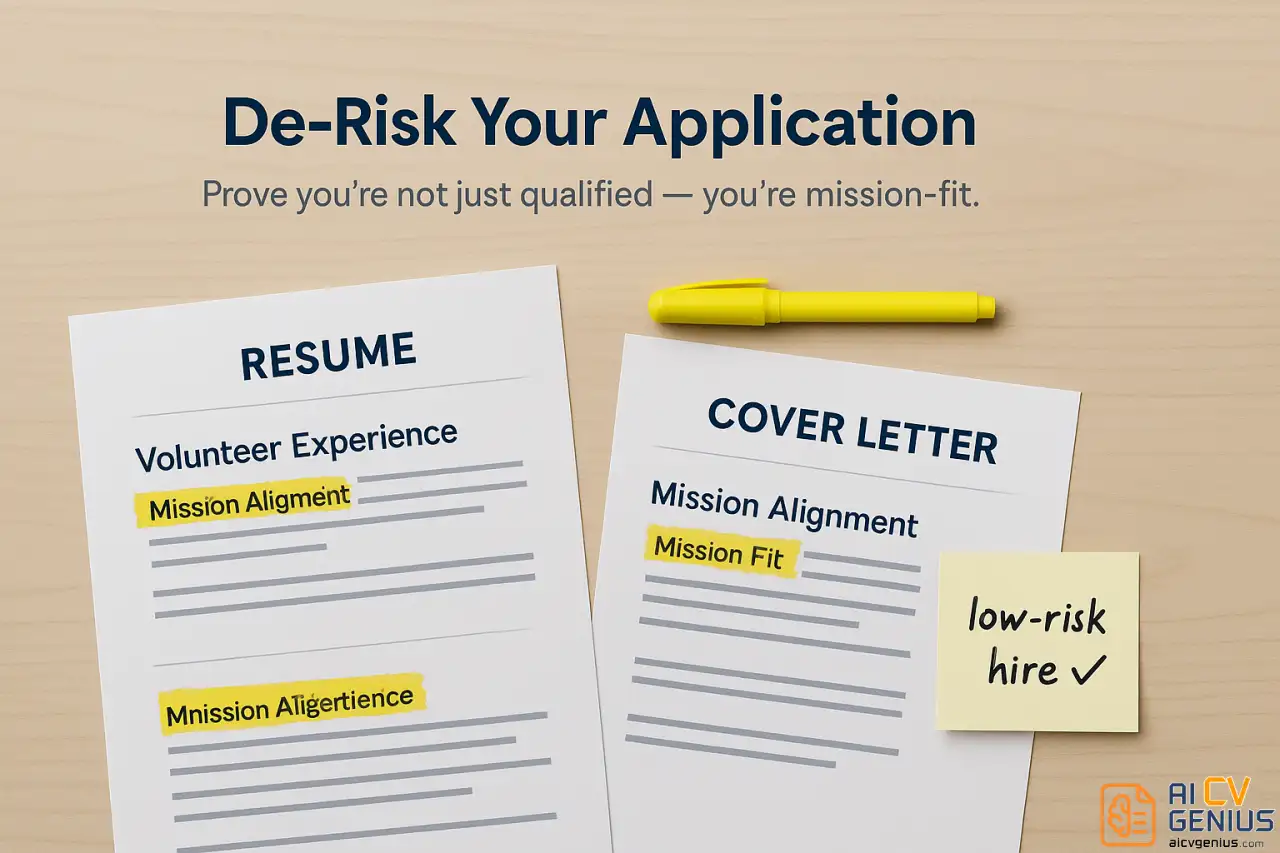
Before we get to formulas, you must understand the hiring manager’s primary fear: risk. Nonprofits run on tight budgets and even tighter timelines. They cannot afford a bad hire. They can’t afford to train someone for six months only to have them quit because the work was “too emotionally draining” or the pay wasn’t what they were used to.
Your cover letter has one secret, primary job: to de-risk your application.
- If you’re a career changer from corporate: Your letter must prove you understand the resource constraints and that you’re not just having a mid-life crisis. You must show you are running toward the mission, not just away from your old job.
- If you’re an entry-level candidate: Your letter must prove you have the maturity, resilience, and grit to handle the work, even without a long resume.
- If you’re an industry veteran: Your letter must prove you aren’t just “coasting” but are specifically passionate about this organization’s unique approach to the problem.
Every sentence you write should be aimed at calming these fears and proving you are a low-risk, high-mission-fit candidate.
The 3-Paragraph Formula That Proves You “Get It”
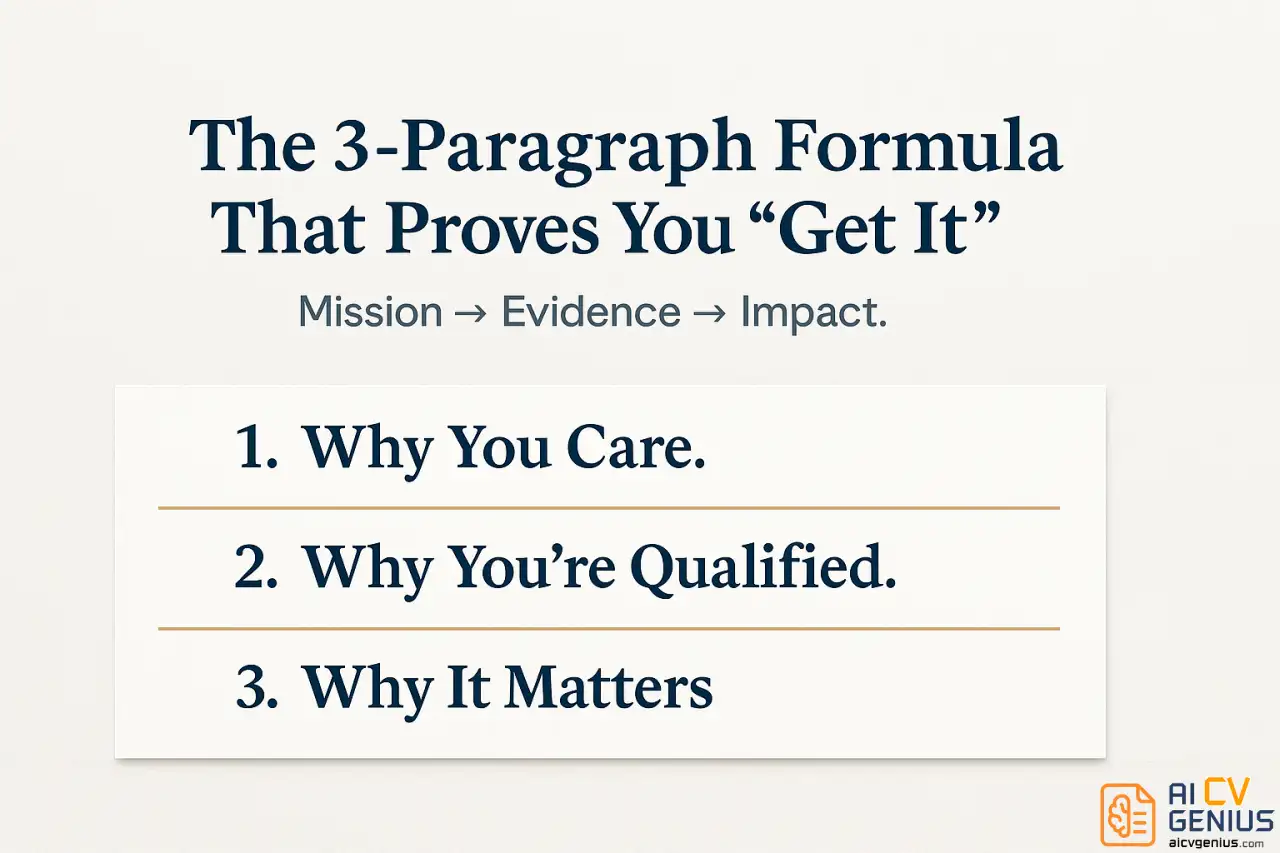
The most effective nonprofit cover letters follow a simple, powerful framework. It’s not about length; it’s about precision. Each paragraph has a distinct job to do.
Paragraph 1: The “Why You, Why This Mission” Opening
This is your hook, and it cannot be generic. You must immediately connect your personal story or professional conviction to their specific mission. This proves you’re not just mass-applying. You chose them.
How to find your hook? Spend 20 minutes on their website. Find the “About Us” page, read their annual report, or look at their programs. Find their specific theory of change.
Weak Openings (Generic):
- ❌ “I am writing to apply for the Program Coordinator role I saw on LinkedIn. I am very passionate about helping people and I think my skills would be a great fit.”
- ❌ “For my whole life, I’ve wanted to make a difference. Your organization’s mission to fight poverty is very inspiring to me.”
Strong Openings (Specific & Passionate):
- ✅ The Personal Story: “When my younger brother struggled with addiction, I saw firsthand how critical non-judgmental recovery programs are. That’s why I have followed Hope House’s work for the past three years; your ‘harm reduction first’ model is exactly what my family needed.”
- ✅ The Volunteer Connection: “Having volunteered with Habitat for Humanity since 2019, I’ve seen how stable housing transforms families. Your organization’s specific focus on permanent supportive housing for veterans is the critical next step I want to dedicate my career to.”
- ✅ The Program Connection: “Your ‘Fresh Start’ employment program for formerly incarcerated individuals is a model I’ve admired since my time in workforce development. I’m writing because I believe my experience in building corporate partnerships is the perfect fit to help you scale it.”
In one paragraph, you’ve proven: 1) You know who they are. 2) You know what they do. 3) You care about it personally.
Paragraph 2: The “Why You Are Qualified” Evidence
Now that you’ve established your “why,” you must prove your “how.” This paragraph provides the 2-3 concrete, quantified achievements from your resume that prove you can solve their specific problems. Do not just list your job duties.
Read the job description. What is their #1 problem? Are they trying to grow? Raise money? Manage volunteers? Speak directly to that need.
Weak Evidence (Generic):
- ❌ “I have strong communication skills and am very organized. I also have experience with project management and working in teams.”
Strong Evidence (Specific & Quantified):
- ✅ For a Fundraising Role: “In my current role at the Community Arts Center, I grew our individual donor base by 40% in 18 months by launching a new ‘Friends of the Arts’ digital campaign. I also personally secured $250K in new grant funding. I am eager to bring this same blend of digital outreach and traditional grant writing to expand your funding base.”
- ✅ For a Program Role: “As a volunteer coordinator, I managed a team of over 40 volunteers for our weekly food distribution, coordinating schedules to ensure we served 200+ families every Saturday. I know the logistics, compassion, and on-the-ground problem-solving it takes to run a frontline program like yours.”
This paragraph proves you haven’t just had a job; you’ve excelled at it, and you can connect those results to their needs.
Paragraph 3: The “Mission-Forward” Close
Your closing paragraph should be short, confident, and professional. It must circle back to the mission.
Weak Close (Passive):
- ❌ “I hope to hear from you soon. Thank you for your time.”
Strong Close (Active & Mission-Focused):
- ✅ “I would be honored to discuss how my fundraising experience and my deep commitment to arts education can help support your mission. I am available for an interview at your convenience and can be reached at (555) 123-4567 or email@example.com. Thank you for your consideration.”
You’re not just asking for a job. You’re asking to join their cause. It’s a small but powerful difference in tone.
Complete Nonprofit Cover Letter Example (Experienced)
Here’s a full nonprofit cover letter sample that brings all three paragraphs together. This is for an experienced candidate applying for a role they are a perfect fit for.
Sarah Martinez
Chicago, IL 60614
(312) 555-0198
sarah.martinez@email.comMarch 15, 2025
James Park
Program Director
Youth Empowerment Network
2400 N Lincoln Ave
Chicago, IL 60614Dear Mr. Park,
I am writing to express my enthusiastic interest in the Community Outreach Coordinator position at Youth Empowerment Network. I first learned about your organization three years ago when I volunteered as a mentor for your Summer Leadership Academy. Watching those students present their community action projects – and seeing their confidence transform over just eight weeks – convinced me that your model of youth-led change is the most powerful in the city. I have followed your expansion into three new neighborhoods since then, and I am eager to bring my professional experience to help you continue that growth.
In my current role as Volunteer Coordinator at the Lincoln Park Community Center, I am responsible for recruiting, training, and managing volunteers for our after-school tutoring program serving 85 students. Over the past two years, I’ve built partnerships with six local high schools to bring in college-bound seniors as tutors, increasing our active volunteer base by 120%. More importantly, I created and implemented a new volunteer retention program that reduced turnover by 35%. I understand that consistency is critical when working with young people who need stable mentors. Your organization’s focus on long-term mentorship aligns perfectly with this philosophy, and I am confident I can apply these relationship-building skills to expand your volunteer network across Chicago’s South Side.
I would welcome the opportunity to discuss how my experience in volunteer management and my personal commitment to youth development can support Youth Empowerment Network’s mission. I am available for a conversation at your convenience and can be reached at (312) 555-0198 or sarah.martinez@email.com. Thank you for your time and consideration.
Sincerely,
Sarah Martinez
Why this works: It’s a “lock and key” letter. The first paragraph is a “key” that fits the “lock” of their specific mission. The second paragraph provides the hard-data “proof” that she can do the job. The close is professional and mission-focused. This letter gets an interview.
The Entry-Level Nonprofit Cover Letter: Passion as Proof
What if you don’t have years of paid experience? An entry level nonprofit cover letter must use passion, volunteerism, and academic work as evidence.
Your goal is to show that what you lack in paid experience, you make up for in proven commitment and transferable skills.
- ✅ Academic Projects: “My capstone thesis analyzed food insecurity in Cook County, which is what first led me to your mobile pantry program. I’ve admired your ‘client-choice’ model ever since.”
- ✅ Volunteer Experience: “While I don’t have paid program management experience, I have spent the last two years volunteering 10 hours a week at the animal shelter, where I personally created the new volunteer scheduling system.”
- ✅ Transferable Skills: “My three years as a shift supervisor in retail taught me more about de-escalation, logistics, and managing diverse personalities under pressure than any textbook could. I’m ready to apply that grit to your community resource center.”
Entry Level Example:
Dear Ms. Johnson,
I am writing to apply for the Program Assistant position at Green Cities Coalition. As a recent Environmental Studies graduate from DePaul University, I’ve spent the last two years focused on a single issue: sustainable urban development. My passion for this is not just academic; I have been an active volunteer with your Urban Garden Initiative since 2023, and I am eager to turn my proven commitment into a full-time career with your team.
Through my volunteer work, I’ve helped coordinate ten community garden installations and engaged over 150 residents in sustainable growing practices. This hands-on work was the perfect complement to my senior thesis, where I researched the impact of community gardens on local food security. I also have leadership experience; as president of the campus sustainability club, I planned our annual “Eco-Week,” managing a $5,000 budget and coordinating events for 200+ students.
I know I have the practical skills, the academic background, and the genuine enthusiasm to support your team from day one. I would love to discuss how my passion for environmental justice can support your mission. Thank you for your consideration.
Sincerely,
Alex Chen
The Career Changer: From Corporate to Nonprofit
This is the hardest letter to write. A cover letter for nonprofit job switching from corporate must address the “elephant in the room”: Why the change? And can you handle the culture (and pay) cut?
Do not apologize for your corporate background. Use it. Show how it makes you more valuable, not less. Your job is to translate your metrics and explain your “why.”
Example Opening for a Career Changer:
“For the past eight years, I’ve managed multi-million dollar brand campaigns for Fortune 500 tech companies. While I am proud of that work, I’ve reached a point where I want to use my strategic storytelling skills to amplify voices that don’t usually get heard. My journey to this decision was solidified by my two years as a volunteer grant writer for [Local Shelter], where I saw how a single, well-told story could fund a program for a year. I am writing because I want to bring my corporate-level strategic planning and my personal passion for your reentry services to this Communications Director role.”
This opening is perfect. It:
- Acknowledges the corporate past.
- Translates “brand campaigns” to “strategic storytelling.”
- Provides a “why” (amplifying voices).
- De-risks the application by mentioning two years of relevant volunteer work.
How to Show Passion Without Sounding Generic
Everyone says they’re “passionate.” Not everyone proves it. How to show passion in a cover letter for nonprofit work is about “showing,” not “telling.”
Your passion is not a feeling; it’s a series of actions you have already taken. Prove it.
| Generic “Telling” (❌) | Specific “Showing” (✅) |
|---|---|
| “I’m very passionate about helping people.” | “I have spent every Saturday for the past two years volunteering at the local homeless shelter.” |
| “I deeply care about education equity.” | “As a first-generation college student, I know what it’s like when resources don’t match potential.” |
| “I want to make a real difference.” | “Your legal aid clinic helped my family in 2018. That’s when I decided to pursue a paralegal certificate.” |
| “I really believe in your mission.” | “I’ve attended three of your community forums on affordable housing and read your 2024 annual report.” |
Passion is demonstrated through actions, personal stories, and specific knowledge of the organization. Research them. Read their annual report. Mention a recent news article. Cite a statistic from their website. That is how you prove you are passionate, not just saying it.
Common Mistakes That Kill Nonprofit Cover Letters
Avoid these, and you are already in the top 10% of applicants.
- ❌ The “To Whom It May Concern” Opening: It’s 2025. Spend five minutes on their website or LinkedIn to find a name. “Dear Hiring Manager” or “Dear [Department] Team” is acceptable. “To Whom It May Concern” is lazy.
- ❌ Focusing on What You Will Gain: “I am looking for a role where I can gain experience in nonprofit management.” This is the kiss of death. It’s about you, not them. Reframe: “I am eager to apply my project management skills to support your youth programs.”
- ❌ The “Copy-Paste” Letter: Using the same generic letter for every application. They can tell. If your letter could be sent to their biggest competitor without changing a word, it’s a bad letter.
- ❌ Being Too Formal or Stiff: Nonprofit culture is often personal. Your letter should be professional, but warm and human. It’s a “letter,” not a legal brief.
- ❌ Forgetting to Proofread: Typos suggest a lack of attention to detail. If you can’t get a one-page letter right, how will you handle a complex grant application or donor report?
Using Nonprofit Keywords Effectively
Many nonprofits use Applicant Tracking Systems (ATS) to filter resumes. Your cover letter should also be optimized. Look at the job description and mirror their language. Common nonprofit cover letter keywords include:
- Mission-driven
- Community Engagement / Community Outreach
- Stakeholder Collaboration / Stakeholder Engagement
- Grant Writing / Grant Management
- Fundraising / Development
- Program Evaluation / Program Management
- Volunteer Coordination / Volunteer Management
- Social Impact / Systems-Change
- Capacity Building / Advocacy
Weave these naturally into your narrative. Don’t “stuff” them. Your paragraph 2 (the “evidence” paragraph) is the perfect place for this.
Frequently Asked Questions (From an Expert’s POV)
Write a Letter They’ll Actually Remember
The best nonprofit cover letter example isn’t the one with the fanciest language. It’s the one that makes a hiring manager feel understood. It’s the one that makes them think, “This person gets it. They understand our work, they care about our specific mission, and they have the skills to help us.”
That kind of letter takes work. It requires 30 minutes of research before you write a single word. You have to dig into their website, understand their programs, and think deeply about how your specific experiences connect to their specific needs. You have to be vulnerable enough to share your “why” in a professional way.
But when you do that work, your application transforms. You stop being one of 200 qualified applicants and become the one candidate who feels like a future colleague. Be specific. Be genuine. And they’ll remember you.
Ready to pair your cover letter with an equally strong resume? It’s important to improve your CV to make sure your entire application package proves you’re mission-driven. For more nonprofit career resources, explore our complete career guide.