
- What it is: The chronological resume format (Reverse-chronological) lists your most recent job first, then works backward, so recruiters can read your career like a timeline.
- Why it is the default: It makes it easiest to judge relevance, progression, stability, and role fit in a fast scan.
- ATS advantage: Standard headings plus clear dates and titles parse cleanly, while tables, text boxes, heavy columns, and graphics can scramble parsing.
- Best use cases: Works best for steady work history, clear growth, and applying for similar roles.
- When to use another format: Big gaps, frequent short jobs, major career changes, or project-only freelance work often read better as hybrid or functional.
What Is the Chronological Resume & Why It’s the Gold Standard
In the ever-evolving landscape of job applications, one constant remains: the enduring power of the chronological resume format. Often referred to as the reverse-chronological format, it’s the most widely recognized, universally accepted, and recruiter-preferred layout in the professional world. Why? Because it presents your career journey logically, tracing your progression from your most recent position backward through time. This linear narrative allows employers to quickly grasp your growth trajectory, increasing responsibilities, and key achievements within specific contexts.
Think of it as the bedrock of resume structures. It’s not necessarily flashy or innovative, but its strength lies in its clarity and intuitive flow. It tells a story of stability, progression, and accumulated expertise – qualities highly valued in almost every industry. When a hiring manager receives a chronological resume, there’s an immediate sense of familiarity and ease. They know exactly where to find crucial information – dates, titles, company names – without deciphering complex layouts or unconventional structures. This format doesn’t rely on design gimmicks; its authority comes from substance and straightforward presentation.
This guide will delve deep into the nuances of the chronological format, exploring why it remains the gold standard, who benefits most from using it, how to structure it effectively for modern Applicant Tracking Systems (ATS) and human eyes, and how to inject personality and impact into this traditional framework.
The Enduring Appeal: Why Chronological Remains the Gold Standard
In a world obsessed with disruption, why does such a seemingly conventional format continue to dominate? The reasons are rooted in both human psychology and technological reality.
Cognitive Ease for Recruiters
Recruiters are inundated with applications, often spending mere seconds on initial scans. The chronological format significantly reduces their cognitive load. Our brains are naturally wired to understand sequences and timelines. Presenting information from present to past allows recruiters to quickly assess:
- Current Relevance: What are you doing *now* or most recently? This is often the most critical factor.
- Career Trajectory: Have you shown consistent growth, taken on more responsibility, or specialized over time?
- Stability and Commitment: How long have you typically stayed in roles? Are there significant unexplained gaps?
- Industry Alignment: Have you remained within a relevant field, or does your path show diversification?
This linear structure provides immediate context. Recruiters don’t have to piece together fragmented skill sections or decipher unconventional layouts. They can follow a clear narrative, making their evaluation process faster and more efficient. This efficiency is paramount when dealing with high volumes of applicants.
ATS Compatibility: The Technological Imperative
Applicant Tracking Systems (ATS) are now ubiquitous, used by over 90% of large companies and increasingly by smaller ones. These systems are essentially parsing software designed to extract key information (keywords, dates, titles, skills) and rank candidates based on relevance to the job description. The chronological format, with its predictable structure and standard headings, is inherently ATS-friendly.
ATS algorithms are trained to recognize patterns like:
- Standard Section Headers: “Professional Experience,” “Education,” “Skills.”
- Consistent Date Formats: Clearly defined start and end dates for each role.
- Clear Job Titles and Company Names: Easily identifiable entities.
- Bulleted Achievement Lists: Parsable text describing responsibilities and results.
More creative formats (like highly graphical resumes or those using tables and columns extensively) can confuse ATS parsers, leading to misinterpretation or outright rejection before a human ever sees the application. The chronological format minimizes this risk, ensuring your qualifications are accurately captured and passed along for human review. Choosing this format is, in many ways, a strategic decision to ensure baseline visibility.
Demonstrating Growth and Stability: A Narrative Advantage
For candidates with a relatively stable career path, the chronological format naturally tells a compelling story of progression. Seeing promotions within the same company or moves to increasingly senior roles at different organizations provides powerful evidence of competence, reliability, and ambition. It allows recruiters to visualize your journey and infer positive traits without you explicitly stating them. This narrative of upward momentum is often exactly what employers are looking for, especially for mid-career and senior positions where a proven track record is essential.
Ideal Candidates: Who Should Embrace the Chronological Format?
While versatile, the chronological format is particularly advantageous for certain candidate profiles. If you fall into one of these categories, this format is likely your strongest choice:
- ✅ Professionals with a Consistent Work History: If you’ve worked steadily within one or two related industries and have minimal or easily explainable employment gaps, this format highlights your reliability and focus.
- ✅ Those Showing Clear Career Progression: If your career demonstrates a pattern of increasing responsibility, promotions, or moves to more senior roles, the chronological layout makes this upward trajectory immediately obvious. Think of the teacher who became a department head, the engineer who became a team lead, or the marketing coordinator who advanced to director.
- ✅ Applicants for Traditional or Conservative Industries: Fields like finance, law, government, and academia often prefer the predictability and formality of the chronological structure. It signals adherence to professional norms.
- ✅ Candidates Targeting Similar Roles: If you’re applying for a position that is a logical next step based on your previous experience, this format clearly shows the relevance of your background.
- ✅ Entry-Level Candidates with Relevant Internships/Experience: Even for recent graduates, if internships or part-time jobs show a clear path toward the desired field, the chronological structure works well to demonstrate focus from an early stage.
For these individuals, the chronological resume acts as a clear, compelling narrative of their professional development, directly addressing recruiters’ core interest in seeing a logical and progressive career path.
Cautionary Cases: When to Consider Alternatives
Despite its strengths, the chronological format isn’t universally optimal. Its linear nature can inadvertently highlight aspects you might prefer to de-emphasize. Consider alternative formats like the functional or combination (hybrid) resume if you identify with these situations:
- ❌ Significant Employment Gaps: If you have lengthy periods of unemployment (due to personal reasons, travel, illness, etc.), the chronological format makes these gaps highly visible between dated entries. A functional or combination format allows you to focus on skills acquired before and after the gap.
- ❌ Frequent Job Hopping: If you’ve held multiple short-term positions (less than a year each) without clear progression, this format can make you appear unstable or lacking commitment. A skills-focused format might better consolidate your experience.
- ❌ Major Career Changers: If you’re pivoting to a completely new industry where your past job titles aren’t directly relevant, the chronological emphasis on those titles can be a disadvantage. A combination format lets you lead with transferable skills before detailing less-related work history.
- ❌ Freelancers or Gig Workers with Project-Based Histories: If your work consists of numerous short-term projects for various clients rather than steady employment, a chronological list can look fragmented. A functional or project-based section might better showcase the breadth and depth of your skills.
- ❌ Returning to the Workforce After a Long Break: Similar to employment gaps, re-entering the workforce after years away (e.g., raising children, caring for family) can be better presented by emphasizing skills and recent training/certifications first.
In these cases, the chronological format’s transparency can become a liability. Alternative formats allow you to strategically control the narrative, emphasizing strengths (skills, achievements) while minimizing potential perceived weaknesses (gaps, lack of direct title relevance).
The Subconscious Impact: Why Chronology Resonates Psychologically
The preference for the chronological format isn’t purely practical; it taps into fundamental aspects of human cognition and trust-building. We naturally process information through narratives and timelines. The chronological structure provides this inherent narrative arc:
- Storytelling Instinct: It presents your career as a story with a clear beginning (earlier roles), middle (progression), and current state (most recent role). This makes your experience more memorable and easier to understand than fragmented lists of skills.
- Perception of Stability and Reliability: Consistency over time is subconsciously interpreted as reliability. Seeing steady employment and logical progression signals commitment and reduces the perceived risk of hiring someone who might leave quickly.
- Cause and Effect Inference: Recruiters naturally look for cause-and-effect relationships. Promotions or moves to larger companies suggest competence and recognition by previous employers. This inferred validation builds credibility.
- Predictive Value: The principle of “past behavior predicts future performance” is central to hiring. A chronological history provides the clearest data points for recruiters to make these predictions about your potential success in their organization.
- Sense of Order and Control: The neat, descending order of dates creates a visual sense of organization and control, subtly reflecting positively on the candidate’s own professionalism and attention to detail.
By aligning with these cognitive preferences, the chronological format doesn’t just present facts; it builds an implicit case for your competence, reliability, and suitability, often before the recruiter consciously analyzes the details.
Weighing the Options: Pros and Cons of the Chronological Format
Like any tool, the chronological format has distinct advantages and disadvantages. Understanding these helps you decide if it’s the right choice for your specific situation.
| Pros ✅ | Cons ❌ |
|---|---|
| Universally Recognized & Preferred: Easiest format for recruiters and hiring managers to quickly scan and understand. Reduces cognitive load. | Highlights Employment Gaps: Clearly exposes periods of unemployment or breaks in work history, which may require explanation. |
| Highlights Career Progression: Effectively showcases promotions, increased responsibilities, and a clear upward trajectory. Tells a story of growth. | Less Effective for Career Changers: Emphasizes past job titles, which may not be directly relevant to the new target industry. Can make transferable skills less prominent. |
| ATS-Friendly: Standard structure and headings are easily parsed by Applicant Tracking Systems, increasing visibility. | Can Emphasize Job Hopping: Makes frequent changes in employment (multiple short-term roles) very apparent. |
| Demonstrates Stability & Focus: Particularly strong for candidates with a consistent history in one field or company. | May Seem Traditional or Unimaginative: If poorly designed or filled with generic duty descriptions, it can lack personality compared to more creative formats. |
| Provides Clear Context: Achievements are linked directly to specific roles and time periods, making them easier to verify and understand. | Can Bury Key Skills: If top skills aren’t also highlighted in the summary and skills section, they might get overlooked within lengthy job descriptions. |
The Complete Chronological Resume Example (Putting It All Together)
Theory is one thing; practice is another. Let’s apply every strategy we’ve discussed to build a complete chronological resume for a fictional candidate, Sarah Chen, a Senior Marketing Manager, based on the principles in this guide.
SARAH CHEN
Senior Marketing Manager | Digital Strategy & Demand Generation
New York, NY 10001 | (555) 222-3333 | sarah.chen.mktg@email.com | linkedin.com/in/sarahchen
PROFESSIONAL SUMMARY
Results-driven Senior Marketing Manager with 8+ years of experience leading integrated digital strategies that build pipelines and increase revenue. Proven ability to lead cross-functional teams and manage $1.5M+ budgets to exceed KPIs. Expert in SEO, demand generation, and data analytics, with a track record of increasing qualified leads by over 50% and reducing CAC by 15%.
CORE COMPETENCIES
|
|
|
PROFESSIONAL EXPERIENCE
Senior Marketing Manager | BrightWave Agency | New York, NY (June 2020 – Present)
- Developed and executed integrated digital marketing strategies, resulting in a 58% increase in qualified organic traffic and a 35% growth in lead conversions.
- Led and mentored a cross-functional team of 6 marketing specialists, improving campaign launch efficiency by 20%.
- Managed a $1.5M annual marketing budget, optimizing spend to achieve a 15% reduction in customer acquisition cost (CAC).
- Spearheaded 3 major social media campaigns for key clients, generating over $500K in attributable sales leads.
Marketing Coordinator | BrightWave Agency | New York, NY (August 2017 – May 2020)
- Supported the content marketing team by conducting keyword research, contributing to a 30% uplift in blog traffic.
- Coordinated paid digital advertising campaigns (Google Ads, LinkedIn) with budgets up to $50K/month, achieving a CTR 10% above industry benchmarks.
- Recognized for exceptional performance, resulting in promotion to Marketing Manager.
EDUCATION & CERTIFICATIONS
- Certified Digital Marketing Professional (CDMP) | Digital Marketing Institute
- HubSpot Inbound Marketing Certified
- Bachelor of Science in Marketing (Magna Cum Laude) | New York University (NYU)
Building & Optimizing Your Chronological Resume
Building Blocks: The Core Structure of a Chronological Resume
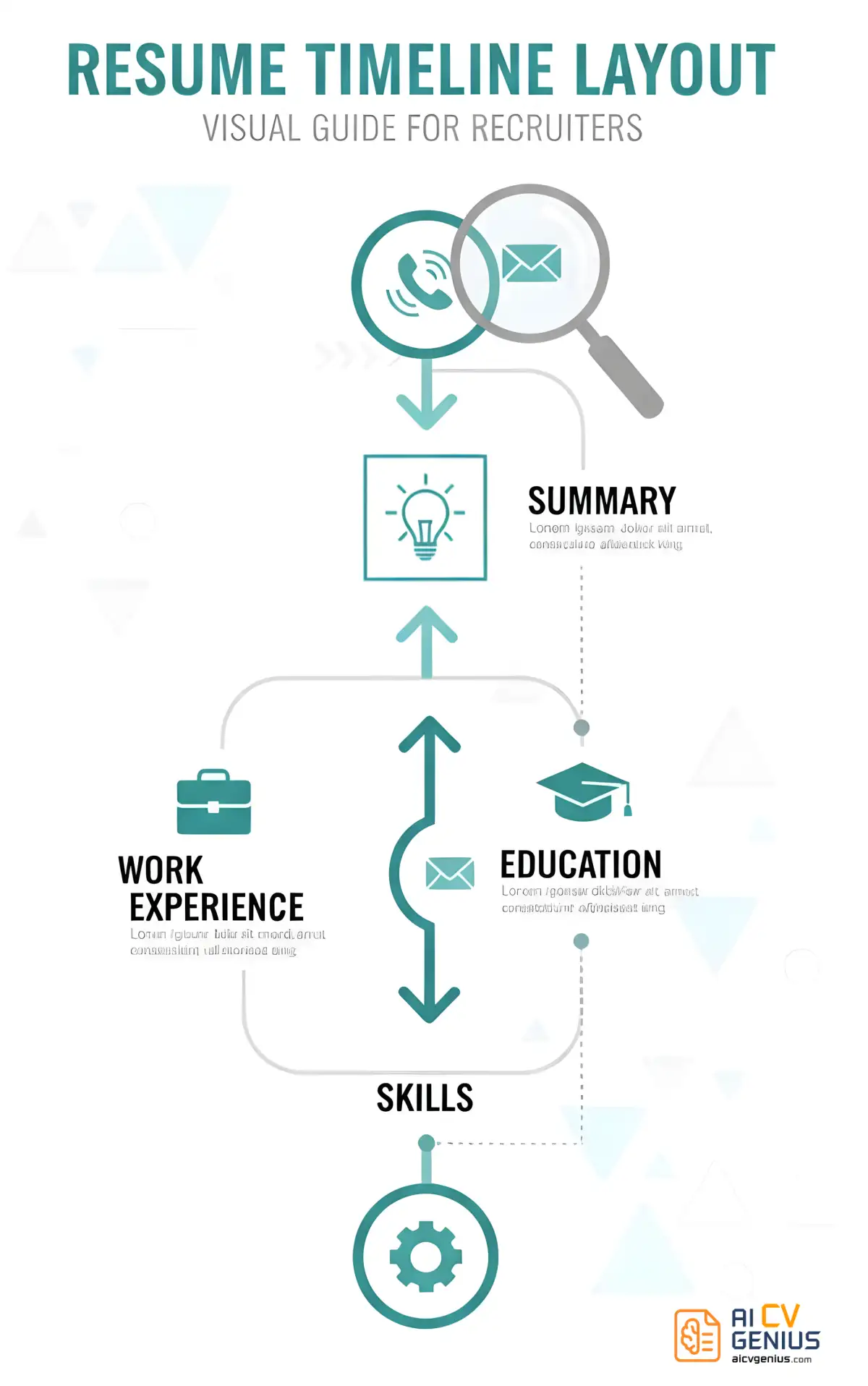
A successful chronological resume adheres to a clear, logical structure that guides the reader effortlessly through your professional story. While minor variations exist, the standard, recruiter-expected order is as follows:
- ✅ Contact Information: Positioned prominently at the very top. Includes your full name (use a slightly larger font), professional email address, phone number, city and state (full address is unnecessary), and links to your LinkedIn profile and/or professional portfolio/website. Ensure all links are clickable and lead to updated profiles.
- ✅ Professional Summary (or Objective): A concise 3-5 sentence paragraph directly below your contact info. This is your high-level pitch, summarizing your key experience, top skills, major achievements (quantified if possible), and career focus. Tailor this section meticulously for each application. (Use an Objective if you’re entry-level or changing careers).
- ✅ Work Experience (or Professional Experience): The heart of the chronological resume. List your jobs in reverse chronological order (most recent first). For each position, include:
- Job Title
- Company Name and Location (City, State)
- Dates of Employment (Month, Year – Month, Year or Present)
- 3-5 bullet points describing key responsibilities and, more importantly, *quantifiable achievements*. Start each bullet with a strong action verb.
- ✅ Education: List your degrees in reverse chronological order. Include the degree name (e.g., Bachelor of Science in Marketing), university name, location, and graduation year. Include relevant honors (e.g., Magna Cum Laude, Dean’s List) or minors/concentrations.
- ✅ Skills: Create a dedicated section listing relevant hard skills (software, tools, languages, technical abilities) and key soft skills (leadership, communication, problem-solving). Categorizing skills (e.g., “Technical Skills,” “Languages,” “Certifications”) can improve readability. Align skills listed with those mentioned in the job description.
- ✅ Optional Sections (Tailor as needed): Depending on your background and the specific role, you might include sections for:
- Certifications & Licenses: Essential for many technical, trade, or licensed professions.
- Projects: To showcase specific accomplishments outside of formal employment (especially relevant for tech, design, or freelance roles).
- Publications or Presentations: Relevant for academic, research, or thought leadership roles.
- Volunteer Experience: Demonstrates community involvement and can highlight transferable skills.
- Awards & Recognition: To showcase significant professional accolades.
- Languages: Specify proficiency level (e.g., Native, Fluent, Proficient, Basic).
This structure provides a familiar framework that allows recruiters to quickly locate the information they need while building a coherent narrative of your career journey. Consistency in formatting (bolding, dates, bullet style) across sections is crucial for professionalism.
Modernizing the Classic: Tips to Make Your Chronological Resume Stand Out
“Traditional” doesn’t have to mean “boring.” You can enhance the impact and visual appeal of a chronological resume without sacrificing its core strengths:
- ✅ Lead with a Powerful Summary: Ensure your top 3-5 lines are packed with keywords, quantifiable achievements, and a clear statement of your value proposition. This is your hook.
- ✅ Quantify Ruthlessly: Numbers grab attention and provide concrete proof of impact. Aim for at least 1-2 quantified achievements per role. Use percentages, dollar amounts, time saved, or scale (e.g., “managed a team of 15,” “supported 500+ users”).
- ✅ Use Strong Action Verbs: Start every bullet point with a dynamic verb (e.g., Led, Managed, Developed, Implemented, Increased, Reduced, Optimized, Collaborated). Avoid passive phrases like “Responsible for.”
- ✅ Incorporate Strategic Keywords: Weave in keywords from the job description naturally throughout your summary, skills section, and experience bullets to optimize for ATS and human scanners.
- ✅ Employ Clean, Modern Design:
- Use ample white space (margins, line spacing) for readability.
- Choose professional, legible fonts (e.g., Inter, Lato, Roboto, Calibri) in appropriate sizes (10-12pt for body, 14-18pt for headers).
- Use bolding strategically to highlight job titles, company names, or key metrics.
- Consider subtle color accents (e.g., navy blue, dark gray) for headings or section dividers, but avoid overly bright or distracting colors.
- ✅ Include a Link to Your LinkedIn Profile/Portfolio: Provide an easy way for recruiters to see more context, recommendations, or visual examples of your work. Ensure the linked profiles are updated and professional. Find modern template examples at Resume Templates Finder.
- ✅ Tailor Relentlessly: Customize your summary, skills, and highlighted achievements for *each specific job* you apply to. Generic resumes rarely impress.
- ✅ Proofread Meticulously: Typos and grammatical errors undermine professionalism. Use spell check, grammar tools (like Grammarly), and ask a trusted friend or mentor to review it.
By combining the trusted structure of the chronological format with modern content strategies and clean design, you create a document that is both easy to read and highly impactful.
Pitfalls to Avoid: Common Mistakes in Chronological Resumes
Even with the right structure, common errors can weaken your chronological resume:
- ❌ Listing Duties Instead of Achievements: Focusing on tasks (“Responsible for managing social media accounts”) instead of results (“Grew social media engagement by 40% by implementing a new content strategy”).
- ❌ Inconsistent Formatting: Using different date formats, varying bullet point styles, or inconsistent fonts/spacing makes the resume look sloppy and unprofessional.
- ❌ Vague or Passive Language: Using weak verbs (“Assisted with,” “Involved in”) or unclear descriptions that don’t convey specific contributions.
- ❌ Irrelevant Information Overload: Including outdated or irrelevant jobs (beyond 10-15 years unless highly significant) or listing every minor task performed. Focus on relevance and impact.
- ❌ Generic, Untailored Content: Sending the same resume for every application without customizing the summary, skills, and highlighted achievements to match the specific job requirements.
- ❌ Mixing Tenses Incorrectly: Use past tense for completed jobs and present tense for your current role’s ongoing responsibilities.
- ❌ Poor Readability: Using tiny fonts, insufficient white space, or long, dense paragraphs makes the resume hard to scan quickly.
Avoiding these mistakes ensures your resume is not only structured correctly but also communicates your value effectively and professionally.
The Recruiter’s Scan: How They Actually Read Chronological Resumes
Understanding the typical recruiter scanning pattern helps you optimize your layout for maximum visibility in those crucial first seconds. Eye-tracking studies often reveal variations of an “F” or “Z” pattern:
- Top Left: Name & Title: They first confirm who you are and your current or target role.
- Across the Top: Summary/Objective: They scan the summary for keywords, experience level, and immediate relevance. This is often the decision point for reading further.
- Down the Left Side: Job Titles & Companies: They quickly scan down the left margin, looking at your most recent job titles, company names, and employment dates to grasp your career path and stability.
- Selectively Across: Bullet Points: If the initial scan is promising, they might read the first bullet point under your most recent role(s), looking for quantifiable impact or key responsibilities matching the job.
- Quick Scan of Skills/Education: Finally, a brief glance at the skills and education sections to check for specific required qualifications or tools.
This entire process can take less than 10 seconds. Therefore, optimizing the top third of your resume (Contact Info, Summary, Most Recent Role details) is absolutely critical. Ensure your most compelling information is placed where it will be seen first.
Final Thoughts & FAQs
Final Thoughts: The Power of Clarity and Consistency
The chronological resume format endures for a simple reason: it works. It provides the clarity, structure, and narrative flow that both recruiters and ATS systems value. While it may seem traditional, its power lies in its ability to transparently showcase your growth, stability, and impact over time.
It’s not inherently flashy, but when executed well – with a compelling summary, quantified achievements, strategic keywords, and clean design – it becomes a powerful testament to your professionalism and potential. If your career path demonstrates steady progress and relevant experience, embracing this gold standard format allows your story to be told with honesty, confidence, and undeniable credibility. Focus on substance over style, tailor diligently, and let your consistent track record speak for itself.