
- Why it matters: A resignation letter is a permanent record that protects references, networks, and future options.
- What to include: Clear resignation statement, Exact last day date, Brief gratitude, And a professional offer to help transition.
- What to never include: Complaints, Detailed reasons, Emotional language, Overpromises, Or any legal accusations.
- Templates covered: Seven safe examples for standard two weeks, Ultra short, Personal reasons, Career change, Remote roles, Toxic exits, And immediate resignation.
- How to resign well: Tell your manager first, Email immediately after, Then handle counteroffers, Exit interviews, And your final two weeks with a clean transition plan.
The way you leave a job matters far more than most people think. It is not just the end of one chapter; it is the prologue to the next. A bad exit – a hasty, emotional email, a bridge-burning rant in the hallway, or the silent “ghosting” of a remote role – is a self-inflicted wound that can follow you for your entire career. It creates a permanent record of unprofessionalism, generates awkward reference checks, severs valuable network connections, and slams the door on all future opportunities with that company and its people.
A professional, graceful exit, however, is one of the most powerful and overlooked career moves you can make. It does the opposite. It opens doors. Your boss, even if disappointed, respects your professionalism and becomes a future advocate. Your colleagues see you as a person of integrity and become your allies. That company, which you are leaving today, becomes a potential client, a business partner, or a place you could one day return to on your own terms, perhaps in a more senior role.
The pivot point between these two starkly different outcomes often comes down to a single, simple document: your resignation letter. The resignation letter examples in this guide are more than just templates; they are strategic tools. They are the result of understanding the psychology, politics, and legal practicalities of a professional departure.
This isn’t about a dramatic, cinematic goodbye. It’s about creating a clean, professional, unemotional, and strategic record of your departure. This in-depth guide will cover the non-negotiable elements every letter must have, the career-killing traps you must avoid, and a new, expanded set of templates you can adapt for any situation, from the standard two weeks to the most toxic and difficult exits.
What to Include in Every Resignation Letter (The 4 Non-Negotiables)
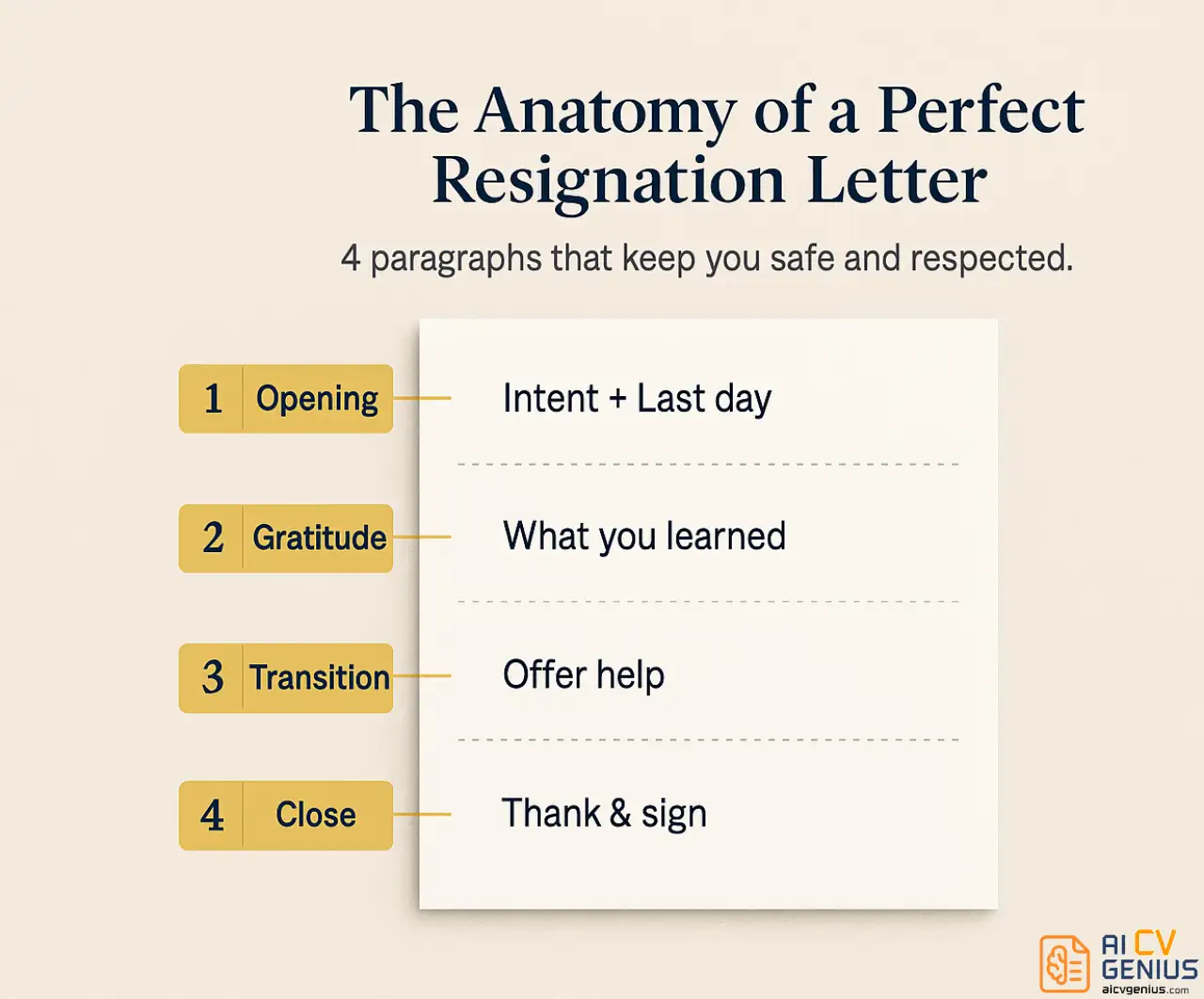
Your resignation letter is, first and foremost, a formal business document. It will be placed in your permanent employee file and may be referenced for legal or administrative reasons years from now. It must contain these four elements to be effective, clear, and professional.
1. The Clear and Direct Statement of Resignation
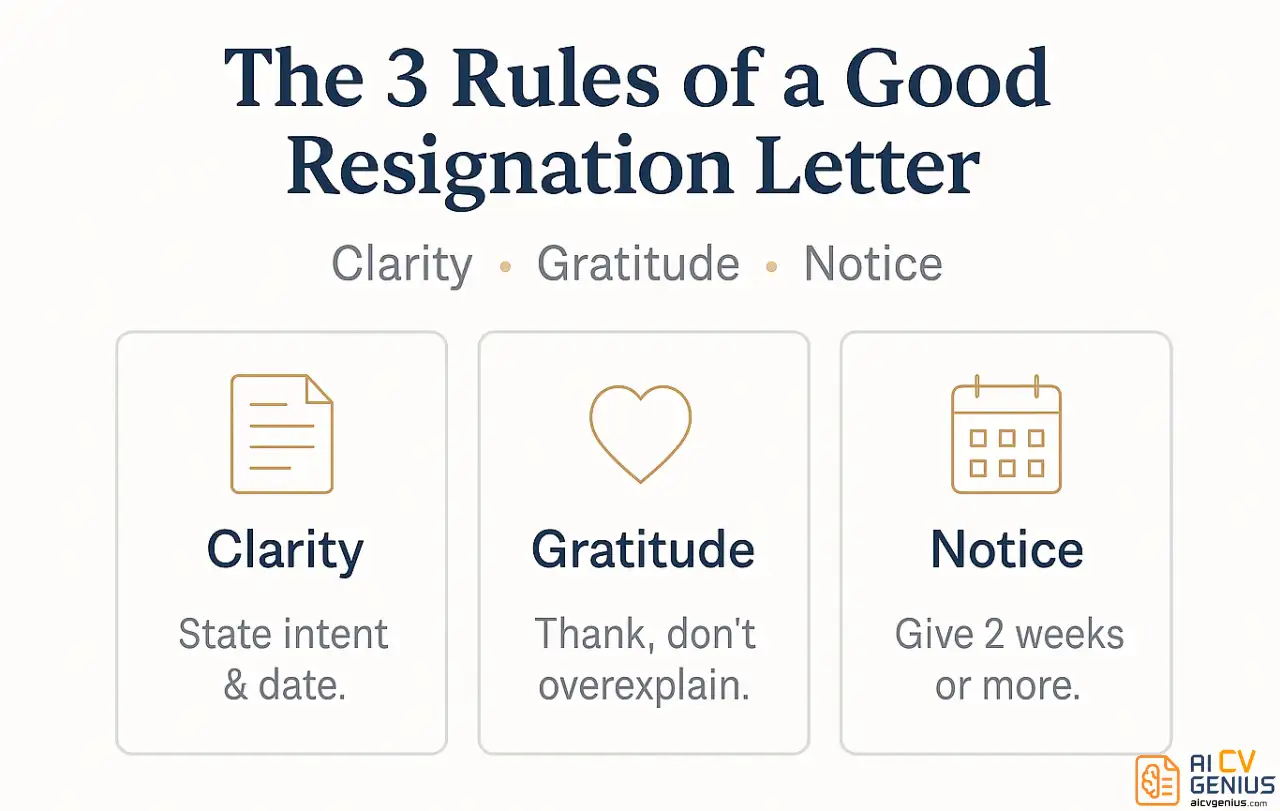
This is not the time for subtlety, hints, or soft-pedaling. Your very first or second sentence must be direct, unambiguous, and absolute. There should be zero room for interpretation.
Good:
“I am writing to formally resign from my position as [Your Title] at [Company Name].”
“Please accept this letter as formal notification that I am resigning from [Company Name].”
Bad:
“I’m thinking about making a change,” or “I’ve been exploring other options.”
This isn’t the beginning of a negotiation; it’s the notification of a final decision. HR and your manager need this legal and administrative clarity to begin the offboarding process, calculate your final pay, and start the process of finding your replacement.
2. Your Specific Last Day of Work
The second non-negotiable element is the exact date of your departure. Do not be vague. This prevents any ambiguity, which is critical for calculating accrued PTO, benefits, and the transition timeline.
Good: “My last day of employment will be Friday, November 15, 2025.”
Bad: “I’ll be leaving in two weeks,” or “I plan to finish up around the end of the month.”
The standard notice period in most professional roles is two full weeks (ten business days). For senior or executive roles, this can be 30 days or more. Check your employment contract or employee handbook for any specific notice periods you are contractually obligated to provide. Providing a clear date makes you look organized and professional.
3. A Brief, Specific Expression of Gratitude
This is the single most important part for preserving the relationship, especially if you are leaving a job you hated. You must find one positive, true thing to say. This small act of grace and maturity is what people will remember. It costs you nothing and preserves the bridge.
Even in a bad job, you can say:
- “Thank you for the opportunity to develop my skills in project management.”
- “I’ve truly valued the experience of working with the client services team.”
- “I am grateful for the chance I had to contribute to the [Project Name] launch.”
You are not thanking them for the toxic culture or the bad management; you are thanking them for an opportunity or an experience. This is the difference between emotional immaturity and strategic professionalism.
4. A Professional Offer to Help With the Transition
This sentence signals that you are a professional, not a deserter. You are showing that you care about the team’s success after you are gone, which is a key trait of a leader.
Good: “I am committed to ensuring a smooth transition during my final two weeks.”
Good: “I will do my best to wrap up my current projects and document my responsibilities to help train my replacement.”
Notice the careful wording. You are not promising to work 80-hour weeks or finish six months of work in ten days. You are promising to “do your best” and “assist.” This is a professional, bounded courtesy.
What to NEVER Include in a Resignation Letter (The Career Killers)
What you leave out of your letter is far more important than what you put in. Your resignation letter is a permanent legal document. It will live in your HR file forever. It can be read by future employers during a deep background check. It can be pulled into a lawsuit. Never, ever write something you wouldn’t want a future CEO or a lawyer to read out loud.
- ❌ Complaints or Criticisms: This is the cardinal sin. Do not mention your toxic boss, your lazy colleagues, the low pay, the broken processes, or the terrible company policies. Your letter is not a therapy session or a burn book. It makes you look petty, unprofessional, and bitter. The exit interview is the only (and optional) place for mild, constructive, and unemotional feedback. The letter is not.
- ❌ Detailed Reasons for Leaving: You do not need to justify your decision. “I’ve accepted another opportunity” or “I am leaving for personal reasons” is all the detail anyone needs. Do not mention your new salary, your new company’s name, or how excited you are to join your amazing new team. It’s no one’s business and sounds like bragging or-worse-an attempt to make your colleagues feel bad.
- ❌ Emotional Language: Avoid any and all emotional phrases. “With a heavy heart,” “I’ve struggled with this decision for months,” “I am so sad to leave,” or “I’m so sorry to do this.” This is not a breakup text. It’s a business transaction. Keep the tone professional, neutral, grateful, and positive. Any emotion introduces awkwardness and implies a need for a discussion you don’t want to have.
- ❌ Overly-Specific Promises: Do not box yourself in. Don’t promise “I will finish the entire X project before I leave” or “I will find and fully train my replacement.” You may not be able to, which sets you up for failure and leaves a final impression of not keeping your word. Stick to “I will do my best to wrap up…”
- ❌ Any Mention of Legal Issues or Harassment: If you are leaving due to harassment, discrimination, or any other serious legal matter, your resignation letter is not the place to detail it. This is a separate, serious issue that you should be discussing with an employment lawyer. Putting accusations in a resignation letter can have unintended legal consequences.
The golden rule: If you wouldn’t want a future CEO to read it, don’t write it. When learning how to write a resignation letter, remember: this letter is a strategic tool for your future, not a diary about your past.
7 Resignation Letter Examples for Any Situation
Here are seven clean, safe, and professional templates. Adapt them to your needs by copying the text and filling in the brackets. They range from the standard two weeks to more complex scenarios.
Example 1: The Standard Two Weeks Notice (The Default)
This is your go-to two weeks notice letter example. It is perfect for 90% of situations. It is professional, clear, grateful, and safe. It builds bridges and leaves a positive final impression.
[Your Name]
[Your Address]
[City, State ZIP]
[Your Email]
[Your Phone][Date]
[Manager’s Name]
[Manager’s Title]
[Company Name]
[Company Address]Dear [Manager’s Name],
I am writing to formally resign from my position as [Your Job Title] at [Company Name]. My last day of work will be [Date – two weeks from today].
Thank you so much for the opportunity over the past [duration, e.g., three years]. I have truly valued my time here and am particularly grateful for the experience I gained in [specific skill or area, e.g., client management] and the chance to work on [specific project].
I am committed to ensuring a smooth transition. I will work to complete my current projects and am happy to assist in documenting my responsibilities and training my replacement.
I wish you and the company all the best and look forward to staying in touch.
Sincerely,
[Your Signature (if sending a hard copy)]
[Your Typed Name]
Example 2: The Ultra-Short Version (Just the Facts)
Use this when you have a distant or poor relationship with your manager, are in a high-turnover role, or simply want to be as neutral as possible. These short resignation letter examples are all business.
[Date]
Dear [Manager’s Name],
I am writing to resign from my position as [Job Title] at [Company Name], effective [Date].
Thank you for the opportunity. I will work with the team to ensure a smooth transition during my notice period.
Sincerely,
[Your Name]
Example 3: Resignation for Personal Reasons (The Vague but Warm)
When you’re leaving for family, health, burnout, or relocation, you do not owe anyone the details. This template is designed to protect your privacy while remaining professional and warm.
[Date]
Dear [Manager’s Name],
I am writing to inform you of my resignation from my position as [Job Title], effective [Date].
After careful consideration, I have made this decision due to personal circumstances that require my full attention at this time.
This was not an easy decision, and I want to thank you for all the opportunities I’ve had here. I have truly enjoyed working with the team and am proud of what we accomplished, especially [specific project].
During my remaining time, I will focus on documenting my responsibilities and organizing my files to ensure a smooth handoff. Thank you for your understanding.
Sincerely,
[Your Name]
Example 4: The Career Change Resignation
This resignation letter for career change frames your departure as a positive, proactive step in your own journey, which is great for future references. It shows ambition, not unhappiness.
[Date]
Dear [Manager’s Name],
Please accept this as formal notification of my resignation from [Company Name], effective [Date].
After much reflection, I’ve decided to pursue a career change into [new field, e.g., software development]. This was not an easy decision, as I’ve greatly valued my work as [Job Title] here.
I am so grateful for the mentorship you’ve provided and the skills I’ve learned in [specific area]. The experience I’ve gained in this role has been instrumental in preparing me for this next step.
I am fully committed to making this transition as smooth as possible and will assist in any way I can.
Best regards,
[Your Name]
(If you’re making this move, our guide on how to position yourself during career changes can help.)
Example 5: The Remote Job Resignation
When you’re remote, the process is the same, but the letter needs to acknowledge the logistics. You will still have a video call first, then follow up with this email.
[Date]
Dear [Manager’s Name],
Following our video call today, please accept this as my formal resignation from my position as [Job Title], effective [Date].
Thank you for the opportunity to be part of the [Company Name] team. I’ve enjoyed my time here and am especially grateful for the experience of working on [specific project] and collaborating with such a talented remote team.
I will focus on completing my transition plan and documenting all my work to ensure a smooth handoff. Please let me know the process for returning my company equipment, and I will ensure it is shipped promptly.
I wish you and the team all the best.
Sincerely,
[Your Name]
Example 6: Resigning from a Toxic Job (The “Grey Rock” Method)
When you’re leaving a truly toxic environment, your only goal is to get out cleanly without giving them any more ammunition. This letter is deliberately bland, neutral, and unemotional. It’s called the “grey rock” method – you become as boring and unreactive as a stone.
[Date]
Dear [Manager’s Name],
I am writing to provide formal notification of my resignation from my position as [Job Title]. My final day of employment will be [Date].
Thank you for the opportunity. I will use my remaining time to finalize my projects and assist with transition-related tasks as needed.
Sincerely,
[Your Name]
(Note the single, generic sentence of gratitude. It’s the bare minimum of professionalism required to show you are taking the high road.)
Example 7: Immediate Resignation (Use with Extreme Caution)
This burns bridges. It should be a last resort. Use it only for severe health emergencies, a family crisis, or a truly toxic, unsafe, or unethical situation. Check your contract first for any financial penalties for not giving notice.
[Date]
Dear [Manager’s Name],
I am writing to inform you that I am resigning from my position as [Job Title], effective immediately, [Date].
Due to unforeseen personal circumstances, I am unable to provide the standard notice period. I apologize for any inconvenience this may cause.
I am available by email for the next few days to answer any critical questions regarding the transition. I will also coordinate with HR to return all company property promptly.
Sincerely,
[Your Name]
How to Deliver Your Resignation Letter (The Professional Process)
The how you resign is just as important as the what you write. Never, ever surprise your manager with a cold email. This is a conversation first, a document second.
- Step 1: Schedule the Meeting. Schedule a 15-minute private meeting with your direct manager. Do this in person if you’re in the office, or via a video call if you are remote. Title the meeting “Catch-up” or “Quick Chat.”
- Step 2: The Verbal Resignation (The Script). This is the hard part. Be calm, polite, and firm.
- You: “Thanks for meeting with me. I’m here to let you know that I’ve made the difficult decision to resign. I’ve accepted another opportunity, and my last day will be [Date].”
- (Pause. Let them react. They will be surprised. They may ask why, where, or what they can do.)
- Them: “Oh, wow. I’m sorry to hear that. Why are you leaving?”
- You (The Safe Answer): “It was a tough decision, but this new role is a great opportunity for my career growth that I just couldn’t pass up. I’ve really valued my time here, and I want to thank you for everything, especially [specific gratitude].”
- (If they push for details): “I’m not really in a position to share all the details, but I wanted to tell you personally and assure you I’m 100% committed to a smooth transition over the next two weeks.”
- Step 3: Email Immediately After. The moment the meeting ends, send the email. This creates the official, timestamped record.
To: Your Manager
CC: Your HR representative (or HR department email)
Subject: Resignation – [Your Name]
Body:
“Dear [Manager’s Name],
Following our conversation, please accept this as my formal resignation from my position as [Job Title]. As discussed, my last day will be [Date].
[Paste in the body of your chosen template, e.g., gratitude, transition, etc.]
Sincerely,
[Your Name]“
Do not attach the letter. Just put the letter’s text directly in the email body. It’s simpler, ensures it gets read, and prevents any “I couldn’t open the attachment” issues.
What Happens After You Resign: A Strategic Guide
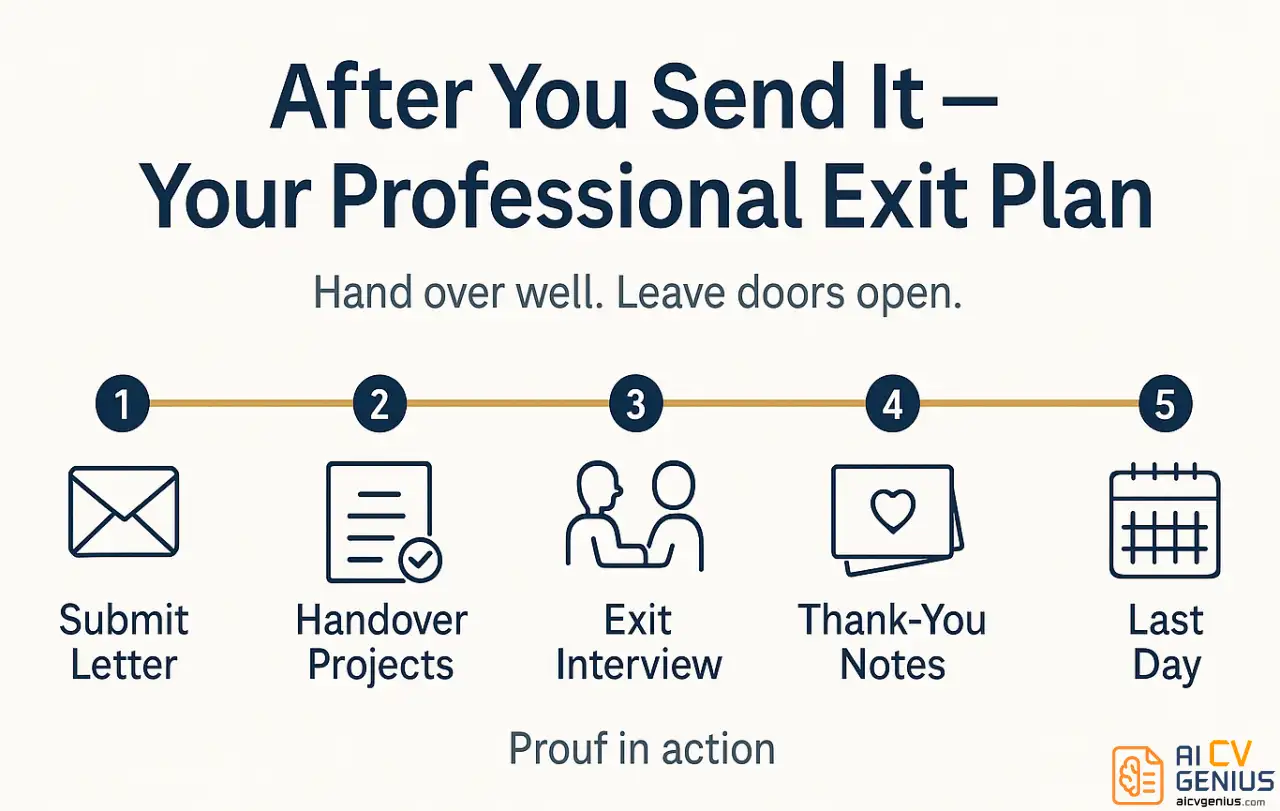
The moment you click “send” is not the end. It’s the beginning of your two-week-long final performance. How you handle this period determines your lasting reputation.
Navigating the Counteroffer
Be prepared for your boss to offer you more money. It’s flattering, but it’s almost always a trap. Statistics show that the vast majority (up to 80%) of people who accept a counteroffer are gone within a year anyway.
Why? The money rarely fixes the real reasons you wanted to leave (culture, lack of growth, bad management, burnout).
Worse:
- Your loyalty is now permanently in question. You’ll be seen as a flight risk.
- You may be passed over for future interesting projects or promotions.
- When the next round of layoffs comes, you may be first on the list.
- The raise was likely just an advance on your next review, so you’ll get nothing later.
How to Handle It: Be polite but firm. “I am so grateful for that offer, and it means a lot. But my decision is final. I’ve given my word to the new company and I’m excited about this next step for my career.”
For more, check our career resources.
Surviving the Exit Interview
HR will likely ask for an exit interview. Remember this: The exit interview is a tool for the company, not for you. HR’s job is to protect the company from lawsuits and gather data on turnover. It is not a therapy session for you to air your grievances.
You gain nothing by being brutally honest. It will not change the company, but it can get you blacklisted.
Safe, Professional Feedback:
| Instead of | Say |
|---|---|
| “My manager is a toxic micromanager.” | “I’m seeking a role with a different management style and more autonomy.” |
| “The pay here is terrible.” | “My new role offers a compensation package that is more aligned with my career goals.” |
| “The culture is awful and everyone is burned out.” | “I found a new opportunity that offers a better work-life balance.” |
Be polite, constructive, and vague. Your goal is to end the meeting with the HR person thinking, “What a professional. We’re sad to see them go.”
How to Work Your Final Two Weeks
This is your last impression. Do not “check out.” Do not spend your days on social media. Work harder and more professionally than ever.
- Create a Transition Document: This is your most important task. A detailed document with:
- A list of all your current projects and their status.
- Key contacts (internal and external) for each project.
- A list of your daily, weekly, and monthly tasks.
- Links to all important files, folders, and software.
- Login information (for generic accounts, not personal ones).
- Proactively Train: Don’t wait to be asked. Schedule time with teammates to walk them through your processes.
- Clean Your Files: Organize your digital folders. Delete personal files from your computer.
- Stay Positive: Do not complain. Do not brag about your new job. Be a helpful, positive, and gracious team member until your very last minute.
FAQ: Your Toughest Resignation Questions Answered
Final Thoughts on Resigning Professionally
Your resignation letter is the final document in your employee file. It’s one of the simplest you’ll ever write, but its impact – positive or negative – can last for years. These resignation letter examples provide a safe, strategic, and professional framework to leave any job with your head held high, regardless of the circumstances.
The goal is never to express your full range of emotions. The goal is to create a clean, clear, unemotional record that protects your professional reputation, maintains your network, and allows you to move forward to the next opportunity without burning the bridge behind you.
Ready for that next step? Explore our resume templates and guides to make sure your application for your next great role is just as professional as your exit from the last one.
Want a clean, professional template you can copy and send? Browse these Resignation Letter Examples.