
- Preparation paradox: Real prep is not memorizing scripts, it is building strong frameworks so you can speak naturally.
- Why it works: Preparation lowers cognitive load so you listen better, stay calm, and answer with clearer stories.
- 8-step checklist: Research the company, deconstruct the role, build a story library, use STAR, prepare strong questions, control logistics, practice out loud, send a thoughtful follow-up.
- Confidence signals: Ask peer-level questions, document decisions in your answers, and show curiosity instead of performing.
- Common mistakes: Rambling, perfect generic answers, no questions, sounding rehearsed, fix by using stories not scripts and ending your answers cleanly.
The Preparation Paradox: Why Over-Preparing Is the Secret to Being Authentic
Most of us get interview preparation wrong. We think it means memorizing robotic answers, staring at our own resume until the words blur, and scripting the “perfect” response to “What’s your greatest weakness?” This approach doesn’t make you feel confident. It makes you feel brittle, terrified that one unexpected question will shatter your entire performance.
Here is the paradox: Real preparation is not about scripting. It is about building a framework so strong that you can afford to be spontaneous. It is about doing the research so thoroughly that you can stop “performing” and start having a genuine conversation.
This interview preparation checklist is not a script. It is a strategic framework. It is designed to move you from a place of anxiety (What will they ask me?) to a place of confidence (I know what I bring, and I am curious to see if we align). Let’s walk through it, not as a test, but as a systematic way to build the calm, authentic confidence that interviewers are actually looking for.
“You don’t prepare to build a perfect script. You prepare so you can throw the script away.”
The Psychology of Preparation: Why It Actually Works
When you walk into an interview unprepared, your brain is doing two things at once: 1) Trying to listen to the question, and 2) Frantically searching your entire life’s history for a relevant answer. This is called high cognitive load, and it is why you freeze or ramble.
Preparation is the process of reducing that load. By thinking through your stories and the company’s needs beforehand, you are not memorizing lines. You are building mental “file folders.” When the interviewer asks a question, your brain does not have to search the whole library; it just goes to the right folder.
This process changes the entire dynamic. It frees up your mental energy to focus on what actually matters: active listening, building rapport, and showing genuine curiosity. You stop sounding like a nervous candidate and start sounding like a future colleague.
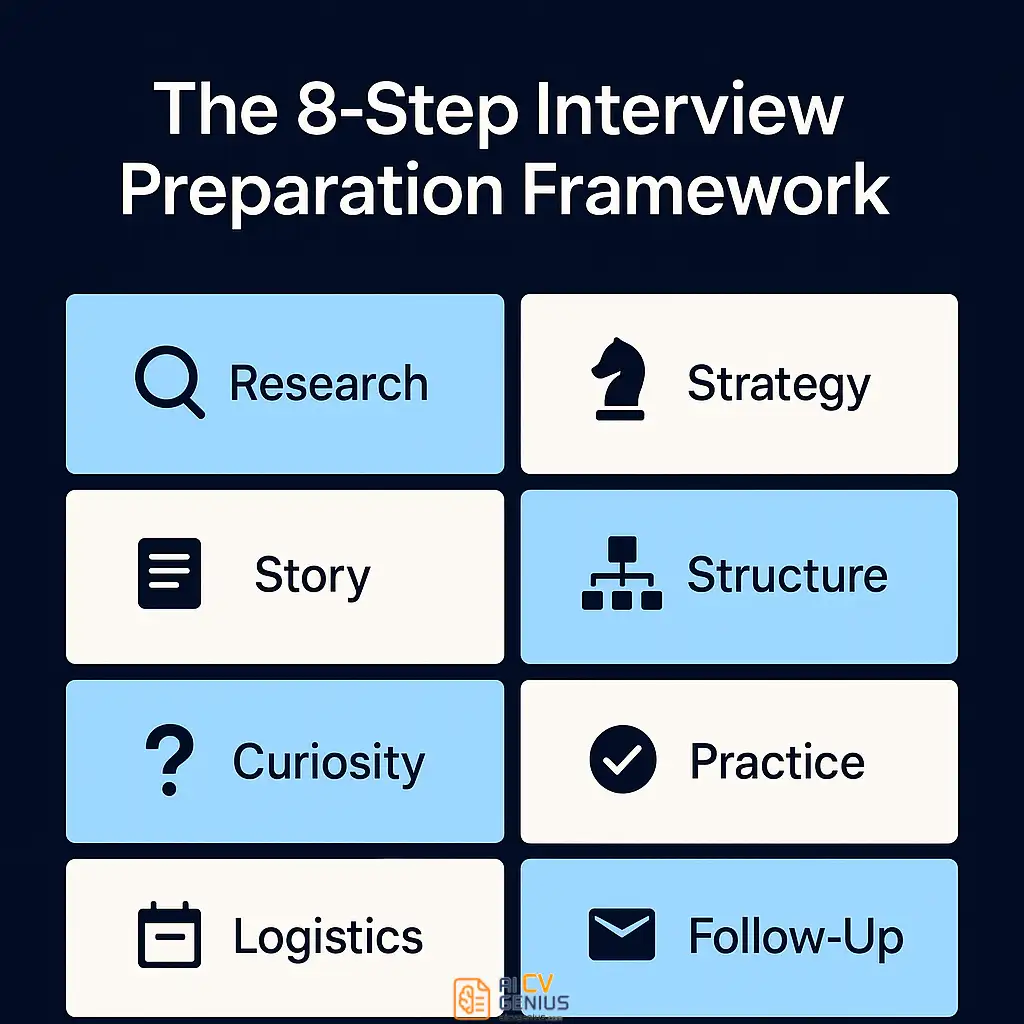
The 8-Step Interview Preparation Checklist for a Confident Conversation
Step 1: Decode the Company Beyond the “About Us” Page
Recruiters are impressed by candidates who understand their current reality, not their marketing tagline. Your goal is to understand their problems so you can position yourself as the solution.
- ✅ Read Their News & Press Releases: What have they launched in the last six months? Did they just get funding? Are they expanding into a new market? This gives you context.
- ✅ Analyze Their Competitors: How are they different from their top 2-3 competitors? What is their unique value proposition? This shows strategic thinking.
- ✅ Find Your Interviewer on LinkedIn: Look at your interviewer’s career path. How long have they been there? Did they get promoted? This helps you build rapport (e.g., “I saw you also came from the X industry…”).
- ✅ Check Employee Reviews (Glassdoor): Read reviews with a critical eye. What are the common themes, both positive and negative? This gives you a feel for the real culture, not the stated one.
The Goal: To be able to naturally weave this into your answers. Instead of a generic, “I am a team player,” you can say, “I saw you just launched the new X feature, which must have required incredible cross-functional collaboration. My experience leading a product launch…” This is a night-and-day difference.
Step 2: Deconstruct the Role Like an Engineer
The job description is not a wish list; it is a blueprint of the company’s problem. They are hiring because there is a gap or a pain point. Your job is to prove you are the person to fill it. Read the job description and sort every bullet point into three categories:
| Category | What It Is | Example |
|---|---|---|
| 1. The “Must-Haves” | The non-negotiable hard skills. These are the “gatekeeper” requirements. | “5+ years of Python experience,” “Salesforce Certified,” “Proficient in Figma.” |
| 2. The “Culture-Fits” | The soft skills that show how you work. | “Fast-paced environment,” “strong communicator,” “ability to work independently.” |
| 3. The “Hidden Problem” | The reason the job exists. (Usually a blend of the first two). | “Scale our user acquisition,” “streamline our reporting process,” “manage key client accounts.” |
Now, for every point in those three categories, find one specific example from your past. This pre-links your experience directly to their needs. You can find excellent examples of how to word these impact statements in our career resources guides.
Step 3: Build Your “Story Library” (Not Scripts)
This is the most critical step. Do not memorize answers. Curate your stories. An interviewer does not remember your claims (“I’m a hard worker”); they remember your proof (a story about a time you worked hard).
Go through your resume and find 5-7 “core stories” that you can adapt to multiple questions. Focus on these themes:
- A Time You Led a Project: (Shows leadership, planning, execution)
- A Time You Handled Conflict: (Shows empathy, communication, maturity)
- A Time You Solved a Complex Problem: (Shows analytical skills, creativity)
- A Time You Failed or Made a Mistake: (Shows self-awareness, accountability, resilience)
- A Time You Collaborated Successfully: (Shows teamwork, influence)
“Interviewers don’t remember perfect answers. They remember compelling, honest stories told with calm confidence.”
By preparing these stories, you will have a flexible answer ready for 80% of behavioral questions, whether they ask about “a challenge,” “a disagreement,” or “a success.”
Step 4: Master the STAR Method for Behavioral Questions
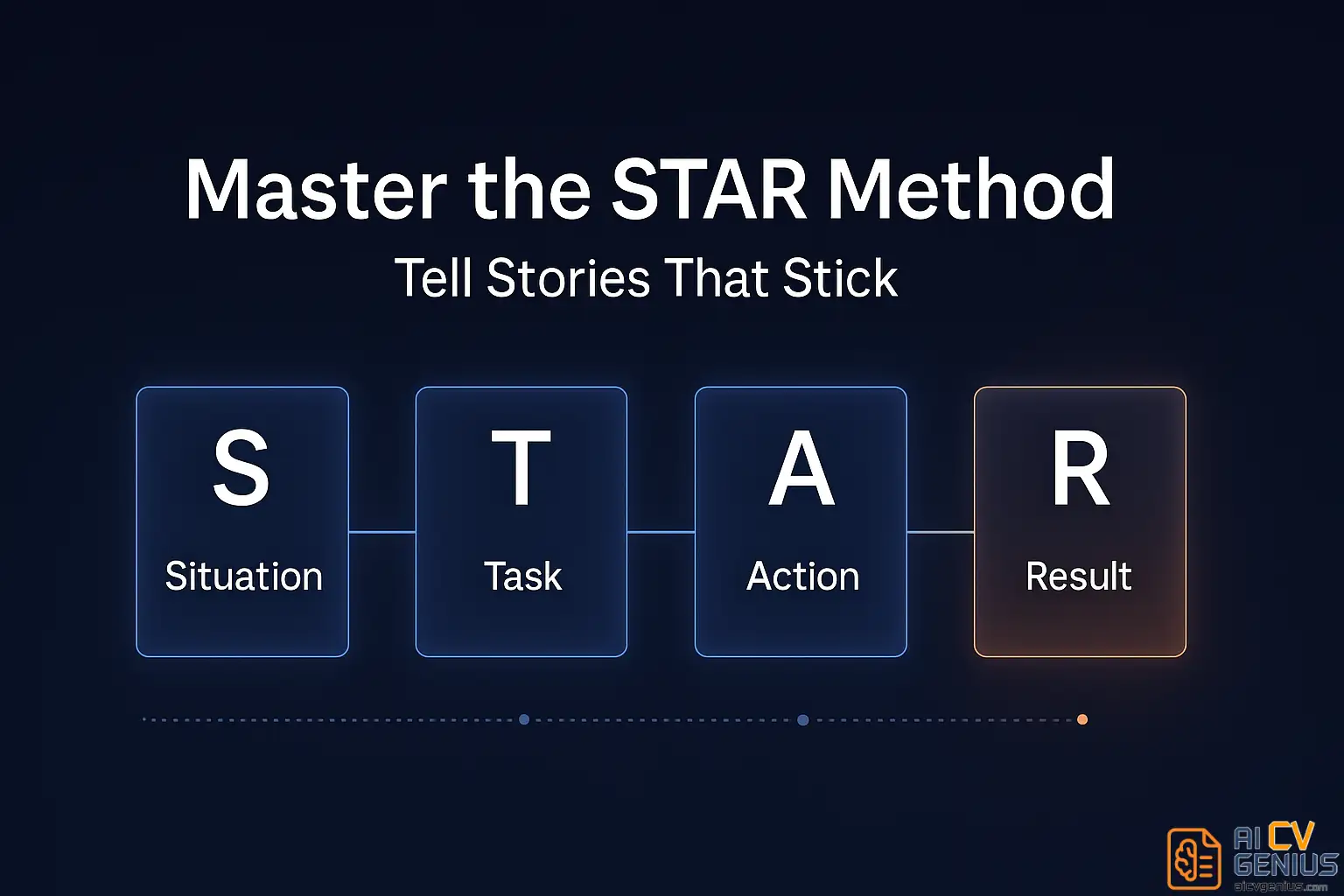
Having your stories is step one. Structuring them is step two. The STAR method (Situation, Task, Action, Result) is the gold standard for a reason: it forces you to be concise and outcome-focused.
- S (Situation): Set the scene. (1-2 sentences). “In my last role as a project manager, our team was struggling with missed deadlines.”
- T (Task): What was your specific responsibility? (1 sentence). “My task was to diagnose the bottleneck and implement a new system.”
- ️A (Action): What did you do? This should be 70% of your answer. “First, I interviewed each team member and learned the old software was the problem. Then, I researched and pitched a new tool, got buy-in, and led a 2-week training sprint.”
- R (Result): What was the outcome? Quantify it. “As a result, our team’s on-time delivery rate improved by 40% in the first quarter.”
Pro-Tip: Add a “+L” for “Learned.” After the Result, add: “What I learned from that experience was…” This shows high-level self-awareness.
Step 5: Prepare Questions That Prove You Are a Peer, Not a Subordinate
At the end of the interview, they will ask, “Do you have any questions for us?” This is not a formality. This is your final test.
Weak Questions (show anxiety): “What’s the salary?” “How much vacation time?” “What’s the next step?”
Strong Questions (show curiosity, strategy, and cultural fit):
- About the Role: “What does success look like for this position in the first 90 days? What are the biggest challenges I would face?”
- About the Team: “How does the team handle feedback and disagreements? What is the collaboration style between this team and [Other Department]?”
- About the Interviewer: “What has been your favorite part about working at this company? What is a quality you see in your most successful team members?”
- About the Future: “As the company grows in the next year, what is the biggest opportunity or challenge this team will face?”
These questions show you are already thinking like an employee and are evaluating them as much as they are evaluating you. This is a massive confidence signal.
Step 6: Control Your Environment (The Logistics That Matter)
Nothing shatters confidence faster than a preventable last-minute panic. Your goal is to eliminate all friction so your brain can focus on the conversation. This is a non-negotiable part of your interview preparation checklist.
If it is a Video Interview (The “Remote” Checklist):
- ✅ Tech: Test the link the day before. Use wired headphones for clear audio (AirPods can die).
- ✅ Lighting: Put your main light source (like a window) in front of you, not behind you.
- ✅ Camera Angle: Position the camera at or slightly above eye level.
- ✅ Background: A clean, simple wall is 100x better than a distracting virtual background.
- ✅ Notifications: Quit Slack, email, and all other apps. Put your phone on silent and in another room.
If it is an In-Person Interview:
- ✅ The Outfit: Lay out your entire outfit the night before, ironed and ready.
- ✅ The Route: Map the route. Know exactly where you are going. Plan to arrive 10-15 minutes early. (Do not walk in more than 10 minutes early; wait in your car or a nearby cafe).
- ✅ The Bag: Pack a folder with 3-4 copies of your resume (yes, even today), a nice pen, a small notebook, and a bottle of water.
Step 7: Practice Out Loud (The Most Skipped, Most Valuable Hack)
You may feel silly, but this is the secret weapon. Your answers sound perfect in your head. The first time you say them out loud, they are often a rambling mess. You need to get the “first draft” of your answers out before you are in the room.
Find a friend or mentor and do a mock interview. If you cannot, just open your laptop, hit record, and answer your “core stories” from Step 3. Watch it back. You will instantly see where you ramble, use filler words (“um,” “like”), or lose energy. This is the fastest way to polish your delivery from “rehearsed” to “natural.”
Step 8: The Follow-Up That Feels Genuine
Your interview is not over when you leave the room. The follow-up email is your final (and easiest) chance to make a professional, lasting impression. Send it within 24 hours.
Do not use a generic template. Your note must be personal. Use this simple structure:
- Gratitude: Thank them for their time.
- Reference a Moment: Mention something specific and positive from the conversation. “I particularly enjoyed our discussion about [Specific Topic, e.g., the new content strategy].”
- Reiterate Value: Briefly connect your experience to their need. “My experience in [Your Skill] feels like a strong match for the challenges you described.”
- Enthusiasm: End with a simple, confident closing. “I am even more excited about the role now and look forward to hearing about the next steps.”
This shows you were actively listening. For more examples, the same principles of tone in our cover letter writing tips apply to thank-you emails.
Quick Recap: The Confidence Checklist
| Phase | Checklist Item | Why It Matters |
|---|---|---|
| Research (3 Days Out) | Decode the company’s recent news and competitors. | Shows strategic thinking, not just basic interest. |
| Strategy (2 Days Out) | Deconstruct the job description into needs/problems. | Aligns your experience as the perfect solution. |
| Storytelling (2 Days Out) | Build a “Story Library” (5-7 core examples). | Gives you flexible, authentic answers (no scripts). |
| Structure (1 Day Out) | Practice your core stories using the STAR method. | Makes your answers concise, compelling, and outcome-focused. |
| Curiosity (1 Day Out) | Prepare 3-5 intelligent questions to ask them. | Proves you are a curious, high-level thinker. |
| Logistics (1 Day Out) | Removes all last-minute friction and anxiety. | Plan your outfit, tech, and travel route. |
| Practice (1 Day Out) | Practice your answers out loud (record yourself). | Polishes your delivery and removes filler words. |
| Mindset (Day Of) | Reframe nervousness as excitement. Be a partner, not a performer. | Lets your genuine personality and confidence show. |
| Follow-Up (After) | Send a specific, thoughtful thank-you email. | Reinforces your professionalism and interest. |
Common Interview Mistakes (And the Psychology Behind Them)
| ❌ The Mistake | The (Anxious) Psychology | ✅ The (Confident) Fix |
|---|---|---|
| Talking too much / rambling | “I’m afraid I’m not giving them enough, so I’ll just keep talking.” | Answer, then stop. Use the STAR method to force a conclusion. Let silence happen. It signals confidence. |
| Giving generic, “perfect” answers | “They want a flawless candidate. I can’t admit I’ve ever failed.” | Be human. A story about a real mistake and what you learned is far more credible than “My weakness is I’m a perfectionist.” |
| Not asking any questions | “I’m just happy to be here. I don’t want to seem difficult.” | Be curious. An interview is a two-way street. Asking smart questions shows you are evaluating them, too. |
| Appearing robotic or rehearsed | “I’ve memorized all 50 common questions and my perfect answers.” | Prepare stories, not scripts. Focus on your bullet points (STAR) and let the connecting words be natural. |
In-Depth FAQs: Your Toughest Preparation Questions
Final Thoughts: Preparation Is an Act of Respect
A great interview is not a performance; it is a conversation. It is not about being the smartest person in the room; it is about being the most self-aware, curious, and prepared one.
Following this interview preparation checklist is an act of respect – for the company’s time and for your own potential. It is the work you do beforehand that allows you to walk in, be present, and let your genuine competence and personality shine through. Do not memorize. Reflect, prepare, and walk in ready to connect.