
- Main idea: A “soft skills vs hard skills” resume is the wrong frame, recruiters want proof you can execute and work well with others.
- Definitions: Hard skills are teachable and measurable tools, soft skills are how you work, adapt, and collaborate in real situations.
- Big mistake: A generic skills laundry list is empty, put keywords in Skills but put proof in Experience.
- Best method: Pair one soft skill action with one hard skill tool inside a result driven bullet so impact is obvious.
- Formatting: Split Skills into soft and hard categories for fast scanning and ATS, then support each category with real bullets by role.
The Great Resume Debate: Why a Soft Skills vs Hard Skills Resume Misses the Point
Think of your resume as a story of your professional capability. For decades, job seekers have been told to focus on the “what” – the technical tools, the degrees, the certifications. But in the modern workplace, a new truth has emerged: the “what” is useless without the “how.”
This is the central tension of every hiring decision. A soft skills vs hard skills resume is not a battle where one side wins. It is a puzzle that a successful candidate must solve. Recruiters are not looking for a technical genius who cannot collaborate, nor are they looking for a charming communicator who cannot execute. They are looking for a complete professional.
Employers often say, “We hire for hard skills, but we fire for soft skills.” That is why a resume that skillfully blends both creates immediate and profound trust. It signals that you are not just competent, but also adaptable, reliable, resilient, and a low-risk, high-impact addition to any team.
The Recruiter’s Psychology: What “Balance” Really Signals
When a hiring manager scans your resume, they are conducting a rapid risk assessment. Every bullet point either builds trust or raises a red flag. Understanding the difference between soft and hard skills on a resume is key to understanding this psychology.
- Hard Skills = Your “Can Do” Evidence: These are your entry ticket. They prove you have the technical, teachable, and quantifiable knowledge to perform the job’s core functions. A lack of relevant hard skills signals an immediate “no” due to a capability gap.
- Soft Skills = Your “Will Do” Predictor: These are your force multipliers. They predict how you will apply your hard skills. Will you use them in isolation, or will you use them to elevate the team? Will you adapt when a tool changes? Will you communicate a complex idea clearly? A lack of soft skills signals a long-term “no” due to a collaboration or culture risk.
A balanced resume proves you are a “safe bet.” It tells the recruiter: “I have the technical ability to do the job, and I have the emotional and interpersonal intelligence to do it well with others.”
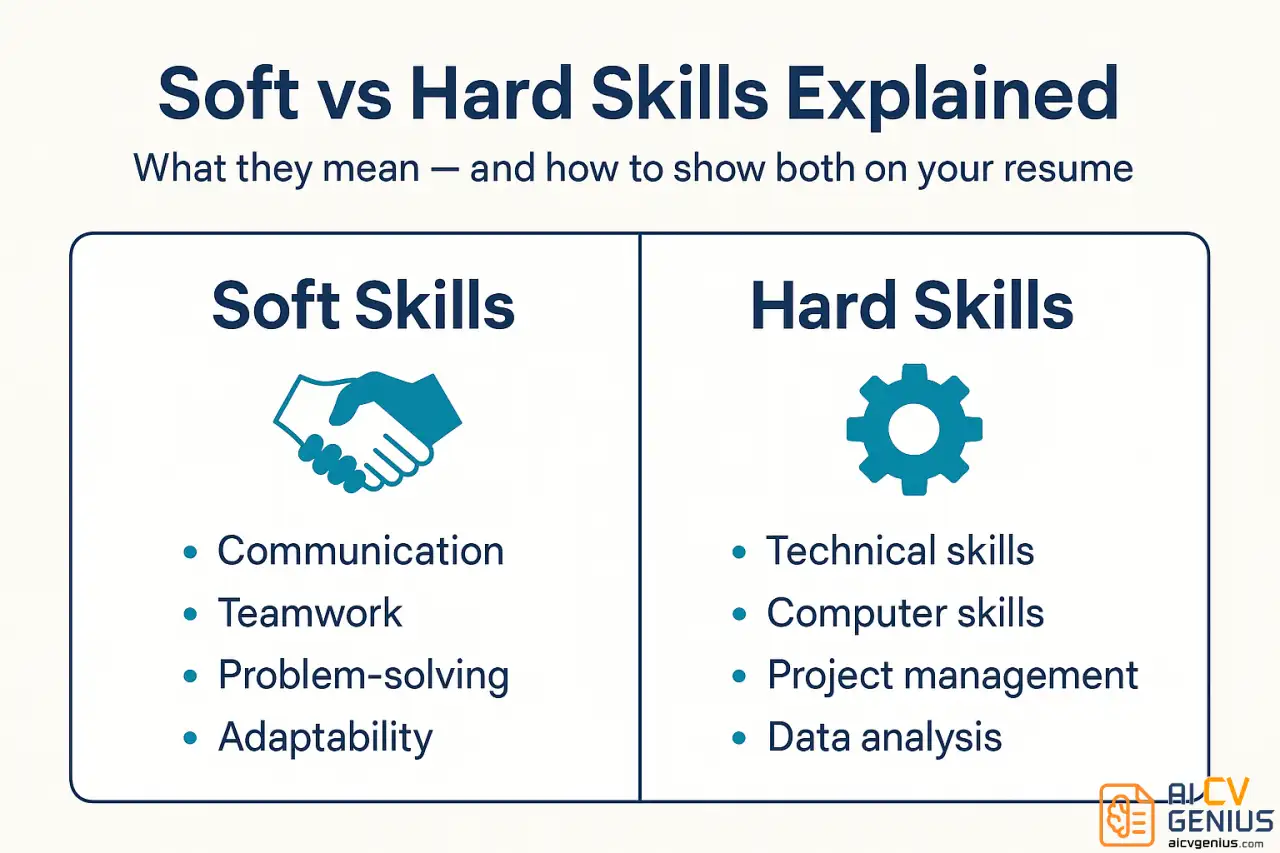
How to Demonstrate Hard and Soft Skills on Your Resume
Deconstructing the Divide: Soft Skills vs. Hard Skills
Before we can blend them, we must clearly define them. The difference is not just in the skill itself, but in how it is acquired, demonstrated, and measured.
What Are Hard Skills?
Hard skills are tangible, teachable, and measurable proficiencies. They are the “technical” mechanics of a job. You can earn a certificate in a hard skill, take a class on it, or prove your level with a test.
Examples of Hard Skills:
- Technical: Python, Java, SQL, AWS, Git, Network Security, SAS
- Analytical: Data Analysis, Financial Modeling, A/B Testing, SEO/SEM, Google Analytics
- Software: Microsoft Excel (PivotTables, Macros), Salesforce, Adobe Creative Suite, AutoCAD, Jira
- Marketing: Content Writing, Email Marketing, PPC Advertising, Social Media Management
- Language: Fluency in Spanish, French, Japanese (written and verbal)
- Other: Project Management (Agile, Scrum), Grant Writing, Video Editing, Bookkeeping
What Are Soft Skills?
Soft skills are the interpersonal, behavioral, and cognitive traits that define how you work. They are harder to quantify, context-dependent, and developed through experience rather than instruction. They are, in essence, your professional character.
Examples of Soft Skills:
- Communication: Verbal Presentation, Written Clarity, Active Listening, Negotiation, Persuasion
- Leadership: Mentorship, Strategic Planning, Decision-Making, Delegation, Change Management
- Collaboration: Teamwork, Conflict Resolution, Empathy, Cross-Functional Collaboration
- Productivity: Time Management, Organization, Prioritization, Adaptability, Reliability
- Thinking: Critical Thinking, Problem-Solving, Creativity, Analytical Mindset, Curiosity
Neither side outweighs the other. A resume that only lists hard skills feels robotic. A resume that only lists soft skills feels hollow. The magic is in the integration.
The Worst Mistake: The “Laundry List” Skills Section
Most job seekers fail right here. They wonder how to list soft and hard skills on a resume and default to the weakest possible method: the “laundry list.”
Example (The 99% Resume):
Skills: Microsoft Office, Python, SQL, Communication, Teamwork, Problem-Solving, Leadership, Adaptability.
This tells a recruiter nothing. It is a list of empty claims. You have not proven you possess “Leadership” any more than you have proven you are a “Time Traveler.”
The solution is simple: Your skills section is for keywords. Your experience section is for proof.
The Skill-Pairing Method: How to Prove Both at Once
The most effective resume bullet point is a mini-story that weaves a hard skill and a soft skill together to produce a measurable result. This “Skill-Pairing” method is the secret to balancing technical and interpersonal skills resume writing.
The Formula: [Action Verb (Soft Skill)] + [Hard Skill Application] + [Context/Result (Metric)]
Let’s see this formula transform weak bullets into undeniable proof.
Example 1: The Software Engineer
- Weak (Hard Skill Only): “Wrote backend code in Python and SQL.”
- Weak (Soft Skill Only): “A good team-player and communicator.”
- ✅Strong (Skill-Pairing): “Collaborated [Soft] with product managers to define [Soft] project scope, then developed [Hard] a new Python/SQL backend [Hard] that reduced [Result] API latency by 30%.”
Example 2: The Marketing Manager
- Weak (Hard Skill Only): “Used SEO tools and Google Analytics.”
- Weak (Soft Skill Only): “A creative and strategic thinker.”
- ✅Strong (Skill-Pairing): “Analyzed [Soft] a 50% drop in traffic using Google Analytics [Hard], identified [Soft] a critical keyword gap, and led [Soft] a new SEO content strategy [Hard] that recovered [Result] all traffic in 3 months.”
Example 3: The Administrative Assistant
- Weak (Hard Skill Only): “Proficient in Microsoft Excel.”
- Weak (Soft Skill Only): “Very organized and efficient.”
- ✅Strong (Skill-Pairing): “Designed [Soft] and implemented [Hard] a new Excel-based tracking system [Hard] for vendor invoices, automating [Hard] a manual process to save [Result] 10+ hours of admin work per week.”
In each strong example, the hard skill is the tool, but the soft skill is what provides the direction, purpose, and impact. This is what recruiters want to see.
In-Depth Examples of Soft and Hard Skills for Resume (By Role)
Let’s apply the Skill-Pairing method to different career paths. Notice how the balance shifts, but is always present.
For Technical Roles (e.g., Data Analyst, IT, Engineer)
You must prove your hard skills, but soft skills show you are not just a “coder” – you are a problem-solver and a collaborator.
- ✅ “Communicated [Soft] complex findings to non-technical stakeholders by visualizing [Hard] data in Tableau dashboards [Hard], leading [Soft] to a 15% shift in marketing budget.”
- ✅ “Mentored [Soft] two junior developers in Python [Hard] best practices, improving [Soft] team code quality and reducing [Result] code-review cycle time by 25%.”
- ✅ “Resolved [Soft] a critical P1 bug by debugging [Hard] a legacy Java application [Hard], restoring [Result] service for 10,000+ users in under an hour.”
For Managerial Roles (e.g., Project Manager, Team Lead)
Here, soft skills like leadership and communication become the primary hard skills. They are paired with management methodologies (which are hard skills).
- ✅ “Led [Soft] a 12-person cross-functional team, implementing [Hard] Agile/Scrum methodologies [Hard] to deliver [Result] a $1M project 2 weeks ahead of schedule.”
- ✅ “Negotiated [Soft] a new contract with a key vendor, identifying [Soft] new terms that saved [Result] the company $50,000 annually.”
- ✅ “Mediated [Soft] a scope-creep conflict between engineering and product, refocusing [Soft] the team on the core MVP and preventing [Result] a 4-week delay.”
For Creative Roles (e.g., Designer, Writer)
Your hard skills (Adobe Suite, Figma) are assumed. Your soft skills (creativity, communication) are what get you hired.
- ✅ “Presented [Soft] three new brand identity concepts (designed in Figma [Hard]) to C-level executives, synthesizing [Soft] their feedback to deliver [Result] a final design that was adopted company-wide.”
- ✅ “Collaborated [Soft] with the marketing team to write [Hard] and optimize [Hard] a new email nurture sequence [Hard], increasing [Result] click-through-rates by 22%.”
For Customer-Facing Roles (e.g., Sales, Customer Support)
Hard skills (Salesforce, CRMs) are the tools you use to execute your soft skills (empathy, persuasion).
- ✅ “Leveraged [Hard] Salesforce data [Hard] to identify 20 high-risk accounts, then used active listening [Soft] to resolve [Soft] their core issues, saving [Result] $250K in potential churn.”
- ✅ “Persuaded [Soft] 5 new enterprise clients to sign on by demonstrating [Hard] how our product’s technical features [Hard] solved [Soft] their specific business problems, exceeding [Result] quota by 115%.”
Strategic Formatting and Real-World Application
How to Format Your Resume’s Skills Section (The Smart Way)
After you have proven your skills in your experience section, you can use your “Skills” section as a keyword-rich area for ATS scanners. Do not “laundry list.” Categorize.
Instead of this (Weak):
Skills: Teamwork, JavaScript, Leadership, Microsoft Office, Problem-Solving, Agile.
Try this (Strategic & Organized):
Core Competencies (Soft Skills):
Strategic Planning | Team Leadership | Cross-Functional Communication | Stakeholder Management | Conflict Resolution | Process OptimizationTechnical Proficiencies (Hard Skills):
JavaScript (ES6+), React, Node.js | SQL & NoSQL (PostgreSQL, MongoDB) | Agile/Scrum Methodologies | AWS (S3, EC2) | Data Visualization (Tableau)
This structure is clean, professional, and lets a recruiter see your skill profile in 3 seconds. Many of our Resume Templates Finder options are designed to present this balanced structure clearly.
Real-World Example: A Balanced Resume Transformation
Meet Lara, a graphic designer. Her old resume was all hard skills – a list of software she knew. It got her almost no calls.
Old Bullet:
“Used Adobe Illustrator, Photoshop, and InDesign for branding projects.”
(This is a hard skill claim with no context or impact.)
We rewrote it using the Skill-Pairing method to include the human side of her work.
New Bullet:
“Collaborated [Soft] directly with 5 clients to understand [Soft] their brand vision, translating [Soft] their ideas into 10+ new brand assets using the Adobe Suite [Hard], and delivering [Result] all projects 100% on time.”
The result? Her new resume connected her technical ability (hard) with her client management and communication (soft), proving she was not just a technician, but a creative partner. That simple shift doubled her interview callbacks.
“Hard skills get you the interview. Soft skills get you the job – and the promotion.”
Pros & Cons of Emphasizing Both Skill Types
| Pros | Cons |
|---|---|
|
|
Final Thoughts: It’s Not “Vs.” – It’s “And”
Stop thinking in terms of a soft skills vs hard skills resume. The most successful professionals in any field are “bilingual” – they speak the language of technical execution (hard skills) and the language of human connection (soft skills).
Your resume is your first and best chance to prove your fluency in both. Do not just list your tools; show how you used them to solve a problem. Do not just claim you are a leader; show how you collaborated with a team to achieve a result. When you master this balance, your resume stops being a simple list of facts and becomes a compelling story of your true value.