

- Core focus: Your first week is about relationships, observation, and learning the unwritten rules, not proving output.
- Day 1 to 2: Set up access, learn the rhythm, then ask smart questions about priorities, culture, decision-making, and who matters.
- Day 3 to 5: Schedule 1-on-1s, synthesize notes into patterns and gaps, check in with your manager, then set 3 to 5 realistic Week 2 goals.
- Mistakes to avoid: Trying to change things too fast, staying invisible, overcommitting, comparing to your old company, and stepping into office politics.
- Success signal: Leave week one with a clear map of people, processes, and expectations, plus a plan to contribute safely in week two.
The First Week Is About People, Not Tasks
Most new employees make the same mistake: they focus on proving themselves through work output in their first week. They rush to complete tasks, demonstrate expertise, or suggest improvements.
This is backwards. Your first week is not about productivity – it’s about relationships, observation, and learning the cultural code. The work will come. Right now, your job is to understand who people are, how things get done, and where the landmines are.
Think of your first week as intelligence gathering. You’re mapping the terrain: who has influence, what the unwritten rules are, how decisions get made, and what behaviors are rewarded or punished.
This day-by-day checklist shows you exactly what to focus on each day to maximize your first week.
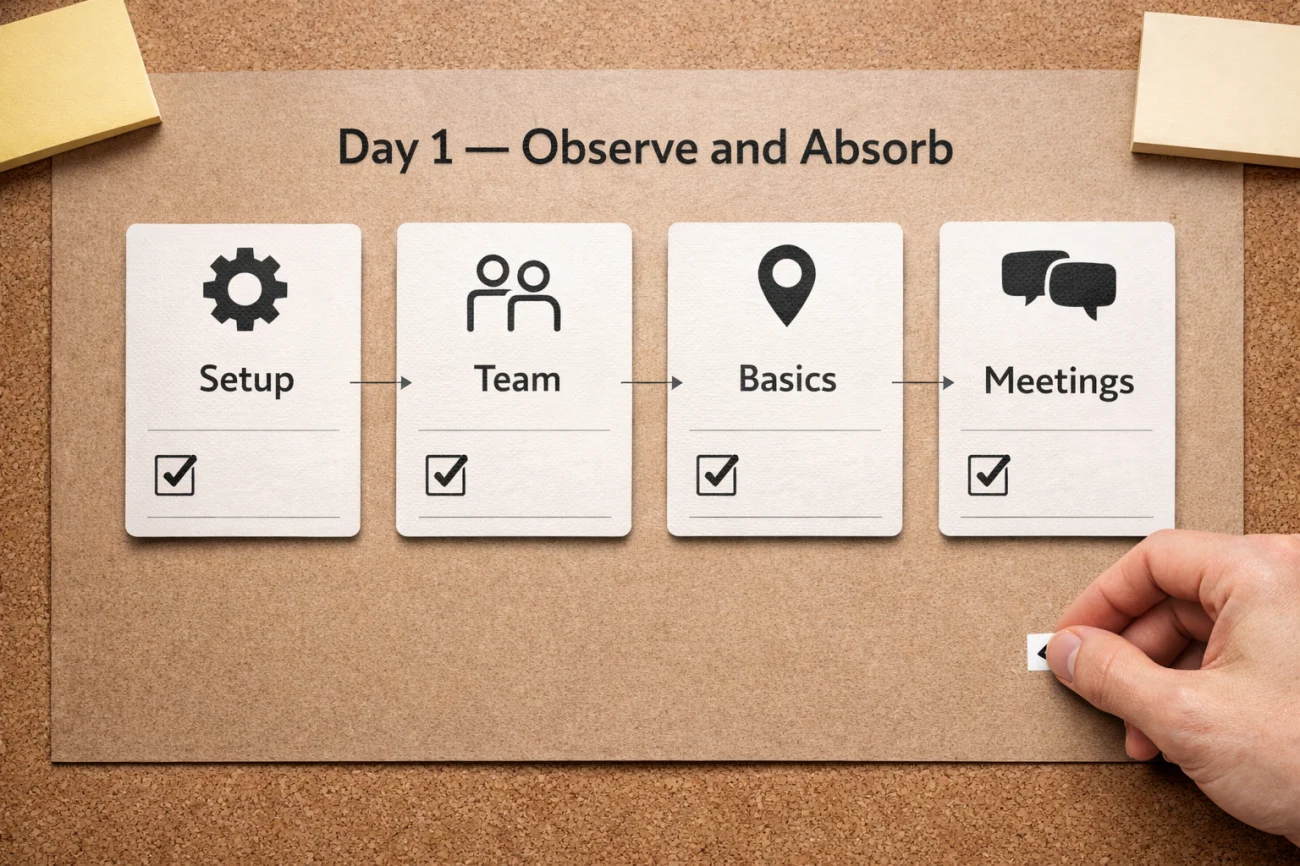
Day 1: Observe and Absorb
Your first day is overwhelming. New systems, new people, new processes, new everything. Don’t try to be productive. Focus on setup and observation.
Essential Tasks
- Complete technical setup: Get laptop, accounts, credentials, access to systems. Don’t leave anything incomplete – technical blockers compound.
- Meet your immediate team: Put faces to names. Learn what each person does. Don’t try to remember everything – just absorb.
- Find the basics: Bathroom, kitchen, where to park, how lunch works, what time people arrive/leave.
- Attend any scheduled meetings: Say yes to everything. Just listen – don’t contribute opinions yet.
What to Observe
Pay attention to the unwritten rules:
- What time do people actually arrive vs. official start time?
- Do people eat lunch at their desks or together?
- How casual are Slack/email communications?
- Who talks in meetings? Who stays quiet?
- What’s the dress code in practice vs. policy?
These cultural signals matter more than official policies.
Day 1 Success Metric
You’re set up technically, you’ve met your immediate team, and you have a sense of the office rhythm. You don’t need to have accomplished actual work.
For comprehensive onboarding strategies, see our complete new job guide.
Day 2: Ask Smart Questions
Day two is when you start asking questions. But not just any questions – strategic questions that help you understand how things really work.

Questions That Matter
About the work:
- “What should I prioritize in my first 30 days?”
- “What does success look like in this role after 3 months?”
- “What are the biggest challenges the team is facing right now?”
About the culture:
- “What’s the best way to communicate with you – Slack, email, in person?”
- “How do decisions typically get made here?”
- “What mistakes do new people typically make?”
About the people:
- “Who should I connect with outside our immediate team?”
- “Who are the go-to people for [specific area]?”
- “What’s something I should know that’s not in the documentation?”
Questions to Avoid
Don’t ask questions that make you seem unprepared or entitled:
- ❌ “When do I get promoted?”
- ❌ “What are the PTO policies?” (you should know this from offer stage)
- ❌ “Why don’t we do it like [your old company]?”
Take Extensive Notes
Write everything down. People’s names, terminology you don’t understand, processes you need to learn. You won’t remember it all, and taking notes shows you’re taking things seriously.
Day 2 Success Metric
You’ve asked substantive questions to key people and taken notes on their answers. You’re building a mental map of how things work.
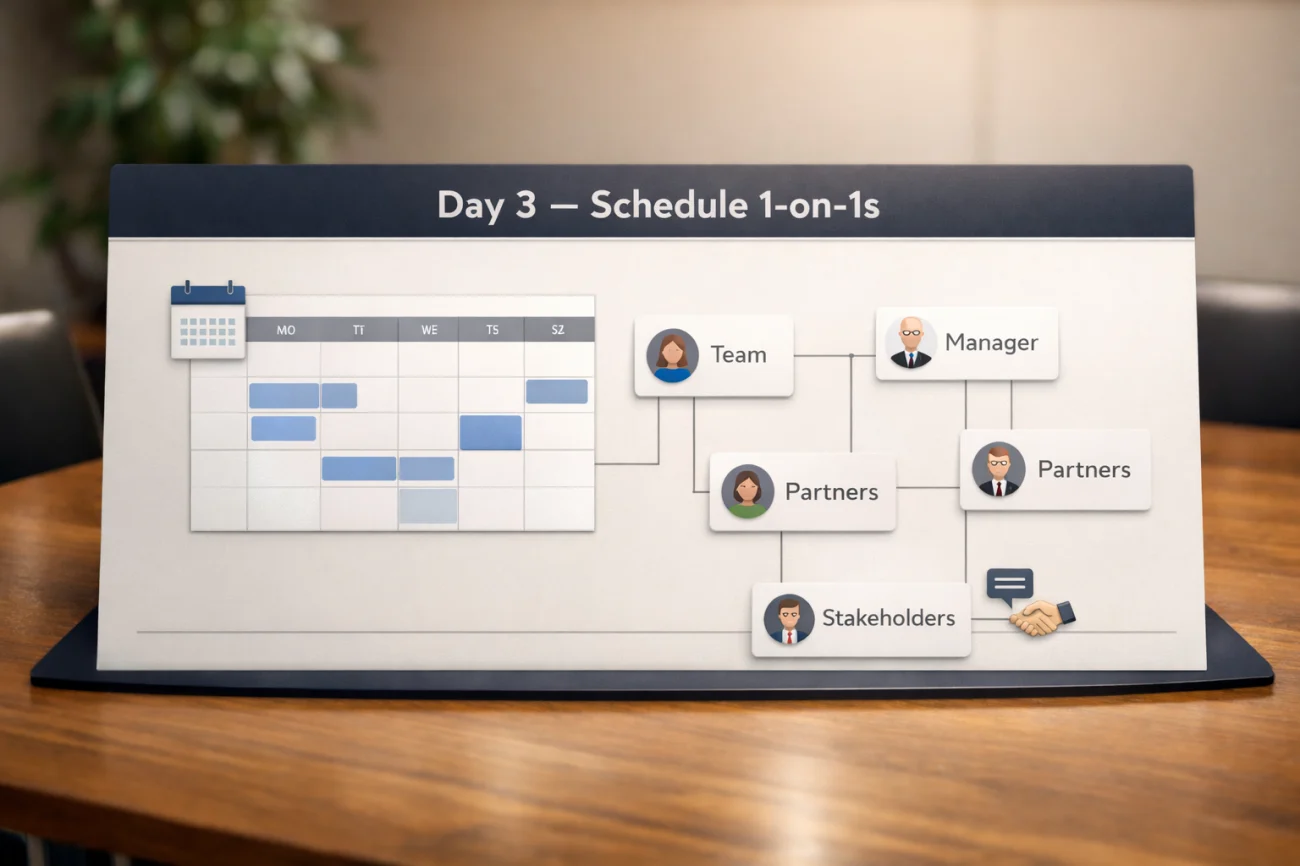
Day 3: Schedule 1-on-1s
By day three, you should start scheduling 15-30 minute 1-on-1 meetings with teammates and key stakeholders. These aren’t just social – they’re strategic relationship building.
Who to Meet With
- Direct teammates (everyone on your immediate team)
- Your manager (if you haven’t had a substantive 1-on-1 yet)
- People in other departments you’ll work with
- Anyone your manager suggests connecting with
How to Request the Meeting
Send a brief Slack or email message:
Hi [Name], I’m new to the team and would love to schedule 15-20 minutes to learn about what you do and how we might work together. Would you have any time this week or next?
Most people will say yes. New employees get a grace period for asking for people’s time.
What to Ask in 1-on-1s
Keep it conversational but purposeful:
- “What do you work on day-to-day?”
- “How does your role intersect with mine?”
- “What should I know about working with your team?”
- “What’s one thing you wish you’d known when you started here?”
- “What’s the best way to reach you if I need something?”
End with: “Is there anyone else you think I should connect with?”
Day 3 Success Metric
You’ve scheduled at least 3-5 1-on-1 meetings for this week and next. These meetings will build the foundation for your working relationships.
Day 4: Review and Synthesize
By day four, you have a lot of information. Today is about organizing it and identifying patterns.
What to Review
Your notes: Go through everything you’ve written down. Organize by theme:
- People and roles
- Processes and workflows
- Tools and systems
- Cultural norms
- Priorities and goals
Identify gaps: What don’t you understand yet? What questions remain unanswered? Write these down to ask later.
Start contributing: Look for small, low-risk tasks you can take on. Don’t start anything major, but offering to help with small things shows initiative:
- “I noticed the team needs meeting notes – I can take those next time.”
- “Is there documentation I can help update or improve?”
- “Are there any small tasks I can take off your plate?”
Check In With Your Manager
Brief update to your manager (in person or Slack):
Quick update: I’ve met with [list people], completed [onboarding tasks], and I’m getting up to speed on [current priorities]. Planning to focus on [specific area] next week. Anything you’d like me to prioritize differently?
This shows you’re organized and proactive.
Day 4 Success Metric
Your notes are organized, you’ve identified knowledge gaps, and you’ve checked in with your manager about priorities.
Day 5: Plan for Week 2
Friday is about consolidating what you’ve learned and planning your approach for week two.
Reflect on Week 1
Answer these questions for yourself:
- What did I learn about the team’s priorities?
- Who are the key people I need to build relationships with?
- What are the biggest challenges or problems I’ve heard about?
- Where can I start adding value in week 2?
- What do I still not understand?
Set Week 2 Goals
Draft 3-5 specific goals for your second week:
Week 2 Goals:
1. Complete remaining 1-on-1s with team members
2. Take ownership of [specific small task] 3. Attend [specific meeting] and contribute thoughtfully
4. Learn [specific tool or system] 5. Deliver [specific small deliverable]
These should be concrete and achievable – this is week 2, not week 10.
End the Week on a Social Note
If people are grabbing lunch or drinks Friday, join them. Building informal relationships matters as much as formal work relationships.
If nothing is planned, suggest something simple: “Anyone want to grab coffee this afternoon?”
Day 5 Success Metric
You have a clear plan for week 2, you’ve built initial relationships, and you’re ready to start contributing more actively.
For more first-week strategies, explore our complete onboarding guide.
5 Mistakes to Avoid in Your First Week

1. Trying to Prove Yourself Too Quickly
Don’t suggest major changes or criticize existing processes in your first week. You don’t have enough context yet. Focus on learning, not impressing.
2. Being Invisible or Antisocial
Don’t hide at your desk or skip social opportunities. Eat lunch with people. Accept coffee invitations. Join team activities. Relationships matter.
3. Saying Yes to Everything Without Boundaries
You should be accessible and eager, but not to the point of burnout. If someone asks you to take on something major in week one, it’s okay to say: “I want to make sure I do this well – can we plan for me to start this in week 2 once I’m more settled?”
4. Constantly Comparing to Your Old Company
Never say: “At my last company we did it this way…” in your first week (or first month, honestly). Even if you have great ideas, frame them as questions: “Have you considered [approach]?” not “We should do it like [old company].”
5. Getting Involved in Office Politics
You’ll notice tensions or conflicts. Don’t pick sides or express opinions about interpersonal dynamics in your first week. Stay neutral and observe.
FAQ
The First Week Sets the Foundation
Your first week isn’t about proving you’re worth the salary. It’s about building the foundation for long-term success: relationships, cultural understanding, and credibility.
Follow the day-by-day framework: observe on day one, ask smart questions on day two, schedule 1-on-1s on day three, review and synthesize on day four, and plan for week two on day five.
Avoid the common mistakes: don’t try to prove yourself too quickly, don’t be antisocial, don’t overcommit, don’t compare to your old company, and don’t get involved in office politics.
Focus on people, not tasks. The work will come. Right now, your job is to understand the environment, build relationships, and position yourself for success in the weeks and months ahead.
Get the first week right, and everything else becomes easier.
For additional new job resources, check out our comprehensive career transition guide.