
- Main idea: A career change nursing resume must read like a purposeful pivot, not a random switch.
- Hiring manager lens: They weigh risk versus reward, so your job is to reduce doubt and highlight maturity, resilience, and motivation.
- Core strategy: Translate your old career language into healthcare outcomes like safety, patient advocacy, coordination, and clear communication.
- What to emphasize: Put education, licensure, and clinical rotations up front, then support them with focused bullets that show real practice.
- What makes it work: A human summary that connects your “why” to the unit, plus a clean structure that makes the story obvious in 6 seconds.
The Identity Shift: When a Resume Becomes a Calling
Changing careers is one of the most profound acts of self-discovery an adult can undertake. But shifting into healthcare is something deeper. It is rarely just about finding a new job; it is about answering a call and finding a truer version of yourself. For the countless professionals moving into healthcare, that journey starts with a quiet, persistent realization: they want their work to mean something tangible.
A career change nursing resume is therefore more than a list of qualifications. It is a bridge. It is the story of how your compassion, your intellect, and your resilience finally found a single, focused direction. It is the most important story you will tell in your professional life, because it explains not just what you did, but why you are here now.
You might have spent years, or even decades, in another field – business, education, customer service, law, or tech. You built a successful identity. And now, you are ready to bring that entire library of experience into something more fundamentally human. The good news is, nothing you have learned is wasted. Not a single second. It all still matters. You are not starting from zero. You are starting from a place of deep understanding, maturity, and perspective that new graduates cannot match.
“You are not switching paths – you are aligning with your purpose. Your old career was not a detour; it was the training ground.”
The Hiring Manager’s Dilemma: What They Really Think
Before you write a single word, you must get inside the head of the Nurse Manager or HR Director reading your resume. They are not reading a story; they are managing risk. Their inbox is full of resumes from new graduates with fresh clinical hours and experienced nurses with years on the floor. Yours is the wild card.
When they see your career change nursing resume, they have two immediate, conflicting thoughts:
- The Risk: “This person has no ‘real’ nursing experience. Will they handle the physical demands? Will they crack under the pressure of a code? Are they just ‘playing nurse’ because they were bored in their office job? Will they be harder to train?”
- The Reward: “This person has 10 years of real-world experience. They know how to handle difficult people. They understand process. They are mature, organized, and have proven they can hold a job. They are choosing nursing for a reason, which means their motivation might be higher than someone who just drifted into it.”
Your resume has one job: to minimize their perceived risk and maximize their perceived reward. You must prove, with every bullet point, that your past experience is not irrelevant – it is a powerful asset that makes you more prepared, more resilient, and more valuable than the typical applicant.
From Marketing to Medicine: Sarah’s Story
Take Sarah, for example. She spent a decade in marketing, managing complex campaigns and demanding clients. She was successful by every external metric – good salary, steady promotions, a respected rhythm – but something was profoundly missing. When her father got sick, she spent weeks in and out of the hospital, watching nurses do the kind of work that demanded not just skill, but heart. She saw them coordinate, advocate, and provide comfort under immense pressure. She never forgot it. Two years later, she was finishing her accelerated BSN, terrified but more determined than she had ever been.
When it came time to write her resume, Sarah’s biggest fear was that her past would not fit her future. How could “marketing strategy” possibly connect to bedside care? But when we sat down together, it became clear that it was not about matching industries – it was about translating values.
Communication. Empathy. Coordination. Education. All those years managing clients were actually years of learning how to care for people, manage their expectations, and communicate complex information under pressure. Her new summary opened like this:
“Former marketing professional turned resilient nursing graduate, bringing 10 years of experience in high-stakes communication, project coordination, and human connection into patient-centered care. Eager to apply proven organizational skills and a passion for advocacy to the [Unit Name] team.”
It was short, sincere, and true. It did not hide her past; it leveraged it. And it worked – she got three interviews that month, all in competitive units.
The Core of Your Resume: The Art of Translation
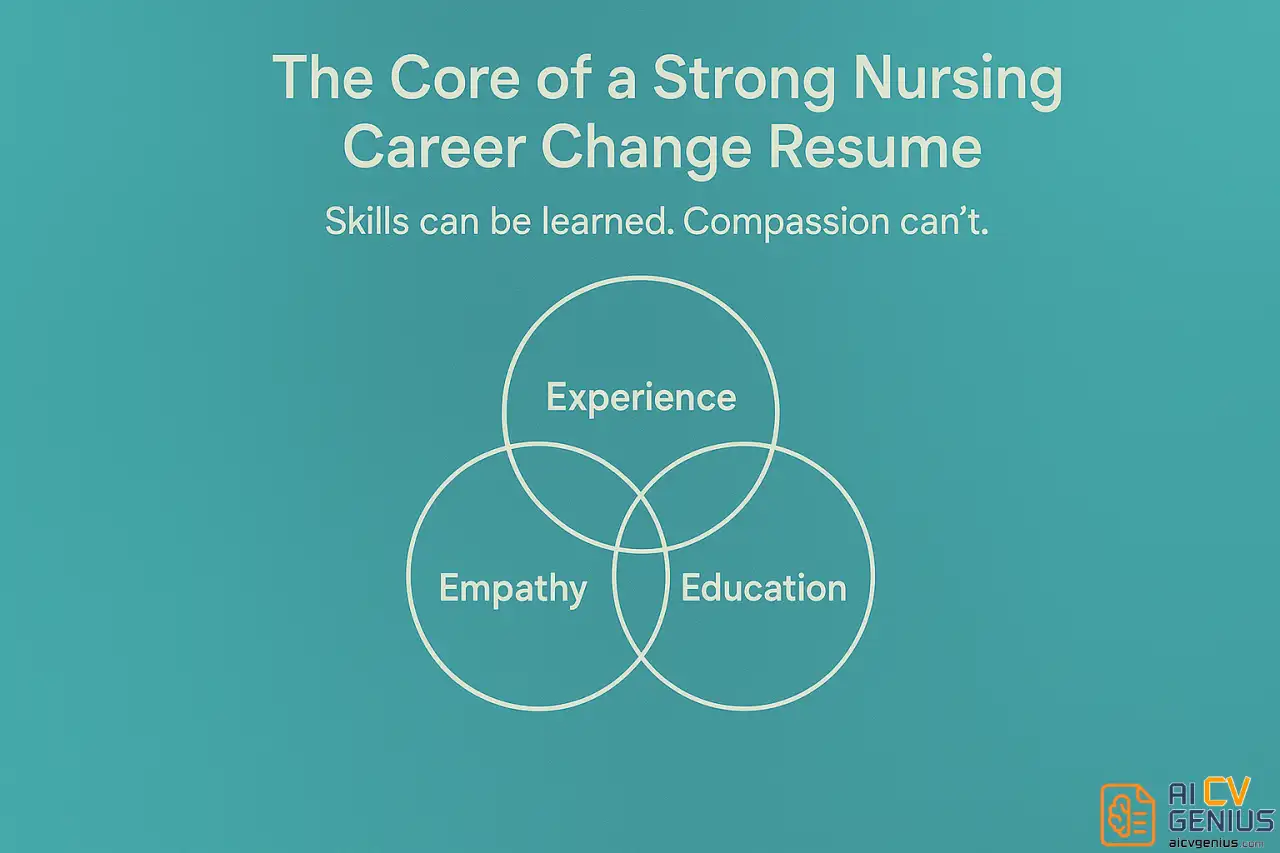
This is where your resume will succeed or fail. You cannot use the language of your old career. You must “translate” your experience into the language of healthcare. Every past job leaves you with something that belongs in nursing. Your job is to show how your skills now serve patients instead of clients, projects, or bottom lines.
Let’s break it down by common former careers. Find yourself in this list and see how the language shifts from “corporate” to “care.”
Scenario 1: From Corporate (Marketing, Finance, Project Management) to Care
Your strengths are organization, communication, and performing under pressure.
| Old Career Language (What you wrote) | Reframed for Nursing (What they read) |
|---|---|
| “Managed key client accounts and resolved complaints to ensure retention.” | “Patient Advocacy: Supported individuals and families under stress, using clear communication and empathy to de-escalate conflict and ensure needs were met.” |
| “Coordinated multi-department projects to meet quarterly deadlines.” | “Team Coordination: Collaborated across diverse teams (similar to interdisciplinary care teams) to ensure consistent and safe project delivery under tight deadlines.” |
| “Presented complex data reports to senior leadership.” | “Patient Education: Skilled in breaking down complex information into simple, understandable terms to guide decision-making (a core skill for patient education).” |
Scenario 2: From Service (Retail, Hospitality, Customer Service) to Stewardship
Your strengths are empathy, resilience, and managing unpredictable human behavior.
| Old Career Language (What you wrote) | Reframed for Nursing (What they read) |
|---|---|
| “Handled high volumes of customer complaints in a fast-paced environment.” | “Conflict Resolution: Remained calm and empathetic while managing high-stress, emotionally charged situations with the public, consistently finding positive resolutions.” |
| “Trained new employees on service procedures and protocols.” | “Process & Education: Guided peers through learning new, detailed processes with patience, ensuring 100% compliance with quality standards.” |
| “Managed daily operations, including inventory and scheduling.” | “Time Management: Mastered prioritizing competing tasks in an unpredictable environment, ensuring all essential duties were completed safely and efficiently.” |
Scenario 3: From Education (Teacher, Administrator) to Empathy
Your strengths are patience, education, and managing diverse needs.
| Old Career Language (What you wrote) | Reframed for Nursing (What they read) |
|---|---|
| “Developed lesson plans for students with diverse learning needs.” | “Care Planning: Skilled in assessing individual needs and developing tailored plans to achieve specific goals (a direct parallel to patient care planning).” |
| “Communicated with parents about student progress and concerns.” | “Family Communication: Practiced in delivering sensitive information with empathy and clarity to families, building trust and collaborative relationships.” |
| “Managed a classroom of 30 children, ensuring safety and order.” | “Risk & Safety Management: Maintained a safe and structured environment for a vulnerable population, adhering to strict safety protocols and managing group dynamics.” |
Notice how small the change is? You are not rewriting your past. You are reframing it around care, safety, communication, and people.
Education and Credentials: Your New Foundation
When you are new to nursing, your education is your strongest anchor. It must be placed prominently at the top of your resume, right after your summary. This section proves you have the required license and clinical foundation.
Structure it for clarity:
EDUCATION & LICENSURE
Bachelor of Science in Nursing (BSN) – University of Michigan, Ann Arbor, MI (Expected 2024)
- Relevant Coursework: Pathophysiology, Geriatric Care, Community Health Nursing
- Honors: Graduating Summa Cum Laude (GPA: 3.9/4.0)
Bachelor of Arts in English – Michigan State University, 2015
LICENSURE & CERTIFICATIONS
- Registered Nurse (RN), State of [Your State] – License #1234567 (or “Pending NCLEX – July 2024”)
- Basic Life Support (BLS) – American Heart Association, Expires 2026
- CPR Certified – American Red Cross, Expires 2026
Including your previous degree is vital. It adds dimension and explains your story. A psychology major brings emotional intelligence. A business graduate brings organization. A tech background brings analytical skill. It all makes you a more complete caregiver.
Spotlight on Clinical Rotations: Your Proof of Practice
This is your “experience” section before you have experience. Do not just list the hospitals. Create a separate section called “Clinical Experience” and treat it like a real job. Use 2-3 bullet points to highlight skills, not just tasks. Focus on the units that match the job you want.
CLINICAL ROTATION EXPERIENCE
[Total Clinical Hours: 600+]Senior Practicum: Medical-Surgical Unit – [Hospital Name] (120 hours)
- Managed a 4-patient caseload, performing head-to-toe assessments, medication administration, and wound care.
- Collaborated with the interdisciplinary team to coordinate patient discharge planning, focusing on patient education.
Pediatrics Rotation – [Hospital Name] (60 hours)
- Adapted communication styles for pediatric patients and families to reduce anxiety during procedures.
- Assisted in post-operative care, vital sign monitoring, and electronic health record (EHR) charting.
Geriatrics Rotation – [Hospital Name] (60 hours)
- Developed and implemented care plans for patients with complex co-morbidities, including dementia and diabetes.
- Focused on mobility assessments and fall prevention protocols.
Writing the Summary That Sounds Like You
Your summary – those first three lines – is your handshake. It must sound like something you would actually say out loud. No buzzwords, no stiff corporate tone. It must, in one breath, connect your past to your future.
Formula: [Past Professional Identity] + [Transition Verb] + [New Nursing Identity] + [2-3 Key Transferable Skills] + [Your "Why" or Goal].
Here are more examples that work beautifully:
From Education:
“After several years in education, I realized that my greatest fulfillment came from helping others feel safe, heard, and capable. Now, as a newly licensed nurse, I am bringing that same patience, empathy, and organizational skill into clinical care.”
From Tech:
“Detail-oriented former analyst now pivoting to nursing, bringing a strong background in data-driven problem-solving and process improvement to patient care. Eager to apply analytical skills to a new, human-centered challenge.”
From Service:
“Resilient customer service leader with 8+ years of experience in high-stress, fast-paced environments. Transitioning into nursing to apply a proven talent for de-escalation, empathy, and service excellence to patient advocacy.”
This kind of summary does not just list skills; it tells a small truth about why you changed – and that truth creates connection.
Structure That Tells a Story
For a career change nursing resume, your resume must read like a narrative. This layout lets recruiters feel the progression of your journey, not confusion about your shift. Clarity comes first.
A simple, powerful structure looks like this:
- Contact Information & RN License #
- Professional Summary (Your 3-line “bridge” story)
- Education & Licensure (New degree first, old degree second)
- Clinical Rotation Experience (Detailed, with bullet points)
- Relevant Skills (Split into “Clinical Skills” and “Transferable Skills”)
- Professional Experience (Your previous career, reframed for healthcare)
This structure immediately tells the hiring manager: “I am a licensed nurse, this is my clinical foundation, and here is the deep professional experience I bring with me.” It answers their questions before they can even ask them.
The Cover Letter: Where You Get to Breathe
If your resume is your proof, your cover letter is your heartbeat. This is your non-negotiable opportunity to tell your story. A cover letter for a career-changer is more important than for any other candidate. It is the one place where you can explicitly state your “why.”
Your cover letter should be a brief, 3-paragraph story:
- Paragraph 1: The Hook. State the role you are applying for and your excitement. Briefly connect your unique background to their needs. “As a recent BSN graduate with a 10-year background in project management, I was immediately drawn to the fast-paced, collaborative environment of your Emergency Department.”
- Paragraph 2: The “Why.” This is it. Tell your story. Be honest and professional. “While I found success in marketing, my experience [e.g., in a volunteer role, or with a family member’s illness] solidified my desire for a more direct, human-impact role. Nursing is not a ‘new’ career for me; it is the career all my other experiences – in communication, organization, and advocacy – have been leading up to.”
- Paragraph 3: The Close. Reiterate your value. “I am eager to bring my unique blend of maturity, resilience, and clinical training to [Hospital Name]. Thank you for your time and consideration.”
If you need a place to start, you can find examples in our cover letter collection. You will notice they do not sound fancy. They sound sincere.
In-Depth FAQs: Your Toughest Career Change Questions
Final Thoughts: You Are Not Starting Over
Switching careers takes immense courage, especially into a field as demanding and essential as nursing. But what employers care about most is not where you have been – it is how you think, how you care, and what you bring with you from every chapter before this one.
So when you write your career change nursing resume, do not try to sound like someone who has always been in healthcare. Sound like yourself. Sound like someone who has always cared, always learned, and always persevered – and has finally found the right place to show it.
Your past is not a detour. It is your foundation. And in nursing, that foundation of maturity and diverse experience is precisely the thing that will make you exceptional.