
- The article explains that missing resume keywords is a common reason qualified applications get filtered out, because ATS systems scan for role-matching terms before a recruiter reads anything.
- It defines keyword categories clearly: Hard skills, soft skills, tools and certifications, industry terminology, and action verbs, and it stresses that keywords must be real and verifiable, not filler.
- Three mini case studies show how specificity changes outcomes: A tech grad adds concrete stack terms, a healthcare applicant adds patient care and EMR compliance language, and a finance candidate highlights GAAP, analysis, and ERP tools.
- It gives a practical method to find the right keywords: Pull repeated terms from several job descriptions, sanity-check with industry norms and peer profiles, and use scanners like Jobscan as a guide without sacrificing readability.
- It warns against keyword stuffing and hidden text, notes that newer ATS and AI evaluate context not just matches, and closes with a checklist mindset: Tailor terms per job, keep formatting ATS-safe, and embed keywords inside accomplishment statements.
You’ve meticulously crafted your resume, highlighting years of experience and significant achievements, yet your applications often disappear into a digital void. Why? The likely culprit isn’t necessarily your qualifications – it could very well be the absence of the right keywords.
In today’s hiring landscape, the vast majority of companies rely on Applicant Tracking Systems (ATS) to perform the initial screening of applications. These sophisticated software systems scan resumes specifically for relevant terms that match the job description.
If your document doesn’t effectively “speak the language” the ATS is programmed to understand, it risks being automatically filtered out before a human recruiter ever lays eyes on it. The solution lies in mastering the strategic use of resume keywords. They function as the essential access codes that unlock interview opportunities, enabling you to successfully navigate past automated gatekeepers and capture the attention of the decision-makers on the other side.
What Exactly Are Resume Keywords?
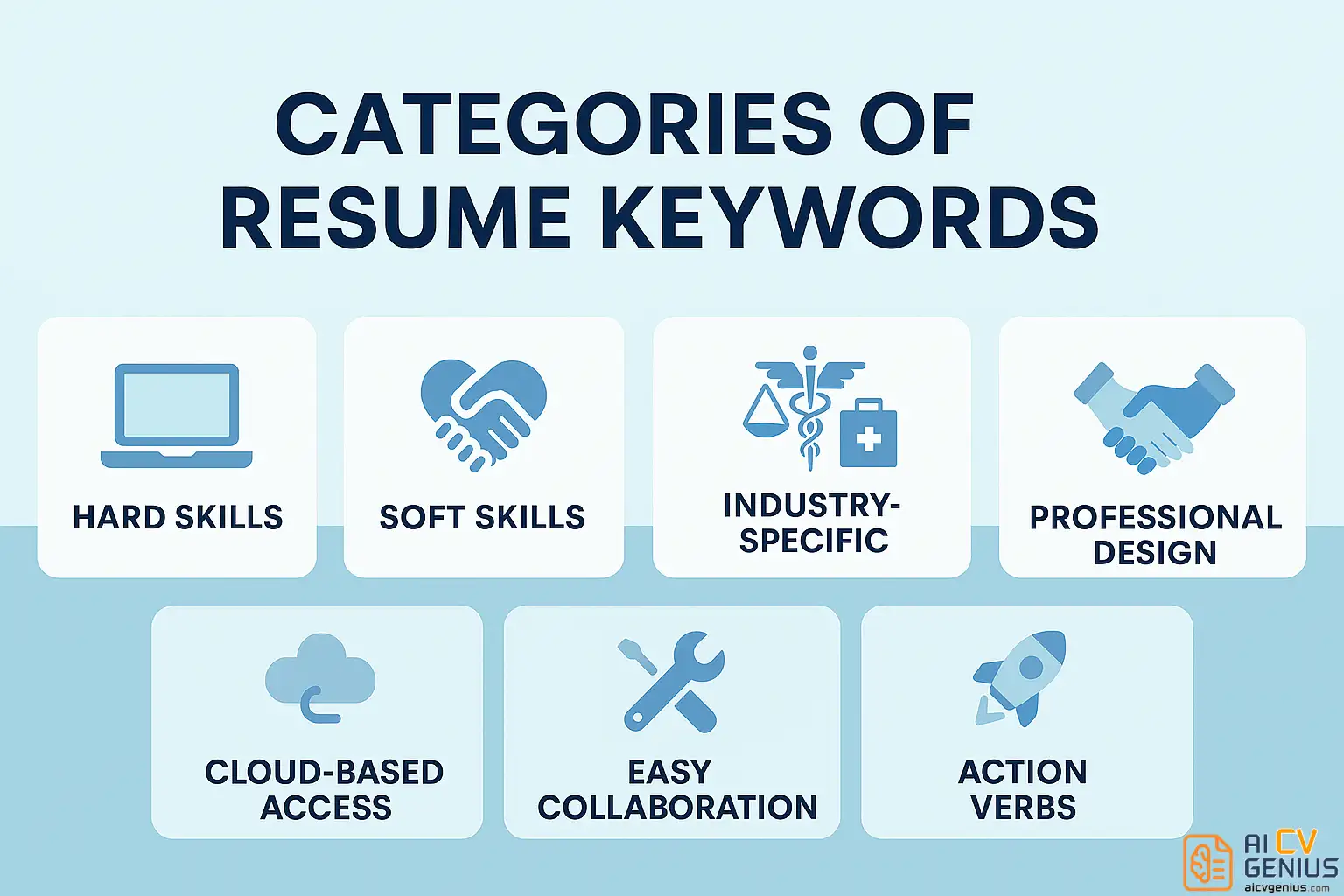
Think of resume keywords as precise navigational coordinates for your career. They are specific terms and phrases that signal your relevant qualifications, skills, and experiences directly to both ATS software and human recruiters scanning for suitability. These crucial terms typically fall into several key categories:
- Hard Skills: Specific, measurable, and often technical abilities required for a role. Examples include “Data Analysis,” “Python Programming,” “Financial Modeling,” “Search Engine Optimization (SEO),” or “Patient Assessment.”
- Soft Skills: Interpersonal attributes and work habits demonstrating how you interact and perform within a team or organization. Examples: “Leadership,” “Cross-Functional Collaboration,” “Problem-Solving,” “Communication,” or “Adaptability.”
- Tools, Software & Certifications: Names of specific software, platforms, equipment, or professional credentials relevant to the job. Examples: “Salesforce CRM,” “Google Analytics Certification,” “Adobe Creative Suite,” “Certified Public Accountant (CPA),” “AWS Certified Solutions Architect.”
- Industry-Specific Terminology: Jargon, processes, regulations, or methodologies unique to a particular field. Examples: “HIPAA Compliance” (Healthcare), “Mergers & Acquisitions (M&A)” (Finance/Law), “User Experience (UX) Design” (Tech), “Agile Methodologies” (Project Management/Tech).
- Action Verbs (Power Words): Dynamic verbs used to describe your accomplishments and contributions, showing impact rather than passive responsibility. Examples: “Led,” “Managed,” “Developed,” “Increased,” “Implemented,” “Reduced,” “Optimized,” “Negotiated.”
Effective keywords are not mere buzzwords or filler – they constitute verifiable evidence demonstrating that your profile directly aligns with the specific requirements and desired attributes outlined in the job description.
Why Resume Keywords Are Critical for Your Job Search Success
Integrating relevant keywords strategically throughout your resume is no longer optional – it’s essential for several critical reasons:
- ✅ Pass Mandatory ATS Filters: This is the primary hurdle. Without sufficient keyword matching aligned with the job description, your resume has a high probability of being automatically rejected by the ATS before it ever reaches a human reviewer.
- ✅ Demonstrate Immediate Relevance: Recruiters typically spend only seconds conducting an initial scan of each resume. Well-placed keywords act as visual signposts, immediately highlighting your most pertinent qualifications and capturing their attention.
- ✅ Position You Competitively Against Other Candidates: In a crowded applicant pool where many candidates may possess similar qualifications, the effective use of precise, relevant keywords helps differentiate your resume and signals a stronger match for the role’s specific needs.
Case Study 1: Alex the Tech Graduate’s Keyword Transformation
Alex, a recent Computer Science graduate, diligently applied for 25 entry-level software developer positions. His initial resume vaguely stated: “Worked on various coding projects during university.” He received zero interview callbacks. Frustrated, he revisited the job descriptions he had targeted and meticulously updated his resume, incorporating specific technical keywords found repeatedly in those postings: “Python,” “Java,” “Agile Methodologies,” “Developed REST APIs,” “Git version control.”
Within two weeks of submitting the revised, keyword-optimized resume, he received three interview invitations. Same core skills, but strategically chosen keywords made the crucial difference between digital rejection and tangible opportunity.
Deep Dive: Understanding and Applying Different Keyword Categories
Hard Skills (Your Core Technical & Measurable Abilities)
These are specific, teachable, and often quantifiable skills essential for performing the job. Employers can typically verify these through tests, portfolio reviews, or specific interview questions. Examples across fields:
- Tech: Data Analysis, SQL, Python, Java, C++, Cloud Computing (AWS, Azure), Network Security, Machine Learning
- Finance: Financial Forecasting, Budget Management, Auditing, Risk Analysis, GAAP Compliance, Investment Banking
- Marketing: UX Design, Wireframing, Prototyping (Figma, Sketch), SEO Strategy, PPC Campaign Management, Content Marketing
- Healthcare: Patient Assessment, Electronic Medical Records (EMR/EHR systems), Phlebotomy, Medication Administration
Pro Tip: Integrate hard skills naturally within both your dedicated “Skills” section and your work/project achievement bullet points. Don’t merely list “Data Analysis.” Instead, demonstrate it: “Analyzed over 50,000 rows of customer sales data using SQL and Excel (Pivot Tables), identifying key purchasing trends that informed a new marketing strategy, ultimately improving campaign forecasting accuracy by approximately 20%.”
Soft Skills (How You Collaborate and Perform)
These reflect your interpersonal abilities, work ethic, and character traits. Recruiters assess these to gauge cultural fit and potential for effective collaboration. Examples:
- Collaboration / Teamwork
- Leadership / Mentoring
- Adaptability / Flexibility
- Communication (Written & Verbal)
- Problem-Solving / Critical Thinking
- Time Management / Organization
Crucial Note: Never just list soft skills in isolation (e.g., “Good communicator”). This lacks credibility. Instead, embed them within your achievement statements to provide concrete evidence. Instead of listing “Leadership,” write: “Led a cross-functional project team of 5 members, successfully delivering the product launch two weeks ahead of schedule through effective collaboration and clear communication of milestones.”
Industry-Specific Keywords (The Language of Your Field)
Every profession has its own specialized terminology, acronyms, regulations, or methodologies. Using these accurately demonstrates your familiarity and expertise within that specific domain:
- Healthcare: Patient Care, Electronic Medical Records (EMR), Diagnostics, HIPAA Compliance, Triage Protocols, ICD-10 Coding
- Marketing: Search Engine Optimization (SEO), Pay-Per-Click (PPC) Advertising, Campaign Management, Content Strategy, Customer Relationship Management (CRM), A/B Testing
- Finance: Risk Analysis, Generally Accepted Accounting Principles (GAAP), Regulatory Compliance (SOX, Basel III), Financial Modeling, Due Diligence
- Tech / IT: Agile Development, Cloud Computing (AWS, Azure), Cybersecurity Frameworks (NIST, ISO 27001), DevOps Practices, Network Administration
Tools, Software, Platforms & Certifications (Your Technical Toolkit)
Avoid vague claims like “tech-savvy.” Be explicit about the specific technologies and credentials you possess that are relevant to the job:
- Analytics & BI: Google Analytics (GA4), Tableau, Power BI, Looker
- CRM & Sales: Salesforce CRM, HubSpot, Zoho CRM
- Design & Creative: Adobe Creative Suite (Photoshop, Illustrator, InDesign), Figma, Sketch
- Accounting & Finance: QuickBooks, SAP ERP, Oracle NetSuite, Bloomberg Terminal
- Cloud & DevOps: AWS (EC2, S3, Lambda), Microsoft Azure, Google Cloud Platform (GCP), Docker, Kubernetes
- Certifications: PMP (Project Management Professional), CPA (Certified Public Accountant), AWS Certified Cloud Practitioner, Google Ads Certified
Action Verbs (Words That Demonstrate Impact)
Starting your achievement bullet points with strong, dynamic verbs instantly conveys proactivity and results. Use varied verbs to keep your resume engaging:
- Led / Managed / Directed / Coordinated / Supervised
- Created / Developed / Designed / Implemented / Built / Launched
- Increased / Grew / Expanded / Improved / Enhanced / Generated
- Optimized / Streamlined / Reduced / Saved / Consolidated
- Transformed / Revitalized / Restructured / Overhauled
- Analyzed / Researched / Evaluated / Assessed
- Negotiated / Secured / Achieved / Resolved
Case Study 2: Priya the Healthcare Applicant Finds the Right Terms
Priya, a qualified nursing assistant, struggled to get interviews for positions in major hospitals. Her resume initially described her duties as: “Worked closely with patients daily.” This generic phrasing failed to trigger ATS matches or impress recruiters.
She revised her key bullet points after analyzing several target job descriptions, incorporating specific industry keywords: “Provided direct Patient Care for up to 12 diverse individuals per shift, accurately documenting vital signs and observations in EPIC EMR system, while strictly adhering to HIPAA compliance regulations.” These three highlighted keywords directly matched common requirements, significantly increased her ATS score, and resulted in an interview invitation within just one week of applying with the updated resume.
This experience mirrors the impact demonstrated in another case where small, strategic resume improvements yielded significant results. You can explore that transformation here:
We Improved This CV in 20 Minutes – Here’s the Result.
How to Identify the Right Keywords for Your Resume
Finding the most effective keywords requires a systematic approach:
- Analyze Target Job Descriptions Meticulously: This is your primary source. Carefully read 3-5 job postings for roles you are interested in. Highlight or list nouns (skills, tools, qualifications) and verbs (actions, responsibilities) that appear repeatedly or seem critical. Pay close attention to the “Requirements” or “Qualifications” sections.
- Research Industry Standards and Trends: Use platforms like LinkedIn (check profiles of people in similar roles or companies you admire) and Glassdoor (company reviews sometimes mention desired skills) to identify currently trending skills, tools, and terminology within your field.
- Utilize Online Resume Analysis Tools (Use Cautiously): Tools like Jobscan can compare your resume draft against a specific job description, highlighting keyword gaps and providing a match score. Use these as a guide, but don’t obsess over achieving a perfect score at the expense of natural language and readability.
- Review Profiles of Successful Peers: Search for professionals on LinkedIn who hold the types of roles you aspire to. Analyze the keywords they use in their headlines, summaries, experience descriptions, and skills sections for inspiration and validation.
Table: Transforming Weak Phrases into Strong Keyword-Based Achievements
The difference lies in specificity and demonstrating impact:
| Weak Resume Language | Strong Keyword-Based Language with Impact |
|---|---|
| “Helped with various sales tasks and customer outreach.” | “Increased quarterly sales by 18% through targeted B2B outreach using Salesforce CRM for lead tracking and follow-up.” (Adds action, metric, context, tool) |
| “Worked on developing company websites.” | “Developed responsive and user-friendly corporate websites using HTML5, CSS3, and JavaScript (React), resulting in a 30% improvement in mobile usability scores.” (Adds specifics, technologies, outcome) |
| “Good at teamwork and working with others.” | “Collaborated effectively with cross-functional teams (Product, Design, QA) within an Agile/Scrum framework to deliver software features on schedule.” (Adds context, methodology, specific function) |
Case Study 3: Miguel in Finance Focuses on Compliance and Analysis
Miguel, an experienced accountant, found his job search stalling. His resume stated he “Handled company accounts and reporting.” This description was too broad and lacked industry-specific keywords.
After analyzing job postings for Senior Accountant roles, he refined a key bullet point: “Performed monthly Financial Analysis and reporting in strict accordance with GAAP standards using SAP ERP, identifying and correcting discrepancies that reduced reporting errors by approximately 15%.” This single, keyword-rich change, highlighting specific skills (Financial Analysis), standards (GAAP), and tools (SAP), immediately triggered positive responses from recruiters specializing in corporate finance.
Do’s and Don’ts of Using Resume Keywords Effectively
Strategic keyword integration requires balance:
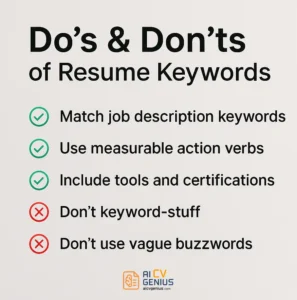
- ✅ DO integrate keywords naturally within the context of your achievements and responsibilities. Sentences should flow smoothly and make sense to a human reader.
- ✅ DO use relevant variations and synonyms where appropriate (e.g., “Project Management,” “Managed Projects,” “Project Coordination”). ATS systems are often sophisticated enough to recognize related terms.
- ✅ DO meticulously update and tailor your resume’s keywords for every single job application to maximize alignment with that specific role’s requirements.
- ❌ DON’T engage in “keyword stuffing” – randomly inserting keywords excessively or out of context, often in small font or white text. Modern ATS can often detect this tactic, and human recruiters will immediately notice and reject resumes that are unreadable or nonsensical.
- ❌ DON’T include keywords for skills or experiences you don’t actually possess. Be prepared to discuss and demonstrate everything listed on your resume during interviews. Misrepresenting qualifications will inevitably backfire.
The Evolving Landscape: AI, Context, and the Future of Resume Keywords
Applicant Tracking Systems are continuously evolving. Newer systems, often incorporating elements of Artificial Intelligence (AI) and Natural Language Processing (NLP), are moving beyond simple keyword matching. They are increasingly capable of analyzing the context in which keywords appear, assessing the candidate’s proficiency level based on surrounding language, and understanding semantic relationships between terms. Furthermore, platforms like LinkedIn utilize sophisticated algorithms that match keywords and skills listed in your profile with recruiter search queries and job recommendations.
This evolution means your keyword strategy must be nuanced:
- Focus on demonstrating skills through specific achievements, not just listing keywords.
- Ensure consistency in keyword usage across your resume, cover letter, and LinkedIn profile.
- Prioritize clarity, readability, and natural language that appeals to both advanced algorithms and human reviewers.
While basic keyword matching remains crucial for passing initial filters, the future emphasizes demonstrating genuine expertise and impact within context.
FAQ: Mastering Resume Keywords
Ultimate Keyword Survival Guide (Checklist)
Before submitting any application, ensure your resume aligns with these key principles:
- ✅ Analyze the job description and meticulously highlight or list essential keywords (skills, tools, qualifications, responsibilities).
- ✅ Integrate a balanced mix of relevant hard skills (technical abilities) and soft skills (demonstrated through achievements).
- ✅ Incorporate industry-specific terminology accurately and appropriately.
- ✅ List specific software, tools, platforms, and professional certifications mentioned or implied in the job posting.
- ✅ Strengthen achievement bullet points by starting them with impactful action verbs.
- ✅ Critically review and tailor your resume’s keyword focus for each individual job application.
- ✅ Maintain clean, simple formatting and a structure known to be compatible with Applicant Tracking Systems (ATS).
- ✅ Ensure keywords are used naturally within context, avoiding awkward phrasing or excessive repetition (stuffing).
Final Thoughts: Speaking the Right Language
Effective resume writing in the modern era isn’t just about eloquently telling your professional story – it’s about strategically telling it in the precise language that both automated systems and human decision-makers understand and value. Incorporating the right resume keywords acts as the critical translation layer, ensuring that your application doesn’t get lost in translation within a machine filter but instead successfully reaches the hands of recruiters who can recognize your true potential and qualifications.
Think of keywords as your essential passport stamps: they provide verifiable proof that you belong on the professional journey you’re applying to undertake. Use them strategically, substantiate them with real results and tangible achievements, and you’ll find your resume not only successfully navigates past the automated gatekeepers but also decisively wins over the humans who hold the keys to your next opportunity.