
- “Tell me about yourself” is your opening statement: It sets the tone, builds first impressions fast, and should be treated as a short, strategic narrative.
- Use the PPF structure: Past (Relevant foundation), Present (What you do now and proof), Future (Why this role and company make sense next).
- Keep it tight: Aim for 60 to 90 seconds, stay professional, and cut anything that does not support your value for this job.
- Do not memorize word-for-word: Internalize bullet points, practice out loud, and deliver it naturally so it does not sound robotic.
- Finish with a clean transition: End on the Future point, connect your goals to the role, and set up the next question smoothly.
It’s the first question you’ll almost always hear in an interview: “Tell me about yourself.” It sounds simple, yet many candidates freeze, ramble through their entire career history, summarize their resume verbatim, or veer into unrelated personal hobbies. When answered strategically, however, this question becomes your prime opportunity to immediately control the narrative and shape the interviewer’s perception of your professional identity.
This isn’t a trick question – it’s a direct invitation to present your concise, compelling professional pitch. This guide will provide a clear framework for structuring your answer, highlight common pitfalls to avoid, and equip you with the techniques to deliver a short, confident introduction that establishes instant rapport and sets a positive tone for the entire interview.
Why Employers Ask “Tell Me About Yourself”
This opening question serves multiple purposes beyond a simple icebreaker. Interviewers use it to gauge:
- ✅ Communication & Structure: How effectively can you organize and articulate information concisely?
- ✅ Prioritization & Relevance: What aspects of your career do you choose to emphasize? Do they align with the role?
- ✅ Self-Awareness & Professionalism: How well do you understand your own narrative and present it appropriately?
- ✅ Initial Rapport & Confidence: Can you establish a comfortable, professional connection naturally?
Essentially, they seek a clear, confident, and purposeful introduction – demonstrating you understand both yourself and the context of the interview.
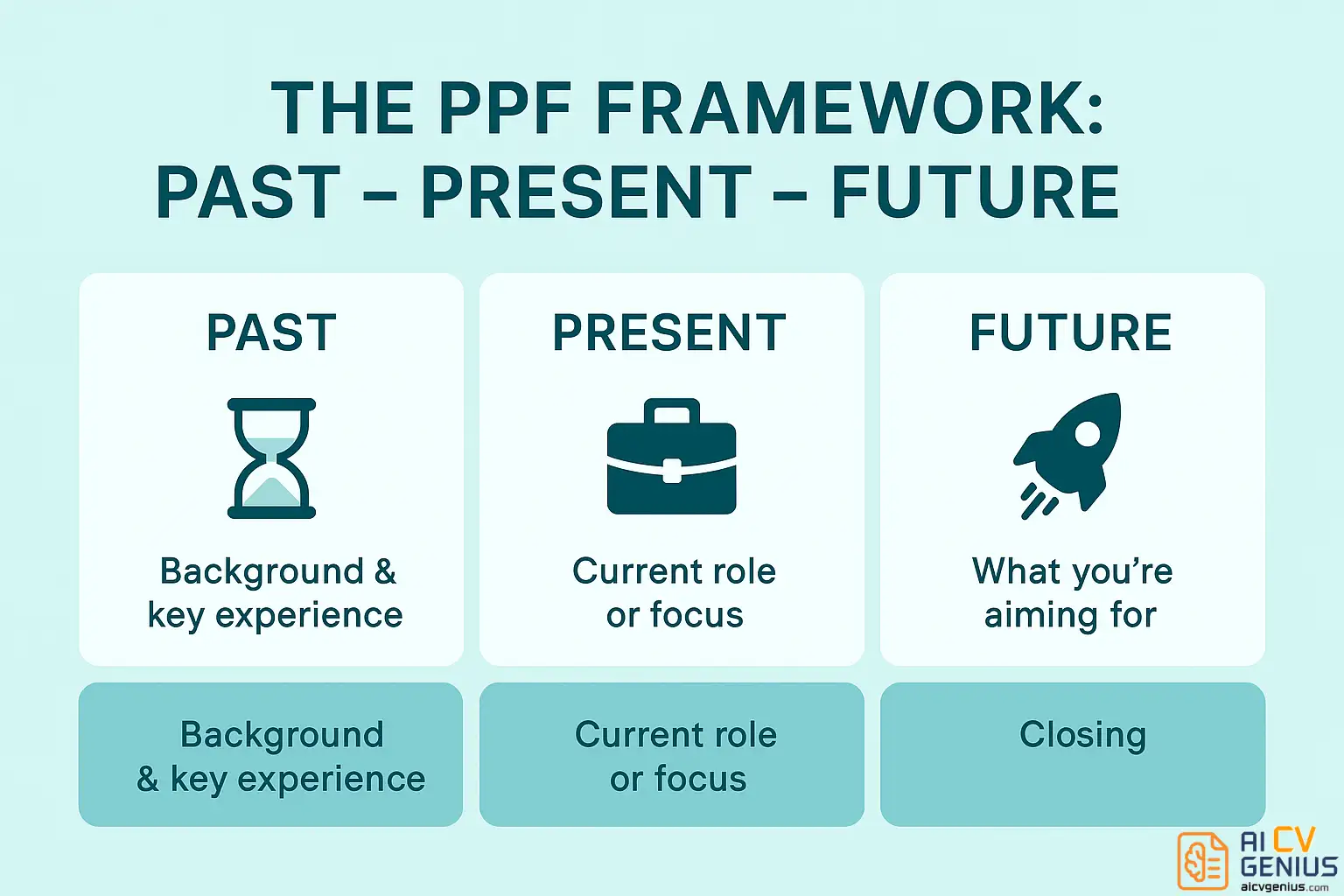
The Perfect Framework: Past – Present – Future (PPF)
The most effective and widely recommended strategy for answering “Tell me about yourself” utilizes the concise PPF method. This three-part narrative structure ensures your response remains relevant, focused, easily digestible, and memorable.
| Part | What to Include | Focus |
|---|---|---|
| Past | Briefly introduce relevant background – key experiences, foundational skills, or academic context that led you here. (1-2 sentences) | Set the stage concisely. |
| Present | Describe your current situation, role, or area of focus, highlighting 1-2 key accomplishments or core strengths directly relevant to the target job. (2-3 sentences) | Showcase your current value proposition. |
| Future | Clearly state what you are seeking next in your career and explicitly connect your goals and relevant skills to this specific opportunity and company. (1-2 sentences) | Demonstrate alignment and enthusiasm. |
Adhering to this simple Past – Present – Future structure keeps your answer controlled, strategically focused on information most pertinent to the interviewer, and typically within the ideal 60–90 second timeframe.
Step-by-Step: How to Build Your Answer Using PPF
1. Start with Relevant Background (Past)
Begin with a concise summary establishing your professional foundation or entry point into the relevant field. Keep it brief and directly pertinent to the role you’re interviewing for. If you’re experienced, focus on a key transition or foundational role. If entry-level, focus on relevant education or internships
Example (Mid-Level):
“I began my career in digital marketing about five years ago, initially focusing on SEO and content creation for small businesses, where I quickly learned the power of data-driven strategy in achieving measurable growth.”
Example (Recent Graduate):
“I recently graduated with a B.S. in Computer Science from [University Name], where I developed a strong foundation in software development principles and gained hands-on experience through several complex team projects focused on [mention relevant area like web development or data structures].”
2. Highlight Current Role and Key Achievements (Present)
This is the core section where you showcase your current expertise and tangible value. Mention your current role (or most recent relevant experience) and highlight 1-2 significant accomplishments or skills directly related to the target job’s requirements. Quantify results whenever possible – numbers make your impact concrete.
Example (Mid-Level):
“For the past three years, I’ve served as a Marketing Specialist at [Current Company], where I currently lead our email marketing initiatives. In my most recent campaign, I implemented a new segmentation strategy that increased click-through rates by 25% and directly contributed to a 15% uplift in qualified leads for the sales team.”
Example (Recent Graduate):
“During my final year capstone project, I took the lead on developing the front-end interface for our team’s web application using React, collaborating closely with backend developers. This project solidified my passion for creating intuitive user experiences and honed my collaborative problem-solving skills within an Agile framework.”
3. Connect Your Goals to This Specific Position (Future)
Conclude by explicitly stating why you are interested in this particular opportunity and how it aligns with your career aspirations. This demonstrates genuine interest and thoughtful consideration, rather than simply applying indiscriminately. Show you’ve done your research.
Example (Mid-Level):
“I’m now seeking to leverage my expertise in campaign optimization and lead generation within a larger, more strategic role. [Target Company Name]’s focus on [mention specific company initiative or value, e.g., data-driven customer journeys] particularly resonates with my background, and I’m excited by the opportunity to contribute to your team’s success in [mention specific area from job description].”
Example (Recent Graduate):
“I’m eager to apply my technical skills and collaborative mindset in a professional software engineering environment. This Junior Developer role at [Target Company Name] particularly excites me because of the opportunity to work on [mention specific technology or project type] and contribute to a team known for innovation in [mention company’s field].”
Sample Answers Tailored by Experience Level
For Students or Recent Graduates (Focus on Potential & Skills)
“(Past) I recently graduated with a degree in Business Administration, concentrating in marketing analytics. (Present) During my senior year internship at a local retail startup, I was responsible for analyzing customer purchase data using Excel and Google Analytics, which helped identify key trends leading to a 15% increase in online sales conversion for targeted product categories. (Future) I’m now eager to apply that analytical foundation and passion for understanding consumer behavior in an entry-level Marketing Assistant role like this one at [Company Name], where I can contribute to developing data-driven digital strategies and continue learning from experienced professionals.”
For Mid-Level Professionals (Focus on Achievements & Growth)
“(Past) I started my career in Human Resources about five years ago, focusing initially on recruitment and onboarding. (Present) For the past three years as an HR Generalist at [Current Company], I’ve managed the full employee lifecycle for a division of 150 employees. Notably, I successfully implemented a new applicant tracking system that streamlined our hiring process, reducing the average time-to-fill by 25%. (Future) I’m now seeking to transition into an HR Business Partner role where I can apply my comprehensive HR knowledge more strategically to align talent initiatives with overall business objectives, and [Target Company Name]’s reputation for [mention specific value, e.g., employee development] makes this opportunity particularly compelling.”
For Senior or Managerial Roles (Focus on Leadership & Impact)
“(Past) With over a decade of progressive experience in software project management within the FinTech sector, I began my journey leading small development teams. (Present) Currently, as a Senior Project Manager at [Current Company], I oversee a portfolio of enterprise software projects with budgets exceeding $2M, consistently delivering complex initiatives on schedule and within budget using Agile methodologies. For example, I recently led a cross-functional team of 15 to launch a new platform feature that resulted in a 20% improvement in user retention metrics. (Future) I’m now looking to leverage my strategic planning and team leadership expertise in a Director-level position focused on driving innovation and operational excellence, which strongly aligns with the scope and vision outlined for this role at [Target Company Name].”
Common Mistakes to Avoid When Answering
Steer clear of these frequent pitfalls:
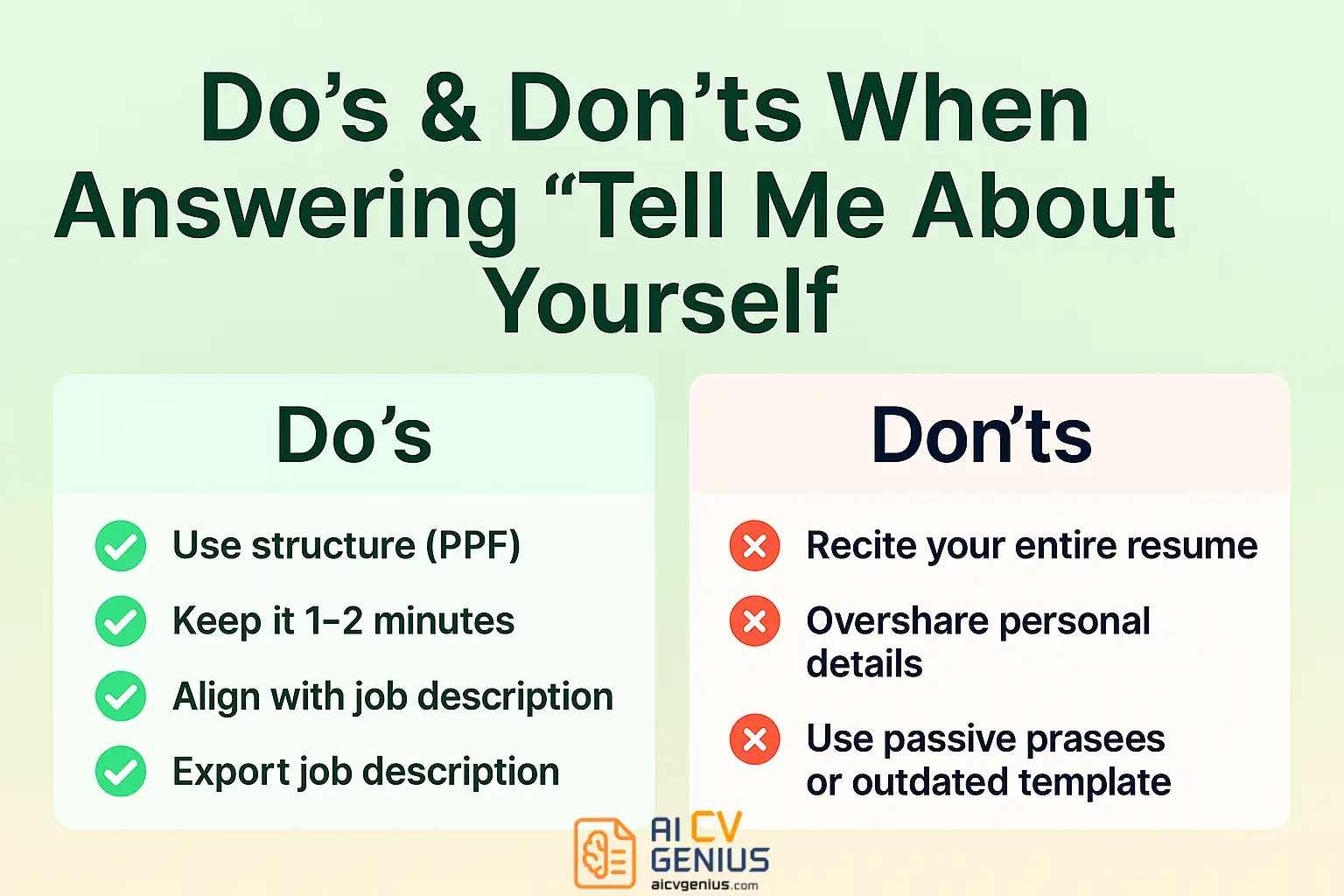
- ❌ Reciting Your Resume Verbatim: The interviewer already has your resume. Use this opportunity to provide context, personality, and connection – not just repeat bullet points.
- ❌ Oversharing Personal Details or Unrelated Hobbies: Keep the focus strictly professional and relevant to the role. Avoid discussing personal life, family, or hobbies unless directly and clearly applicable to required job skills (rare).
- ❌ Excessive Length or Rambling: Aim for 60–90 seconds, maximum 2 minutes. Prepare concise points using the PPF framework to stay focused. Going on too long signals poor communication skills.
- ❌ Sounding Over-Rehearsed or Robotic: Practice key points, not a rigid script. Maintain a natural, conversational tone. Authenticity builds rapport.
- ❌ Using Excessive Filler Words: Frequent use of “umm,” “uhh,” “like,” or “you know” can undermine perceived confidence and clarity. Practice pausing briefly instead.
- ❌ Being Too Generic or Vague: Failing to tailor the “Future” part of your answer specifically to the company and role signals lack of genuine interest or preparation.
Tips to Sound Natural and Confident During Delivery
Preparation meets poise with these techniques:
- ✅ Practice Aloud, Not Just Mentally: Hearing yourself speak helps identify awkward phrasing, refine pacing, and build muscle memory for key points.
- ✅ Maintain Positive Body Language: Sit up straight but relaxed, maintain comfortable eye contact (even in video interviews), and offer a genuine smile when appropriate. Body language significantly influences perceived confidence.
- ✅ Record Yourself (Audio or Video): This provides invaluable feedback on your tone, pacing, energy level, and use of filler words. Adjust accordingly.
- ✅ Adapt Your Tone to Company Culture: Research the company beforehand. Aim for a slightly more formal tone for traditional industries (finance, law) and potentially a more conversational, energetic tone for startups or creative agencies, while always maintaining professionalism.
- ✅ Conclude with a Strong Transition: End your answer confidently, perhaps with a phrase that naturally invites the next question, like “…and that’s why I was so interested in learning more about this opportunity with your team.”
Pros & Cons of the “Tell Me About Yourself” Question
Understanding its function helps you leverage it effectively:
| Pros (for the Candidate) | Potential Cons (if Unprepared) |
|---|---|
| ✅ Provides an immediate opportunity to establish control over the initial narrative and highlight key strengths. | ❌ High risk of rambling, going off-topic, or appearing unfocused without a clear structure like PPF. |
| ✅ Allows you to build rapport quickly and showcase communication skills/professional demeanor right away. | ❌ Can feel vague or intimidating if the candidate doesn’t understand the underlying intent (assessing relevance and communication). |
| ✅ Excellent chance to emphasize achievements and value proposition beyond resume bullet points. | ❌ Overly rehearsed or robotic answers can sound inauthentic and fail to build genuine connection. |
| ✅ Effectively sets a positive, confident tone for the remainder of the interview when answered well. | ❌ Candidates might inadvertently focus too much on irrelevant personal history instead of professional value. |
Checklist: Final Preparation Before Your Interview
Run through this list to ensure you’re ready for the opening question:
- ✅ Prepared your concise PPF story (Past–Present–Future) tailored to the specific role and company.
- ✅ Practiced delivering the answer aloud, aiming for a natural, confident tone within the 60–90 second timeframe.
- ✅ Recorded yourself (optional but recommended) to evaluate pacing, tone, and eliminate filler words.
- ✅ Ensured the “Future” component clearly connects your goals and skills specifically to this company and opportunity, demonstrating research.
- ✅ Ready to transition smoothly from your answer into discussing specific experiences or skills in more detail.
FAQs: Answering “Tell Me About Yourself”
Final Thoughts: Your Opening Statement Matters
The seemingly simple request, “Tell me about yourself,” represents far more than just an interview icebreaker – it’s your critical opening statement, setting the tone and shaping the initial perception of your entire candidacy. By approaching it strategically with the Past-Present-Future (PPF) framework, you transform a potentially daunting question into a powerful opportunity to immediately demonstrate self-awareness, highlight relevant qualifications, project confidence, and establish genuine connection.
Think of your answer as your personal brand’s concise, compelling headline: thoughtfully crafted, confidently delivered, and perfectly positioned to capture interest and invite further exploration.
To ensure the rest of your application consistently supports this strong opening, explore additional interview strategies within our Career Resources hub, polish your foundational document using insights from our Resume Templates Finder, and craft equally compelling introductory narratives with examples from our Cover Letters section.
Remember: true confidence doesn’t arise from feigning perfection – it emerges organically from thorough preparation and authentic self-presentation. Master your opening, and you significantly increase your chances of mastering the entire interview.