
- Treat your teacher assistant resume as a one-page story of structure and care: Open with a summary (experienced) or objective (new) that feels warm, specific, and professional.
- Build your skills section like a toolkit: Group classroom support, special education or inclusion, admin or tech, and interpersonal strengths so recruiters can spot fit fast.
- In experience bullets, stop listing duties and show impact: Use Action + Task + Result, and quantify when you can (groups supported, scores improved, incidents reduced, tools adopted).
- Education and certifications should be clean and easy to scan: List in reverse chronological order, include relevant coursework if helpful, and add expected completion dates for anything in progress.
- Finish with tailoring and formatting basics: Mirror the job description’s keywords honestly, keep it one page, use readable fonts and consistent spacing, and submit as a PDF with a professional filename.
Behind every thriving classroom, navigating the beautiful chaos of learning, stands a quiet pillar of support: the teacher assistant. You are the bridge between instruction and understanding, the extra pair of hands preparing materials, the calm presence guiding a struggling student, the watchful eye ensuring safety. Your role demands a unique blend of structure and heart, organization and empathy. Capturing this multifaceted contribution on a single page requires more than just listing duties; it requires telling a compelling story. This guide is designed to help you craft a standout teacher assistant resume – one that authentically reflects your dedication, showcases your diverse skills, and resonates deeply with principals, hiring committees, and HR coordinators who understand the critical importance of your role.
Your resume isn’t just a document; it’s the first glimpse into your potential impact on young minds and the overall classroom environment. It needs to communicate reliability, patience, adaptability, and a genuine passion for fostering learning.
Why Your Teacher Assistant Resume Matters More Than Ever in Today’s Educational Landscape
The field of education is in constant flux. Classrooms are more diverse, technology integration is accelerating, and the demands on educators are increasing. Consequently, the role of the teacher assistant has evolved significantly. Schools now expect assistants to take on greater responsibilities – managing small group instruction, providing one-on-one support for students with diverse learning needs, facilitating the use of educational technology, communicating with parents, and even contributing to lesson planning and behavior management strategies.
This evolution means your resume is no longer a simple record of tasks performed; it’s a strategic narrative showcasing your adaptability, skill set, and alignment with modern educational philosophies. Whether you’re applying to a bustling public elementary school prioritizing inclusion, a private learning center focused on personalized education, or a specialized program for students with disabilities, a polished, thoughtful, and compassionate resume demonstrates that you grasp the complex realities of today’s classrooms. It signals to potential employers that you possess the essential blend of reliability, empathy, proactivity, and organizational prowess needed to support both teachers and students effectively in a dynamic environment. It’s your miniature teaching philosophy, proving you’re ready to contribute meaningfully from day one.
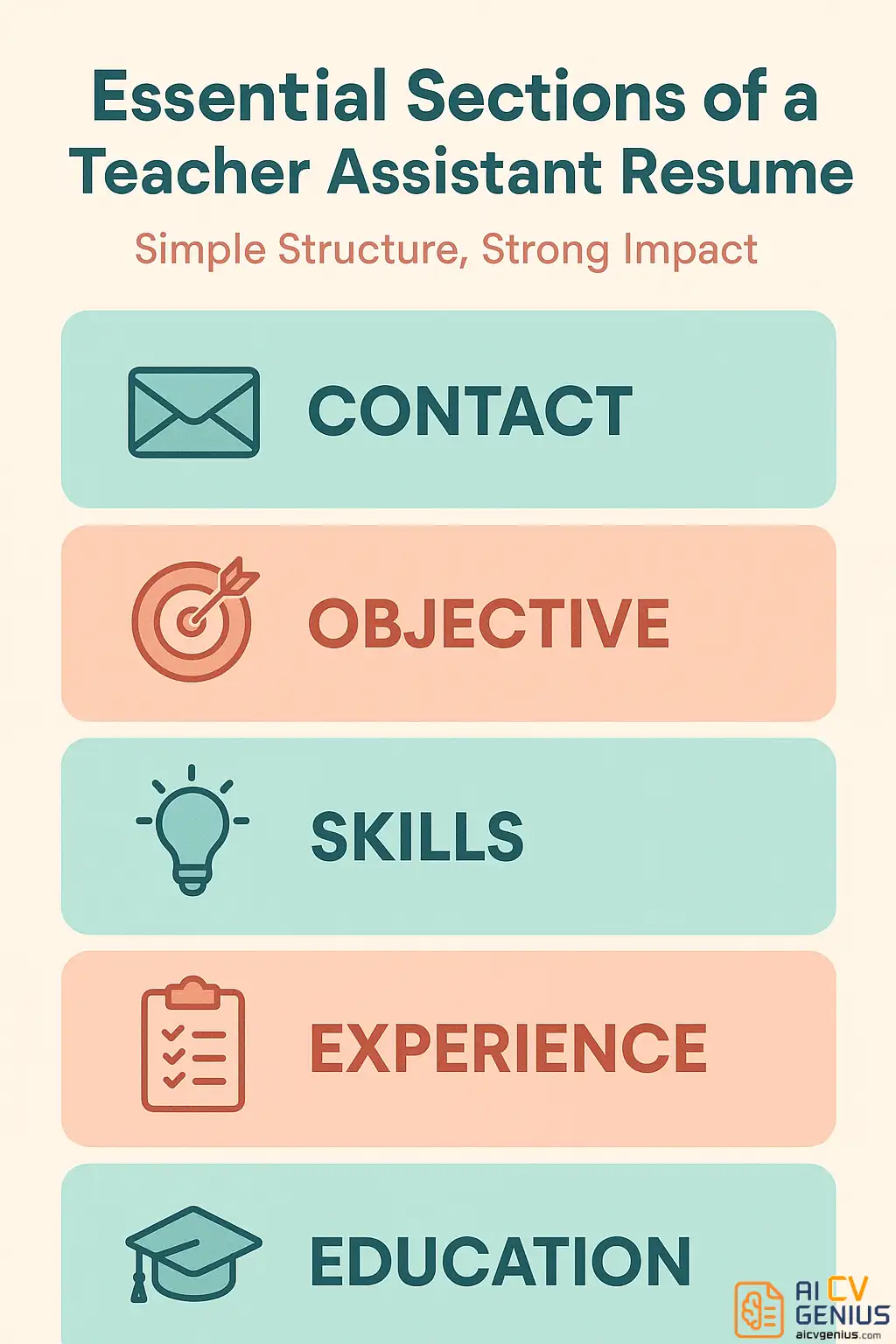
Crafting a Compelling Summary or Objective: Your First Impression
The top section of your resume – whether a summary (for those with experience) or an objective (for entry-level candidates or career changers) – is your 10-second elevator pitch. It needs to immediately convey your core strengths, relevant experience (or potential), and genuine enthusiasm for supporting student success. It must blend warmth with professionalism, capturing both your empathy and your capability.
Professional Summary (For Experienced Assistants)
A summary synthesizes your background, highlighting key skills and quantifiable achievements where possible. Focus on impact, not just activities.
1️⃣Strong Example 1 (General Elementary):
“Dedicated and compassionate Teacher Assistant with 4+ years supporting K-5 classrooms. Proven ability to foster inclusive learning environments, manage small group activities effectively (up to 8 students), and assist lead teachers with lesson preparation and differentiation. Skilled in behavior management techniques (PBIS) and communicating proactively with parents and staff to ensure student well-being and academic progress.”
2️⃣Strong Example 2 (Special Education Focus):
“Highly patient and resourceful Special Education Teacher Assistant with 5+ years experience supporting students with diverse learning needs (Autism Spectrum Disorder, ADHD) in inclusive settings. Adept at implementing IEP goals, utilizing assistive technology (Proloquo2Go), and collaborating closely with OTs, SLPs, and lead teachers. Certified in CPI Nonviolent Crisis Intervention and committed to creating a safe, supportive atmosphere for all learners.”
These summaries work because they are specific (mentioning grade levels, specific needs, techniques like PBIS, tools like Proloquo2Go), action-oriented (“foster,” “manage,” “implementing”), and hint at positive outcomes (“student well-being,” “safe atmosphere”).
Career Objective (For Entry-Level or Career Changers)
If you’re new to the field, an objective expresses enthusiasm, relevant transferable skills, and clear direction. Focus on what you aim to contribute, not just what you want to gain.
Strong Example 1 (Recent Graduate):
“Motivated and empathetic recent graduate with an Associate Degree in Early Childhood Education seeking a Teacher Assistant position at [School Name]. Eager to apply knowledge of child development principles, classroom management strategies learned through coursework, and strong organizational skills to support teachers and foster a positive, engaging learning environment for young students.”
Strong Example 2 (Career Changer from Admin):
“Organized and reliable professional with 6+ years experience in administrative support, now transitioning into education. Seeking a Teacher Assistant role to leverage strong communication, scheduling, and record-keeping skills while contributing to student success at [District Name]. Passionate about supporting diverse learners and currently completing coursework for [Relevant Certification].”
These objectives are effective because they show clear intent, connect past skills (even non-educational ones) to the target role, and express genuine passion aligned with the school’s potential mission.
Highlighting Your Key Skills: The Teacher Assistant Toolkit
The role of a teacher assistant requires a delicate balance of structure and empathy, technical know-how and interpersonal finesse. Your skills section should reflect this duality, showcasing both the “hard” skills (specific techniques, tools) and the “soft” skills (personal attributes, communication styles) that make you effective. Grouping skills logically improves readability and helps recruiters quickly identify relevant competencies.
Classroom Support & Instructional Skills
- Classroom Management Techniques (e.g., PBIS, positive reinforcement)
- Small Group Instruction & Facilitation
- Lesson Plan Preparation & Material Organization
- Differentiated Instruction Support
- Student Behavior Monitoring & Support
- Assisting with Assessments & Grading Support
- Reading & Literacy Support Strategies
- Math Concepts Reinforcement
- Supervision (lunchroom, playground, field trips)
Special Education & Inclusive Practices
- IEP (Individualized Education Program) Implementation Support
- Experience with Specific Needs (e.g., ASD, ADHD, Dyslexia)
- Behavior Intervention Plan (BIP) Support
- Assistive Technology Familiarity (e.g., communication devices, adaptive software)
- Data Collection & Progress Monitoring
- Collaboration with Specialists (OT, PT, SLP)
- Creating Accessible Materials
Administrative & Technical Skills
- Record Keeping & Documentation (attendance, grades)
- Educational Software & Platforms (e.g., Google Classroom, Seesaw, Canvas for Education, Clever)
- Microsoft Office Suite (Word, Excel, PowerPoint) / Google Workspace (Docs, Sheets, Slides)
- Basic Troubleshooting (computers, tablets, smartboards)
- Creating Educational Materials (worksheets, visual aids)
- Scheduling & Coordination
Interpersonal & Soft Skills
- Patience & Empathy
- Active Listening & Observation
- Clear Communication (with students, teachers, parents, staff)
- Collaboration & Teamwork
- Adaptability & Flexibility
- Problem-Solving & Initiative
- Cultural Competence & Sensitivity
- Reliability & Punctuality
- Conflict Resolution (basic)
Pro Tip: Don’t just list skills; weave them into your experience section with concrete examples. Instead of just listing “Classroom Management,” describe how you managed the classroom effectively.
Detailing Your Experience: Focus on Impact, Not Just Duties
This is the core of your resume. Instead of passively listing tasks (“Assisted teacher,” “Helped students”), use strong action verbs and focus on the outcomes of your actions. Whenever possible, quantify your contributions or describe the positive effect you had on students or the classroom environment. Use the simple but powerful Action + Task + Result formula for each bullet point.
Compare these examples:
❌ Weak (Duty-Focused):
- Helped students with reading assignments.
- Prepared classroom materials.
- Supervised children during recess.
- Worked with special needs students.
✅ Strong (Impact-Focused):
- Supported daily reading instruction for a diverse class of 25 third-grade students, contributing to a documented 15% average improvement in reading comprehension scores over the school year through targeted small group work.
- Collaborated closely with lead teachers to prepare and organize engaging learning materials (worksheets, visual aids, science experiments) weekly, ensuring lessons ran smoothly and efficiently.
- Supervised groups of up to 50 students during lunch and recess periods, proactively mediating minor conflicts and ensuring adherence to safety protocols, resulting in zero major incidents during supervised times.
- Adapted lesson plans and provided one-on-one assistance for 3 students with specific learning disabilities (following IEP guidelines), fostering their confidence and enabling successful integration into mainstream classroom activities.
- Organized and facilitated bi-weekly group science projects for fourth graders, which demonstrably boosted student participation rates and enhanced collaborative teamwork skills observed by the lead teacher.
- Communicated regularly with parents regarding student progress and behavior (via email and brief phone calls), strengthening the home-school connection and contributing to a more supportive learning ecosystem.
- Mastered and utilized Google Classroom to post assignments and track student submissions, improving organizational efficiency for both students and the lead teacher.
Even if your experience is informal (like volunteering at a community center, tutoring younger relatives, or assisting at a summer camp), frame it around learning outcomes and the positive impact you made. What changed because you were there? How did you support growth, safety, or engagement?
The Complete Teacher Assistant Resume Example (Putting It All Together)
Theory is one thing; practice is another. Let’s apply every strategy we’ve discussed to build a complete resume for a fictional candidate, Emily Clark, who has experience in special education support.
EMILY CLARK
Special Education Teacher Assistant | CPI Certified
Philadelphia, PA 19103 | (555) 123-9876 | emily.clark.edu@email.com | linkedin.com/in/emilyclarkedu
PROFESSIONAL SUMMARY
Highly patient and resourceful Special Education Teacher Assistant with 5+ years of experience supporting students with diverse learning needs (Autism Spectrum Disorder, ADHD) in inclusive settings. Adept at implementing IEP goals, utilizing assistive technology (Proloquo2Go), and collaborating closely with OTs, SLPs, and lead teachers. Certified in CPI Nonviolent Crisis Intervention and committed to creating a safe, supportive atmosphere for all learners.
CORE COMPETENCIES
|
|
|
PROFESSIONAL EXPERIENCE
Special Education Teacher Assistant | Springfield Elementary School | Springfield, PA (2020 – Present)
- Provide 1:1 and small-group support to 5 students with IEPs (ASD, ADHD), adapting lesson plans to ensure comprehension and successful integration.
- Collaborate with a 4-person support team (Lead Teacher, OT, SLP) to track daily progress against IEP goals, providing detailed notes that informed 3 successful IEP revisions.
- Utilize assistive technology (Proloquo2Go, weighted blankets) to support non-verbal students and manage sensory needs, reducing classroom disruptions by 25%.
- Proactively de-escalate 20+ potential behavioral incidents using CPI techniques, maintaining a safe and positive learning environment for all students.
Teacher Assistant (3rd Grade) | Greenfield Academy | Wilmington, DE (2018 – 2020)
- Supported daily reading instruction for a 25-student classroom, leading small reading groups that contributed to a 15% average improvement in DIBELS scores.
- Prepared all weekly learning materials and managed the Google Classroom page, improving organizational efficiency for the lead teacher.
- Supervised 50+ students during recess and lunch, mediating conflicts and ensuring a 100% safe play environment.
EDUCATION & CERTIFICATIONS
- Nonviolent Crisis Intervention (CPI) Certification (2021)
- ParaPro Assessment Certification (Passed 2018)
- CPR & First Aid Certification (American Red Cross) (Valid through 2026)
- Associate Degree in Early Childhood Education | Delaware County Community College (2018)
Final Polish: Education, Tailoring, and Formatting
Education and Certifications: Showcasing Your Foundation and Commitment
Your educational background and relevant certifications demonstrate your foundational knowledge and commitment to the field. Even if you’re early in your career or don’t have a degree specifically in education, highlight any relevant coursework or training.
List your credentials clearly, usually in reverse chronological order:
- ✅ Associate Degree in Early Childhood Education | [Community College Name], [City, State] | [Year Graduated]
- Relevant Coursework: Child Psychology, Classroom Management, Literacy Development
- ✅ Bachelor of Arts in Psychology | [University Name], [City, State] | [Year Graduated]
- Minor in Education Studies
- ✅ High School Diploma | [High School Name], [City, State] | [Year Graduated]
Follow with a dedicated subsection for certifications and relevant training:
- ✅ Certified Teacher Assistant (CTA) | [Issuing Body] | [Year Obtained]
- ✅ ParaPro Assessment | Passed [Month, Year]
- ✅ CPR and First Aid Certification | American Red Cross | Expires [Month, Year]
- ✅ Nonviolent Crisis Intervention (CPI) Certification | [Year Obtained]
- ✅ Certificate in Special Education Support | [Institution/Online Platform] | [Year Completed]
- ✅ Mandated Reporter Training | Completed [Month, Year]
If you’re currently pursuing a degree or certification, list it with your expected completion date (e.g., “Expected May 2026”). Demonstrating a passion for continuous learning and professional development is highly valued in educational settings.
Optional Sections to Add Depth and Personality
Depending on your unique background and the specific requirements of the job, consider adding one or more optional sections to further strengthen your resume and provide a more holistic view of your candidacy:
- Volunteer Experience: Include roles like tutoring, mentoring, coaching youth sports, assisting at after-school programs, or volunteering at summer camps. Frame this experience using the same impact-focused language as your professional roles (e.g., “Tutored 5 elementary students weekly in reading, improving average assessment scores by one grade level”).
- Professional Development / Workshops: List relevant workshops, seminars, or online courses you’ve completed that enhance your skills (e.g., “Attended workshop on ‘Supporting Students with ADHD in the Classroom'”).
- Achievements / Recognition: If you received positive feedback, an award (even informal), or were recognized for a specific contribution, mention it briefly (e.g., “Received consistent positive feedback from lead teacher for proactive classroom support during remote learning transition,” or “Nominated for ‘Support Staff Member of the Month'”).
- Languages: Specify any additional languages you speak and your proficiency level (e.g., “Spanish – Fluent,” “American Sign Language – Conversational”). Multilingual ability is a significant asset in diverse school communities.
- Relevant Projects: If you created educational materials, developed a small tutoring program, or completed a significant project during your studies, briefly describe it and its outcome.
- Technical Proficiencies (Expanded): If the role specifically requires advanced tech skills, you might list specific software beyond the basics (e.g., specific assessment platforms, communication apps used by the district, basic video editing for educational content).
Use these sections strategically to fill gaps, highlight unique strengths, or further demonstrate your alignment with the school’s values and needs. Ensure everything you include adds relevant value.
Formatting Tips: Ensuring Clarity, Professionalism, and Readability
How your resume looks matters almost as much as what it says. A clean, well-organized format makes it easy for busy principals and HR staff to quickly grasp your qualifications.
- ✅ Length: Keep it to one page. This is the standard expectation for teacher assistants, even those with significant experience. Brevity demonstrates your ability to prioritize information.
- ✅ Font Choice: Use professional, easily readable sans-serif fonts like Inter, Lato, Manrope, Calibri, Arial, or Verdana. Avoid overly decorative or script fonts.
- ✅ Font Size: Use 10-12 points for the body text and 14-18 points for your name and section headers. Ensure consistency.
- ✅ Margins & White Space: Use standard margins (around 0.75 to 1 inch). Don’t crowd the page; ample white space makes the resume feel calm, organized, and less overwhelming to read.
- ✅ Consistency: Maintain consistency in formatting for dates (e.g., “Aug 2021 – Present” or “08/2021 – Present”), bullet points (use standard round or square bullets), bolding (use for job titles, company names, section headers), and spacing.
- ✅ Section Headers: Use clear, standard section headers (e.g., “Professional Summary,” “Skills,” “Professional Experience,” “Education,” “Certifications”).
- ✅ File Format: Always save and submit your resume as a PDF unless specifically asked otherwise. PDFs preserve formatting across all devices and prevent accidental edits. Name the file professionally (e.g., “FirstName_LastName_TeacherAssistant_Resume.pdf”).
For professionally designed layouts that incorporate these best practices and ensure Applicant Tracking System (ATS) compatibility, you can explore options in our Resume Templates Finder. Choose a template that feels clean, modern, and reflects the professionalism expected in education.
Tailor Your Resume for Each School: Speaking Their Language
One size does not fit all in education. Schools and districts vary significantly in their size, demographics, resources, educational philosophies, and specific needs. Sending a generic resume is a missed opportunity to show you’ve done your homework and genuinely understand the specific environment you’re applying to.
How to Tailor Effectively:
- Analyze the Job Description: Read it meticulously. Highlight keywords related to required skills (e.g., “experience with PBIS,” “familiarity with Google Classroom,” “support for ESL students”), responsibilities, and desired qualifications. Note the school’s mission or values if mentioned.
- Research the School/District: Visit their website. Understand their student population, specific programs (e.g., STEM focus, arts integration, special education resources), and overall culture.
- Mirror Language and Priorities: Adjust your resume (especially the Summary/Objective and Skills sections) to incorporate the keywords and reflect the priorities identified. If they emphasize “inclusive education,” ensure your experience supporting diverse learners is prominent. If they value “collaboration,” highlight instances of teamwork with teachers, specialists, and parents.
- Select Relevant Examples: Choose achievement bullet points in your Experience section that most directly align with the specific needs mentioned in the job description or observed during your research.
- Adjust Tone (Subtly): Match the general tone of the job description and school website. Is it formal and traditional, or more innovative and community-focused? Let your language subtly reflect that.
Tailoring isn’t about fabricating experience; it’s about strategically highlighting the most relevant aspects of your background and using language that resonates with the specific employer. It demonstrates attention to detail, initiative, and genuine interest – qualities every educator values highly.
Proofread Like a Teacher: Precision Matters
In a field centered on education and communication, even a single typo or grammatical error can significantly undermine your credibility. It suggests a lack of attention to detail – a critical trait for anyone working in a classroom. Treat proofreading as the final, crucial step in demonstrating your professionalism.
Effective Proofreading Strategies:
- Take a Break: Step away from your resume for at least an hour (or ideally, overnight) before proofreading. Fresh eyes catch more errors.
- Read Aloud: Reading your resume out loud forces you to slow down and helps you catch awkward phrasing, missing words, or grammatical mistakes your eyes might skim over.
- Print It Out: Reading on paper often reveals errors missed on screen. Use a ruler to go line by line.
- Read Backwards: Read sentence by sentence, starting from the last sentence and working your way up. This disrupts the natural flow and forces your brain to focus on individual words and grammar rather than overall meaning.
- Use Technology (Wisely): Utilize spell-check and grammar tools like Grammarly, but don’t rely on them exclusively. They can miss context-specific errors or make incorrect suggestions.
- Check for Consistency: Double-check formatting consistency (dates, bolding, spacing, bullet points) throughout the document.
- Ask for a Second Pair of Eyes: Have a trusted friend, mentor, or career services professional review your resume. They might catch something you’ve overlooked.
Trust your educator’s instinct for precision. A flawless resume reflects the same care and attention you’ll bring to supporting students and teachers.
For AI-powered assistance with refining language, checking for clarity, and ensuring a professional tone, you can explore advanced writing tools and resources reviewed in our Career Resources hub.

Pros & Cons of Using Resume Templates: Navigating the Options
| Pros ✅ | Cons ❌ |
|---|---|
| Saves Time & Ensures Consistency: Provides a pre-formatted structure, saving hours on design and ensuring a professional, consistent look. | Risk of Being Generic: Overly popular or basic templates can make your resume blend in if not sufficiently personalized. |
| Professional Formatting & ATS-Friendliness: Good templates are designed for readability and often optimized to pass Applicant Tracking Systems (ATS). | Limited Customization: Some free or rigid templates may restrict your ability to adjust sections or formatting to perfectly fit your unique background. |
| Visual Structure & Balance Guidance: Helps visualize how to organize information effectively and maintain visual appeal (e.g., white space, hierarchy). | Content Still Requires Effort: A template provides the frame, but you still need to write compelling, tailored content (summary, achievements) yourself. It’s not a magic bullet. |
| Boosts Confidence: Especially helpful for first-time job seekers or those less comfortable with design, providing a polished starting point. | Potential ATS Issues with Overly Designed Templates: Highly graphical templates (using tables, columns extensively, or embedding text in images) can confuse ATS parsers. Stick to simpler, text-focused designs. |
Recommendation: Use a template as a foundation, but always personalize the content extensively. Choose clean, modern, ATS-friendly designs. Focus on making the content unique and impactful, using the template to ensure professional presentation.
Example Layout – Teacher Assistant Resume (Simplified Structure)
Here’s a basic, effective structure to guide your writing:
- Header:
- Full Name
- City, State | Phone Number | Professional Email Address
- LinkedIn Profile URL (Optional, but recommended)
- Professional Summary / Career Objective:
- 3–4 concise sentences highlighting your experience/potential, key skills (classroom management, communication, empathy), and career focus relevant to the school/district. Tailor this heavily.
- Skills:
- Categorize skills (e.g., Classroom Support, Technical Skills, Interpersonal Skills).
- Use bullet points for specific skills (PBIS, Google Classroom, IEP Support, Patience).
- Professional Experience:
- List roles in reverse chronological order.
- Include Job Title, School/Organization Name, City, State, Dates of Employment.
- Use 3-5 bullet points per role, starting with action verbs and focusing on quantifiable results or specific positive impacts (e.g., “Supported reading groups, improving student fluency…”).
- Education:
- List degrees/diplomas in reverse chronological order.
- Include Degree Name, Institution Name, City, State, Graduation Year (or Expected Date).
- Mention relevant coursework or honors if applicable.
- Certifications & Training:
- List relevant credentials (CTA, CPR/First Aid, ParaPro, CPI).
- Include issuing body and date obtained/expiration.
- Optional Extras (Choose 1-2 if relevant):
- Volunteer Work, Languages, Professional Development, Relevant Projects.
When in doubt, prioritize clarity, conciseness, and a kind, professional tone. Structure your information logically, making it easy for the reader to see your value quickly. That’s the essence of effective communication in education – and it starts with your resume.
Final Thoughts: Your Resume Isn’t Just Credentials – It’s Care Manifested
Your work as a teacher assistant is fundamentally about care – care for students’ learning, care for their well-being, care for the smooth functioning of the classroom, and care for the collaborative relationship with the lead teacher. The most effective resumes reflect this core value not just in the words chosen, but in the effort put into presentation and clarity.
The best teacher assistants bring both heart and structure into their classrooms. They anticipate needs, organize resources, communicate effectively, and adapt with patience. Let that powerful duality shine through your writing. When you pair your compassion with clear evidence of your capabilities, your resume becomes more than just an application; it becomes a genuine reflection of who you are and the quiet, essential force you can be behind better learning.
To explore professionally designed templates tailored for education roles, check our Resume Templates Guides. For more tips on navigating the job application process in education, visit our Blog for career advice and insights.