
- Why it matters: A strong follow up proves professionalism, emotional intelligence, and genuine interest, and can be the tiebreaker between equal candidates.
- The timeline: Send a thank you within 24 hours, do a polite check in after 5 to 7 business days, and send one final close after 10 to 12 business days of silence.
- What the best emails include: Use a clear subject, personalized thanks, one specific interview detail, a quick value link, and a confident close.
- What to avoid: Skip anxious phrases, following up too soon or too often, generic templates, asking for feedback, and early LinkedIn connects.
- How to handle outcomes: Reply to rejection with grace to stay memorable, then keep applying and building your pipeline so you do not get stuck waiting.
The Psychology of the Follow-Up: Why It Matters More Than You Think
Most candidates believe the interview ends the moment they walk out the door or close the Zoom window. They think the decision is made, and all they can do is wait. This is a mistake. For hiring managers, the interview is only half the story. The other half happens in their inbox.
A thoughtful, strategic follow up after interview is not just about showing gratitude. It is a demonstration of character, communication skills, emotional intelligence, and genuine, sustained interest. In a competitive field where two candidates are equally qualified, the one who sends a professional, personalized follow-up email often wins.
It is your final opportunity to reinforce your value, build rapport, and remind them exactly who you are, right before they gather to make their final decision. Think of it as your digital closing argument – a quiet, confident handshake that solidifies your professionalism.
“The interview proves your skills. The follow-up proves your professionalism.”
The Follow-Up Timeline: A Strategic Framework
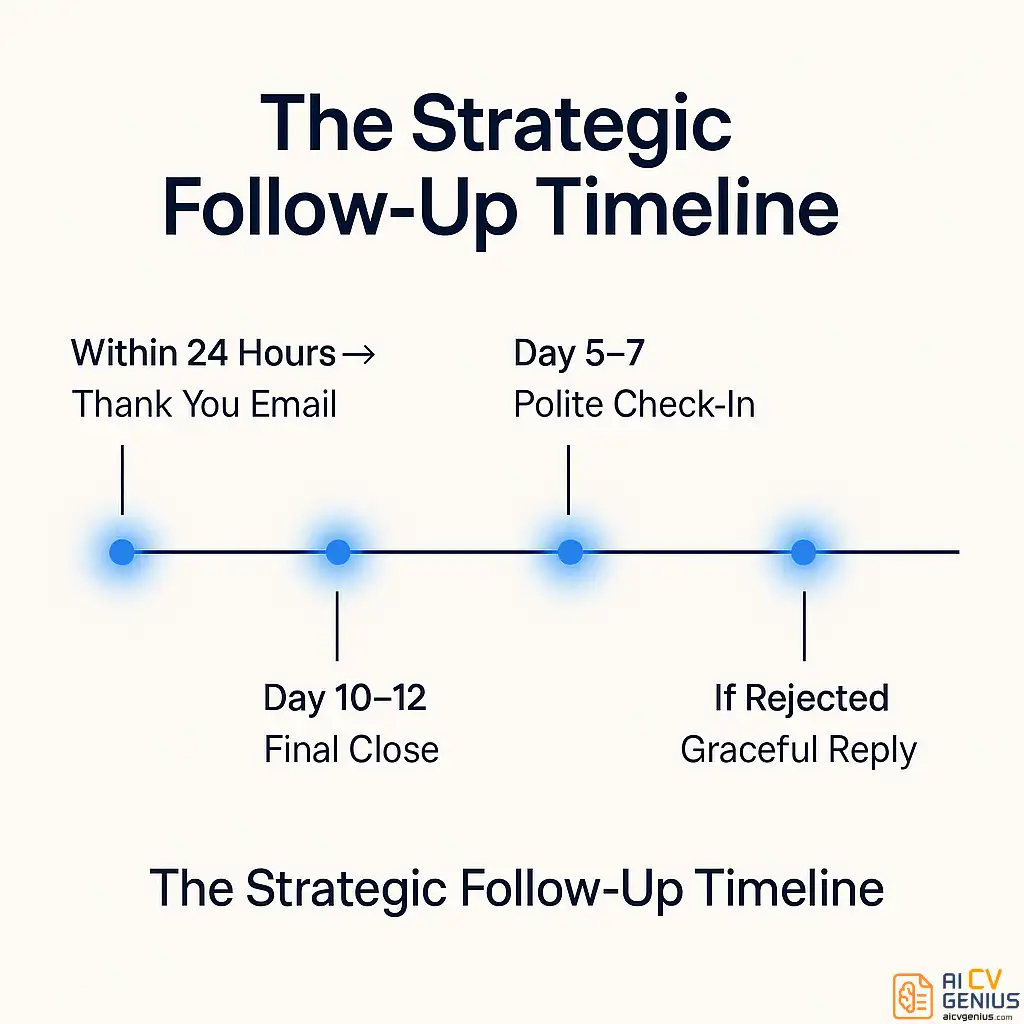
Timing is everything. Sending an email too soon can feel desperate; too late feels like an afterthought. Here is the proven, professional timeline that balances enthusiasm with patience.
| Timeframe | Action | The Psychological Goal |
|---|---|---|
| Within 24 Hours | The Thank-You Email | To show immediate gratitude and reinforce a specific connection. |
| 5-7 Business Days Later | The “Polite Check-In” | To express continued interest and gently prompt for an update. |
| 10-12 Business Days Later | The “Final, Graceful Close” | To get closure or confirm the role is filled, leaving a positive impression. |
| (If Rejected) | The “Graceful Reply” | To build a bridge for future opportunities. |
Step 1: The 24-Hour Thank-You Email (Your First Priority)
This is non-negotiable. Send this email within 24 hours of your interview, ideally the same afternoon or evening. Your goal is to be personal, not generic. You are reminding them why you are the right fit.
Key Components of a Perfect Thank-You Email:
- A Clear Subject Line: Subject: Thank You – Interview for [Job Title] or Subject: Thank You – [Your Name] & [Interviewer’s Name]
- Personalized Gratitude: Thank them by name for their time and insights.
- A Specific Reference Point: This is the most important part. Mention something specific you discussed. This proves you were listening.
- “I especially enjoyed our conversation about…”
- “I’ve been thinking about your point on [Specific Challenge]…”
- Reiterate Your Value: Briefly connect your experience to that point.
- “…and it reinforced how my experience in [Your Skill] could help the team achieve that goal.”
- A Confident Close: Reaffirm your enthusiasm.
- “I remain very excited about this opportunity and look forward to hearing about the next steps.”
Template That Works (For a Standard Interview):
Subject: Thank You for Today’s Conversation – [Job Title]
Hi [Interviewer’s Name],
Thank you so much for taking the time to speak with me today about the [Job Title] position. I truly enjoyed our conversation and learning more about how your team approaches [Specific Company Goal or Project].
I was particularly interested in our discussion about [Specific Topic, e.g., “the upcoming shift to a new platform”]. It reinforced my excitement about the role, and I’m confident that my experience in [Relevant Skill, e.g., “managing similar migrations”] could help make that transition a smooth one for your team.
I appreciate the opportunity and look forward to hearing about the next steps.
Warm regards,
[Your Name]
What if you had a panel interview? Send a separate, personalized email to each person. Do not mass-CC them. Reference a specific question or point that person made.
Step 2: The Art of Waiting (Don’t Chase)
This is the hardest part. After you send the 24-hour thank-you, your job is to wait. Hiring decisions are complex, often involving multiple schedules, budgets, and internal sign-offs. A decision that a recruiter promises by Friday can easily be delayed until the next Wednesday by a manager who is out sick.
Rushing or double-emailing within this window does not make you look eager – it makes you look anxious and signals a potential lack of patience, a key soft skill.
- ✅ If they gave you a timeline: (e.g., “We’ll get back to you by Friday”), wait until 1-2 business days after that date passes before following up.
- ✅ If they did not give a timeline: Wait at least 5-7 full business days before sending your first check-in.
Confidence speaks in calm timing. Give them the space to complete their process.
Step 3: The Gentle Follow-Up (Day 5–7)
You have been patient, and the timeline has passed. It is now perfectly acceptable to send a polite check-in. The key is to be friendly, professional, and helpful – not demanding.
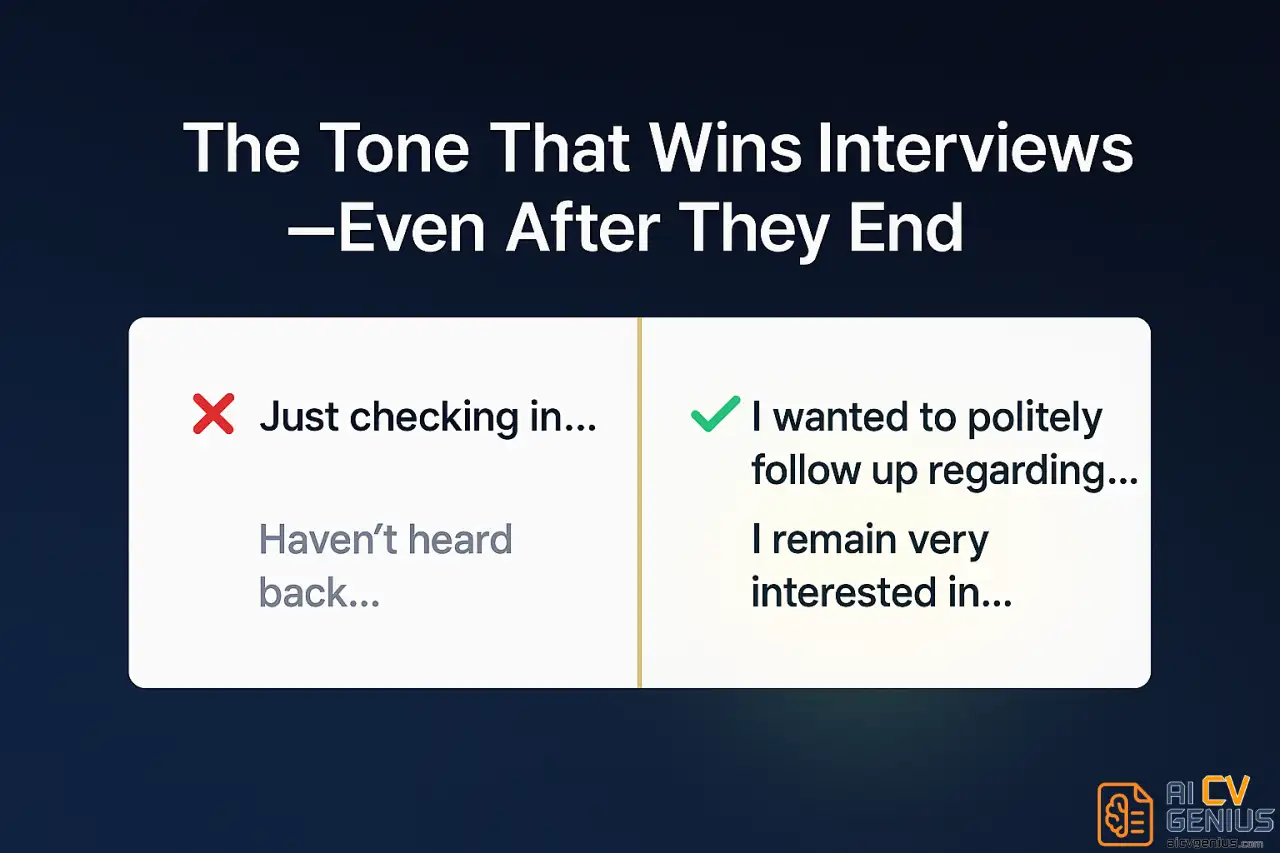
Critical Mistake to Avoid: Do not use anxious, apologetic, or passive-aggressive language like “Sorry to bother you…” or “Just checking in…” or “I haven’t heard from you…”
Your tone should be confident and forward-looking.
Template for a Polite Check-In:
Subject: Following Up on [Job Title] Interview
Hi [Interviewer’s Name or Recruiter’s Name],
I hope your week is going well.
I wanted to politely follow up regarding my interview for the [Job Title] position on [Date of Interview]. I remain very interested in the opportunity to join [Company Name] and contribute to [Specific Team or Goal].
Please let me know if there is any additional information I can provide to assist in your decision-making process.
Thank you again for your time and consideration.
Best,
[Your Name]
This email is perfect. It is short, polite, reaffirms your interest, and gently offers to help (by providing more info). It prompts a reply without applying pressure. For tone consistency, you can explore cover letter tips – the same principles of professional warmth apply.
Step 4: The Final Check-In (After 10–12 Days of Silence)
You sent your check-in (Step 3) and… still nothing. Silence for 10-12+ business days is often called “ghosting.” It is unprofessional, but it happens. This is not the time to be angry or passive-aggressive. This is your moment to demonstrate ultimate class and professionalism.
This one final message is not really about getting the job (at this point, the odds are low). It is about closing the loop gracefully and leaving a positive, lasting impression that could open doors for future roles.
Template for a Final, Graceful Close:
Subject: Checking in on [Job Title] Application
Hi [Recruiter’s Name],
I hope all is well.
I’m writing to check in one last time regarding the [Job Title] position I interviewed for on [Date]. I understand that processes can take time and priorities can shift.
I am still very interested in the role, but I also understand if you have decided to move forward with another candidate. In either case, it was a pleasure speaking with you and learning about [Company Name].
Thank you again for the opportunity.
Wishing you the best,
[Your Name]
This email shows understanding (“I understand processes take time”) and confidence (“I’m still interested, but I’m moving on”). It is the mark of a mature professional. After this email, you must mentally move on.
Step 5: How to Handle a “No” (And Turn Rejection into a Future “Yes”)
You finally get the email. It is a rejection. Most people delete it and feel defeated. This is a massive missed opportunity.
The person who replies to a rejection email with grace and professionalism is memorable. Recruiters keep “silver medalist” lists. When another role opens up, or their first choice falls through, who do you think they call? The person who was polite and professional, even in rejection.
Template for Replying to Rejection:
Hi [Interviewer’s Name / Recruiter’s Name],
Thank you so much for letting me know and for your feedback.
While I’m disappointed I won’t be joining the team this time, I truly appreciated the chance to meet you and learn about [Company Name]. It was a wonderful experience.
Please keep me in mind for any future roles that may be a good fit. I remain very impressed with your team and would love to stay in touch.
Wishing you and the team all the best.
Best,
[Your Name]
This 2-minute email can build a bridge that lasts for years. It turns rejection into a connection. You can learn how to phrase similar messages professionally in career communication guides.

Step 6: Keep Your Momentum Going (The Most Important Step)
The single best way to handle the anxiety of waiting is to not wait. Do not let one pending response freeze your entire job search. The “waiting” period is the perfect time to apply for three more jobs, reach out to two new contacts, and update your portfolio.
This is a psychological hack. When you have multiple opportunities in your pipeline, you stop obsessing over this one job. Your confidence becomes genuine because you are not desperate. Ironically, candidates who continue moving forward often get callbacks sooner – because their relaxed, confident energy comes through in every interaction.
If you want to refresh your resume while waiting, explore resume templates that help you reframe your story with clarity.
Common Mistakes to Avoid At All Costs
Your follow-up can help you, but it can also hurt you if done incorrectly. Avoid these common traps.
| ❌ The Mistake | Why It’s Bad | ✅ The Better Approach |
|---|---|---|
| The “Just Checking In” Email | This phrase is weak, adds no value, and centers your anxiety. | Be direct and confident. “I wanted to politely follow up regarding…” |
| Following Up Too Soon/Often | This signals desperation and a lack of patience. It’s the #1 complaint from recruiters. | Respect their timeline. Wait at least 5-7 business days. |
| Sounding Impatient or Angry | “Since I haven’t heard back…” or “I was told I’d know by Friday…” | Use a neutral, professional tone. Assume they are busy, not malicious. |
| Using a Generic Template | A thank-you note with no specific details from the interview. | Always reference a specific topic you discussed to prove you were listening. |
| Connecting on LinkedIn Immediately | This can feel too familiar, too fast. Wait until you have an offer. | Stick to email, the professional channel for this process. |
| Asking for “Feedback” | “Can you tell me what I did wrong?” This puts the recruiter in an awkward legal/HR position. | Do not ask for feedback. Ask to be kept in mind for the future. |
In-Depth FAQs: Your Toughest Follow-Up Questions
Final Thoughts: The Follow-Up Is a Reflection of Your Character
Following up is not about chasing – it is about connection, respect, and professionalism. It is your final chance to demonstrate how you communicate, how you handle ambiguity, and how much you respect their time.
When you do it right, you come across as confident, considerate, and emotionally intelligent – three traits every employer values more than any hard skill. So send that email. Not to get their attention, but to show your attention – to the people, the process, and the opportunity itself. That is how you stand out.