
- Customizing your resume to each job description is non-negotiable: ATS filters for keyword and phrase alignment, and recruiters reward obvious role fit.
- Start with precision analysis: Identify the top 3 to 5 must-have skills, repeated terms, tools, responsibilities, and the outcomes the role is driving.
- Build a repeatable tailoring workflow: Create a keyword bank, rewrite your summary for the role, then reshape experience bullets to mirror requirements with action verbs and metrics.
- Optimize structure and language, not just keywords: Reorder skills and sections to match what the employer values, frame achievements around company goals, and integrate keywords naturally without stuffing.
- Finish with clean execution: Proofread for customization mistakes, save as a selectable-text PDF with a professional filename, use a quick pre-submit checklist, and extend the same targeting logic into your cover letter.
Submitting the same generic resume to every job application might feel like an efficient time-saver – but in reality, it’s often the primary reason applications get consistently ignored. Recruiters and Applicant Tracking Systems (ATS) operate under immense pressure, prioritizing candidates whose qualifications immediately and obviously align with the specific role’s requirements. Mastering how to customize your resume to a job description isn’t about fabricating experience; it’s about strategically highlighting the relevant skills and achievements you already possess, framing them in the precise language the employer uses and values most.
Think of it this way: a generic resume is like a broad marketing message sent to everyone; a customized resume is like a personalized pitch delivered directly to the decision-maker, addressing their specific needs. This guide will provide a clear, step-by-step process for effectively tailoring your resume, ensuring it speaks directly to each unique opportunity, significantly increasing your chances of passing both automated filters and human review with confidence.
Why Customizing Your Resume is Non-Negotiable
The vast majority of medium to large companies utilize Applicant Tracking Systems (ATS) as their initial screening mechanism. These software platforms are programmed to scan resumes specifically for keywords and phrases that directly match the language used within the job description. A generic resume, even one showcasing strong qualifications, risks being automatically filtered out if it lacks sufficient keyword alignment.
Beyond defeating the digital gatekeeper, customizing your resume demonstrates tangible effort and genuine interest in the specific role and company. It signals professionalism and meticulous attention to detail – qualities universally valued by employers. It transforms your application from just another number into a targeted, compelling case for your candidacy.
- ✅ Significantly increases your chances of passing critical ATS filters.
- ✅ Immediately captures recruiter attention by highlighting direct relevance.
- ✅ Makes your key achievements and skills more persuasive within the context of the role.
- ✅ Demonstrates genuine interest, strong work ethic, and professional attention to detail.
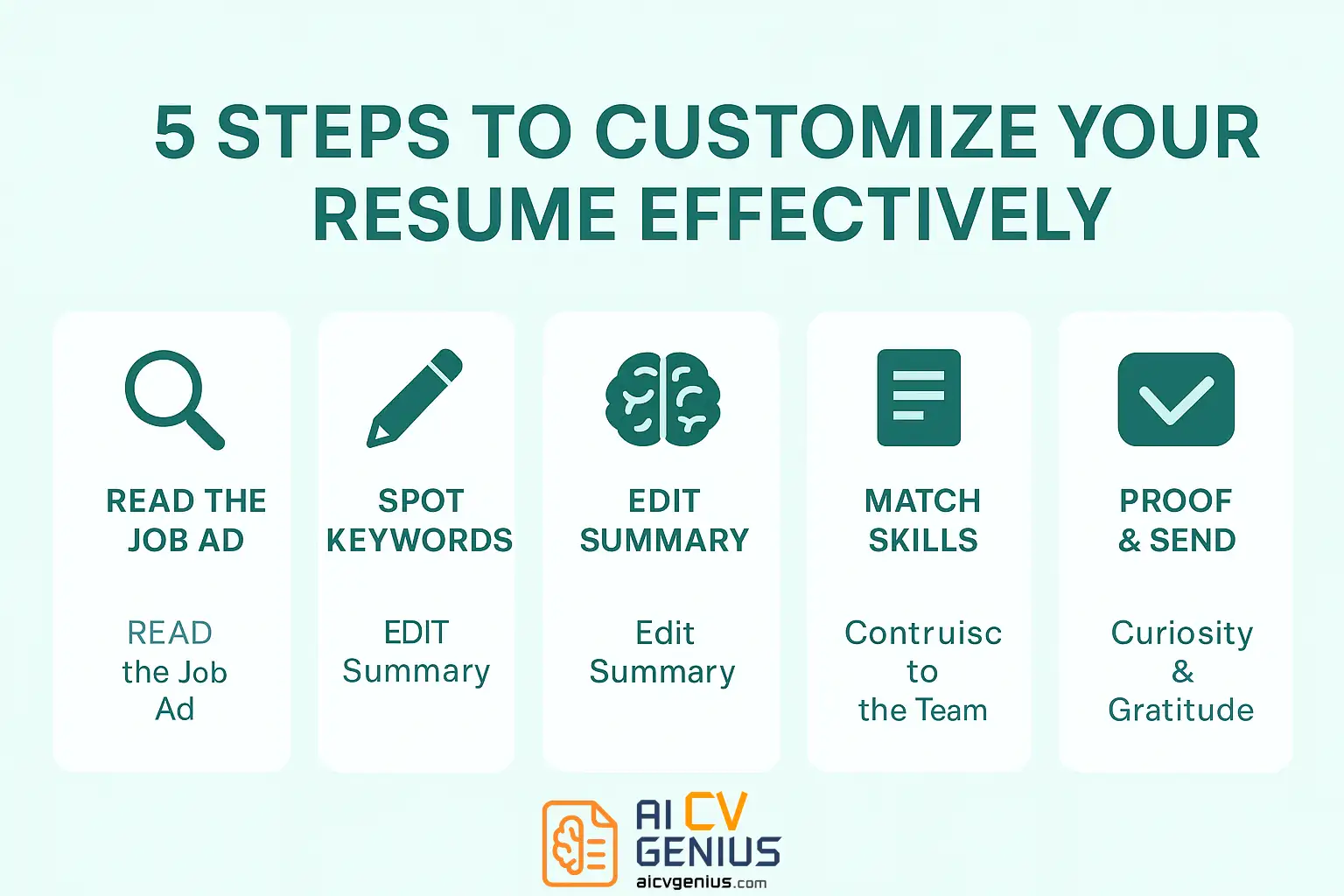
How to Customize Your Resume: A Complete Step-by-Step Workflow
Step 1: Analyze the Job Description with Precision
Before modifying your resume, meticulously dissect the job posting itself. Read it not just as a candidate seeking information, but as a recruiter identifying critical requirements. Highlight or list recurring terms, essential skills (both hard and soft), specific tools or software mentioned, key responsibilities, and desired outcomes or qualifications. Pay close attention to the phrasing used.
Example Analysis:
If a job description for a Project Manager repeatedly emphasizes “strong project management methodologies (Agile/Scrum preferred),” “data analysis for performance tracking,” and “experience leading cross-functional teams,” these exact (or very similar) phrases become your primary targets for integration into your resume.
Ask yourself these critical questions while reading:
- What are the absolute top 3-5 non-negotiable skills or qualifications explicitly stated?
- Which specific keywords, technical terms, or industry jargon appear most frequently?
- What measurable outcomes or strategic goals does the role seem focused on achieving (e.g., increase efficiency, drive growth, manage budgets)?
Think of the job description as the definitive roadmap provided by the employer. Aligning your resume closely with this map is the most direct route to demonstrating your suitability.
Step 2: Create a Targeted Keyword Bank for Each Application
Based on your analysis from Step 1, compile a concise list – your “keyword bank” – of the essential terms and phrases specific to this job posting. Categorizing them can be helpful:
- Job-Specific Hard Skills: e.g., “Python programming,” “Salesforce CRM administration,” “curriculum development,” “financial modeling.”
- Required Soft Skills: e.g., “leadership,” “cross-functional communication,” “problem-solving,” “time management,” “adaptability.”
- Tools & Technologies: e.g., “Microsoft Excel (Advanced),” “Adobe Creative Suite,” “Jira,” “AWS,” “Google Analytics.”
- Industry Jargon & Concepts: e.g., “Return on Investment (ROI),” “client lifecycle management,” “Agile methodologies,” “regulatory compliance (SOX).”
Online tools like Jobscan or Resumeworded can automate comparing your existing resume against a job description to identify keyword gaps. However, careful manual analysis combined with your own industry knowledge often yields the most nuanced and effective results. This keyword bank becomes your checklist for strategic integration.
Step 3: Tailor Your Resume Summary or Objective Statement
Your opening statement (Summary for experienced candidates, Objective for entry-level/career changers) offers the first, most crucial opportunity for customization. Rewrite this concise section (3-5 lines) specifically for each application, incorporating 1-3 high-priority keywords identified from the job description and directly addressing the employer’s needs.
Generic Summary (Less Effective):
Experienced marketing professional with a proven track record in managing digital campaigns and social media presence effectively. Skilled in various marketing tools.
Customized Summary (More Effective, targeting a B2B SaaS role valuing lead generation):
Results-driven Digital Marketing professional with 5+ years of experience specializing in B2B SaaS lead generation and content strategy. Proven ability to increase qualified leads by over 150% through targeted SEO and campaign optimization using HubSpot and Google Analytics – skills directly aligned with [Company Name]’s focus on data-driven growth.
The customized version immediately signals relevance by using specific industry terms (“B2B SaaS”), quantifiable results (“150%”), key skills (“SEO,” “HubSpot”), and mentioning the company by name, demonstrating genuine interest.
Step 4: Align Work Experience Bullet Points with Role Requirements
Do not simply list every task you’ve ever performed under each past role. Instead, strategically curate and refine your bullet points to emphasize the achievements and responsibilities most relevant to the target job. Where possible, mirror the specific language and keywords used in the job description.
Example Alignment:
Job Description requires: “Experience managing cross-team collaboration on product launches.”
Your Original Bullet: “Worked with various departments on new initiatives.”
Your Customized Bullet: “Collaborated effectively with cross-functional teams (Product, Sales, Engineering) to successfully execute 3 major product launches, consistently delivering marketing components 15% ahead of schedule.”
Each tailored bullet point should reinforce the narrative: “Yes, I possess precisely the experience required for this specific responsibility.” Key principles:
- ✅ Begin every bullet point with a strong, specific action verb (Led, Managed, Created, Increased, Optimized, Analyzed).
- ✅ Quantify results and impact whenever feasible using numbers, percentages, or dollar values (%, $, #). Concrete metrics build credibility.
- ✅ Maintain a professional, confident, and specific tone throughout. Avoid vague language.
Step 5: Prioritize and Reorder Skills and Sections Strategically
The sequence of information on your resume matters. For certain roles, adjusting the order of sections or the listed skills can significantly enhance perceived relevance.
- If applying for a highly technical role where specific software proficiency is paramount, consider placing a detailed “Technical Skills” or “Software Proficiency” section prominently near the top, perhaps immediately after your summary.
- If the job emphasizes leadership capabilities, ensure your summary and the initial bullet points under your recent experience highlight management scope and strategic achievements.
- Within your Skills section, list the skills most critical to the target role first. Don’t bury essential qualifications at the bottom of a long list.
Customization extends beyond mere wording – it includes optimizing the structure itself to guide the recruiter’s eye efficiently toward the information they value most for that specific position.
Step 6: Frame Achievements to Resonate with Company Goals
Effective customization involves understanding not just the role’s requirements, but also the company’s broader objectives and values (often found on their website’s “About Us” or “Careers” pages). Frame your past achievements in a way that demonstrates how your contributions align with their priorities.
Instead of (Generic Achievement):
“Trained new staff members on company procedures.”
Try (Aligned with a company valuing efficiency):
“Developed and implemented streamlined onboarding materials and training protocols that reduced new-hire ramp-up time by approximately 30%, enhancing team productivity.”
Or (Aligned with a company valuing employee development):
“Mentored and trained 5 junior team members on [Specific Skill/Process], with 3 subsequently receiving promotions based on improved performance.”
Connecting your actions to measurable outcomes – particularly those reflecting common business goals like efficiency, growth, innovation, or teamwork – makes your contributions significantly more compelling and relevant.
Step 7: Integrate Keywords Naturally, Avoiding “Stuffing”
While keyword alignment is crucial for ATS, simply cramming keywords unnaturally into sentences will appear obvious and unprofessional to human reviewers (and potentially flagged by sophisticated ATS). Integrate keywords organically within the context of your achievements and responsibilities. Use synonyms and variations where appropriate.
Bad Example (Keyword Stuffing):
“Expert in project management, utilizing project management software for effective project management across teams.”
Better Example (Natural Integration):
“Led cross-functional teams using Agile project management methodologies; utilized Jira for task tracking and stakeholder communication, ensuring successful delivery of 10+ software projects.”
Authentic, well-written content demonstrating genuine experience always outperforms awkward keyword repetition.
Step 8: Final Proofread and Strategic Saving
After tailoring, perform one last meticulous proofread specifically checking for consistency between your resume and the job description (e.g., ensuring job titles align where appropriate, confirming all required skills are addressed). Then, save your customized version correctly:
- ✅ Save primarily as a PDF file to preserve formatting perfectly across all devices.
- ✅ Keep a Word (.docx) version only if the company specifically requests it for their ATS or if needed for future minor edits.
- ✅ Use a clear, professional file naming convention that includes your name and potentially the target role or company:
FirstName_LastName_Resume.pdforFirstName_LastName_JobTitle_Resume.pdf. Avoid generic names like “resume_final.pdf”. - ✅ Double-check that the PDF text is selectable (not an image) to ensure ATS compatibility. Copy-paste a section into Notepad to verify.
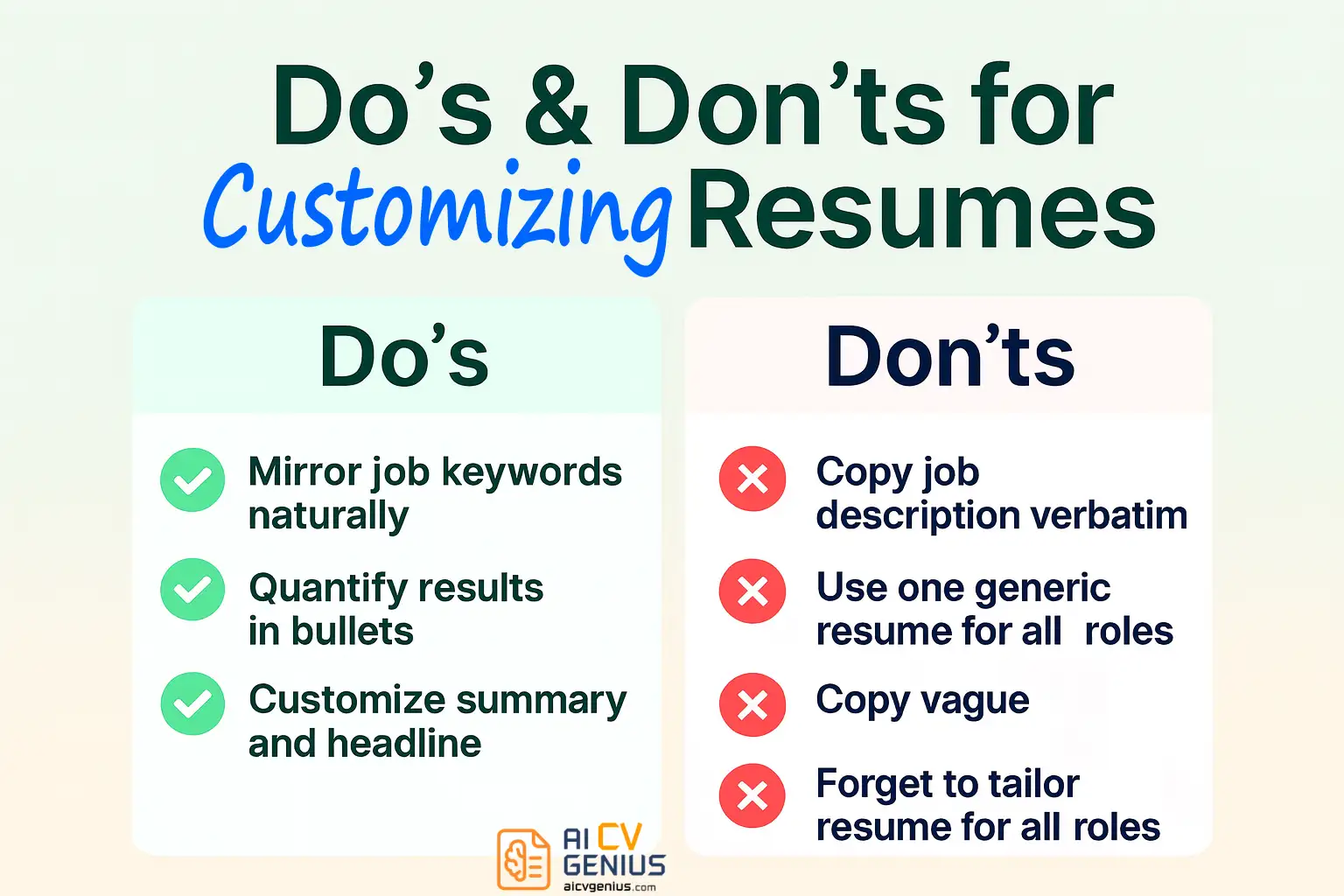
Beyond the Resume: Cover Letters, Trade-Offs, and Pre-Submit Checks
Bonus Tip: Extend Customization to Your Cover Letter
Your cover letter provides the ideal platform for deeper personalization beyond resume constraints. Use it strategically to: explicitly mention the specific company and role, elaborate on 1-2 key achievements highlighted in your resume that directly address the employer’s needs, express genuine enthusiasm based on specific company values or projects, and explain any nuances (like career transitions) requiring further context. Pairing a meticulously customized resume with an equally thoughtful, tailored cover letter significantly multiplies your application’s impact.
For practical guidance and effective examples, explore our comprehensive Cover Letters Tips section.
Pros & Cons of Customizing Every Resume
Understanding the trade-offs involved:
| Pros | Cons |
|---|---|
| ✅ Dramatically increases chances of passing ATS filters and securing interviews by demonstrating direct relevance. | ❌ Requires a significant time investment (typically 10–30 minutes) for each individual application. |
| ✅ Signals genuine interest, professionalism, and strong work ethic to recruiters and hiring managers. | ❌ Necessitates meticulous attention to detail and careful strategic thinking for each unique role. |
| ✅ Improves keyword matching scores within Applicant Tracking Systems, enhancing search visibility. | ❌ Can feel repetitive or tedious, especially when applying to numerous similar positions. |
| ✅ Allows you to strategically position yourself as the ideal candidate by highlighting the most pertinent qualifications. | ❌ Minor errors or inconsistencies introduced during rapid customization can appear obvious and unprofessional if rushed. |
Despite the time investment, the significant increase in interview callback rates generally makes meticulous customization a highly worthwhile strategy, especially for roles you are genuinely interested in.
Final Checklist Before Sending Your Customized Resume
Perform this rapid verification before submitting each application:
- ✅ Target Job Title in Summary/Headline closely matches or aligns with the title in the job listing.
- ✅ Critical Keywords identified from the job description are naturally integrated throughout the resume content.
- ✅ Summary/Objective statement has been specifically rewritten or tweaked for this company and role.
- ✅ Highlighted Achievements and Skills directly address the top 3-5 requirements mentioned in the job posting.
- ✅ File name is professional and clear (e.g., FirstName_LastName_Resume.pdf). File format is PDF (unless specified otherwise).
- ✅ One final meticulous proofread conducted specifically for this version to catch any customization errors or inconsistencies.
FAQs and Final Thoughts
FAQs: Customizing Your Resume Effectively
Final Thoughts: Customization as Communication
Ultimately, customizing your resume isn’t about manipulating systems or fabricating qualifications – it’s fundamentally about effective communication. It’s about proactively demonstrating to employers that you have taken the time to understand their specific needs and can clearly articulate how your unique skills and experiences provide a direct solution.
The time invested in tailoring each application is a tangible signal of respect – respect for the recruiter’s demanding role, respect for the specific opportunity, and ultimately, respect for your own professional craft. It transforms your resume from being merely one application among hundreds into a compelling, personalized conversation starter. It’s frequently the critical difference between remaining unseen and becoming the candidate they absolutely must call for an interview.
For access to professional templates designed to make the customization process faster and more effective, explore our curated Resume Templates Finder. For in-depth guidance on optimizing specific sections like your summary or skills list, visit our comprehensive Resume Templates Guides. And if you aim to perfectly pair your tailored resume with an equally impactful introduction, check the expert advice and examples available in our Cover Letters resources.
Remember this core principle: a truly great resume doesn’t attempt to say everything – it strategically says precisely the right things for the specific opportunity at hand.