
- The article explains the real difference in resume objective vs summary: An objective signals direction and potential, while a summary showcases proven value and results.
- It clarifies when each works best: Objectives fit students, entry-level candidates, career changers, and people re-entering work, while summaries fit professionals with 2+ years of relevant experience and measurable achievements.
- A comparison table and scenarios make the choice practical: Pick based on whether you need to communicate potential and intent, or credibility and impact, then tailor the language to the exact role.
- It gives writing rules for both formats: Keep it concise, lead with role or identity, include 1 to 2 key strengths, add quantifiable proof in summaries, and weave keywords naturally without sounding generic or self-focused.
- The wrap-up adds placement guidance and FAQs: Put the statement at the top under contact info, avoid using both in most cases, keep summaries to 3 to 5 strong sentences, and choose the format that matches your profile and the job’s priorities.
You’ve likely encountered the debate – should your resume kick off with an objective statement or a professional summary? The reality is, both serve distinct strategic purposes, but choosing the right one hinges entirely on understanding your current career stage and precisely what narrative you need to convey to potential employers. Grasping the difference between a resume objective vs summary isn’t just about terminology; it’s about selecting the opening statement that most effectively positions you for the specific role you seek.
Think of your resume’s opening statement like the critical first scene of a film. A resume objective functions as the intriguing trailer: it clearly signals your intended direction and potential. A resume summary acts as the powerful highlight reel: it immediately showcases your proven track record and key accomplishments. Let’s meticulously unpack the distinctions, optimal use cases, and writing strategies for each, empowering you to choose the approach that ensures your resume gets noticed and remembered for all the right reasons.
What Is a Resume Objective? Defining Your Intent
A resume objective is a concise statement (typically 2–3 sentences) placed at the top of your resume that clearly articulates your immediate career goal and highlights key skills relevant to the specific position you are applying for. It primarily functions to express your intent and direction.
This approach is most effective and appropriate for individuals who:
- Are recent graduates entering the workforce for the first time.
- Are making a significant career change into a new industry or function.
- Are re-entering the workforce after an extended period away.
- Have limited direct professional experience relevant to the target role.
Example (Recent Graduate):
Highly motivated and detail-oriented Business Administration graduate (GPA 3.7) seeking an entry-level Marketing Assistant position at [Company Name]. Eager to apply strong analytical skills, proficiency in social media analytics, and collaborative project experience gained through university coursework to support impactful campaign development and contribute to team success.
When to use it: A resume objective is your tool when your primary asset is demonstrable potential, enthusiasm, relevant foundational skills, and a clear vision for your next step, rather than an extensive track record of professional achievements. It helps employers immediately understand your career direction and how you envision applying your capabilities within their organization.
Common Mistakes in Resume Objectives (And How to Fix Them)
- ❌ Too Vague: “Seeking a challenging and rewarding position offering opportunities for growth.” (This tells the employer nothing specific about your goals or their role.)
Fix: Be specific about the role and industry: “Seeking a challenging Junior Accountant role within the technology sector…” - ❌ Too Self-Focused: “Objective is to gain valuable experience and develop new skills in a dynamic company.” (Focuses solely on your needs, not the employer’s.)
Fix: Frame your goal around contributing value: “…where I can apply my quantitative analysis skills and dedication to accuracy to contribute effectively to financial reporting and process improvement.” - ✅ Better, Combined Example: “Seeking a challenging Junior Accountant role within the technology sector where I can apply my quantitative analysis skills and dedication to accuracy to contribute effectively to financial reporting and process improvement at [Company Name].” (Specific role, industry, skills offered, and value proposition.)
What Is a Resume Summary? Showcasing Your Proven Value
A resume summary (often called a “professional summary” or “profile”) is a brief paragraph (typically 3–5 sentences) positioned at the top of your resume that concisely highlights your most relevant qualifications, significant professional achievements, key areas of expertise, and career level. Its primary function is to provide recruiters with an immediate, high-impact snapshot of your proven value proposition.
This approach is most effective and expected for individuals who:
- Have 2+ years of relevant professional experience in their field.
- Possess a clear track record of accomplishments and quantifiable results.
- Are applying for roles where demonstrated experience is a key requirement.
- Want to immediately position themselves as credible, experienced professionals.
Example (Experienced Project Manager):
Results-driven and PMP-certified Project Manager with over 6 years of experience successfully leading complex, cross-functional software development projects within the SaaS industry. Proven track record includes delivering multi-million dollar initiatives on time and consistently under budget (average 10% savings), while significantly improving team workflow efficiency by implementing Agile methodologies, resulting in a documented 25% increase in sprint velocity. Expertise spans risk management, stakeholder communication, and resource allocation.
When to use it: A resume summary is your opening statement when your professional history itself tells a compelling story of achievement. It allows you to immediately present your strongest qualifications and measurable impact, capturing recruiter attention and establishing credibility from the outset.
Resume Objective vs Summary: The Core Distinctions Clarified
Understanding these fundamental differences helps you choose the right approach:
| Feature | Resume Objective | Resume Summary |
|---|---|---|
| Primary Purpose | Clearly state career goals and express specific intent for the target role. | Concisely highlight key professional achievements, skills, and relevant experience level. |
| Typical Length | Shorter: 2–3 concise sentences. | Longer: 3–5 impactful sentences or bullet points. |
| Temporal Focus | Future-oriented: Emphasizes where you are headed and what you aim to contribute. | Past & Present-oriented: Emphasizes what you have already accomplished and currently offer. |
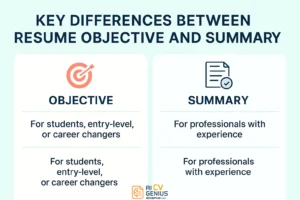
| Ideal Candidate Profile | Students, recent graduates, entry-level candidates, significant career changers, those re-entering the workforce. | Professionals with 2+ years of relevant experience, individuals with a clear track record of quantifiable results. |
| Overall Tone | Ambitious, focused, forward-looking, highlighting potential and relevant foundational skills. | Confident, evidence-based, results-oriented, highlighting proven expertise and impact. |
The core decision hinges on whether your immediate goal is to communicate potential and direction (Objective) or proven value and expertise (Summary).
When to Use Each: Practical Scenarios Illustrated
Let’s apply this understanding to common job seeker situations:
Scenario 1: Student or Recent Graduate (Minimal Formal Experience)
Your primary assets are education, relevant coursework, key projects, internships (if any), and transferable skills. An Objective clearly signals your target role and connects your foundational learning to the employer’s needs.
Objective Example (Computer Science Graduate):
Enthusiastic and detail-oriented recent Computer Science graduate (GPA 3.8) seeking a challenging Software Development position at [Company Name]. Eager to apply proficiency in Java, Python, and Agile methodologies gained through complex university projects to contribute effectively to real-world software solutions and collaborative team environments.
Scenario 2: Career Changer (Pivoting Industries or Functions)
Your objective needs to explicitly bridge the gap between your previous field and your new target area, highlighting relevant transferable skills and demonstrating clear intent.
Objective Example (Teacher to HR):
Former secondary school English Teacher with 8 years of experience developing curriculum and fostering student engagement, now transitioning into Human Resources. Seeking an HR Coordinator role at [Company Name] where I can leverage proven communication, organizational, training development, and conflict resolution skills to enhance employee onboarding and contribute positively to workplace culture. Recently completed [Relevant HR Course/Certification].
Scenario 3: Mid-Level Professional (Established Track Record)
With several years of relevant experience and demonstrable achievements, a Summary provides an immediate, compelling snapshot of your value.
Summary Example (Marketing Specialist):
Data-driven Digital Marketing Specialist with 5+ years of comprehensive experience managing SEO, PPC, and content strategies that consistently drive measurable B2C growth. Proven success includes increasing organic website traffic by 60% and improving lead conversion rates by 30% through targeted campaign optimization using Google Analytics and SEMrush. Proficient in HubSpot and Salesforce integration.
Scenario 4: Senior Executive (Focus on Leadership & Strategy)
Your summary must function as a high-level executive bio, conveying strategic vision, leadership scope, and significant business impact concisely.
Summary Example (Operations Director):
Visionary Operations Director with over 12 years of progressive leadership experience optimizing global logistics networks and implementing data-driven process improvements within the manufacturing sector. Proven record includes reducing operational costs by 18% ($15M annually) and improving on-time delivery rates to 99.5% across complex international supply chains. Expertise in Lean Six Sigma methodologies and leading large, diverse teams (200+).
Pros & Cons: Resume Objective vs Summary
Understanding the inherent strengths and weaknesses helps solidify your choice:
| Pros | Cons | |
|---|---|---|
| Resume Objective | ✅ Clearly communicates career direction and specific target role, especially crucial for entry-level or career change candidates. ✅ Effectively highlights enthusiasm, relevant foundational skills, and potential even when direct experience is limited. ✅ Helps recruiters quickly understand your specific intent and how you align with the position sought. | ❌ Can sound generic, self-focused (“what I want”), or uninspired if not carefully tailored with specific skills and value offered to the employer. ❌ Provides less immediate evidence of past accomplishments compared to a summary. ❌ Generally less impactful for candidates with substantial relevant experience. |
| Resume Summary | ✅ Immediately showcases key qualifications, significant achievements, and level of expertise, capturing recruiter attention quickly. ✅ Builds credibility instantly by focusing on proven results and quantifiable impact. ✅ Works effectively with ATS keyword scanning by incorporating relevant skills and experience highlights upfront. ✅ Positions the candidate confidently as an experienced professional ready to contribute value. | ❌ Less suitable or effective for candidates lacking substantial relevant professional experience or measurable achievements. ❌ Can occasionally feel boastful or overly dense if not written concisely and balanced with factual evidence. ❌ Requires careful tailoring to ensure highlighted achievements directly align with the target role’s priorities. |
Crafting an Effective Resume Objective: Key Principles
Follow this structure for maximum impact:
- Identify the Target Role Clearly: Mention the specific job title or type of position you are seeking (e.g., “seeking a Financial Analyst position,” “aiming for an internship in Graphic Design”).
- Highlight 1-2 Key Strengths/Skills: Briefly showcase your most relevant qualification or core competency pertinent to the role (e.g., “leveraging strong analytical skills,” “applying proficiency in Java and Python,” “utilizing excellent communication and organizational abilities”).
- State Your Goal in Terms of Value Offered: Explain how you intend to contribute to the employer’s goals or needs, not just what you hope to gain. Focus on adding value. (e.g., “…to contribute to accurate financial reporting,” “…to support the development of engaging user interfaces,” “…to enhance patient care quality”).
- Keep it Concise: Strictly limit to 2-3 focused sentences. Brevity is crucial.
- Tailor Relentlessly: Customize the objective for each specific job application, incorporating keywords from the job description where appropriate.
Strong Example (Career Changer to Project Management):
Highly organized former Event Planner with 5+ years experience managing complex logistics and stakeholder communication, now seeking a Project Coordinator role at [Company Name]. Eager to apply proven budget management, timeline adherence, and problem-solving skills gained through coordinating 50+ successful corporate events to contribute effectively to efficient project delivery within the tech sector. Recently completed [Relevant Project Management Course/Certification].
Writing a Winning Resume Summary: Focus on Impact
Structure your summary for immediate credibility:
- Lead with Your Professional Identity: Start with your current or target job title and years of relevant experience (e.g., “Results-driven Sales Manager with 8+ years experience…” “PMP-certified IT Project Manager with a decade of success…”).
- Showcase 1-2 Core Areas of Expertise: Highlight your key specializations or functional strengths most relevant to the target role (e.g., “…specializing in enterprise software sales and key account management,” “…expertise spans Agile methodologies, cloud infrastructure migration, and risk mitigation”).
- Include 1-2 Major Quantifiable Achievements: Provide concrete proof of your impact using numbers, percentages, or dollar values. This is critical for grabbing attention. (e.g., “…proven ability to increase regional sales by 30% year-over-year,” “…successfully reduced project costs by 15% through strategic vendor negotiation”).
- Mention Key Skills/Tools (Optional but Recommended): Briefly incorporate 1-2 essential technical skills or certifications mentioned in the job description if space allows (e.g., “Proficient in Salesforce CRM and data visualization tools like Tableau”).
- Keep it Concise: Aim for 3-5 impactful sentences or bullet points maximum. Avoid generic fluff.
- Tailor Keywords: Ensure the language aligns with keywords found in the target job description.
Strong Example (HR Generalist):
SHRM-CP certified Human Resources Generalist with 6 years of comprehensive experience managing the full employee lifecycle within fast-paced tech environments. Expertise includes talent acquisition (reducing time-to-fill by 20%), employee relations (resolving 95%+ of issues effectively), and HRIS implementation (Workday). Proven ability to partner with leadership to foster positive workplace cultures and ensure compliance.
Objective vs Summary: Making the Definitive Choice
Here’s the straightforward guideline based on your professional context:
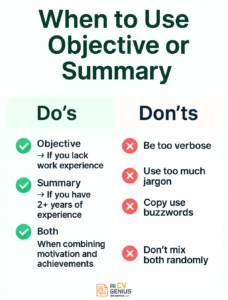
- Use a Resume Objective if you fall into one of these categories:
- Student / Recent Graduate
- Entry-Level Candidate (0-2 years experience)
- Making a Significant Career Change (new industry/function)
- Re-entering the Workforce after an Extended Absence
Focus: Clearly state your target role and highlight potential, relevant skills, and enthusiasm.
- Use a Resume Summary if you meet these criteria:
- Have 2+ years of relevant professional experience.
- Possess a track record of demonstrable achievements and quantifiable results.
- Are applying for roles where proven experience is a primary requirement.
Focus: Immediately showcase your expertise level, key accomplishments, and proven value proposition.
- ⚙️ Hybrid Approach (Rare but Possible): In specific situations (e.g., highly specialized freelancers, consultants targeting diverse projects), a brief hybrid might work: Start with a 1-sentence objective stating the target engagement type, immediately followed by 2-3 sentences summarizing key expertise and results. Use this structure cautiously.
Choose the format that most honestly and effectively represents your current situation and strategically positions you for the specific role you are pursuing.
Formatting & Placement: Ensuring Visibility
Regardless of whether you choose an objective or a summary, adhere to these presentation best practices:
- ✅ Place the statement prominently at the very top of your resume, directly beneath your name and contact information. This ensures it’s one of the first things recruiters see.
- ✅ Present it as a concise paragraph (typically 2-5 sentences). Avoid using bullet points within the objective or summary itself unless crafting a very specific hybrid format.
- ✅ Use clear, professional language. Avoid overly casual slang, excessive jargon (unless standard in the industry), or generic buzzwords (“dynamic,” “passionate,” “driven,” “results-oriented”) unless immediately substantiated with specific evidence. Let your achievements convey these qualities implicitly.
- ✅ Ensure the formatting (font style, size) is consistent with the rest of your resume for a cohesive, professional appearance.
- ✅ Tailor the content and keywords specifically for each job application to maximize relevance and impact.
Direct Comparison: Objective vs Summary Examples
Illustrating the difference for a similar target field (HR):
Objective (Entry-Level/Career Changer):
Recent Psychology graduate (GPA 3.6) with strong interpersonal and organizational skills gained through coordinating university volunteer programs (managing 20+ volunteers). Seeking an HR Assistant position at [Company Name] where I can apply empathy, problem-solving abilities, and a passion for fostering positive workplace culture to support employee onboarding and engagement initiatives effectively.Summary (Experienced HR Professional):
SHRM-CP certified Human Resources professional with 6+ years of comprehensive experience managing talent acquisition, employee relations, and performance management within the technology sector. Proven success includes implementing data-driven retention programs that reduced annual turnover by 15% and streamlining onboarding processes using [HRIS System]. Expertise in coaching managers and ensuring compliance with labor laws.
Notice how the summary immediately highlights proven experience, specific metrics (15% turnover reduction), and certifications (SHRM-CP), establishing credibility. The objective focuses on potential, relevant skills (interpersonal, organizational), academic background, and clear intent for the specific role.
FAQs: Resume Objective vs Summary Clarified
Final Thoughts: Choosing Your Opening Statement Wisely
The decision between crafting a resume objective vs summary isn’t merely about following arbitrary rules – it’s a strategic choice reflecting your professional reality and career aspirations. Your resume’s opening statement sets the immediate tone and focus, significantly influencing how the rest of your document is perceived. The objective effectively signals your intended direction and potential when direct experience is limited; the summary powerfully showcases your proven track record and established expertise when you have achievements to highlight.
Both formats can be incredibly effective when written with clear intent, unwavering authenticity, and sharp focus tailored to the specific role. Ultimately, what matters most isn’t adhering rigidly to one format over the other, but ensuring that your chosen opening statement – those critical first few lines – immediately convinces the reader: “This candidate understands the role, possesses relevant qualifications (or potential), and deserves further consideration.”
For diverse examples illustrating both objective and summary statements across various industries, and access to customizable, ATS-friendly templates, visit our comprehensive Resume Templates Finder. To further refine your overall resume writing strategy and explore advanced techniques for showcasing impact, delve into our detailed Resume Templates Guides or access broader career advice within the extensive Career Resources section.
Your opening statement represents your first opportunity to make a compelling argument for your candidacy – ensure you write it with the precision and confidence it deserves.