

- Core premise: Amazon interviews score you against the 16 Leadership Principles, so every answer needs a clear principle match.
- Answer formula: Use STAR plus the principle, keep Situation and Task tight, spend most time on Action, and end with quantified Results.
- 5 principles to prioritize: Customer Obsession, Ownership, Bias for Action, Dive Deep, Have Backbone; Disagree and Commit.
- Prep method: Build a story matrix, map 2 to 3 stories per principle (wins, failures, conflict, ambiguity), then rehearse until the link is automatic.
- Make it land: Avoid vague claims, long backstory, blaming others, and missing metrics, then ask smart team questions and speak in Amazon’s language.
Amazon Is Obsessed With 16 Leadership Principles
Every Amazon interview – technical, behavioral, or functional – evaluates candidates against their 16 Leadership Principles. These aren’t just corporate values posted on a wall. They’re the framework for every hiring decision.
Interviewers are assigned specific Leadership Principles to assess. They ask questions designed to reveal whether you demonstrate those principles. Your answers either prove you align with Amazon’s culture or don’t.
The candidates who succeed don’t just tell good stories – they speak Amazon’s language by explicitly connecting experiences to Leadership Principles using structured STAR responses.
Here’s how to master the STAR+LP formula and prepare for the most common Amazon interview questions.
The Formula: STAR + Leadership Principle
STAR Structure
Every behavioral answer should follow this format:
- Situation: Brief context (2-3 sentences maximum)
- Task: Your specific responsibility or challenge
- Action: What you did (this is 60% of your answer – be detailed)
- Result: Quantified outcome and what you learned
Weave In Leadership Principles
Don’t just tell a story – explicitly connect it to the relevant Leadership Principle:
“This experience demonstrates Customer Obsession because I prioritized solving the customer’s problem even when it required extra effort that wasn’t technically my responsibility.”
Amazon interviewers are trained to map your answers to specific principles. Make their job easy by being explicit.
Complete Example
Question: “Tell me about a time you went above and beyond for a customer.”
Answer structure:
Situation: “At my previous company, a major client’s data migration failed 48 hours before their fiscal year-end deadline. Our support tier didn’t cover emergency weekend work.”
Task: “As the account manager, I owned the client relationship and knew this failure would cost them significant compliance penalties.”
Action: “I coordinated a weekend recovery effort with three engineers, personally managed communication with the client every 4 hours, and worked alongside the technical team to manually verify migrated data. We completed the migration Sunday evening – 8 hours before their deadline.”
Result: “The client met their compliance deadline, renewed their contract 3 months early, and increased their spend by 40%. This demonstrates Customer Obsession – I prioritized the customer’s success over standard support boundaries, and Ownership – I took responsibility for the solution even though the initial failure wasn’t my team’s fault.”
Notice how the answer explicitly names the Leadership Principles at the end.
For comprehensive interview preparation strategies, see our complete interview guide.
The 5 Most Important Leadership Principles
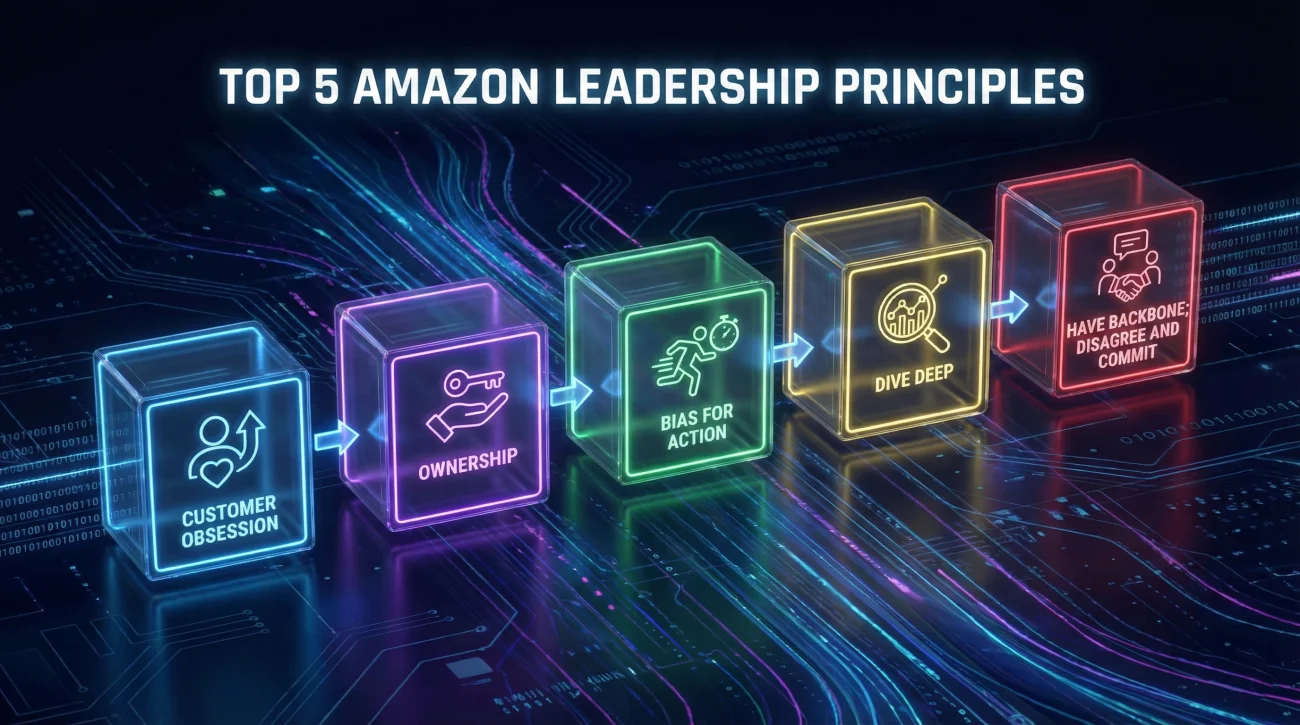
All 16 principles matter, but these five appear most frequently in interviews:
1. Customer Obsession
What it means: Start with the customer and work backward. Earn and keep customer trust.
Sample questions:
“Tell me about a time you had to make a decision between what was best for the customer versus what was best for the company.”
“Describe a situation where you used customer feedback to drive a decision.”
“Give an example of when you went above and beyond for a customer.”
How to answer: Focus on stories where you prioritized customer needs, made trade-offs favoring customer experience, or used customer data to drive decisions. Quantify the customer impact.
What they’re looking for: Evidence you genuinely care about customers, not just company metrics.
2. Ownership
What it means: Act on behalf of the entire company. Think long-term. Never say “that’s not my job.”
Sample questions:
“Tell me about a time you took on something significant outside your area of responsibility.”
“Describe a situation where you had to make a difficult decision that affected other teams.”
“Give an example of when you identified and fixed a problem that wasn’t assigned to you.”
How to answer: Show examples of taking responsibility for problems beyond your direct role, thinking long-term over short-term wins, or making decisions that served the company even when difficult.
What they’re looking for: People who take initiative and accept accountability, not those who stay in their lane.
3. Bias for Action
What it means: Speed matters. Take calculated risks. Decisions are reversible, so move fast.
Sample questions:
“Tell me about a time you had to make a decision with incomplete information.”
“Describe a situation where you took a risk that didn’t work out.”
“Give an example of when you had to act quickly despite uncertainty.”
How to answer: Emphasize moving quickly with available data rather than waiting for perfect information. Show calculated risk-taking and learning from failures.
What they’re looking for: Comfort with ambiguity and ability to make decisions quickly without paralysis.
4. Dive Deep
What it means: Leaders operate at all levels, stay connected to details, and are skeptical when metrics differ from anecdotes.
Sample questions:
“Tell me about a time when you had to deep dive into data to make a decision.”
“Describe a situation where you discovered a problem others missed.”
“Give an example of when you questioned assumptions and discovered something important.”
How to answer: Show analytical depth, attention to detail, and willingness to challenge surface-level explanations.
What they’re looking for: People who don’t accept easy answers and investigate root causes.
5. Have Backbone; Disagree and Commit
What it means: Respectfully challenge decisions. Once decided, commit completely even if you disagree.
Sample questions:
“Tell me about a time you disagreed with your manager and how you handled it.”
“Describe a situation where you had to commit to a decision you disagreed with.”
“Give an example of when you pushed back on a decision and what happened.”
How to answer: Show you’re willing to voice disagreement respectfully, but once a decision is made, you execute fully without passive resistance.
What they’re looking for: Strong opinions held loosely. People who debate, then commit.
For more behavioral interview strategies, explore our interview preparation guide.
How to Prepare: The Story Matrix
Create Your Leadership Principle Story Bank
Prepare 2-3 stories for each of the 16 Leadership Principles. Use a matrix:
| Leadership Principle | Story 1 | Story 2 |
|---|---|---|
| Customer Obsession | Data migration rescue | Product redesign based on feedback |
| Ownership | Fixed broken process | Led cross-team initiative |
| Bias for Action | Launched MVP quickly | Made decision with 70% info |
Each story should map to multiple principles – use the same story for different questions by emphasizing different aspects.
Use Recent Examples
Amazon wants current capabilities, not college projects. Use examples from the last 12-24 months if possible.
Quantify Everything
Amazon is data-driven. Every story needs numbers:
- Revenue impact
- Time saved
- Error reduction percentage
- Customer satisfaction scores
- Team size or scope of project
Practice Out Loud
Write out your STAR stories, then practice delivering them in 2 minutes or less. Amazon interviews move quickly – concise answers matter.
Common Mistakes to Avoid
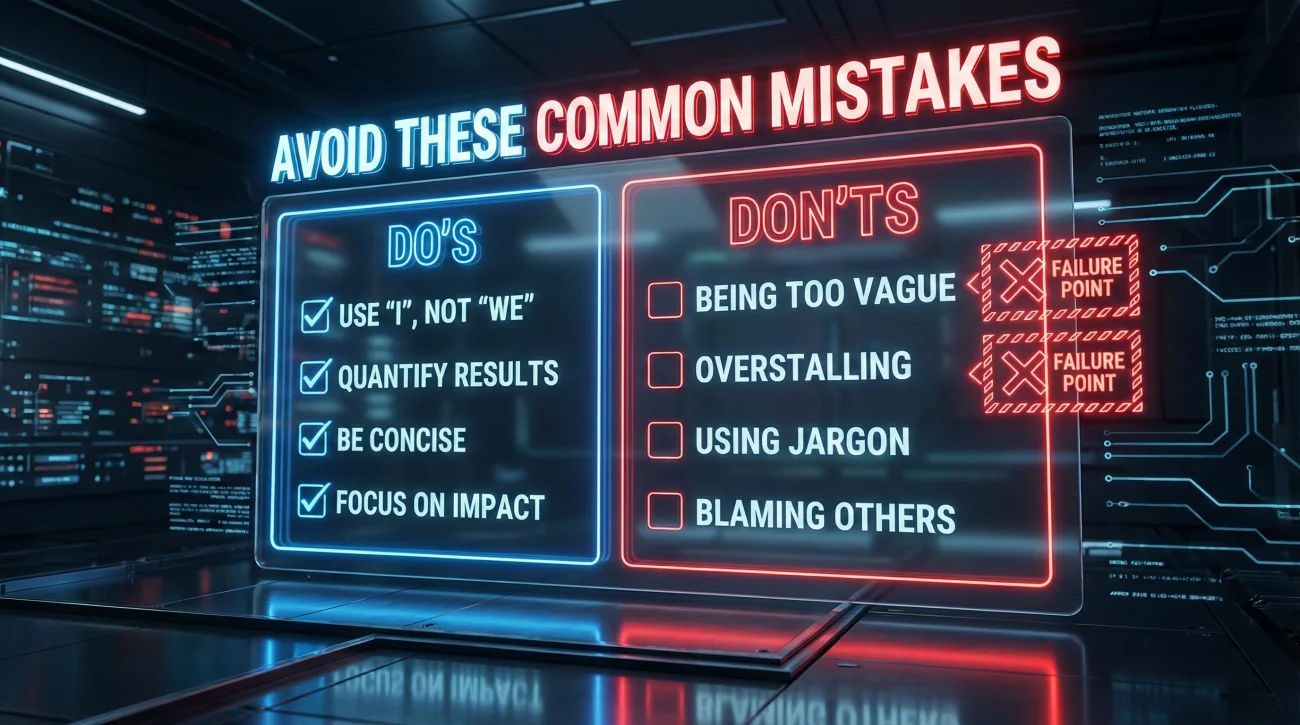
Being Too Vague
“I always put customers first and work well with my team.”
This is generic. Use specific stories with concrete details.
Using “We” Instead of “I”
Amazon wants to know what YOU did, not what the team accomplished. Say “I” not “we.”
If it was a team effort, clarify your specific contribution:
“While the team of 5 worked on different aspects, I personally owned the customer communication and data validation process.”
Forgetting the Result
Don’t skip the outcome. Amazon cares about impact:
“As a result, customer retention improved by 25%, saving $500K in acquisition costs.”
Not Owning Failures
Amazon values learning from failures. When asked about mistakes, don’t deflect blame:
“I underestimated the complexity, which caused a 2-week delay. I learned to build more buffer into technical estimates and now consistently hit deadlines.”
Not Preparing Stories
Don’t wing it. Interviewers can tell when answers are improvised versus prepared. Having a story bank ready is essential.
Questions to Ask Your Amazon Interviewer
Always ask thoughtful questions. Amazon values curiosity:
“How does this team embody [specific Leadership Principle] in day-to-day work?”
“What’s the biggest challenge the team is facing right now?”
“How does Amazon’s culture of Customer Obsession show up on this team specifically?”
“What does success look like for this role in the first 90 days?”
Avoid asking about things easily found on Amazon’s website or in the job description.
FAQ
You Must Speak Amazon’s Language

Amazon interviews are unique because Leadership Principles are explicitly central to every hiring decision. You can’t succeed by being vague about “teamwork” and “hard work” – you need to demonstrate specific principles through concrete stories.
Master the STAR+LP formula: structure every answer with Situation-Task-Action-Result, then explicitly connect your story to relevant Leadership Principles. Don’t make interviewers guess which principle you’re demonstrating – tell them.
Prepare a story bank with 2-3 examples for each of the 16 principles. Focus especially on Customer Obsession, Ownership, Bias for Action, Dive Deep, and Have Backbone. Use recent examples with quantified results.
Avoid common mistakes: being too vague, using “we” instead of “I,” forgetting to share results, and not preparing stories in advance. Amazon interviewers can immediately tell who prepared and who’s improvising.
The candidates who get offers aren’t necessarily the most qualified – they’re the ones who best demonstrate Amazon’s Leadership Principles through structured, specific, data-driven stories.
For additional Amazon interview resources, check out our comprehensive career guide.