
- Why this matters: A specialized restaurant manager resume must read like a business case, not a duty list, because hiring managers decide in seconds.
- What they really scan for: Stable service execution, Guest impact metrics, P&L control, People leadership, And calm communication signals.
- Best structure: Hybrid format usually wins by putting summary and core competencies above the fold, then experience, then certifications like ServSafe and alcohol service.
- How to write bullets: Use Action + Metric + Result to translate daily ops into outcomes like lower waste, tighter labor %, better reviews, and higher check size.
- ATS and polish rules: Use standard headings, clean fonts, no tables or text boxes, export a text-based PDF, and pair with a short cover letter that explains fit.
Why a Specialized Restaurant Manager Resume is Your Most Critical Business Case
You are a restaurant manager. This means you are a logistician, a financial analyst, a brand ambassador, a therapist, a safety officer, and a team captain – often all before 9:00 AM. Your world moves at the speed of a dropped ticket. You don’t have time to waste, and neither does the General Manager or Regional Director reading your resume.
You have minutes, but more often seconds, to prove you can run a shift, protect the P&L, delight guests, and stabilize a team. A generic resume is a conversation-ender. A focused Restaurant Manager Resume Template is your executive summary. It is not a list of past duties; it is a business case for your future value. It must be engineered to package your complex, chaotic story so clearly that the person skimming it can say, “Yes. This person gets it. Let’s interview them.”
Great hospitality resumes are documents of translation. They don’t just list responsibilities; they translate daily decisions into tangible, compelling outcomes: higher table turns, fewer comps, stronger online reviews, tighter labor costs, and lower food waste. They prove you are not just a manager, but a business operator. That is what we will build here – an honest, numbers-driven CV that reads as a narrative of operational success.
What Owners and Hiring Managers Really Scan For (Beyond the Keywords)
When an owner, director of operations, or seasoned GM scans your resume, they are not just looking for “experience.” They are hunting for evidence that you can solve their biggest, most expensive problems. Their eyes are trained to find signals of stability and profitability. This is what they are truly looking for:
- ✅ Evidence You Can Stabilize a Service
This is the baseline. Can you guarantee on-time opens, clean shift handovers, and smooth service change-outs? They are looking for phrases like “managed pre-shift briefs,” “ensured station readiness,” and “executed flawless closing procedures.” This proves you are a reliable operator who won’t let the shift descend into chaos.
- ✅ Measurable Guest Impact
Happy guests are the business. They are scanning for proof you can create them. This means metrics. Do you mention review scores (e.g., “boosted Yelp rating from 4.1 to 4.6”), guest return rates, or a reduction in guest complaints and comps? This shows you own the guest experience, not just react to it.
- ✅ Hard Money: P&L and Cost Control
This is the big one. Can you be trusted with the checkbook? This is where your resume wins or loses. The reader is searching for the holy trinity of restaurant metrics: food cost, labor percentage, and waste control. Did you implement programs that moved these numbers? Did you drive new revenue through upsell programs? This is the language of ownership.
- ✅ People Leadership and Culture
High turnover kills restaurants. A manager who can retain talent is invaluable. They are looking for evidence of coaching, developing line cooks, implementing fair scheduling, and building a safe, positive culture. A bullet point like “reduced server turnover by 25% through new training” is often more powerful than a sales metric.
- ✅ Calm, Clear Communication
The best managers are conduits of information. They are looking for signs of this: “led concise pre-shift briefs,” “liaised between FOH and BOH,” or “managed quick conflict de-escalation.” This proves you won’t escalate a minor issue into a full-blown service disaster.
If you want to understand why this scanning happens so fast, it’s critical to understand the psychology behind it. This breakdown of the six-second resume rule shows exactly how recruiters glance, anchor on these key areas, and make a snap decision.
The Manager’s Resume Blueprint: Crafting Your Business Case
A successful resume flows like a well-run service. Each section transitions logically to the next, building a case for why you are the best candidate. Here is how to structure your document for maximum impact.
Choose the Right Format for Your Managerial Story
Your resume’s format is its narrative structure. For a restaurant manager, the choice is strategic. You need to present your most valuable information first. While a purely functional resume (listing only skills) is a non-starter (it looks like you’re hiding something), most managers will choose between two powerful formats: the Hybrid (Combination) or the Reverse-Chronological.
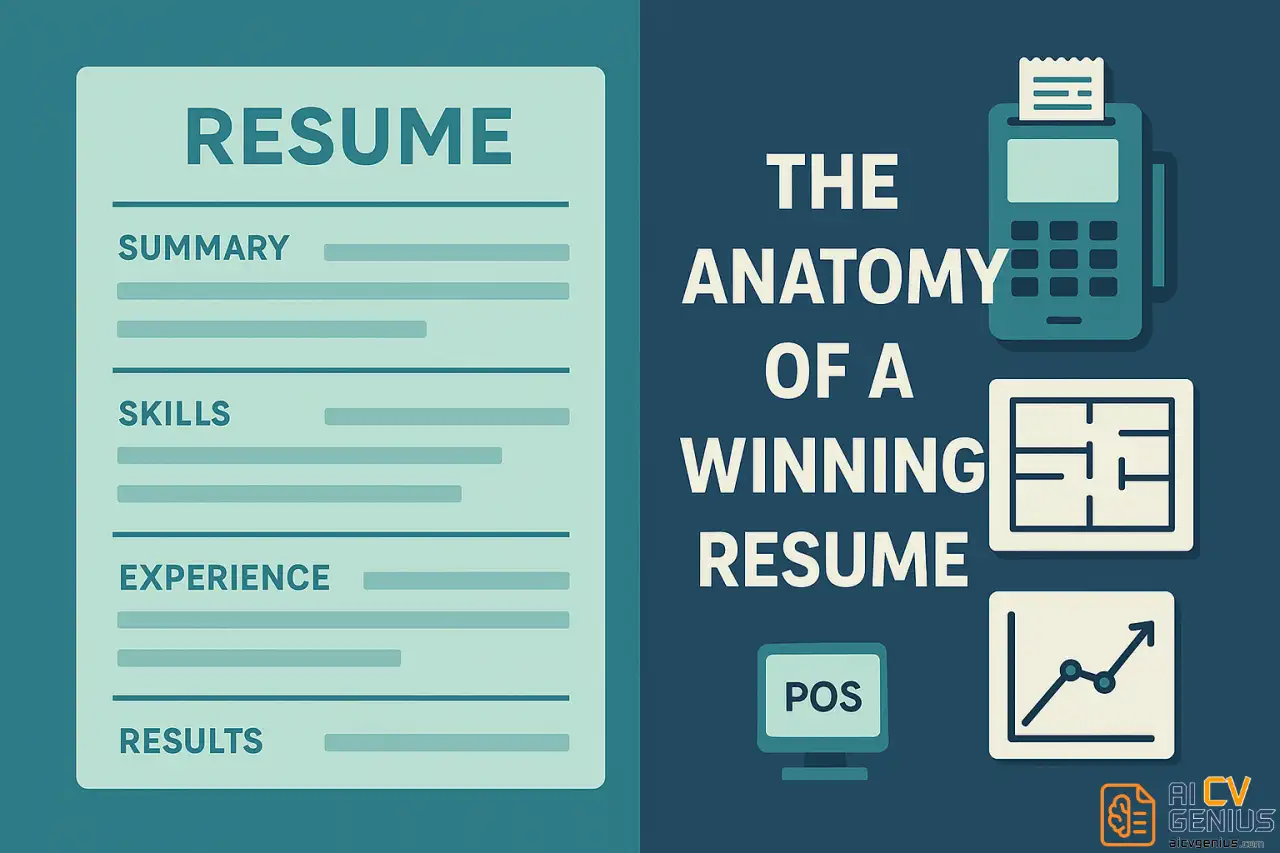
The Hybrid layout is often the most effective for managers. It opens with a strong Professional Summary, followed immediately by a curated “Core Competencies” or “Skills” cluster. This puts your most valuable leadership skills (P&L Management, Team Development, Cost Control) “above the fold” before the reader even gets to your work history. It frames their perception of you from the start.
The Reverse-Chronological format is the traditional gold standard and is equally powerful, especially if your career shows a clear, linear path of growth (e.g., Server → Shift Lead → AGM → GM). Its strength is in showing loyalty and progression. Its only risk is that your best achievements might be buried on page two if your early roles were less impactful.
Here is how to decide:
| Feature | Combination (Hybrid) Layout | Reverse-Chronological Layout |
|---|---|---|
| Best For | Managers blending deep leadership skills with proven results. Ideal for career changers or those with multi-faceted experience. | Managers with a clear, impressive growth path within one or two strong restaurant groups. |
| Scanning Speed | Extremely fast. Skills and key metrics are presented up top, immediately answering the “Can they do the job?” question. | Fast. The reader’s eye is drawn to your most recent job title and venue first. |
| Strategic Risk | Can feel “over-stuffed” in the skills cluster if you aren’t concise. You risk listing duties, not proven competencies. | Your most critical P&L wins from your current role might be pushed down below your summary. |
The Verdict: For most managers, the Hybrid format wins. It gives you the power to define your brand as a “Cost-Cutting Leader” or a “Team-Building Expert” before they read your job history.
Core Sections and Strategic Order
Here is the professional, proven order:
- ✅ Contact Information: Clean and professional. Full Name, City/State/Zip, Phone, Professional Email, and your LinkedIn profile URL (ensure it’s customized, not the default string of numbers).
- ✅ Professional Summary: This is your 3-4 line “executive brief.” It’s not an objective. It states your leadership theme, years of experience, and 2-3 massive, quantifiable wins.
- ✅ Core Competencies / Key Skills: This is the “Skills Cluster” from the hybrid model. Group 9-12 of your most powerful skills by category (e.g., Financial Management, People Operations, FOH/BOH Excellence). This section should be mirroring the keywords from the job ad.
- ✅ Professional Experience: The main course. List in reverse-chronological order. For each role, use 4-6 bullet points that tie a specific action to a metric and then to a business result.
- ✅ Certifications & Education: This is non-negotiable. List your ServSafe Manager, TIPS/Alcohol Service, and First Aid certifications prominently. This is a signal of professionalism and liability reduction.
This structure is designed to be “scannable.” It places your value proposition (Summary) and your hard skills (Competencies) first, so that when the reader gets to your Experience section, they are already convinced of your expertise and are just looking for proof. Need designs that are proven to pass ATS scans and still look modern and professional? Explore options in our Resume Templates Finder and choose a template that prioritizes clean headings, bold job titles, and generous white space.
Crafting Each Section with P&L Impact
Once you have the structure, the next step is to infuse every section with the language of leadership – accountability, metrics, and results. This is how you translate your daily duties into a compelling financial and operational narrative.
Write a Summary That Sounds Like a Leader, Not a Follower
Your professional summary is the “specials board” of your resume. It must be enticing, concise, and packed with value. Avoid “fluff” words like “passionate,” “hard-working,” or “team player.” These are meaningless. A leader’s summary is defined by accountability and results. It states who you are, what concept you excel in, and proves it with your best numbers.
Formula: [Title/Brand] with [X] years in [Concept Type]. Proven ability to [Achieve Result 1] and [Achieve Result 2] through [Core Skill].
Example for a Seasoned GM:
“Results-driven Restaurant General Manager with 7+ years of progressive leadership in high-volume ($8M+) casual dining. Proven track record of raising guest satisfaction to 4.6★, cutting food and paper waste by 14% through new prep standards, and growing bar revenue 18% via server coaching and features.”
Example for a Newer Manager or AGM:
If you’re newer to the official “manager” title, speak to scope and trust, not just the title you held. Show you were already acting as a manager.
“Operations-focused Front-of-House Lead with 5 years in upscale dining, now seeking AGM role. Entrusted to open and close, coach a team of 12 servers, and manage nightly cashouts and reconciliation. Recognized for calm service recovery and consistently exceeding table-turn targets during peak service.”
Experience Bullets That Prove P&L Impact (The A-M-R Formula)
This is the section that separates contenders from pretenders. Do not list your duties. Everyone knows a manager is “responsible for scheduling.” That’s the job description. Your resume must show how you performed that duty with excellence. The best way to do this is with the Action → Metric → Result formula.
Use this micro-formula for every bullet point: Action verb + What you did + The metric it moved + The business value it created.
Here is how to translate your daily responsibilities into powerful, metric-driven achievements.
| Instead of (Weak) | Write this (Strong) |
|---|---|
| “Responsible for server training.” | “Implemented new 4-week server shadowing program and wine-pairing guide; lifted average check size by +9% and beverage attach rate by 12% in 90 days.” |
| “Managed food inventory and ordering.” | “Rebuilt prep sheets and par levels based on sales velocity data; reduced critical 86’s by 40% and cut overall food waste by 15% year-over-year.” |
| “Handled guest complaints.” | “Championed a ‘service recovery’ program empowering leads to resolve issues; raised Google/Yelp ratings from 4.1★ to 4.5★ and reduced guest comp spend by 10%.” |
| “Did staff scheduling and cut costs.” | “Tightened labor by building new schedule templates based on 30-minute sales forecasts; consistently kept labor at or below 29–31% target while sustaining 4.5★ guest reviews.” |
If you are assembling a resume for restaurant manager with experience, every single line must carry a number or show clear business value. When no exact metric exists, use frequency (nightly, weekly), scale (covers per shift, team of X), or rank (top-quartile region, #1 in sales) to show the scope of your responsibility.
The Core Competencies: Skills That Map to the Job Ad
Your “Skills” or “Core Competencies” section is your keyword-optimization tool. It’s where you must explicitly list the restaurant management skills for resume that the job description is asking for. This helps you pass the initial ATS scan and gives the human reader a quick checklist of your capabilities. Group them logically.
| People & Team Leadership | Financial & Operations Mgt. | Technical & Compliance |
|---|---|---|
|
|
|
Achievement Examples You Can Mirror
Use the patterns below as compact, results-oriented models. Do not copy and paste them. Use them as a spark to frame your own unique accomplishments. These restaurant manager resume examples are designed to show cause-and-effect clearly and powerfully.
Guest Experience Win
“Implemented a ‘Greet-and-Seat’ target of 90 seconds and added standardized mid-meal check-backs for all servers; successfully raised Google guest rating from 4.1★ to 4.5★ within two quarters and saw a 5% increase in repeat guest visits.”
Cost and Waste Win
“Aligned standardized portion tools with visual recipe cards and mandated weekly line checks on key proteins; cut overall food waste by 16% and successfully kept food cost within a 30–32% band through heavy seasonal price fluctuations.”
Revenue and Team Win
“Built and led a new 8-week server coaching program focused on suggestive selling, wine features, and pairings; lifted fine wine mix by 11%, increased dessert attach rate by 7%, and saw a 15% increase in average server tips, boosting team morale.”
Education, Certifications, and Extras: The Trust Signals
This section is your proof of professionalism and commitment to safety. For a manager, this is not optional. An owner sees these certifications and thinks, “This person will not be a liability.” Hospitality degrees or business degrees are helpful, but the practical, hands-on badges of trust count heavily.
- ServSafe Manager Certification: This is the gold standard. List it first. Include your expiration date if it’s recent.
- TIPS or State Alcohol Service Certification: Shows you are committed to responsible service.
- First Aid / CPR: A huge plus. It signals you are a leader who can handle any emergency.
- Franchise/Group Training: List any official training from your restaurant group (e.g., “XYZ Corp. Shift Excellence Program,” “Guest Recovery & De-escalation Certified”).
Awards – like “Manager of the Quarter” or “Top-Performing Region for Secret Shopper Scores” – can sit in a small, separate “Recognition” section to make them stand out.

Technical Polish: Design, Templates, and Common Pitfalls
With the core content written, the final step is to ensure your presentation is as professional as your experience. Design, technical choices, and avoiding common mistakes are what separate a good resume from a great one.
Design Choices That Keep You ATS-Friendly (And Human-Friendly)
Your resume has two audiences: a robot (the Applicant Tracking System, or ATS) and a human. You must please both. The ATS scans your resume for keywords and structure before a human ever sees it. A fancy, over-designed resume will be rejected by the robot.
Follow these non-negotiable design rules:
- ✅ Use Standard Headings: The ATS is programmed to look for “Professional Experience,” “Skills,” and “Education.” Don’t get creative with “My Journey” or “Things I’m Great At.”
- ✅ Use a Clean Font: Stick to one professional font family (e.g., Lato, Roboto, Garamond, Calibri). Use a bold weight for headings and a readable 10.5–12 pt size for body text.
- ✅ Avoid Tables, Columns, and Text Boxes: Many ATS systems read from left-to-right, top-to-bottom. A two-column layout can turn your resume into an unreadable jumble of text for the machine.
- ✅ No Graphics as Text: Do not put your skills in a “progress bar” graphic or use heavy icons. The ATS cannot read text embedded in an image.
- ✅ Save as a Text-Based PDF: Always export as a PDF (not a .jpg or scan) and double-check that you can click and highlight the text. If you can, the ATS can.
Curious about what happens after your resume lands in a recruiter’s inbox? It’s a fascinating and stressful moment. This detailed walkthrough of what really happens when a recruiter opens your resume shows the tiny design and content choices that influence whether you actually get the call.
Pros & Cons of Using a Pre-Built Template
Using a template is smart, but it’s a tool. How you use it matters. It provides the “presentation” and “plating,” but you must provide the “quality ingredients” (your achievements).
| Pros | Cons |
|---|---|
| ✅ Speed & Structure: Faster to build. A professional structure prevents you from forgetting critical sections. | ❌ ATS Risk: Over-designed, graphic-heavy templates (often found on creative sites) can confuse ATS scanners. |
| ✅ Visual Consistency: Guarantees a clean, professional, and symmetrical look that is easy for a human to read. | ❌ Generic Wording: The biggest danger is using the template’s default “lorem ipsum” text. You must rewrite every line. |
| ✅ Clarity: Encourages you to be concise. The defined spaces for bullets and headings prevent you from writing long, dense paragraphs. | ❌ Rigidity: Some employers (like very old-school GMs or corporate groups) may prefer an extremely plain, text-only format. |
To get a clean look without the ATS risk, always choose the best restaurant manager resume template that prioritizes text, simple headings, modest color accents, and plenty of open white space. You will find several options that are curated for clarity and scannability inside this gallery.
Put It All Together: The One-Page Flow
Your resume should read like a great dish tastes: balanced. Here is the final flow to aim for:
- ✅ Top Third (The Hook): Your Name, Contact Info, and Professional Summary. This section must be so strong it makes them want to read more.
- ✅ Skills Cluster (The Proof): Your 9-12 grouped skills, right below the summary. This confirms your expertise at a glance.
- ✅ Experience (The Story): Your reverse-chronological history. Each role gets 4-6 bullet points, and each bullet ties an action to a metric. This is the heart of your story.
- ✅ Certs/Education (The Trust): The final section, small but visible, listing your non-negotiable certifications.
If you are a multi-unit leader or have 15+ years of deep experience, you can use a two-page version. However, the rule still stands: page one must be a complete, compelling story on its own. Avoid orphan headings (a new job title at the bottom of page one) or single bullets hanging at the top of page two.
Common Mistakes That Instantly Kill a Manager’s Resume
- ❌ Duty-Only Bullets: Listing “Responsible for…” or “Duties included…” This là passive and tells them nothing. Use strong action verbs.
- ❌ Vague, Fluffy Claims: “Team player,” “Guest-focused,” “Hard worker.” These are empty claims. Prove it with a metric, or delete it.
- ❌ Crowded, Dense Layouts: Using tiny fonts, 0.5″ margins, and long paragraphs of text. This is visually overwhelming and will not be read. White space is your friend.
- ❌ Forgetting Certifications: Leaving off your ServSafe Manager or alcohol permit is a red flag. It’s often a legal requirement and shows a lack of attention to detail.
- ❌ A “One-Size-Fits-All” Approach: Sending the same resume to a fine-dining steakhouse and a high-volume fast-casual chain. You must tweak your summary and skills to mirror the job ad.
Supporting Documents & Quick-Start Templates
A Note on Cover Letters: The “Why You” Story
Your resume proves your capability. Your cover letter frames your fit and intent. It answers the question, “Why this restaurant?” A cover letter is your chance to show your human side and connect your achievements to their specific needs.
Keep it to three concise paragraphs:
- The Hook: State the role you’re applying for and why you are applying. “I have been a great admirer of [Restaurant Group’s] commitment to sustainable sourcing, which aligns perfectly with my background.”
- The Proof: Highlight one major operational win from your resume and connect it to their business. “In my role as GM at [Your Restaurant], I successfully cut food costs by 12% by rebuilding vendor relations, a skill I see as vital to your new expansion.”
- The Close: Reiterate your enthusiasm and call to action. “I am confident I can bring this same level of operational excellence to your team and am eager to discuss this further.”
If you need more detailed prompts and structure for your entire application package, browse the broader advice in this practical improvement guide.
Quick Template Skeleton You Can Copy
Paste this simple, text-based skeleton into your document and then customize every line with your personal metrics and achievements.
[Your Name]
[City, State, Zip] | [Your.Email@gmail.com] | [Phone Number] | [LinkedIn URL]PROFESSIONAL SUMMARY
Restaurant manager with [X] years of experience in [Your Concept, e.g., upscale casual, QSR]. Proven ability to improve [Metric 1, e.g., guest ratings] by [Y%] and reduce [Metric 2, e.g., labor costs] by [Z%] through [Your Method, e.g., team coaching and new scheduling].
CORE COMPETENCIES
People & Leadership: Staff Training & Coaching | Performance Management | Scheduling & Labor Law
Finance & Operations: P&L Analysis | Food/Bev Cost Control | Inventory & Ordering | Waste Reduction
Systems & Compliance: [POS System, e.g., Toast] | [Inventory System] | ServSafe | State Alcohol Laws
PROFESSIONAL EXPERIENCE
[Your Title] – [Restaurant Name], [City, ST] | [Dates, e.g., 2020 – Present]
• [Action Verb] + [lever] + [metric] + [business result].
• [Action Verb] + [lever] + [metric] + [business result].
[Previous Title] – [Restaurant Name], [City, ST] | [Dates, e.g., 2018 – 2020]
• [Action Verb] + [lever] + [metric] + [business result].
• [Action Verb] + [lever] + [metric] + [business result].
CERTIFICATIONS & EDUCATION
ServSafe Manager Certification | [Issuing Body] | [Expiration Date]
[TIPS, etc. Certification] | [Issuing Body] | [Expiration Date]
[Your Degree, if relevant] | [Your University]
Frequently Asked Questions (FAQ) for Manager Resumes
For 90% of restaurant managers, one page is the rule. It forces you to be concise and highlights only your most impressive achievements. An owner should be able to “get” your entire story in 30 seconds. The only exception is for very senior roles, such as a Director of Operations, a multi-unit GM, or a manager with 15+ years of deep, relevant experience. In that case, two pages are acceptable, but page one must still contain your summary, skills, and most recent (and most powerful) role.
There are three categories, and you should aim to have at least one from each:
1. Profitability (Money In): Average check size, upsell attach rates (e.g., beverage, dessert), table turns, revenue growth (e.g., “grew catering sales 20%”).
2. Cost Control (Money Out): Food cost %, labor %, waste %, supply cost %.
3. Guest & Team (The Experience): Guest ratings (Yelp, Google), secret shopper scores, guest complaint reduction %, and team turnover %. Showing you reduced staff turnover is one of the most valuable metrics you can have.
You show it by using the language of scope and trust. If you were a “Shift Lead” or “Key Holder,” your title is less important than your responsibilities. Use bullet points like:
• “Entrusted by GM to open and close the restaurant, including all cash handling and reconciliation.”
• “Selected to train and onboard all new FOH staff, mentoring 8 new servers.”
• “Managed all guest escalations and service recovery during peak dinner service.”
• “Owned all bar inventory and ordering, reducing variance to under 0.5%.”
This proves you were already a manager, even if your title didn’t reflect it.
Yes, but sparingly. Think “elegant steakhouse menu,” not “colorful diner placemat.” A single, professional accent color (like a deep blue, burgundy, or dark green) for your name and section headings can look very sharp. Avoid bright, neon colors. As for icons, avoid them entirely. They are a distraction and can confuse ATS scanners. The only exception is a small, subtle icon for your phone, email, and LinkedIn, but clean text is always safer.
This is a sign of loyalty, which is great. You show it by “stacking” your titles under one company heading. This clearly visualizes your growth path.
[Restaurant Group Name], [City, ST] | 2015 – Present
General Manager (2020 – Present)
• [Your GM-level metric-driven achievements…]
• [Another GM-level achievement…]
Assistant General Manager (2017 – 2020)
• [Your AGM-level achievements, e.g., “Managed FOH scheduling…”]
• [Another AGM-level achievement…]
Server & Lead Trainer (2015 – 2017)
• [Your server-level achievements, e.g., “Top 5% in sales…”]
This format is clean, easy to read, and tells a powerful story of growth and loyalty.
Do not try to hide it on your resume by fudging dates. Recruiters will find it, and it looks dishonest. Your resume should be an honest, chronological record. The cover letter is the place to address it, briefly and positively.
Example: “After taking 18 months away from the industry for personal family reasons (or ‘to pursue travel,’ ‘to complete a certification,’ etc.), I am incredibly re-energized and eager to bring my decade of P&L management experience to the [Restaurant Name] team.”
Be simple, be honest, and frame it as a positive. Don’t over-explain. The interview is the place for more detail if they ask.
Final Thoughts: Your Resume is Proof You Can Lead
If a stranger can skim your resume for 30 seconds and immediately picture a smooth, profitable service with a happy team, you have done your job. Your resume is not a list of what you were asked to do; it is a story of the results you delivered. Use this structure, speak in outcomes, and back up every single claim with a simple, powerful number.
When you are ready to export, choose a clean file format, double-check that every bullet has a strong action verb and a clear result, and send it with confidence. Your Restaurant Manager Resume Template no longer just lists your experience – it now reads like definitive proof that you are ready to lead.