
- The article positions how to use LinkedIn for job search as a full system, not a quick hack: Your profile acts like a living resume, cover letter, and first impression rolled into one.
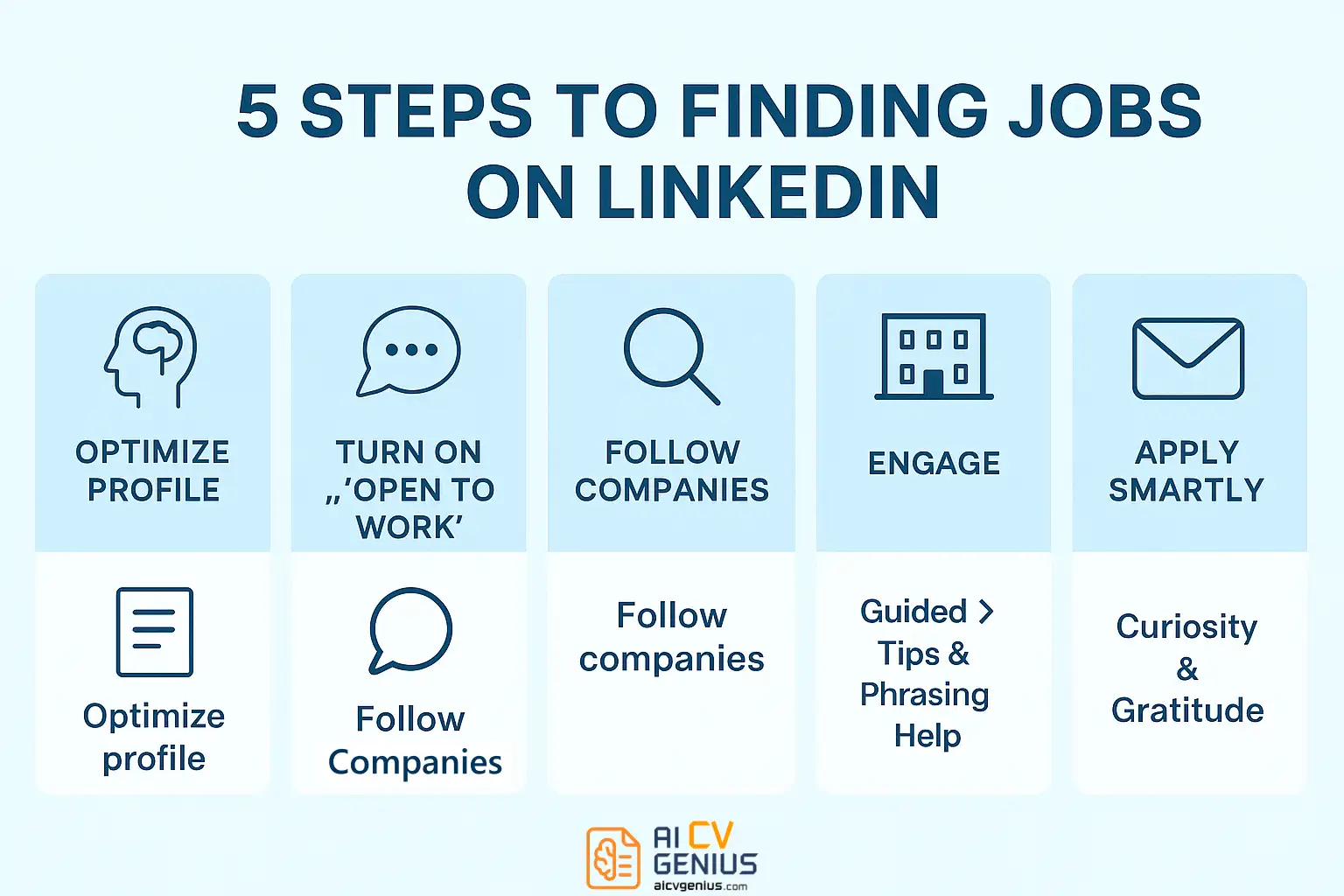
- Step 1 focuses on profile optimization: Professional photo, keyword-rich headline, a strong “About” story, detailed experience with measurable outcomes, relevant skills, and credible recommendations.
- Steps 2 to 4 cover recruiter attraction and networking: Use “Open to Work” with the right privacy setting, follow target companies and groups, and send personalized connection requests that feel human.
- Steps 5 to 7 explain smarter applications and visibility: Use job alerts and filters, treat “Easy Apply” selectively, share content and comments to stay visible, then use profile analytics to iterate.
- The deep-dive section adds practical guardrails: Pros and cons, advanced tactics (Custom URL, Featured section, keyword placement), common mistakes to avoid, a job-ready checklist, and closing FAQs plus final mindset framing.
LinkedIn isn’t merely another social network – it functions as the world’s preeminent career marketplace. With over 900 million professionals utilizing it globally to connect, learn, and critically, discover employment opportunities, mastering how to use LinkedIn for job search effectively unlocks access to unadvertised positions, direct recruiter connections, and influential networks capable of fundamentally altering your career trajectory.
Whether you are actively pursuing new roles or passively open to exploring possibilities, this comprehensive guide will systematically navigate you through every essential step: from meticulously optimizing your profile for maximum visibility to networking strategically without feeling awkward, and ultimately, applying for positions intelligently to maximize your success rate.
Why LinkedIn Is Essential for Job Seekers in Today’s Market
The modern recruitment landscape has shifted dramatically. Most recruiters no longer initiate their candidate search solely through traditional job boards – their primary sourcing tool is frequently LinkedIn. Data consistently indicates that a vast majority (over 85%) of recruiters leverage the platform extensively to identify and vet potential candidates before ever posting a public job advertisement.
This reality transforms your LinkedIn profile into far more than a simple online presence; it functions simultaneously as your dynamic digital resume, introductory cover letter, and crucial first impression – all consolidated into one accessible platform. When optimized correctly, LinkedIn operates as your tireless, 24/7 personal recruiter, diligently working in the background to surface relevant opportunities and connect you with decision-makers.
- ✅ Recruiters can discover your profile directly through targeted keyword searches relevant to their open roles.
- ✅ The “Easy Apply” feature can significantly streamline the application process for certain positions (use judiciously).
- ✅ Your professional brand and visibility grow organically each time you share insightful content or engage meaningfully within your network.
- ✅ Networking opportunities arise naturally through shared connections, industry groups, or mutual professional interests.
How to Optimize Your LinkedIn Profile for Visibility and Impact
Step 1: Meticulously Optimize Your LinkedIn Profile for Visibility and Impact
Consider your LinkedIn profile your digital handshake – the initial point of contact establishing your professional identity. Ensure it is comprehensive, meticulously curated, keyword-rich, and authentically reflects your expertise and aspirations. Treat it as an enhanced, dynamic version of your resume, incorporating personality alongside professionalism.
Utilize a Professional Profile Photo
Data consistently shows profiles featuring a clear, professional photograph receive significantly higher engagement (up to 14 times more views). A studio portrait isn’t necessary; prioritize good, natural lighting, a simple and uncluttered background, appropriate professional attire, and a warm, confident expression.
Write a Headline That Clearly Communicates Value
Your headline is prime real estate, appearing prominently in search results. Move beyond merely stating your current job title. Instead, craft a concise, keyword-rich headline that immediately conveys your core expertise and the value you provide. Examples:
❌ Weak:
“Marketing Specialist”
✅ Stronger:
“Marketing Specialist | Driving Startup Growth Through Data-Driven Digital Campaigns | SEO & Content Strategy”
Craft a Compelling and Keyword-Rich About Section
Your “About” section functions as your extended professional summary or mini-cover letter. Use this space (up to 2,600 characters) to articulate your career story, highlight key strengths and quantifiable achievements, express your professional passions, and strategically incorporate keywords relevant to the roles and industries recruiters are likely searching for (e.g., “project management,” “agile methodologies,” “data analysis,” “financial modeling,” “client relationship management,” “lead generation”). Structure it for readability using short paragraphs or bullet points.
Example Snippet:
“As a PMP-certified Project Manager with over 7 years of experience successfully delivering complex software projects within the FinTech sector, I thrive on bridging the gap between technical teams and business stakeholders. My core focus lies in ensuring clarity through meticulous planning, fostering effective cross-functional collaboration using Agile principles, and consistently achieving measurable impact aligned with strategic objectives. Proven ability to manage budgets up to $2M and lead teams of 10+ engineers.”
Detail Your Experience, Skills, and Education Thoroughly
- ✅ Utilize concise, action-oriented bullet points under each job title in the Experience section for maximum clarity and scannability.
- ✅ Quantify achievements whenever possible to demonstrate tangible impact (e.g., “Increased user engagement by 40% through targeted content initiatives,” “Reduced operational costs by 15% via process optimization”).
- ✅ Populate the Skills section comprehensively, aiming for at least 5-10 core skills directly relevant to your field. Seek endorsements from connections for your most critical skills – these heavily influence LinkedIn’s search algorithm and recruiter filtering.
- ✅ Ensure your Education section is complete, including degrees, institutions, and graduation dates. Add relevant coursework or honors if you are early-career.
Actively Request Recommendations
A few concise, specific recommendations from former managers, senior colleagues, or satisfied clients significantly bolster your credibility and provide powerful social proof. Recruiters often place substantial weight on third-party validation. Reach out personally to request recommendations, perhaps suggesting specific skills or projects you’d appreciate them highlighting.
How to Actively Attract Recruiters on LinkedIn
Step 2: Activate “Open to Work” Strategically and Discreetly
LinkedIn offers a feature allowing you to signal your interest in new opportunities directly to recruiters. Crucially, you can control the visibility of this signal:
- Private (Recruiters Only): Only users with LinkedIn Recruiter subscriptions can see that you are open to new roles. Your current employer or colleagues generally will not see this signal (though absolute privacy cannot be guaranteed). This is the recommended setting if you are currently employed and conducting a confidential search.
- Public (All LinkedIn Members): Adds a visible green “#OpenToWork” banner to your profile photo, broadcasting your job search status widely. Suitable if you are unemployed or your current employer is aware of your search.
Select the option that best aligns with your current employment situation and desired level of discretion. This simple activation significantly increases your visibility within recruiter searches.
Step 3: Actively Follow Target Companies and Engage in Relevant Industry Groups
Shift from passively waiting to proactively positioning yourself within relevant ecosystems. Following companies you admire provides several benefits: you receive timely notifications about their new job postings, gain insights into their culture and initiatives through their updates, and demonstrate genuine interest.
- ✅ Click the “Follow” button on the official LinkedIn Company Pages of organizations you wish to work for.
- ✅ Engage thoughtfully with their posts occasionally (liking relevant updates, adding insightful comments).
- ✅ Identify and join active, niche LinkedIn Groups related to your specific industry, function, or technical skills. Participate constructively in discussions to build connections and showcase expertise.
These seemingly small interactions subtly enhance your profile’s visibility to recruiters operating within those same company and industry circles, often surfacing your profile higher in their search results.
Step 4: Network Authentically Without Feeling Awkward
Effective networking on LinkedIn isn’t about transactional requests or cold messaging strangers for job leads – it’s primarily about building genuine professional relationships based on mutual interest and value exchange. Approach it as digital relationship cultivation.
Connecting Effectively and Respectfully
- ✅ Always personalize connection requests. Briefly explain why you want to connect (e.g., shared industry, admire their work, common connection, attended same event). Avoid generic default requests.
- ✅ Engage with an individual’s content (like, comment thoughtfully) before sending a connection request to establish initial familiarity and demonstrate genuine interest.
- ✅ If requesting informational interviews or advice, be specific about what you’re asking for, respect their time, and express gratitude clearly.
- ✅ Follow up politely and professionally if you don’t receive an immediate response, but avoid excessive persistence.
Example Personalized Connection Request:
“Hi Sarah, I came across your recent article on LinkedIn about data-driven marketing strategies for SaaS startups – your insights on [mention specific point] really resonated with my own experiences in growth marketing. I’d be keen to connect and follow your work in this space.”
This single, thoughtful message transforms a potentially cold outreach into the beginning of a genuine professional conversation, significantly increasing the likelihood of acceptance and future interaction.
How to Apply Effectively on LinkedIn
Step 5: Utilize Job Alerts and the “Easy Apply” Feature Judiciously
LinkedIn’s integrated job board is exceptionally powerful, but requires strategic usage for optimal results.
- Set up specific, targeted job alerts based on relevant keywords (job titles, skills), desired locations (including “Remote”), and preferred industries. Refine alerts regularly to improve relevance.
- Utilize filters effectively, particularly “Experience Level,” “Job Type” (Full-time, Contract, Internship), and “Date Posted” to narrow down opportunities that best match your profile.
- Use the “Easy Apply” button selectively. It’s convenient but often sends only your basic LinkedIn profile data. Ensure your profile is fully optimized and tailored before using Easy Apply. For high-priority roles, consider applying directly through the company’s career portal with a customized resume and cover letter whenever possible, as this often demonstrates greater effort and allows for more detailed application materials.
Bonus Tip: Data suggests applying within the first 24–48 hours of a job posting significantly increases your chances of being noticed, as recruiters are typically most active reviewing initial applications during that window. Prioritize timely applications for roles you are highly interested in.
Step 6: Share Content Thoughtfully (Yes, It Genuinely Matters)
LinkedIn functions as a content platform, not merely a static resume database. Sharing relevant content periodically (even just once or twice a month) demonstrates ongoing engagement, showcases your professional interests, and reinforces your personal brand within your network. You don’t need to be a prolific writer; focus on quality over quantity.
- ✅ Share concise insights, practical tips, or valuable lessons learned related to your field or recent projects.
- ✅ Comment thoughtfully and constructively on posts shared by others within your network or industry leaders. Add value to the conversation.
- ✅ Reshare interesting industry articles or news, adding your own brief perspective or key takeaway to provide context.
Consistent, relevant engagement creates visibility – and sustained visibility attracts recruiter attention and strengthens network connections organically.
Step 7: Regularly Monitor Your Profile Analytics and Iterate
LinkedIn provides valuable (though limited in the free version) analytics accessible via your profile dashboard, including metrics like “Profile views” and “Search appearances.” Pay attention to these numbers – they offer crucial feedback on whether your profile optimization efforts are successfully attracting the right audience (recruiters, industry peers).
If your profile views or search appearances seem low or irrelevant, revisit and refine your Headline and About section. Ensure they incorporate relevant, high-demand keywords directly gleaned from current job descriptions in your target field. Sometimes, tweaking just a few key phrases can significantly impact your visibility within LinkedIn’s search algorithm. Treat your profile as a living document, subject to continuous improvement based on performance data.
LinkedIn Strategy Deep Dive: Pros, Advanced Tactics, Mistakes, and Checklist
Pros & Cons of Relying Heavily on LinkedIn for Job Search
Understanding the platform’s strengths and limitations helps manage expectations:
| Pros | Cons |
|---|---|
| ✅ Direct access to a vast network of recruiters, hiring managers, and millions of active job postings globally. | ❌ Extremely high competition – millions of professionals use the platform daily, making it harder to stand out without strategic effort. |
| ✅ Excellent platform for building and showcasing your professional brand through content sharing and engagement. | ❌ Can be time-consuming to maintain an active, optimized profile and engage consistently if not managed efficiently. |
| ✅ Features like “Easy Apply” can significantly simplify the application process for some roles. | ❌ Generic or incomplete profiles are frequently overlooked amidst the sheer volume of candidates. Personalization is key. |
| ✅ Provides valuable insights into company cultures, employee backgrounds, and industry trends through profiles and posts. | ❌ Certain advanced features (e.g., seeing everyone who viewed your profile, sending InMail messages to non-connections) require a paid LinkedIn Premium subscription. |
Bonus: Advanced LinkedIn Tactics Most Users Overlook
Elevate your LinkedIn strategy beyond the basics:
- Utilize a personalized custom URL for your profile (e.g., linkedin.com/in/yourprofessionalname) for enhanced branding and easier sharing. Access this via your profile settings.
- Strategically incorporate primary keywords related to your target roles not just in your Headline and About section, but also subtly within your Experience descriptions and Skills endorsements.
- Leverage the “Featured” section on your profile to prominently showcase key achievements, portfolio links, impactful posts you’ve authored, or media mentions.
- Actively follow and engage with recruiters specializing in your specific industry or function – many regularly post exclusive job opportunities directly to their feeds.
- Participate actively in relevant industry-specific hashtag conversations (e.g., #DigitalMarketing, #SoftwareEngineeringJobs, #ProjectManagement) to increase visibility among peers and potential employers.
Want to ensure your traditional resume perfectly complements your optimized LinkedIn profile? Explore professionally designed Resume Templates Finder for layouts that maintain consistent branding and effectively highlight the same core strengths showcased online.
Critical LinkedIn Mistakes to Avoid During Your Job Search
Steer clear of these common errors that can undermine your efforts:
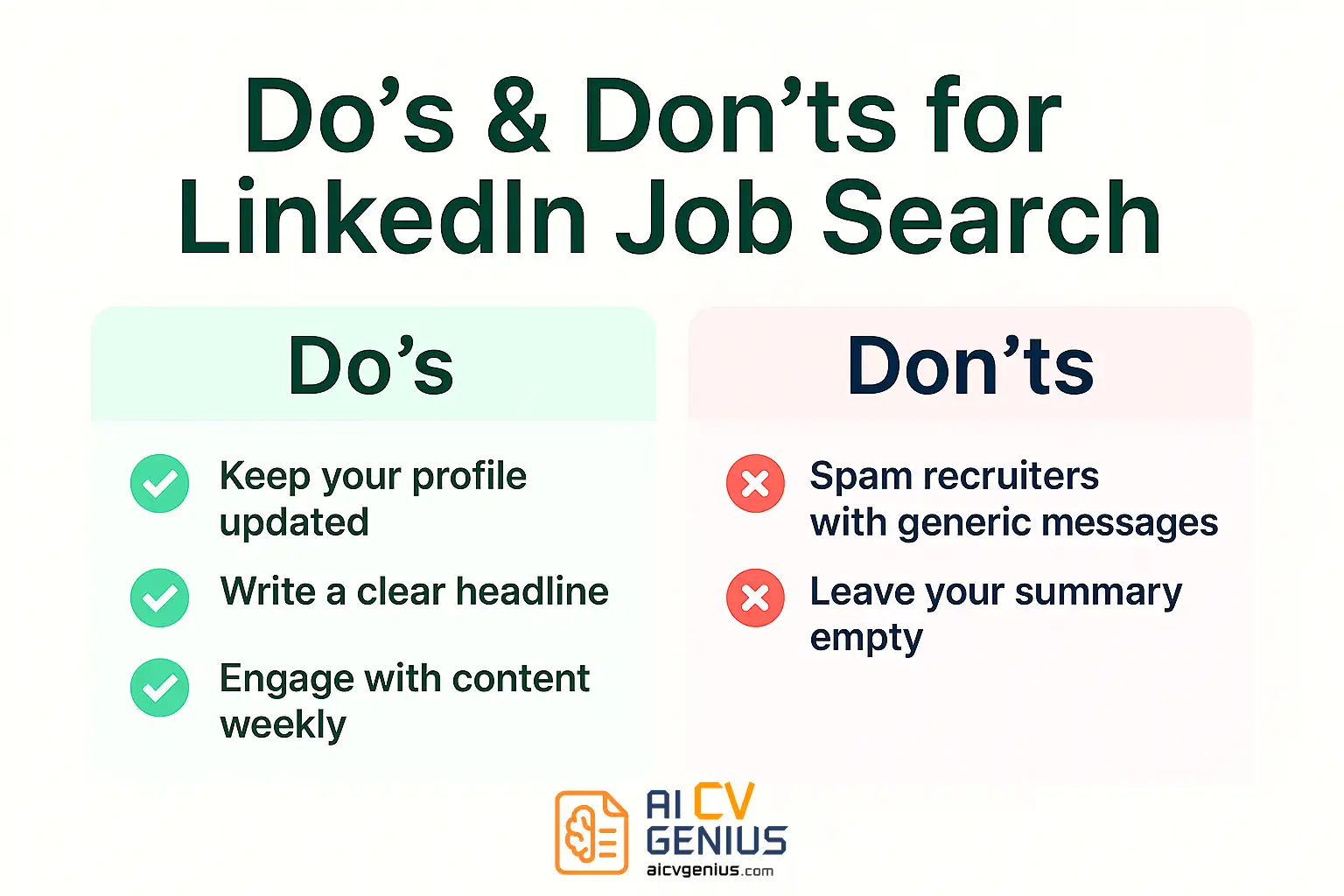
- ❌ Sending generic, unpersonalized connection requests without adding a brief introductory note explaining your reason for connecting.
- ❌ Leaving your professional headline blank, using only your current job title, or employing vague, uninformative descriptions.
- ❌ Treating LinkedIn like a casual social media platform (e.g., posting overly personal updates, engaging in unprofessional debates, using inappropriate language or imagery). Maintain professional decorum.
- ❌ Neglecting the “About” section or leaving it significantly incomplete – this is prime real estate for conveying your value proposition and incorporating keywords.
- ❌ Failing to update your profile regularly with new skills, experiences, projects, or certifications. An outdated profile signals lack of engagement.
- ❌ Using an unprofessional or unclear profile picture (or having no picture at all).
Checklist: Is Your LinkedIn Profile Truly Job-Ready?
Perform this quick audit to ensure your profile is optimized for job seeking:
- ✅ Professional, clear profile photo uploaded and visible.
- ✅ Compelling, keyword-rich headline accurately reflecting your target role/expertise.
- ✅ Detailed, engaging “About” section articulating your value proposition and incorporating relevant keywords.
- ✅ Comprehensive Experience section with achievement-oriented bullet points (quantified where possible).
- ✅ At least 5-10 relevant skills listed and ideally endorsed by connections.
- ✅ Education section complete and accurate.
- ✅ Minimum 2-3 specific, positive recommendations from credible sources visible.
- ✅ “Open to Work” status configured appropriately based on your current situation (Private or Public).
- ✅ Custom profile URL set for easier sharing and branding.
Closing: FAQs and Final Thoughts
FAQs: Leveraging LinkedIn Effectively
Final Thoughts: Your Digital Professional Passport
In today’s interconnected professional world, LinkedIn is no longer merely an optional add-on – it functions as your essential digital passport, granting access to opportunities and networks previously inaccessible. Whether you consider yourself an adept networker comfortable with digital engagement or someone who prefers quieter observation, the platform provides equitable pathways for discovery and connection based on the quality and clarity of your profile.
Recognize that your next significant career opportunity might not originate from a traditional job advertisement; it could very well emerge from a single insightful post you share, a thoughtful comment you contribute, or a personalized connection request you initiate. Build your presence consistently, engage genuinely by adding value, and strategically allow your curated digital reputation to work diligently on your behalf, 24 hours a day, 7 days a week.
For comprehensive resources designed to ensure perfect alignment between your LinkedIn presence and your formal application documents, explore our Resume Templates Finder for professionally designed, ATS-friendly layouts. Refine your formatting strategy with insights from our Resume Templates Guides, or access broader expertise on networking, personal branding, and interview preparation within our extensive Career Resources hub.
Remember this empowering truth: every highly successful professional you admire on LinkedIn once started with a completely blank profile, just like everyone else. What truly matters isn’t where you begin, but rather the consistent, strategic effort you invest in utilizing the platform effectively starting today.