
- What this guide does: Gives five hospitality resume templates plus a strategy to turn duties into a clear story of service.
- What managers scan for: Grace under pressure, Warm professionalism, And proof through hospitality metrics like volume, speed, and satisfaction.
- What to highlight: Systems and tools (PMS, POS, booking platforms) paired with people skills shown as micro-stories with outcomes.
- What to use: Role-specific templates for front desk, restaurant and F&B, management, entry-level pivot, and niche roles like events or concierge.
- How to win fast: Use service verbs, avoid five common mistakes, keep ATS-friendly formatting, and tailor each resume in five minutes.
In hospitality, your resume is not a piece of paper. It is your first act of service. It’s the digital check-in, the warm welcome, and the first impression all rolled into one. Before you can greet a guest, manage a crisis, or lead a team, your resume has to do its job: prove you understand what 5-star service truly means.
When a hotel manager is drowning in 200 applications for a single front desk position, a strong hospitality resume template does more than just organize your work history. It acts as a filter. It immediately separates the candidates who just want a job from the professionals who are passionate about the guest experience. It signals that you are meticulous, professional, and empathetic before you’ve even spoken a word.
The problem? Most resume templates are built for corporate, tech, or finance roles. They’re cold, sterile, and focused entirely on hard metrics. They don’t have a place for what truly matters in this industry: your ability to make people feel welcome, your talent for solving problems under pressure, and your endurance for the controlled chaos of a Saturday night rush.
This guide is built to solve that problem. It provides five downloadable, hospitality-specific templates – whether you’re a recent graduate, a restaurant veteran, an event-planning expert, or a management-bound leader. More importantly, it provides the strategy, examples, and industry-specific tips to transform your resume from a simple list of duties into a compelling story of service.
Why Hospitality Resumes Are Different (And What Managers Really Look For)
A corporate resume might highlight “synergies leveraged” or “pipelines optimized.” A hospitality resume must highlight “guest complaints resolved” and “service standards implemented.” Unlike roles where your primary interaction is with a computer, hospitality is a human-centric, real-time profession. Your resume must reflect this.
Hiring managers in this industry are not just looking for skills; they are looking for a specific psychology. They are looking for “fire preventers,” not just “fire fighters.”
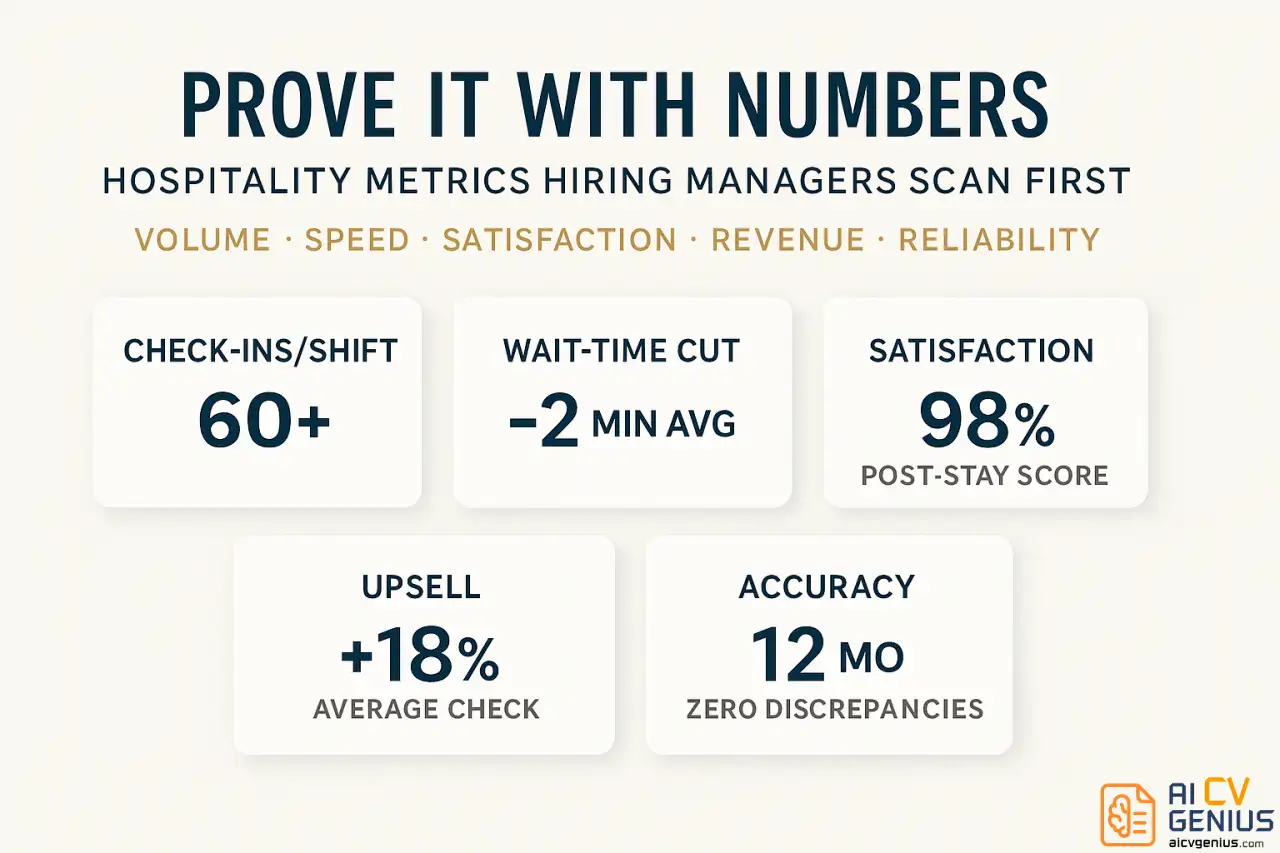
Here’s what makes a hospitality resume unique and what managers are scanning for in the 10 seconds they give your document:
- ✅ Evidence of “Grace Under Pressure”: Every bullet point should quietly scream “I don’t panic.” They look for examples of you handling complaints, managing multiple tasks (the classic “managed 30+ calls per shift while checking in guests”), or dealing with unexpected issues (like an overbooking).
- ✅ A Blend of Hard & Soft Skills: You must prove you can handle both the systems and the humans. A great resume shows you can run the Opera PMS and de-escalate an angry guest. One without the other is a deal-breaker.
- ✅ Service-Oriented Action Verbs: The language is different. Corporate resumes use “Executed” or “Implemented.” Hospitality resumes should use “Welcomed,” “Resolved,” “Assisted,” “Coordinated,” and “Anticipated.” The verbs themselves should feel hospitable.
- ✅ Quantifiable Service: Metrics in hospitality are not just about money (though they are for managers). They are about volume, speed, and satisfaction. “Handled 50+ check-ins daily” proves stamina. “Maintained a 98% guest satisfaction score” proves quality. “Reduced check-in time by 30 seconds” proves efficiency.
- ✅ A Vibe of Professional Warmth: This is crucial. Your resume should not be cold or stiff. It should be impeccably professional, clean, and error-free (attention to detail!), but also feel like it was written by a person who genuinely likes other people. It’s a difficult balance, but it’s the whole job.
A good hospitality resume answers one question above all: “Will this person make my guests happy and my team’s life easier?” If your resume doesn’t answer a resounding “yes” to both, you’re getting passed over.
Essential Hospitality Resume Skills to Highlight (Show, Don’t Tell)
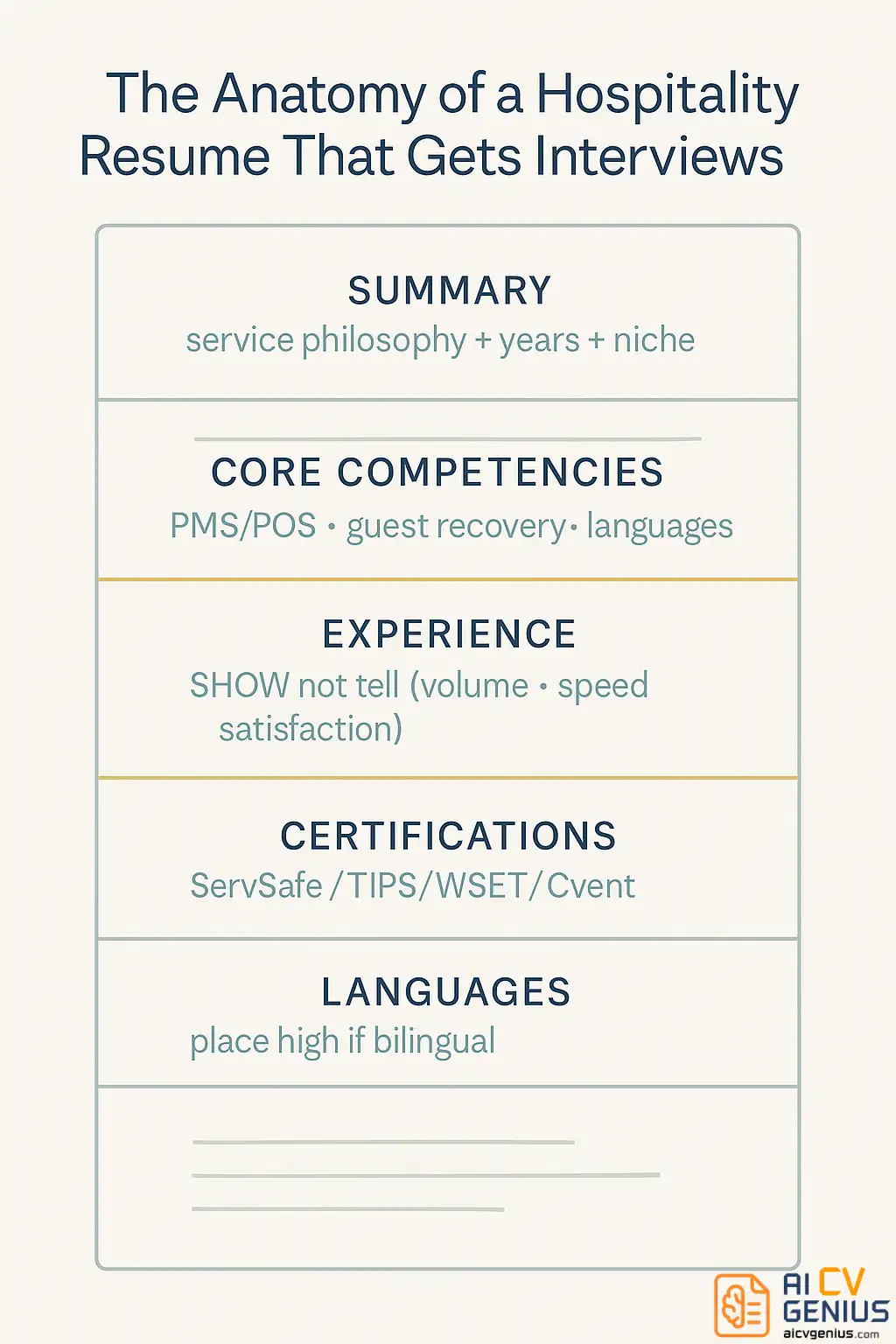
This is the cardinal rule of a hospitality resume: SHOW, DON’T TELL.
Telling is listing “Problem-Solving” in a skills section. It’s lazy and unconvincing.
Showing is writing: “Resolved a critical overbooking for a VIP guest by coordinating with a sister property, resulting in a positive online review for ‘going above and beyond.'”
One is a claim. The other is proof. Here are the essential skills and how to show them.
Technical Skills (The “Systems”)
These are the non-negotiable, teachable skills. You must list the specific software you know. Don’t just put them in a skills list; weave them into your experience to prove you’ve actually used them under pressure.
- Property Management Systems (PMS): Opera, Cloudbeds, Maestro, Mews, RoomKey
- Point of Sale (POS) Systems: Micros, Aloha, Toast, Square, Lightspeed, Revel
- Booking & Reservation Platforms: Resy, OpenTable, Expedia Partner Central, Booking.com Admin
- Event Management Software: Social Tables, Cvent, Tripleseat, Caterease
- Revenue Management: IDeaS, Duetto, or even advanced Excel modeling
- Languages: Fluency in any language is a massive asset. List it near the top (e.g., “Fluent in Spanish and English”).
How to Show Them:
Weak:
“Proficient in Opera PMS.”
Strong:
“Processed 70+ daily guest reservations, check-ins, and check-outs using Opera PMS with 100% booking accuracy.”
Weak:
“Experience with Toast.”
Strong:
“Managed high-volume order entry and payment processing for a 150-seat restaurant using Toast POS, handling over $15,000 in daily transactions.”
People Skills (The “Service” & The “Grit”)
These are the skills that determine your success. You cannot list them. You must prove them with micro-stories (your bullet points).
| Skill | Don’t Say This (The “Tell”) | Show This Instead (The “Show”) |
|---|---|---|
| Communication | “Strong communication skills” | “Acted as the primary liaison between the kitchen and front-of-house, clearly communicating 86’d items and wait times to 10+ servers during peak rush.” (Proves clarity under pressure) |
| Problem-Solving | “Good problem solver” | “Resolved a ‘walked’ guest situation during a sold-out night by securing luxury accommodation at a partner hotel, arranging transport, and comping the stay, resulting in a retained corporate client.” (Proves empathy and resourcefulness) |
| Multitasking | “Able to multitask” | “Managed a busy 6-line phone system, processed concierge requests, and assisted with front desk check-ins simultaneously, reducing guest wait time by an average of 2 minutes.” (Proves capacity and efficiency) |
| Teamwork | “Team player” | “Voluntarily assisted the housekeeping team during peak turnover, helping strip and prep 20+ rooms to ensure all check-ins were met by the 3 PM guarantee.” (Proves you are “all-hands-on-deck”) |
| Attention to Detail | “Detail-oriented” | “Consistently reconciled all end-of-shift cash and credit transactions with zero discrepancies for 18 consecutive months.” (Proves meticulousness and trustworthiness) |
| Upselling | “Good at upselling” | “Increased average check size by 18% through intuitive, knowledge-based wine pairing suggestions and dessert recommendations.” (Proves you can drive revenue) |
The pattern is always: [Action] + [Specific Task or Challenge] + [Result or Metric]. This formula proves your value far beyond a simple list of adjectives.
5 Hospitality Resume Templates You Can Use Now
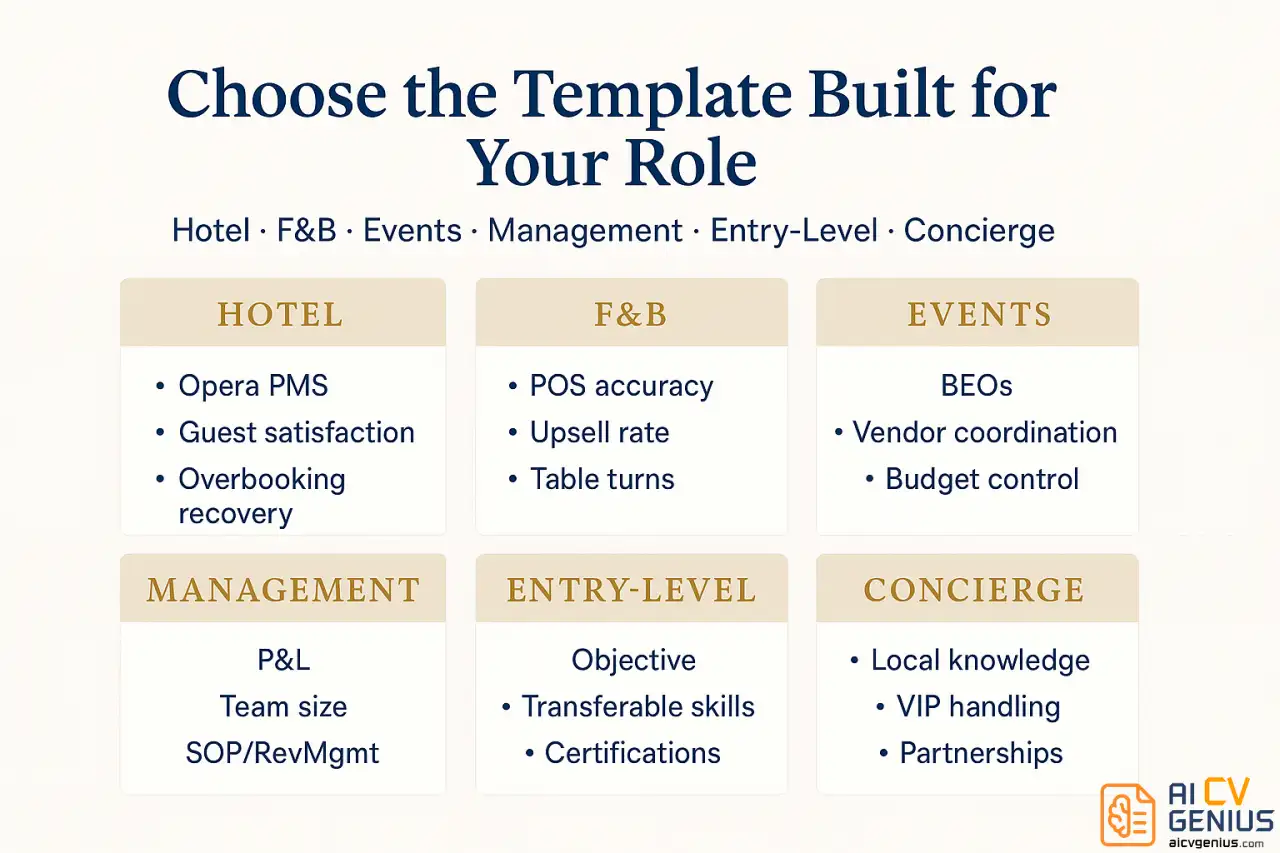
Each template below is designed for a specific career path within the hospitality industry. These are not rigid rules, but strategic starting points. Pick the one that aligns with your goals and customize it with your unique, quantified achievements.
Template 1: Hotel Front Desk & Guest Services
This template is your frontline calling card. It’s built for receptionists, guest service agents, night auditors, and front desk coordinators. It’s all about blending technical skill (PMS software) with high-touch guest interaction.
Best for: Applying to hotels, resorts, boutique properties, and extended-stay brands.
Strategic Focus: Emphasizes problem-resolution, system proficiency, and guest satisfaction metrics. The “Core Competencies” section is key for passing ATS scans for specific software.
️Key sections to include:
- Professional Summary: 2-3 sentences highlighting your guest service philosophy and years of experience (e.g., “Guest-centric Front Desk Agent with 3+ years of experience in high-volume luxury properties…”).
- Core Competencies: A bulleted list of your key skills. Use this to list software AND concepts (e.g., Opera PMS, Cloudbeds, Guest Recovery, VIP Relations, Payment Processing).
- Professional Experience: This is the heart. Use the “Show, Don’t Tell” bullet points.
- Education & Certifications: Include any hospitality degrees, language certificates, or service training (e.g., “Certified in Marriott’s GuestService Foundations”).
Hotel Front Desk Resume Example Bullet:
Guest Service Agent | Hilton Garden Inn | Dallas, TX | June 2021 – Present
• Welcomed and processed check-ins/check-outs for 60+ guests daily using Opera PMS, consistently maintaining a 98% positive feedback score on post-stay surveys.
• Resolved guest complaints and requests (e.g., room issues, billing disputes) within 10 minutes, achieving a 95% first-contact resolution rate and frequently mentioned by name in positive reviews.
• Coordinated seamlessly with housekeeping and maintenance teams via radio and internal software to fulfill special requests, ensuring rooms were prioritized and guest needs met.
• Managed a multi-line phone system, processed payments, and reconciled all end-of-shift reports with zero discrepancies over a 12-month period.
• Trained 3 new front desk agents on customer service standards, property systems, and emergency procedures.
Template 2: Restaurant and Food & Beverage
This template is built for speed, teamwork, and revenue. It’s for servers, bartenders, hosts, and F&B supervisors. It needs to show you can handle a fast-paced environment and work as a cohesive unit with both FOH and BOH.
Best for: Fine dining, casual dining, bars, and hotel restaurant outlets.
Strategic Focus: Emphasizes POS proficiency, menu knowledge, upselling metrics, and teamwork. Certifications are non-negotiable and should be highly visible.
️Key sections to include:
- Resume Objective/Summary: An objective is useful for entry-level (e.g., “Seeking a server position to leverage 3 years of customer service experience…”). A summary is for veterans (e.g., “Fine-dining server with 5+ years experience…”).
- Certifications: List them prominently. (e.g., ServSafe Certified, TIPS Certified, State Food Handler’s Card).
- Experience: Focus on table management, order accuracy, upselling, and side-work.
- Skills: POS systems, wine knowledge (e.g., “WSET Level 1”), craft cocktail knowledge.
Restaurant Server Resume Example Bullet:
Lead Server | The Capital Grille | Chicago, IL | March 2020 – Present
• Managed a 6-table section in a high-volume, upscale dining environment, serving 20-25 tables per shift and maintaining an average tip rate of 22%.
• Mastered a rotating 100-bottle wine list and daily specials to provide informed recommendations, increasing average per-table sales by $15.
• Collaborated with kitchen staff and expediters to accommodate complex dietary restrictions and special requests, ensuring 100% order accuracy.
• Trained and mentored 5 new servers on the Toast POS system, fine-dining service standards, and menu details.
• Consistently received positive mentions in OpenTable reviews for “attentive” and “knowledgeable” service.
Template 3: Hospitality Management
This template shifts the focus from doing the work to leading the work. It’s for assistant managers, hotel managers, F&B directors, and event directors. Your resume must prove you are a business leader, not just a senior employee.
Best for: Anyone applying for a role with P&L, staffing, and operational oversight.
Strategic Focus: Leadership, financial acumen, and operational improvement. This resume must be full of numbers: budgets, team sizes, revenue, cost savings, and guest satisfaction scores.
️Key sections to include:
- Executive Summary: A 3-4 point summary at the top (e.g., “Hospitality Manager with 8+ years of experience… Led a 30-person team to increase GOP by 8%…”).
- Professional Experience: Bullets must focus on results, not duties. “Responsible for staff” is weak. “Hired, trained, and supervised a team of 18…” is strong.
- Core Competencies: P&L Management, Staff Training & Development, SOP Implementation, Revenue Management, Budgeting & Forecasting, Vendor Negotiations.
- Education: Hospitality or business degrees are very relevant here.
Hotel Manager Resume Example Bullet:
Assistant General Manager | Marriott Residence Inn | Austin, TX | January 2019 – Present
• Oversaw all daily operations for a 120-room extended-stay property, supervising a multi-departmental team of 18 staff members (Front Desk, Housekeeping, Maintenance).
• Drove guest satisfaction scores (GSS) from 87% to 94% over 18 months by implementing a new staff training protocol and a “first-contact resolution” empowerment model.
• Managed a $450,000 annual operating budget, reducing supply costs by 12% through strategic vendor renegotiation while maintaining all brand service standards.
• Handled all escalated guest and corporate client issues, achieving a 90% resolution rate without needing corporate involvement.
• Conducted all staff scheduling, payroll, weekly leadership meetings, and quarterly performance reviews to maintain team accountability and boost morale.
Template 4: Entry-Level Hospitality (The “Pivot”)
This template is for those with passion and potential, but not direct experience. It’s designed to highlight transferable skills from other industries (retail, food service, admin, even a camp counselor) and frame them in a hospitality context.
Best for: Recent graduates, career changers, and first-time job seekers.
Strategic Focus: The Resume Objective is everything. It must tell a compelling, 2-sentence story of why you want this and what you bring. The experience section focuses on skills, not job titles.
️Key sections to include:
- Career Objective: This is mandatory. It must be specific and confident.
- Education & Certifications: A hospitality degree, or even a simple Food Handler’s Card, shows initiative.
- Relevant Experience: Not “Work Experience.” This lets you cherry-pick. Include retail, volunteer work, or any job where you dealt with customers.
- Skills: List any and all relevant software (even just MS Office) and soft skills (e.g., “Conflict Resolution,” “Customer Service”).
Entry-Level Resume Objective Examples:
1️⃣Example 1 (Recent Graduate):
“Recent graduate from [University Name] with a B.S. in Hospitality Management. Seeking a Front Desk Agent position to apply hands-on experience from a 300-hour internship at the Four Seasons, where I gained proficiency in Opera PMS and luxury service standards. Eager to bring a strong work ethic and a passion for guest service to the [Hotel Name] team.”
2️⃣Example 2 (Career Changer from Retail):
“Customer service professional with 3+ years in high-volume retail, where I managed 40+ customer interactions daily and resolved issues with a 99% satisfaction rate. Seeking to transition these skills into a Guest Service role within the hotel industry. Recently TIPS certified and eager to learn.”
Template 5: Specialized & Niche Roles (Events, Spa, Concierge)
This template is for experts. Event coordinators, spa managers, concierge, or catering directors. Your resume must immediately signal your deep, niche expertise. General hospitality language won’t cut it.
Best for: Event planners, banquet managers, spa coordinators, housekeeping supervisors.
Strategic Focus: Your summary and skills must be laser-focused on your specialty. An event planner’s resume should be 90% about events, not general hotel operations. Metrics and project highlights are critical.
️Key sections to include:
- Professional Summary: Highlight your specialty (e.g., “CMP-certified Event Manager with 5 years of experience…”).
- Specialized Skills: List niche software (Social Tables, Cvent), certifications (CMP, WSET), or techniques (e.g., “Luxury Concierge Services,” “Menu & Cost Engineering”).
- Notable Projects/Events (for Event Planners): A small, 2-3 bullet section showcasing your biggest, most successful events.
- Industry Certifications: Place these prominently.
Event Coordinator Resume Example Bullet:
Event Coordinator | Hyatt Regency Hotel | Miami, FL | April 2020 – Present
• Planned, coordinated, and executed 30+ B2B and social events annually, including corporate conferences, weddings, and galas for groups of 50 to 500 attendees.
• Acted as the single point of contact for clients, coordinating with all internal departments (Catering, AV, F&B) to deliver seamless events with a 98% client satisfaction rate.
• Managed all event budgets, ranging from $10,000 to $150,000, and consistently delivered all events at or under budget through meticulous vendor negotiation.
• Created detailed event timelines (BEOs) and floor plans using Social Tables and Tripleseat software.
Power Verbs: The “Secret Menu” of Hospitality Resumes
The words you choose are signals. “Responsible for” is passive and weak. “Managed” is better, but “Orchestrated” is best. Using strong, specific action verbs is the fastest way to make your resume sound more professional and dynamic.
Stop using “Responsible for” or “Duties included.” Start every bullet point with a power verb.
| For Guest-Facing & Service Roles | For Operational & Teamwork Roles | For Management & Leadership Roles |
|---|---|---|
|
|
|
Compare these two identical job descriptions:
Weak version:
“Responsible for checking in guests and answering questions. Also handled complaints and payments. Duties included end-of-shift reports.”
Strong version:
“Welcomed 60+ guests daily, processed check-ins using Opera PMS, and resolved all booking issues to maintain a 95% satisfaction rating. Managed all payment processing and reconciled end-of-shift reports with 100% accuracy.”
The second version tells a story of an active, competent professional. The first sounds like a list of chores.
5 Mistakes That Kill Hospitality Resumes (And How to Fix Them)
Even with a beautiful template, these common (and fatal) mistakes will land your resume in the “no” pile. Hiring managers are looking for reasons to discard resumes, don’t give them an easy one.
- ❌ Mistake 1: Typos and Grammar Errors.Why it’s fatal: Hospitality is attention to detail. A typo on your resume tells a manager you’ll make a typo in a guest’s reservation. It’s the #1 deal-breaker.The Fix: Proofread twice. Use a grammar checker. Then, have a friend or mentor proofread it again.
- ❌ Mistake 2: Generic, Meaningless Objectives.Why it’s fatal: “Seeking a challenging position to utilize my skills and grow with a company.” This tells the manager nothing and wastes valuable space.The Fix: If you’re entry-level, be specific (as shown in Template 4). If you’re experienced, replace the objective with a powerful 3-sentence Professional Summary.
- ❌ Mistake 3: No Numbers or Metrics.Why it’s fatal: Hospitality is a game of volume, speed, and satisfaction. “Checked in guests” is meaningless. “Checked in 60+ guests per shift” proves you can handle the pace.The Fix: Go through every bullet point. Can you add a number? (e.g., number of guests, team size, tables, calls, satisfaction score, budget size, % improvement).
- ❌ Mistake 4: Using Corporate Jargon.Why it’s fatal: “Leveraged synergies to optimize guest-facing protocols” sounds ridiculous. Hospitality has its own language. Using stiff, corporate-speak shows you don’t ‘get’ the industry.The Fix: Write like a human, but a professional one. Use service-oriented words: “Collaborated with,” “Resolved for,” “Assisted with.” Be clear and warm.
- ❌ Mistake 5: Irrelevant Experience & Length.Why it’s fatal: A manager hiring for a Front Desk role does not care about your 2015 summer job as a camp counselor (unless you frame it as “guest experience”).The Fix: Keep your resume to ONE page unless you are a GM or executive with 15+ years of experience. Be ruthless. If it’s not relevant to the job you want, cut it or minimize it.
Need help polishing your resume? Check out our guide on how to improve your CV for additional tips.
A Quick Guide to Beating the ATS (Applicant Tracking Systems)
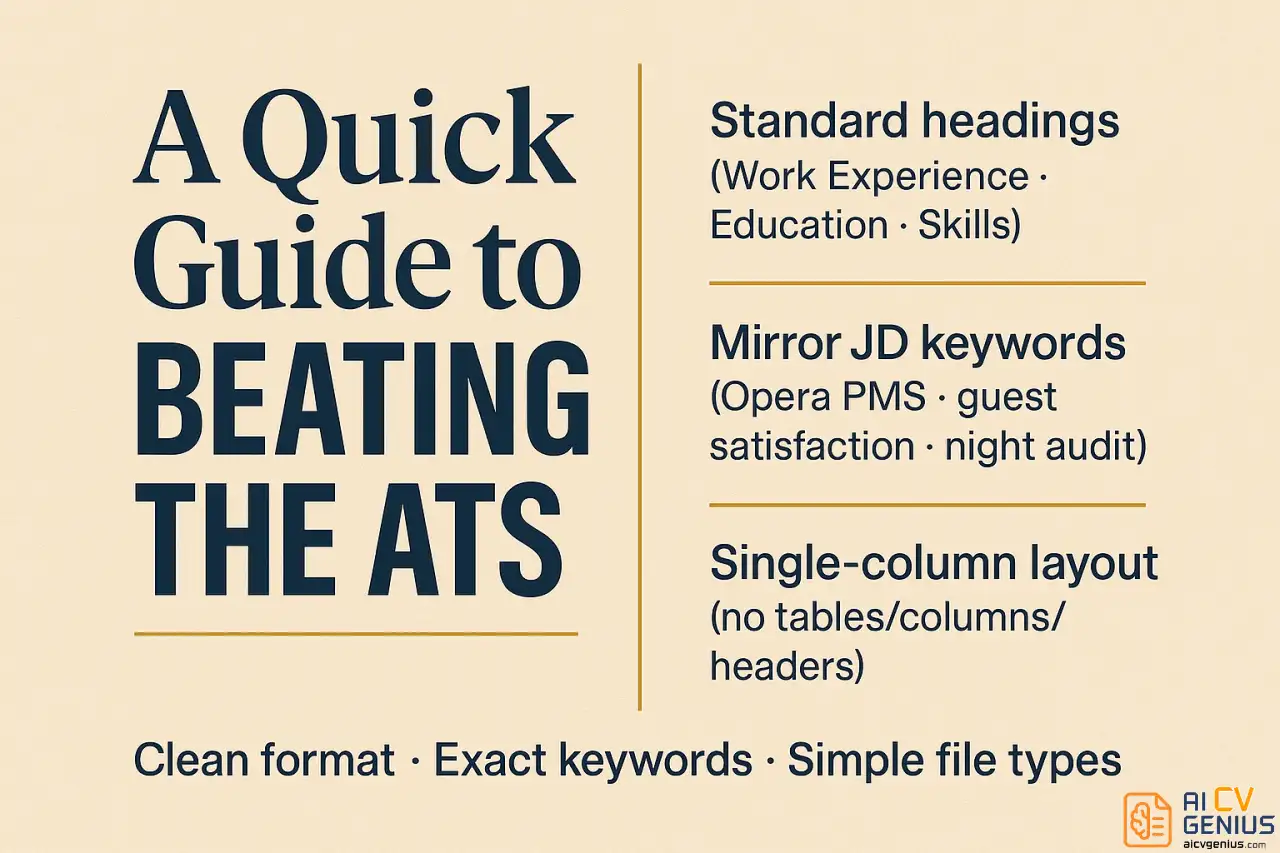
Yes, most hotels and large restaurant chains use ATS software to scan your resume before a human ever sees it. If your resume isn’t formatted correctly, you are invisible. Here’s how to get through.
- Use Standard Section Headings: “Work Experience,” “Education,” “Skills,” “Certifications.” Don’t get creative with “My Journey” or “Where I’ve Been.”
- Mirror Keywords: Look at the job description. If it says “Opera PMS,” “guest satisfaction scores,” and “night audit,” your resume must have those exact phrases.
- Simple Formatting is King: Do not use tables, text boxes, or columns. Do not put your name or contact info in the header/footer (the ATS can’t read it). A simple, single-column, top-down resume is always best.
- File Type Matters: Save your resume as a .docx or .pdf. Most ATS systems prefer .docx, but .pdf locks in your formatting. Always follow the application’s instructions. If it doesn’t specify, a .pdf is generally safer for human readability.
- Avoid Graphics: No photos, no logos, no fancy fonts, no skill-rating bars. They are meaningless to the robot and look unprofessional to the human.
A clean, simple template is your best friend. It works for the robot and for the hiring manager who has 10 seconds to read it.
If you’re worried about ATS rejections, read our article on why your resume isn’t getting responses.
How to Customize Your Template for Each Job (in 5 Minutes)
You must tailor your resume for every job. A generic “blast” resume gets generic results (i.e., none). Hiring managers can spot a generic application from a mile away. But this doesn’t have to take an hour.
Here’s a 5-minute tailoring process:
- Minute 1: Read the Job Description (Twice). First, for the role. Second, for the keywords. Highlight 3-5 key phrases (e.g., “luxury-level service,” “high-volume,” “event coordination”).
- Minute 2: Update Your Summary. Tweak your professional summary to include 1-2 of those exact keywords. If they want a “luxury-level” professional, use that phrase.
- Minute 3: Re-order Your Bullets. Look at your “Work Experience” for your last job. Do you have a bullet point that matches their keywords? Move it to the top of that job’s list. (e.g., if they prize “event coordination,” move your “Coordinated 3 B2B events” bullet to the #1 spot).
- Minute 4: Check Your Skills Section. If they require “Cvent” and you have it listed, make sure it’s spelled identically.
- Minute 5: Save As… Save the file with the company and role name. (e.g., “JohnDoe_Resume_Marriott_FrontDesk.pdf”). This shows organization.
This simple process proves you read the posting and are genuinely interested in their job, not just any job.
If you’re changing careers, our guide on career change CVs will help you position your transferable skills.
Expert FAQ: Your Toughest Hospitality Resume Questions
Final Thoughts: Your Resume is Your First “Welcome”
A strong hospitality resume template is your foundation. It’s the clean uniform, the polished silverware, the perfectly set room. It gives you the structure to present yourself professionally. But the structure alone won’t get you the job. Your experience, quantified with numbers, described with service-oriented verbs, and tailored to the role, is what brings it to life.
The best hospitality resumes don’t just list jobs; they tell a story. They tell the story of a person who understands service, thrives under pressure, and genuinely cares about making a guest’s day better. This is not a “soft” industry; it’s a high-pressure, operations-heavy business built on human connection. Your resume must prove you can handle both sides of that equation: the spreadsheet and the smile.
Use the templates and strategies in this guide as your starting point. Customize them. Quantify your achievements. Proofread them until they are perfect. And remember: a hiring manager in this industry values one thing above all: can you deliver a 5-star experience? Make your resume the very first one they receive.
Want more resume help? Browse our collection of resume templates or check out our career resources for additional job search tips that actually work.