
- Business Analyst resume writing is framed as proof of value: Replace responsibility lists with measurable outcomes that show you translate between business and tech.
- Recruiters scan for three signals fast: Translator across KPIs and systems, problem-finder who asks why, and value-creator whose analysis drives decisions, not extra documentation.
- ATS rules are non-negotiable: Use a single-column layout, standard headings, and mirror job-description keywords like Process Mapping, Agile, SQL, Power BI, and UAT.
- The core structure follows five sections: Clean metadata header, 3 to 4 line executive summary, grouped skills toolkit, impact-first experience bullets using Action + Project + Metric, and education plus certifications.
- Advanced tactics raise the ceiling: Add a projects section as proof of concept, quantify time, money, scale, and accuracy, tailor keywords by BA type, avoid jargon-only claims, and use templates for speed without sacrificing personalization.
Behind every smart business move, every efficient process, and every successful product launch stands a sharp analyst who turned complexity into clarity. Your Business Analyst resume is more than a list of skills – it is your first piece of evidence that you are this person. It’s proof that you think in systems, bridge the gap between people and technology, and deliver measurable, tangible results.
The problem is, most Business Analyst (BA) resumes are cluttered. They list responsibilities (“Responsible for gathering requirements”) instead of proving impact (“Gathered requirements that cut development time by 15%”). They are a list of “what” without the “so what.”
This guide will deconstruct the psychology of what hiring managers are truly searching for. We will build a resume that functions like a perfectly designed dashboard: it’s clean, focused, and every single data point tells a story of value. Let’s build a document that proves you don’t just report data – you use it to shape strategy.
The Recruiter’s View: Passing Filters and Impressing Managers
Hiring managers don’t hire BAs because they need reports. They hire BAs because they have expensive problems they can’t solve. They are losing money, their processes are slow, or their tech and business teams are misaligned. Your resume is their first diagnostic tool.
In their 7-second scan, they are subconsciously asking three questions:
- 1. Are you a Translator? Do you speak both “Business” (KPIs, ROI, Revenue) and “Tech” (SQL, Agile, API)? They are looking for the person who can sit between a VP of Sales and a Senior Developer and make sure they are building the same thing.
- 2. Are you a Problem-Finder or a Task-Taker? Do you just document what you’re told, or do you ask “why” five times to find the real problem? Your resume must show initiative, not just obedience.
- 3. Do you Create Value or Create Work? Does your analysis lead to a decision? They want someone who delivers insights that make the company faster, smarter, or more profitable – not someone who just generates more documents.
Before a human sees your resume, the Applicant Tracking System (ATS) must approve it. This software is not smart; it’s a simple matching algorithm. It scans for keywords and structure. A beautifully designed resume that is unreadable by an ATS is useless. Always use a single-column format, as an ATS reads left-to-right and jumbles two-column layouts. Match keywords from the job description (e.g., “Process Mapping,” “Agile Methodology,” “Power BI”) and stick to standard headings like “Professional Experience.”
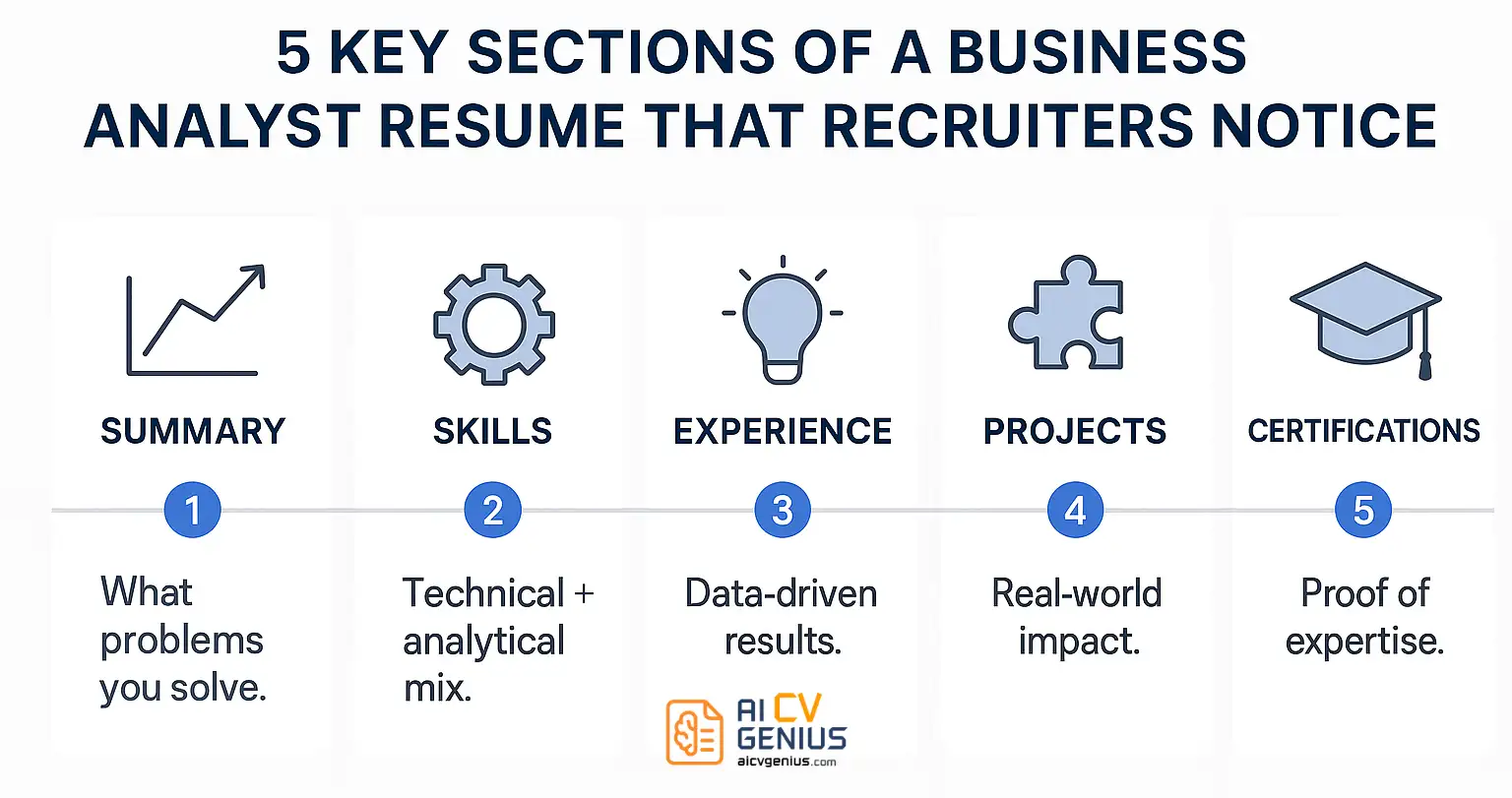
Structure: The 5 Core Sections of an Analyst Resume
Recruiters scan resumes in a predictable “F” pattern – top-down, left-to-right. Your resume must present the most critical information in a logical hierarchy.
1. Header: The Metadata
Make it clean and professional. This is not the place for creativity.
Your Name | Professional Title (e.g., “Business Analyst,” “IT Business Analyst,” “Senior Business Systems Analyst”) | City, State, Zip | Phone | Email | LinkedIn URL | Portfolio Link (Optional, but powerful if you have a public Tableau profile or a website with case studies).
2. Professional Summary: The Executive Summary
This is your “executive summary.” In 3-4 lines, it summarizes your entire business case for the hiring manager. It must be dense with value.
Weak Summary:
“Detail-oriented Business Analyst with experience in requirements gathering and working with stakeholders. Looking for a challenging role.”
(This is passive and generic).
Strong Summary:
“Strategic Business Analyst with 5+ years of experience bridging business and IT to deliver data-driven solutions. Proven ability to translate complex stakeholder needs into technical requirements, leading to an 18% reduction in operational costs. Expert in SQL, Tableau, and Agile methodologies.”
Career Changer Summary:
“Analytical marketing professional transitioning into Business Analysis. Leveraging 4 years of experience in data analysis and project coordination to gather requirements and deliver insights. Recently certified in Google Data Analytics and proficient in SQL and Power BI.”
3. Key Skills: The BA Toolkit
A Business Analyst is a hybrid. Your skills section must show a balance between technical fluency and business acumen. Group them logically to prove you think in systems.
| Business Analysis | Requirements Gathering, Stakeholder Management, Process Mapping (BPMN), Gap Analysis, SWOT Analysis, Use Case Development, User Story Creation, UAT (User Acceptance Testing) |
| Data & Technical Skills | SQL (T-SQL, PostgreSQL), Data Visualization (Tableau, Power BI), Advanced Excel (Pivot Tables, VLOOKUP), Python (Pandas, NumPy), Database Management, JIRA, Confluence |
| Methodologies | Agile, Scrum, Waterfall, Hybrid, Lean Six Sigma (Yellow/Green Belt) |
| Soft Skills | Communication, Facilitation, Problem-Solving, Critical Thinking, Negotiation |
4. Experience: The Business Case
This is the core of your resume. Each bullet point is a mini business case. Use the “Problem → Action → Result” framework, or simply “Action Verb + Project + Metric.”
| ❌ Weak Bullet (Duty) | ✅ Strong Bullet (Impact) |
|---|---|
| “Responsible for gathering requirements from stakeholders.” | “Facilitated requirement-gathering workshops with 15+ cross-functional stakeholders, creating a clear project scope that reduced developer rework by 25%.” |
| “Made dashboards for the sales team.” | “Designed and launched a new sales dashboard in Tableau, visualizing real-time KPIs that helped the sales team increase lead conversion by 12%.” |
| “Involved in process improvement.” | “Mapped the ‘as-is’ procurement process using BPMN and identified three key bottlenecks, leading to a new ‘to-be’ process that cut invoice processing time by 40%.” |
More High-Impact Examples:
- ✅ Authored 200+ user stories and acceptance criteria for a new CRM implementation, ensuring 98% alignment with business needs during UAT.
- ✅ Conducted gap analysis on the existing software stack, providing recommendations that led to the adoption of a new solution saving $150k annually.
- ✅ Acted as the primary liaison between the development team and executive leadership, translating technical constraints into clear business implications.
5. Education & Certifications
List your degree, university, and graduation year. For a BA, certifications are highly valuable as they standardize your knowledge.
- Certified Business Analysis Professional (CBAP) – IIBA
- PMI Professional in Business Analysis (PMI-PBA)
- Certified ScrumMaster (CSM) or Professional Scrum Master (PSM I)
- Google Data Analytics Professional Certificate (Excellent for entry-level)
- Microsoft Certified: Power BI Data Analyst Associate
The Complete Business Analyst Resume Example (Putting It All Together)
Theory is one thing; practice is another. Let’s apply every strategy we’ve discussed to build a complete resume for a fictional candidate, Sarah Jenkins, an experienced IT Business Analyst.
SARAH JENKINS, PMP, CSM
Senior IT Business Analyst | Agile & Data Visualization
New York, NY 10001 | (555) 456-7890 | s.jenkins.ba@email.com | linkedin.com/in/sarahjenkinsba
PROFESSIONAL SUMMARY
Strategic and results-oriented Senior Business Analyst with 7+ years of experience aligning technology solutions with business goals in Agile environments. Proven ability to lead requirements elicitation for multi-million dollar projects, resulting in a 30% increase in development efficiency. Expert in SQL, Tableau, and JIRA, translating complex data into actionable strategies and clear user stories.
CORE COMPETENCIES
|
|
|
PROFESSIONAL EXPERIENCE
Senior Business Analyst | TechSolutions Global | New York, NY (2019 – Present)
- Lead BA for a $2.5M Salesforce CRM implementation; facilitated workshops with 20+ sales and marketing stakeholders to define scope and gather 300+ user stories.
- Designed and launched 5 new sales operations dashboards in Tableau, visualizing real-time KPIs that helped leadership identify and cut lead leakage by 18%.
- Mapped the ‘as-is’ client onboarding process using BPMN and identified 4 key bottlenecks; the redesigned ‘to-be’ process cut onboarding time from 10 days to 4 days.
- Acted as Scrum Master for a 6-person dev team, clearing roadblocks and facilitating sprint planning, which improved on-time feature delivery by 30%.
Business Analyst | FinCorp Services | New York, NY (2016 – 2019)
- Conducted gap analysis on legacy financial reporting software, providing recommendations that led to the adoption of a new solution saving $120k annually in licensing fees.
- Authored and managed all technical documentation and user stories in Confluence and JIRA for 3 major software update cycles.
- Wrote and executed UAT test plans with business users, identifying and resolving 50+ critical bugs prior to launch, ensuring a 99% error-free release.
EDUCATION & CERTIFICATIONS
- Project Management Professional (PMP) | Project Management Institute (PMI)
- Certified ScrumMaster (CSM) | Scrum Alliance
- Bachelor of Science in Business Administration, Information Systems | New York University (NYU)
Advanced Strategies: Quantify, Tailor, and Avoid Mistakes
Beyond the core structure, several advanced tactics can further refine your resume. This includes adding a projects section, quantifying your impact, and tailoring your document for specific roles.
Add a Dedicated “Projects” Section (Your Proof of Concept)
If you are a junior BA, a career-changer, or have done freelance/consulting work, a projects section is your single best tool. It proves you can apply your skills. Describe each project like a mini-case study.
Supply Chain Optimization Analysis (Tableau, SQL) | [Link to Dashboard]
Analyzed a 500k-row dataset to identify shipping bottlenecks. Built an interactive Tableau dashboard to visualize on-time delivery rates, leading to a recommendation that improved delivery accuracy by 22%.
Agile Project: E-commerce Checkout Redesign (JIRA, BPMN)
Acted as project BA for a 4-person academic team. Mapped the ‘as-is’ checkout flow, gathered user feedback, and wrote 15 user stories to design a ‘to-be’ process, reducing cart abandonment by a projected 10%.
Use Data as Your Resume’s Language: Quantify Everything
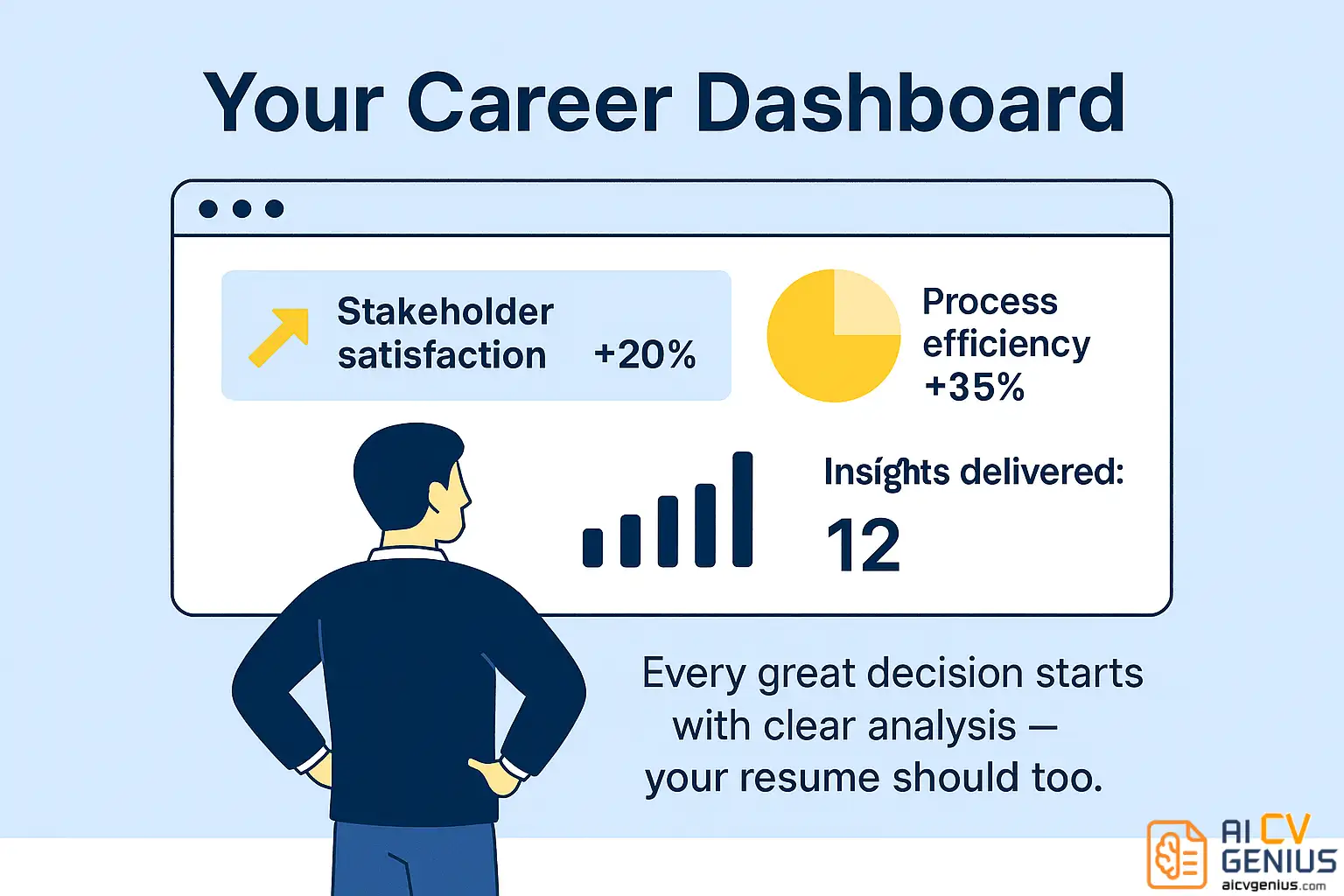
Hiring managers trust numbers. As an analyst, this is your native language. Do not make vague claims. “Improved process” is meaningless. “Reduced process time by 30%” is a fact.Where to find your numbers:
- Time Saved: “Reduced monthly reporting time by 40 hours.”
- Money Saved/Generated: “Identified a software redundancy that saved $120k annually.”
- Efficiency Gained: “Streamlined data entry, improving accuracy by 25%.”
- Scale: “Managed requirements for a $2M project.”
- People: “Trained a 15-person team on a new CRM.”
If you don’t have an exact number, estimate. “Reduced rework by an estimated 20%” is still more powerful than “Reduced rework.”
Tailor Your Resume: Filter Your Own Data
A good BA adapts their communication to their audience. Do the same with your resume. A “one-size-fits-all” resume will be ignored. Tailor it for each role.
| Role Type | Focus Area | Resume Strategy & Keywords |
|---|---|---|
| IT Business Analyst | Systems, software, and technical teams. | Emphasize: JIRA, Agile, Scrum, UAT, SQL, API, Systems Integration, ERP. |
| Financial Analyst (BA) | Revenue, forecasting, and finance teams. | Emphasize: Excel Modeling, SQL, Forecasting, KPIs, Cost-Benefit Analysis, ROI. |
| Marketing Analyst (BA) | Campaigns, customer insights, and sales teams. | Emphasize: Power BI/Tableau, CRM (Salesforce), Customer Journey Mapping, ROI. |
| Operations Analyst (BA) | Efficiency, logistics, and process. | Emphasize: Process Mapping (BPMN), Lean, Six Sigma, Supply Chain, Automation. |
Avoid These Common Mistakes (Data Leaks)
- ❌ Using BA Jargon: Don’t just say “Elicited requirements.” Say “Led workshops with 10+ stakeholders.” One is jargon, the other is a skill.
- ❌ Forgetting the “Business” Part: Don’t just list tools. Connect every tool to a business outcome. (e.g., Used SQL to find…, Built Tableau to show…).
- ❌ Inconsistent Formatting: As an analyst, you are judged on your attention to detail. Different date formats or misaligned bullets are a major red flag.
- ❌ A “Wall of Text”: Use white space. A resume that is hard to read will not be read.
Pros & Cons of Using a Resume Template
| Pros | Cons |
|---|---|
| ✅ Saves significant time on formatting. | ❌ Can look generic if not customized with strong content. |
| ✅ Ensures a clean, ATS-friendly (single-column) structure. | ❌ Many “creative” templates are ATS-incompatible. |
| ✅ Provides a logical hierarchy that recruiters expect. | ❌ Might limit flexibility for highly creative or non-linear careers. |
For a clean, ATS-optimized template, try Resume Templates Finder – it’s designed for clarity, not clutter.
In-Depth FAQs for Business Analysts
Final Thoughts: Your Resume is a Business Case for You
Your resume isn’t just a summary – it’s a business case for why you are the right investment. Like any good report, it should be clear, logical, and focused on measurable outcomes. Clarity, logic, and quantified results will always win over buzzwords.
Explore more templates at Resume Templates Finder or read step-by-step writing tips at Career Resources.