
- Core idea: A phone screen is an audio filter, they judge energy, clarity, poise, and warmth through your voice.
- Setup: If a surprise call hits, reschedule calmly, then take it in a quiet room with wired earphones and a simple desk setup.
- Delivery: Stand up, smile, speak a bit slower, and use short pauses instead of filler words or rushed rambling.
- Content: Prep bullet notes for the core questions and bring 2 to 3 smart questions that show real curiosity about the role.
- Closeout: Use active listening cues, handle curveballs with a pause and buffer phrase, then send a thank-you email within 24 hours.
The Audio Handshake: Why Phone Interviews Matter More Than Ever
In the age of remote work and global hiring, the first real connection often happens through your voice. A phone interview might seem casual, but it is frequently the most critical filter in the hiring process. Think of it as the gatekeeper; it can filter out 80% of candidates before anyone ever sees their face.
The challenge is immense. You cannot rely on warm eye contact, confident body language, or a reassuring smile. All you have are your words, your tone, and your ability to convey presence and professionalism through a speaker. This is why this list of phone interview tips is not about sounding rehearsed – it is about mastering the art of vocal connection and sounding authentically confident.
This is not just a conversation; it is a performance where your voice is the main character. Mastering it is the first step to proving you are a serious contender.
“In a phone interview, your tone is your body language. Your pacing is your eye contact. Your clarity is your professional attire.”
The Psychology of the Phone Screen: What Are They Really Listening For?
A phone screen, typically conducted by an HR professional or recruiter, is not designed to see if you are the best candidate. It is designed to see if you are the wrong candidate. It is a process of rapid elimination.
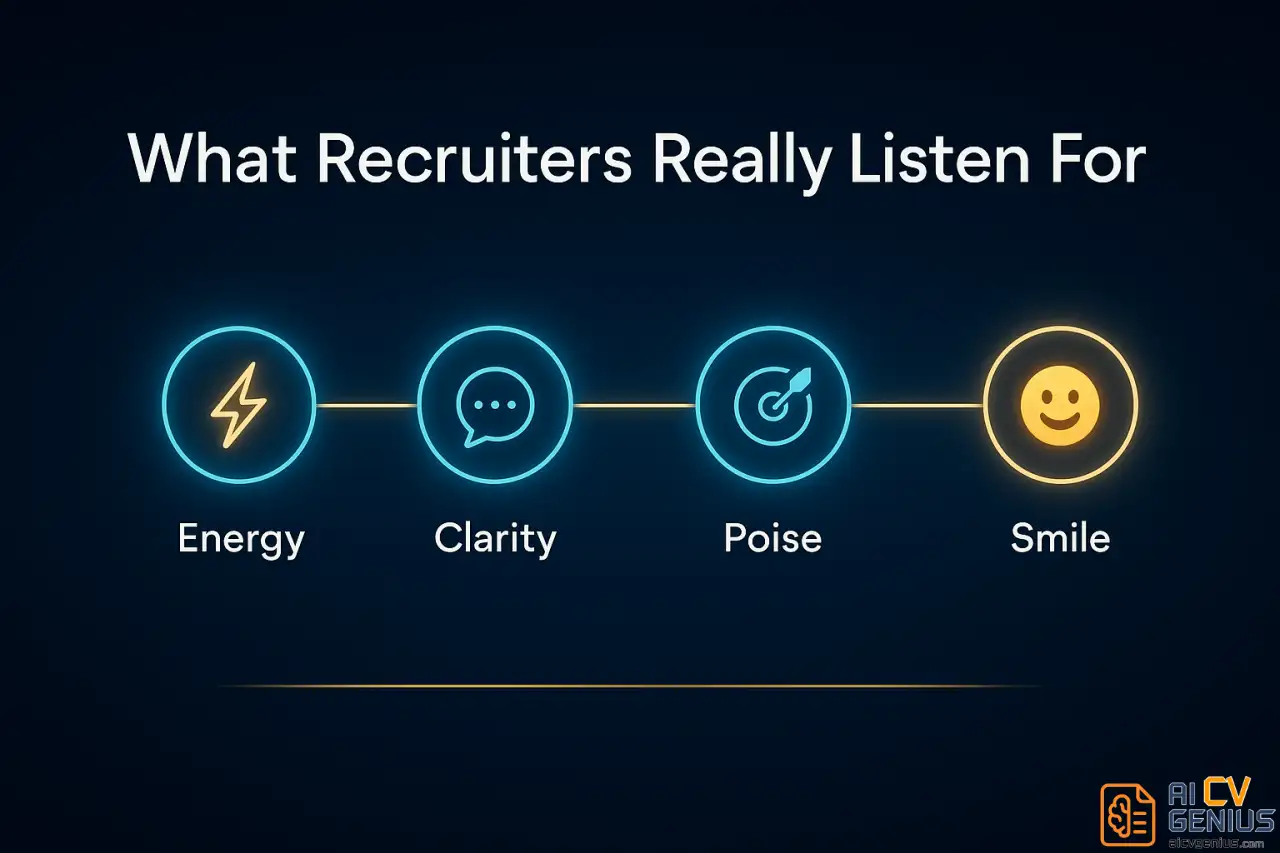
When an interviewer cannot see you, their hearing becomes hyper-sensitive. They are listening for hidden cues:
- Energy & Enthusiasm: Does your voice have energy, or do you sound bored, tired, or distracted? A flat tone is the vocal equivalent of slouching.
- Clarity & Coherence: Can you articulate your thoughts clearly without rambling? Rambling signals disorganized thinking.
- Professionalism & Poise: Do you sound flustered, or do you sound calm and in control? How you handle the call suggests how you handle workplace pressure.
- “The Smile Test”: Can they hear a smile in your voice? A smile genuinely changes your vocal tonality, making you sound warmer and more approachable.
Your goal is to pass this audio test by proving you are an engaged, articulate, and positive professional worth advancing to the next round.
The Comprehensive 10-Step Guide to Acing Your Phone Interview
Step 1: Know Who’s Calling You (And Handle the Surprise Call)
This is the first rule of professionalism. If you have a scheduled call, know the recruiter’s name, their title, and the exact job title you applied for. Have this information written on the notepad in front of you.
But what about the unscheduled “surprise” call?
Recruiters often do this to catch you off-guard and get your “unfiltered” self. If you are in a car, at the grocery store, or simply not mentally prepared, do not panic-answer. You have one chance to make a first impression. It is 100% acceptable and professional to reschedule.
Use this script with a calm, friendly tone:
“Thank you so much for reaching out, [Recruiter’s Name]. I am very interested in speaking with you about this role. I’m not at a private desk right now – could I give you my full attention by scheduling a time later this afternoon or tomorrow morning?”
This response shows you are organized, respectful of their time, and in control. It is a sign of confidence, not weakness.
Step 2: Set the Scene for Vocal Success
Your environment directly shapes your performance. Do not take the call lying in bed or sitting on a noisy patio. Your voice will betray your lack of preparation.
- ✅ Find a “Dead” Room: A small, quiet room with carpet and furniture is ideal. Hardwood floors and empty rooms create echoes.
- ✅ Eliminate All Distractions: Close your door. Silence your computer notifications, email pop-ups, and your other phone. Nothing is more unprofessional than a text alert buzzing while you’re answering a question.
- ✅ Use Wired Earphones: This is a critical pro-tip. Do not use your phone’s speakerphone; it makes you sound distant and flattens your tone. Do not rely on Bluetooth; it can drop or have a lag. A simple, wired set of earphones with a built-in microphone provides the clearest, most reliable audio.
- ✅ Have Your “Command Center” Ready: Keep these items on your desk:
- A printed copy of your resume.
- A printed copy of the job description.
- A pen and notepad.
- A glass of water (a dry throat signals nervousness).
Step 3: The Physical Hack: Stand Up and Smile
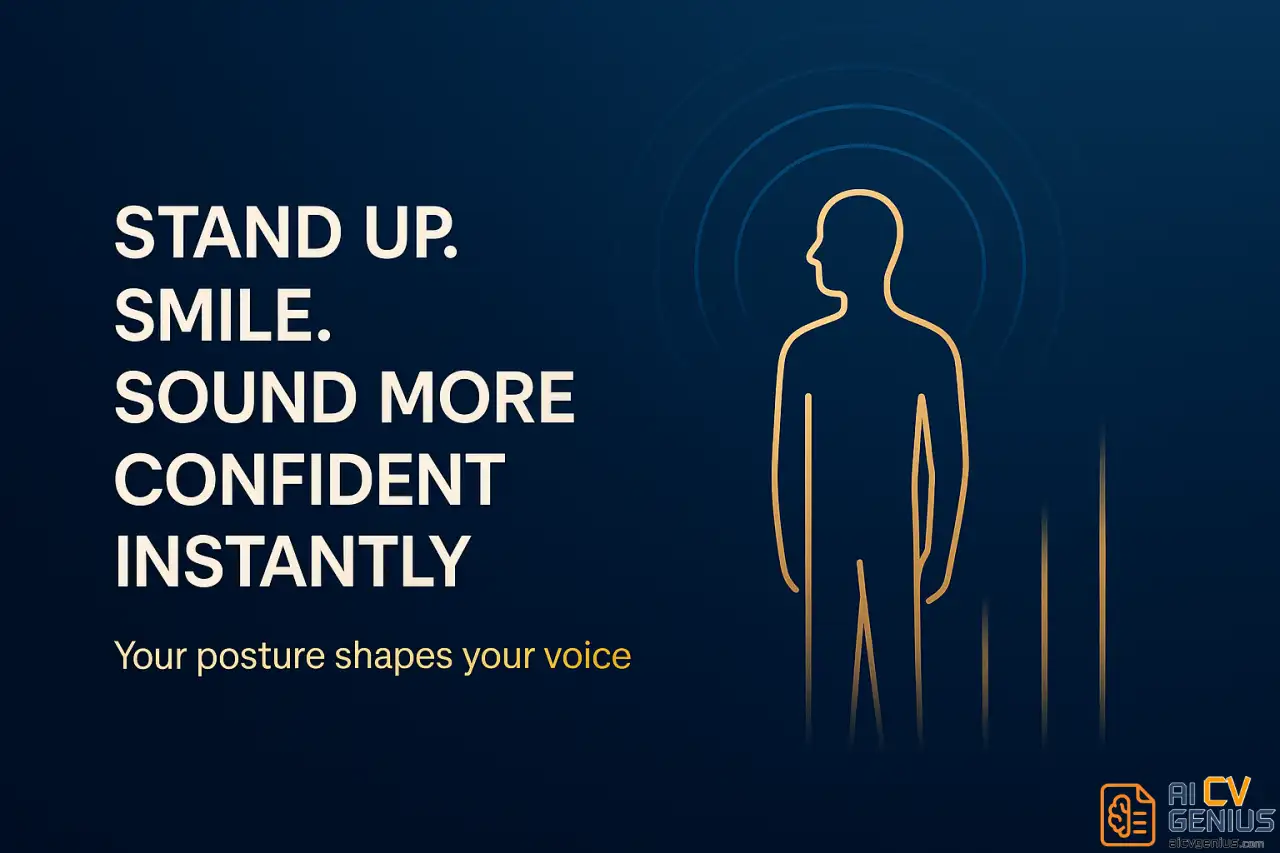
Your physiology controls your psychology. If you slouch in a chair, your diaphragm is compressed, and your voice sounds low-energy. If you lie down, you sound sleepy.
Stand up. Many professional speakers and sales leaders stand during important calls. Standing opens your diaphragm, allowing for deeper breaths. This gives your voice more power, energy, and confidence. It makes you sound more authoritative and engaged.
Smile while you speak. This may feel strange, but it is the single most effective vocal tip. A physical smile changes the shape of your mouth, which alters the resonant qualities of your voice. It makes your tone brighter, warmer, and more positive. The interviewer can hear it, and it makes you instantly more likable.
Step 4: Research Beyond the “Homepage”
Even for a 20-minute phone screen, you must do your homework. The recruiter is checking if you are genuinely interested in this company, or just any job. Have a “cheat sheet” with bullet points.
| Preparation Area | What to Look For (And Write Down) |
|---|---|
| Company Background | Read their “About Us” page and find their mission statement. Look at their LinkedIn posts for recent news (e.g., a new product launch, a recent funding round). |
| Role Details | Print the job description. Highlight the top 3 “must-have” skills. You must be ready to give an example for each. |
| Your Personal Story | Prepare your 60-second “Tell me about yourself” answer. It should be a narrative, not a list. (See Step 6). |
| Interviewer Intel | Look up the recruiter on LinkedIn. Knowing their background (e.g., “I see you’ve been with the company for 3 years…”) can help build rapport. |
You can find strong phrasing examples for your personal story in our career resources, which will help you refine your narrative.
Step 5: Practice Tone and Pacing, Not Scripts
The biggest phone interview mistake is reading from a script. The interviewer can instantly tell – your voice becomes robotic, your pacing is unnatural, and all connection is lost. You sound like a telemarketer, not a candidate.
Instead of writing full-sentence scripts, write bullet points. This forces you to form the sentences naturally, which sounds authentic. Then, practice your tone.
Record Yourself: Use your phone’s voice memo app and answer two common questions (like “Tell me about yourself”). Listen back and ask:
- ✅ Do I sound rushed? (The #1 sign of nerves. Slow down.)
- ✅ Am I using filler words? (e.g., “um,” “like,” “you know”). Replace them with a silent pause. A pause makes you sound thoughtful; “um” makes you sound unsure.
- ✅ Do I sound interested? (Is my voice flat, or does it have range and energy?)
Confidence is not about volume. It is about control. A slow, steady, and thoughtful pace beats a fast, nervous, and rambling one every single time.
Step 6: Prepare Bullet Points for the Core Questions
You cannot predict every question, but 90% of phone screens include these themes. Have bullet points ready for each.
- “Tell me about yourself.”
- This is not your life story. It’s your professional pitch.
- Formula: Present (Your current role/expertise) → Past (How you got here, 1-2 key achievements) → Future (Why you are excited about this role). Keep it under 90 seconds.
- “Why are you leaving your current job?”
- Stay positive. Never criticize a past employer, boss, or team. It makes you sound negative.
- Good Answer: Focus on growth. “I’ve learned a great deal in my current role, but I’m looking for a new challenge where I can focus more on [Skill a]. This role seems like a perfect fit for that.”
- “What do you know about our company?”
- This tests your research (Step 4).
- Good Answer: “I know you’re a leader in [Industry]. I was particularly impressed by your recent launch of [New Product] and your commitment to [Company Value, e.g., sustainability], which is what prompted me to apply.”
- “What’s your expected salary?”
- This is a filter. The goal is to defer politely.
- Good Answer: “I’m focusing on finding the right fit, and I’m confident we can agree on a fair number if we move forward. Could you share the budgeted range for this position?”
Step 7: Master the Art of Active Listening
On a phone call, you cannot nod to show you are listening. Silence can be ambiguous. You must use small, verbal cues to show engagement.
While the interviewer is speaking, use brief, affirmative phrases like “That’s interesting,” “I see,” or “That makes sense.” This shows you are engaged without interrupting their flow.
Build Connection Without Seeing Faces:
Connection comes from empathy. Mirror their energy – if they sound relaxed and friendly, match that. If they are formal and direct, tighten your tone. A simple but powerful hack is to use the interviewer’s name once, naturally, in the middle of the call.
“That’s a great point, Sarah. In my last project, I faced a similar challenge when…”
This small touch builds rapport and makes the exchange feel human, not transactional.
Step 8: Ask Smart Questions That Show Curiosity
At the end, they will ask, “Do you have any questions for us?” Answering “No” is a major red flag. It signals a lack of interest or preparation.
Your questions prove your credibility. Have 2-3 thoughtful ones written down. Do not ask about salary, vacation, or benefits (that is for later). Ask about the role and the team.
Good Questions to Ask a Recruiter:
- ✅ “What does success in this role look like in the first 6 months?”
- ✅ “Can you tell me more about the team I’d be working with?”
- ✅ “What qualities do the most successful employees at [Company Name] share?”
- ✅ “What is the biggest challenge this team is facing right now?”
Avoid asking: “What are the next steps?” until after they have answered your smart questions. Frame it professionally: “May I ask what the next steps in your hiring process typically look like?”
Step 9: Handle Unexpected Questions with “The Pause”
Inevitably, they will ask something you did not prepare for. Your instinct is to panic and fill the silence. Do not. This is your moment to show poise.
Deploy “The Pause.”
The silence feels much longer to you than it does to them. Take a breath, smile (they’ll hear it), and use a buffer phrase to buy yourself 10 seconds of thinking time.
Buffer Phrases:
- “That’s an excellent question. Let me think about that for a moment.”
- “That’s an interesting scenario. My first thought is…”
This response does not make you look stupid; it makes you look thoughtful, calm, and in control. An honest, considered answer is always better than a panicked, rambling one.
Step 10: The 24-Hour Follow-Up Email
This is non-negotiable. Within 24 hours (ideally the same day), send a concise thank-you email. It is the same principle as in post-interview follow-up guides: keep it short, personal, and grateful.
This email is your final handshake. It shows you are organized, professional, and genuinely interested.
Example Template:
Subject: Thank You – Phone Interview for [Job Title]
Hi [Interviewer’s Name],
Thank you so much for taking the time to speak with me today about the [Job Title] role. I truly enjoyed our conversation, especially learning about [Specific Topic You Discussed, e.g., “the team’s new project management system”].
Our discussion confirmed my enthusiasm for this opportunity. My experience in [Your Key Skill] aligns well with your team’s focus on [Their Goal], and I am very excited about the possibility of contributing.
I appreciate your time and look forward to hearing about the next steps.
Best,
[Your Name]
Quick-Hit List: Common Mistakes to Avoid
| ❌ The Mistake | Why It’s Bad | ✅ The Better Approach |
|---|---|---|
| Talking too fast | Signals nervousness and is hard to follow. | Slow down. Breathe. Use deliberate pauses. |
| Over-explaining answers | Feels like rambling and a lack of confidence. | Answer the question, then stop. Let them ask for more. |
| Interrupting the interviewer | Extremely rude. Phone lag makes this worse. | Wait one full second after they finish speaking before you reply. |
| Sounding distracted (typing, etc.) | The #1 complaint from recruiters. It’s disrespectful. | Give them 100% of your focus. No typing. No alerts. |
| Using a speakerphone | Makes you sound distant, flat, and unprofessional. | Use a wired headset with a mic for crystal-clear audio. |
| Skipping the thank-you email | A missed opportunity. Makes you look forgetful or uninterested. | Always send one. It keeps you memorable and professional. |
In-Depth FAQs: Your Toughest Phone Interview Questions
Final Thoughts: Your Voice Is Your Signature
A phone interview is a test of presence, not performance. It is not about having perfect, scripted answers. It is about being focused, calm, and genuinely curious. When you prepare your space, your mind, and your vocal strategy, you make connection feel effortless – even through a line of static.
Take a deep breath, speak 10% slower than you normally would, and remember to smile. It will show in your voice. That is how you turn a simple phone call into a confident handshake and an invitation for the next step.