

- Core framing: A “no experience extraction” resume is really a potential resume, recruiters expect short work history and scan for proof you can learn fast, communicate clearly, and show initiative through real work-like examples.
- Open strong: Use a targeted objective (2 to 3 sentences) that names the role, mirrors job keywords, and includes 1 concrete proof point (GPA, project result, internship, or portfolio), not generic “hard-working” claims.
- Build credibility fast: Put Education high, add 3 to 5 job-relevant courses, honors, and 2 to 4 meaningful certifications, then group Skills cleanly (Technical + Soft) and only list skills you can demonstrate.
- Turn “no jobs” into evidence: Treat internships, projects, volunteering, leadership, and part-time work as experience and write bullets as Achievements (Action + What + Result), using numbers whenever possible.
- Make it easy to scan and ATS-safe: Keep one page, single column, standard headings, no graphics or fancy layouts, tailor keywords per job, proofread hard, and avoid common mistakes like vague duties, clutter, and filler.
Writing Your First Resume (With No Experience)
Everyone has to start somewhere. But what if your “somewhere” doesn’t come with formal job titles or years of extensive work history? Don’t worry – possessing no experience in the traditional sense absolutely doesn’t mean you possess no value. It simply signifies that your resume needs to articulate your story strategically, emphasizing potential over tenure.
Recruiters actively reviewing entry-level applications inherently understand and expect candidates to have limited formal work experience. What they genuinely seek instead are clear signals of potential: demonstrable skills acquired through coursework or activities, inherent drive shown through initiative, and tangible evidence indicating you’ve undertaken meaningful endeavors – even if those endeavors weren’t conventional paid employment.
This comprehensive guide will systematically walk you through precisely how to construct a compelling resume with no experience that effectively captures attention, secures interviews, and successfully launches your career opportunities.
Why Employers Read Graduate Resumes Differently
Recruiters reviewing applications from recent graduates understand they won’t find lengthy job histories. Instead, they actively search for indicators of future potential – initiative demonstrated through projects, effective communication skills honed in coursework or activities, intellectual curiosity, adaptability, and the motivation to learn rapidly within their organization.
Your resume’s primary objective shifts accordingly: it must clearly communicate, “While I may be early in my career journey, I possess the foundational skills, relevant knowledge, and strong work ethic required to contribute effectively and grow quickly within this role.”
Focus on Structure – Not Perceived Gaps
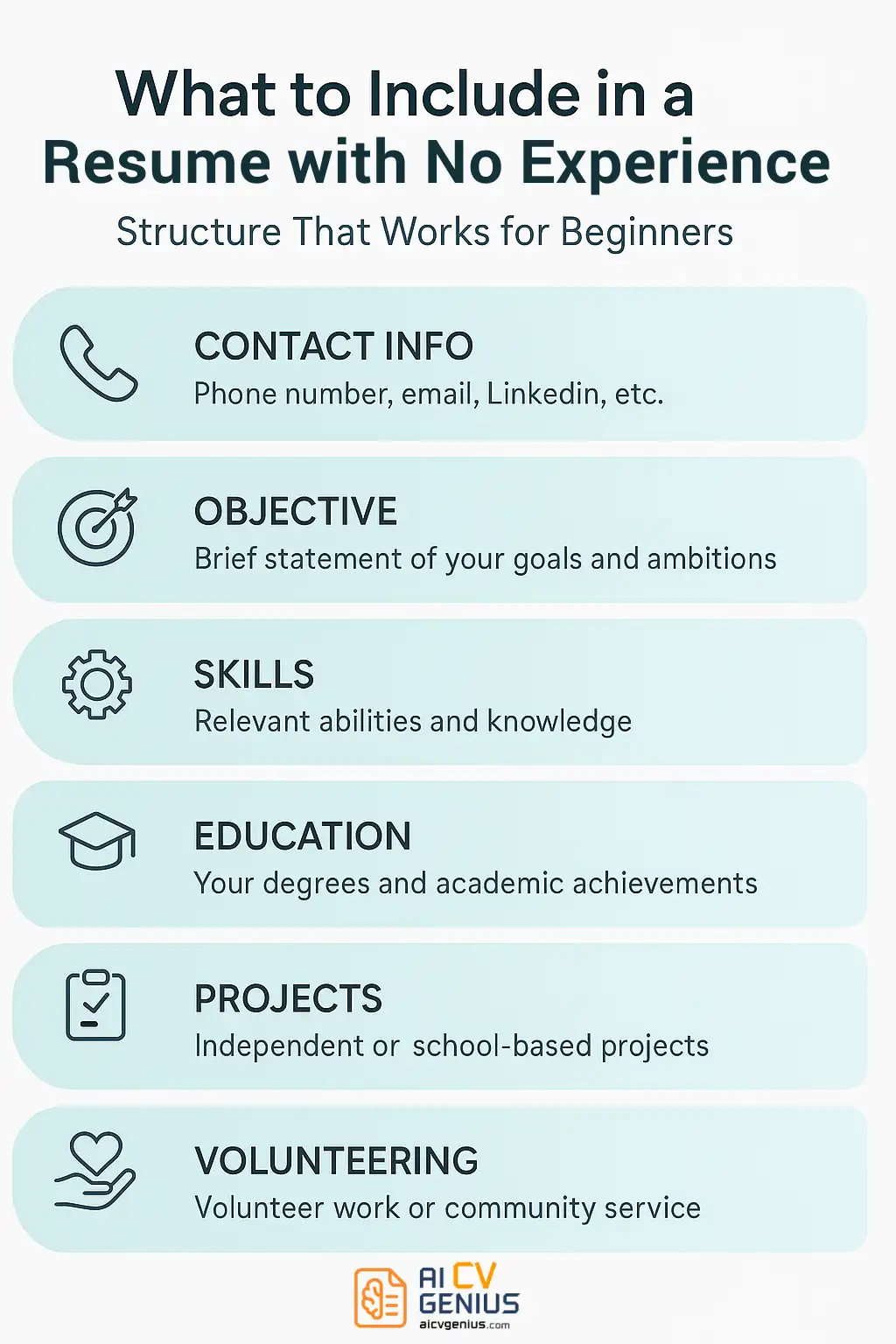
When lacking extensive professional history, the structure of your resume becomes your most powerful strategic tool. A well-organized, logical layout can transform a seemingly simple resume into a document radiating polish and confidence. Consider adopting this recommended section order for maximum clarity and impact:
- ✅ Contact Information (Clear and Professional)
- ✅ Career Objective (Targeted and Value-Driven)
- ✅ Skills (Highlighting Relevant Hard & Soft Competencies)
- ✅ Education (Emphasizing Relevant Coursework & Achievements)
- ✅ Projects / Volunteering / Extracurricular Activities (Showcasing Initiative & Applied Skills)
- ✅ Certifications or Relevant Training (Demonstrating Proactive Learning)
Adhering to this structure enables recruiters to swiftly locate your key strengths and assess your potential – eliminating confusion and minimizing visual clutter.
Core Components: Objective, Skills & Education
Start with a Strong, Tailored Career Objective
For candidates with limited experience, a concise Career Objective typically replaces the conventional “Professional Summary.” This brief statement (2–3 sentences) functions as your targeted introduction – clearly articulating your immediate career goals, expressing genuine enthusiasm for the specific role, and highlighting 1-2 core qualities or skills directly relevant to the employer’s needs.
Highly motivated recent Communications graduate (GPA 3.6) possessing strong written communication and teamwork skills developed through university projects and coordinating student events. Eager to contribute creativity and organizational abilities to a dynamic Marketing Assistant role at [Company Name], supporting campaign execution and learning from experienced professionals. Skilled in research, content creation basics (Canva), and utilizing digital tools effectively, with a proven ability to learn quickly and adapt proactively to new environments.
This section’s primary function is to immediately signal your intent and core mindset – connecting your potential directly to their opportunity.
Highlight Relevant Transferable Skills
Transferable skills represent universally valuable competencies applicable across various roles and industries – such as effective communication, critical problem-solving, collaborative teamwork, efficient time management, and adaptability. Even without formal employment, you have inevitably cultivated these essential skills through academic coursework, volunteer activities, part-time jobs, or even personal hobbies requiring discipline. Strategically identify and showcase these:
- ✅ Communication: Demonstrated through class presentations, written reports/essays, group discussions, or customer interactions in part-time roles.
- ✅ Organization & Time Management: Proven by successfully balancing demanding coursework schedules, meeting multiple project deadlines simultaneously, or coordinating events/activities.
- ✅ Teamwork & Collaboration: Evidenced through effective participation in group academic projects, sports teams, volunteer committees, or collaborative work environments.
- ✅ Initiative & Problem-Solving: Showcased by independently starting a campus club, developing a personal project (like a website or app), identifying and resolving issues in a volunteer role, or proactively seeking solutions to academic challenges.
- ✅ Technical Proficiency: List specific software learned (e.g., Microsoft Excel – Pivot Tables, Google Analytics basics, Canva, Trello, basic coding languages if applicable) through coursework or self-study.
Focus intently on demonstrating what you can do effectively, rather than dwelling on formal job titles you haven’t yet held.
Focus Intently on Skills and Demonstrable Potential
Without extensive formal work history, your Skills section carries significant weight. Showcase a balanced mix of technical (hard) skills acquired through coursework or projects and essential interpersonal (soft) skills demonstrated through various experiences. Tailor this section based on keywords found in target job descriptions.
- ✅ Technical Skills: Relevant software (e.g., Microsoft Office Suite – Advanced Excel, Google Workspace), programming languages (Python, Java – specify proficiency), analytical tools (SQL basics, R basics), design software (Canva, Figma basics), research methodologies.
- ✅ Interpersonal Skills (Soft Skills): Communication (Written & Verbal), Teamwork & Collaboration, Problem-Solving, Adaptability, Time Management, Leadership (demonstrated via activities), Critical Thinking, Customer Service (if applicable).
Group skills logically under clear subheadings like Technical Skills and Soft Skills or Core Competencies to enhance readability and allow recruiters to quickly identify relevant proficiencies.
Emphasize Demonstrable Soft Skills
Soft skills often form the core foundation of successful entry-level hiring decisions. Employers frequently prioritize attitude, adaptability, communication ability, and collaborative potential over deep technical expertise at this stage. Highlight key interpersonal strengths, providing brief contextual examples where possible:
- ✅ Adaptability: (e.g., Quickly learned new software for a class project)
- ✅ Curiosity & Eagerness to Learn: (e.g., Proactively completed relevant online courses)
- ✅ Team Spirit & Collaboration: (e.g., Successfully contributed to multiple group projects)
- ✅ Empathy & Communication: (e.g., Effectively handled customer interactions in a part-time role)
- ✅ Time Management & Organization: (e.g., Balanced demanding coursework with extracurricular leadership roles)
Crucially, don’t just list these skills – subtly demonstrate them through the specific examples provided within your Projects, Volunteering, or Education sections (e.g., “Collaborated effectively within a 4-person team…”).
Highlight Your Education Strategically
For recent graduates, your education often represents your most significant qualification. Position this section prominently, typically near the top of the resume, and include details that showcase relevant knowledge and achievements beyond just the degree itself.
- ✅ Full Degree Name (e.g., Bachelor of Science in Computer Science), Major/Minor, University Name, Location, Graduation Year (or Expected Graduation Date).
- ✅ GPA (Include only if strong, generally 3.5 or higher on a 4.0 scale).
- ✅ Relevant Coursework: List 3-5 specific, upper-level courses directly related to the target job (e.g., “Data Structures & Algorithms,” “Financial Modeling,” “Digital Marketing Strategy”).
- ✅ Academic Honors & Awards: Dean’s List, scholarships, thesis titles (if relevant), specific academic awards or recognitions.
Example:
- Bachelor of Science in Computer Science, University of Melbourne, Melbourne, VIC | Graduated May 2024
- GPA: 3.8/4.0
- Relevant Coursework: Data Analytics, Advanced Algorithms, User Experience (UX) Design Principles, Mobile Application Development
- Dean’s List (2022–2024); Winner, University CodeFest Hackathon 2023
Leverage Your Education as a Primary Strength
Bachelor of Arts in Psychology, University of Melbourne | Melbourne, VIC | May 2024
Relevant Coursework: Research Methods in Psychology, Statistical Analysis for Behavioral Sciences, Cognitive Psychology, Human Motivation & Performance
Honors: Dean’s List (2022, 2023); Psi Chi International Honor Society Member
If specific academic projects directly align with the job requirements, consider listing 1-2 concise bullet points detailing those projects directly within the Education section or in a dedicated “Projects” section immediately following. For example, if applying for marketing roles, explicitly mentioning a class campaign project, market research report, or data analytics assignment provides tangible evidence of applied skills.
Consider Adding a “Relevant Coursework” Subsection
If specific university courses directly align with the knowledge or skills required for the target job, explicitly highlighting them within your Education section provides valuable context and evidence of foundational understanding:
- ✅ Example (Marketing role): “Relevant Coursework: Marketing Research Methods, Consumer Behavior, Statistics for Business, Digital Advertising Principles, Creative Writing.”
This simple addition immediately signals to recruiters that you possess relevant theoretical knowledge – a smart, strategic reinforcement, particularly when practical experience is limited.
Add a Dedicated Section for Relevant Certifications or Training
Completing relevant online courses, certifications, or specialized training programs (even free ones) demonstrates proactive learning, initiative, and specific skill acquisition beyond standard coursework. This can be a powerful differentiator.
- ✅ Google Analytics Individual Qualification (GAIQ)
- ✅ HubSpot Content Marketing Certification
- ✅ LinkedIn Learning Certificate: Fundamentals of Business Communication
- ✅ Coursera Specialization Certificate: Project Management Principles and Practices
Don’t list every minor course completed. Select only 2–4 certifications or significant training programs that directly align with the requirements and desired skills mentioned in your target job descriptions.
Include Relevant Certifications or Online Courses
Successfully completing short online programs, industry-recognized certifications (even entry-level ones), or relevant workshops provides powerful evidence of your commitment to continuous learning and proactive skill development – qualities highly attractive to employers hiring for potential.
- ✅ Google Project Management: Professional Certificate (Coursera)
- ✅ Excel Skills for Business Specialization (Macquarie University via Coursera)
- ✅ HubSpot Content Marketing Certification
- ✅ Adobe Photoshop CC – Essentials Training Course (LinkedIn Learning)
Selectively include 2–4 certifications or significant training programs that directly demonstrate proficiency in skills required by your target roles. Each listed credential adds tangible credibility and implicitly signals a proactive growth mindset – a universal asset valued by nearly every employer seeking entry-level talent.
Showcasing Experience and Impact (Without Formal Jobs)
Showcase Diverse Experiences Strategically
Recognize that valuable “experience” extends beyond traditional paid employment. Strategically include internships (paid or unpaid), significant academic projects (especially capstone or thesis work), leadership roles within student organizations, relevant volunteer positions, freelance assignments, or even part-time jobs that demonstrate transferable skills.
- ✅ Project Example: Led a 4-person team for a university marketing course project, developing a comprehensive digital strategy for a local non-profit that included competitor analysis and content recommendations; presented findings to stakeholders.
- ✅ Internship Example: Completed a 3-month summer internship at Green Digital Agency, assisting the SEO team with keyword research using SEMrush and contributing to client performance reports using Google Analytics.
- ✅ Volunteer Example: Coordinated logistics and volunteer schedules for the university’s annual charity fundraising event involving 50+ participants, successfully meeting fundraising goals.
- ✅ Part-Time Job Example: Provided customer assistance and managed transactions accurately in a fast-paced retail environment, consistently receiving positive feedback for problem-solving skills.
Focus rigorously on framing these experiences to highlight relevant skills and quantifiable outcomes whenever possible. Ask: What specific skills did I apply? What positive result occurred because of my contribution? The impact demonstrated matters more than the job title held.
Showcase Initiative Through Projects and Volunteering
Employers actively value demonstrated initiative and practical application of skills – unpaid work, academic projects, and volunteer contributions absolutely count as relevant experience, especially when formal job history is limited. Create a dedicated section titled “Projects & Relevant Experience” or “Volunteer & Leadership Activities” and describe your contributions with a focus on achievements and skills utilized.
- ✅ Example (Project): “Led a 5-member student team for a capstone engineering project, designing and building a functional prototype for [Project Goal]; presented final design and performance metrics to faculty panel.” (Shows leadership, technical skills, presentation ability)
- ✅ Example (Personal Project): “Developed a personal portfolio website using HTML, CSS, and basic JavaScript to showcase graphic design projects created using Adobe Illustrator and Photoshop.” (Shows initiative, technical skills, relevant tools)
- ✅ Example (Volunteering): “Volunteered weekly (10+ hours/month) as a teaching assistant for a local community center’s ESL program, assisting instructors and providing one-on-one language support to adult learners.” (Shows commitment, communication skills, patience)
Focus intently on articulating the results achieved or key skills learned through these experiences, rather than merely listing activities. Answer the implicit question: “What positive outcome occurred or skill was demonstrated because you participated?”
Include Concrete Achievements and Relevant Projects
If you’ve led an initiative, built something tangible, achieved a measurable result, or received recognition, showcase it prominently. Employers highly value demonstrated initiative and practical application of skills, even outside formal job settings.
- ✅ Developed and executed a social media campaign for the university photography club that increased membership inquiries by 40% within one semester.
- ✅ Designed and built a functional mobile application prototype for a senior capstone project using [Technology], which received the “Best Overall Project” award from the department faculty.
- ✅ Authored a series of 5 well-researched blog posts on sustainable urban planning for a personal blog, attracting over 3,000 unique reads and positive comments from industry professionals.
Quantify results whenever credible (using %, $, #, time saved). Numbers provide objective evidence and capture attention significantly faster than descriptive adjectives alone.
Frame Contributions as Achievements, Not Just Responsibilities
Even seemingly minor wins or standard tasks gain significant professional weight when framed correctly. Instead of passively listing generic duties, actively transform them into concise accomplishment statements demonstrating impact or specific skills applied.
| ❌ Weak | ✅ Stronger |
|---|---|
| “Helped manage school events throughout the academic year.” | “Coordinated logistics, vendor communications, and volunteer schedules for 3 major campus events (average 200+ attendees each), contributing to successful execution within established budgets.” |
| “Assisted professors with various research tasks as needed.” | “Compiled and analyzed data from over 300 survey responses for a faculty psychology research project using SPSS, contributing to findings presented at a regional conference.” |
When you articulate specific outcomes and quantify contributions where possible, you instantly elevate the perceived professionalism and impact of your experiences, regardless of their formal context.
Don’t Overlook Extracurricular Activities and Leadership Roles
Meaningful involvement in student organizations, sports teams, volunteer groups, or community initiatives provides valuable evidence of character, teamwork ability, responsibility, leadership potential, and commitment beyond academics. Choose examples that best showcase relevant transferable skills.
- ✅ Vice President, University Debate Society (2022–2023): Coordinated team travel logistics and managed event budgets.
- ✅ Volunteer Coordinator, Habitat for Humanity Campus Chapter: Recruited and scheduled 30+ student volunteers for local build projects.
- ✅ Event Organizer, Student Technology Club: Planned and executed monthly speaker series events attended by an average of 75 students.
Each of these examples implicitly communicates valuable professional competencies – organization, communication, leadership, project coordination – qualities highly relevant in nearly every entry-level job.
Employ Strong, Active Verbs Consistently
Ensure every bullet point describing an experience or project begins with a dynamic action verb – this simple technique instantly conveys confidence, initiative, and ownership.
- ✅ Instead of “Was involved in organizing events,” use “Organized…”
- ✅ Instead of “Helped develop website content,” use “Developed…”
- ✅ Instead of “Duties included creating presentations,” use “Created…”
- ✅ Common strong verbs: Organized, Developed, Created, Managed, Supported, Analyzed, Presented, Coordinated, Led, Researched, Implemented, Collaborated.
Using active verbs consistently maintains an energetic, professional tone throughout your resume, contrasting sharply with passive phrasing that can inadvertently sound hesitant or lacking in contribution.
Formatting, Mindset & Final Review
Strictly Adhere to a One-Page Limit
As a recent graduate or entry-level candidate, your resume should almost always be confined to a single, well-organized page. This constraint forces clarity, prioritization, and demonstrates respect for the recruiter’s time. Utilize clean spacing, consistent professional fonts (like Inter, Lato, Calibri, or Georgia), and avoid overly cluttered or complex visual templates. Simplicity often projects confidence and professionalism more effectively than elaborate designs, especially ensuring compatibility with Applicant Tracking Systems (ATS).
Need inspiration for clean, effective layouts specifically designed for early-career candidates? Explore diverse options optimized for scannability and ATS-friendliness in our Resume Templates Finder.
Keep It Concise – But Substantial within One Page
For recent graduates or first-time job applicants, adhering strictly to a one-page limit is standard practice and highly recommended. Recruiters typically spend only about 7 seconds performing the initial scan; clarity, focus, and brevity consistently outperform exhaustive length or overly elaborate design. Ensure every section adds clear value and directly supports your candidacy. Avoid unnecessary visual clutter – simplicity often projects greater maturity and professionalism.
Format Cleanly and Ensure ATS Compatibility
Even for entry-level applications, your resume must successfully navigate Applicant Tracking Systems (ATS). Prioritize clean, simple, text-based formatting: use standard professional fonts (like Calibri, Lato, Arial, Georgia), maintain a predominantly single-column layout, utilize consistent spacing, and rely on standard section headings (e.g., “Skills,” “Education,” “Projects”).
Strictly save and submit your resume as a .docx (Word) or preferably a text-based PDF file. Avoid overly creative templates with complex graphics, tables, text boxes, or embedded images, as these frequently cause parsing errors. You can confidently browse professionally designed, ATS-tested templates suitable for beginners in our Resume Templates Finder.
Strategically Incorporate Keywords from Target Job Descriptions
ATS software primarily functions by matching keywords from your resume against those specified in the job posting. Meticulously read 2–3 relevant job descriptions for roles you are interested in. Identify and note recurring essential skills, qualifications, tools, or industry terms (e.g., “team collaboration,” “Excel proficiency,” “customer service orientation,” “data entry,” “project coordination”). Naturally and authentically sprinkle these specific keywords throughout your objective, education details (relevant coursework), skills section, and descriptions of projects or volunteer work where applicable. Precise keyword alignment significantly boosts your relevance score.
Include a Link to Your LinkedIn Profile or Relevant Portfolio
“Portfolio: janedoe.myportfolio.com”
“LinkedIn: linkedin.com/in/janedoe”
Ensure links are correctly formatted and lead directly to professional, curated content.
Maintain a Balance Between Confidence and Honesty
Focus on clearly demonstrating your potential, not attempting to fabricate non-existent perfection. Enthusiasm combined with demonstrable foundational skills is highly compelling.
The Crucial Mindset Shift: From “No Experience” to “Ready to Contribute & Learn”
Employers hiring entry-level candidates don’t expect fully formed experts – they primarily seek individuals demonstrating strong potential, eagerness to learn quickly, adaptability, and a positive attitude. The most successful graduate resumes implicitly radiate humility balanced with confidence. Frame your narrative proactively: be the candidate whose resume clearly communicates, “While I recognize I am early in my professional journey, I possess the foundational skills, relevant knowledge, and strong work ethic required to learn rapidly and begin contributing effectively to your team from day one.”
Your demonstrable energy, curiosity, and proactive learning mindset – evidenced through projects, coursework, and activities – often become your most compelling differentiators at this career stage. That potential is precisely what makes hiring early-career talent exciting for many organizations.
Recommended Resume Structure for Fresh Graduates
Prioritize sections highlighting potential and foundational skills:
- Header: Full Name, Professional Contact Information (Phone, Email, LinkedIn URL), Location (City, State).
- Resume Objective: Concise, tailored statement expressing career goal and key relevant skills offered.
- Education: Detailed section including Degree, University, Graduation Date, GPA (if strong), Relevant Coursework, Honors.
- Skills: Clearly categorized Technical Skills and Soft Skills, aligned with target job keywords.
- Projects: 2-3 significant academic or personal projects detailed with role, actions taken, skills used, and outcomes.
- Experience: Internships, Volunteer Roles, Part-Time Jobs, focused on transferable skills and achievements.
- Optional Sections: Certifications/Training, Extracurricular Activities/Leadership, Languages (if applicable and add value).
Common Mistakes to Avoid Rigorously
Steer clear of these frequent errors that undermine graduate resumes:
- ❌ Writing overly generic or self-focused resume objectives (“Seeking a position where I can utilize my skills and gain valuable experience”). Focus on the value you offer the employer.
- ❌ Over-designing the resume with excessive graphics, distracting color blocks, or unconventional layouts that hinder readability and ATS compatibility. Prioritize clarity.
- ❌ Using informal or unprofessional email addresses (e.g., “partylover123@email.com”). Create a simple, professional address (firstname.lastname@email.com).
- ❌ Failing to meticulously proofread for typos, grammatical errors, or inconsistencies. A single careless mistake can create a significantly negative first impression regarding attention to detail.
- ❌ Listing every single course taken or minor activity participated in. Prioritize relevance and impact rigorously to maintain focus within the one-page limit.
Pros & Cons of Using Resume Templates for Fresh Graduates
Templates offer significant advantages but require mindful usage:
| Pros | Cons |
|---|---|
| ✅ Saves considerable time and provides an immediate professional structure, ensuring all key sections are included. | ❌ Highly popular or overused templates might occasionally make your resume appear less unique if not sufficiently personalized with strong content. |
| ✅ Helps organize information logically, especially crucial when lacking extensive work history to structure around. | ❌ Some free templates found online may include unnecessary graphics, complex formatting, or sections not optimized for ATS compatibility. Choose wisely. |
| ✅ Most well-designed modern templates are inherently ATS-friendly, improving chances of passing initial software screening. | ❌ A template provides only the framework; it does not substitute for the critical need to craft compelling, tailored content and meticulously proofread. |
Final Checklist: Essential Tips Before You Apply
- ✅ Utilize clear, consistent formatting and professional, readable fonts throughout the single page.
- ✅ Meticulously customize your resume objective, highlighted skills, and project details for each specific role you apply for.
- ✅ Rigorously check grammar, spelling, and overall tone for absolute professionalism (use tools like Grammarly and ask a friend to review).
- ✅ Save your final resume document under a clear, professional file name (e.g., “John_Doe_Resume.pdf”). Submit as PDF unless DOCX is requested.
- ✅ Always pair your targeted resume with an equally tailored, concise cover letter – explore effective free examples in our Cover Letters section to get started.
Where to Go Next: Building Your Career Foundation
Writing your first effective resume marks a crucial initial step. Once it’s polished and ready, strategically focus your efforts on:
- Exploring additional beginner-friendly, ATS-compatible resume layouts and designs at Resume Templates Finder.
- Learning essential strategies for navigating interviews confidently and effectively answering common skill-based questions in Career Resources.
- Reading practical job-hunting insights, networking tips, and career development advice from experienced professionals on our Blog.
Final Thoughts: Your Potential, Clearly Articulated
Your first professional resume isn’t about attempting to prove you’ve already arrived – it’s fundamentally about showcasing that you are prepared, capable, and enthusiastic about embarking on the journey ahead. Maintain honesty, prioritize structure and clarity, and project hopeful confidence. Let your resume accurately reflect genuine curiosity, not perceived insecurity regarding experience gaps. Remember, you aren’t starting from zero – you are strategically launching from a foundation built on potential, skills acquired, and demonstrated initiative.
To explore diverse template options specifically tailored for students and entry-level applicants, designed for clarity and ATS compatibility, visit our comprehensive Resume Templates Guides. For broader advice on navigating interviews, networking effectively, and launching your career successfully, check the resources available on our Blog.