

- The article frames the first post-grad job search as a transition problem, not a talent problem, and pushes you to replace panic with a simple plan you can repeat every week.
- It lays out five foundations: Build a skills-focused one-page resume, create a credible LinkedIn presence, use your existing network on purpose, apply selectively with tailoring, and prepare interviews with a few practiced STAR stories.
- Two case studies show how “no experience” gets solved in real life: One graduate wins by turning projects into proof, another wins by networking plus volunteer work that creates a referral path.
- The tools section argues for a balanced mix of job boards, university career services, niche boards, and events, while still treating LinkedIn as the central hub recruiters actually use to vet you.
- It closes with a realistic mindset reset: Rejections are normal, focus on what you control, keep momentum, and treat each pass as feedback that improves your next round.
Graduating from college often feels like standing at the edge of a cliff – you’re excited about the leap into your career, but understandably nervous about where you’ll land. You’ve earned your degree, perhaps gained some internship experience, and now face a barrage of questions: How do I find my first professional job? Where do I even begin in this competitive market? Rest assured, every successful professional you admire once stood exactly where you are now. With a strategic approach and persistence, you can transform this uncertainty into a launchpad for opportunity. Here are practical, actionable, and inspiring job search tips for fresh graduates designed to help you navigate this transition and launch your career with confidence.
5 Foundational Steps to Kickstart Your Job Search
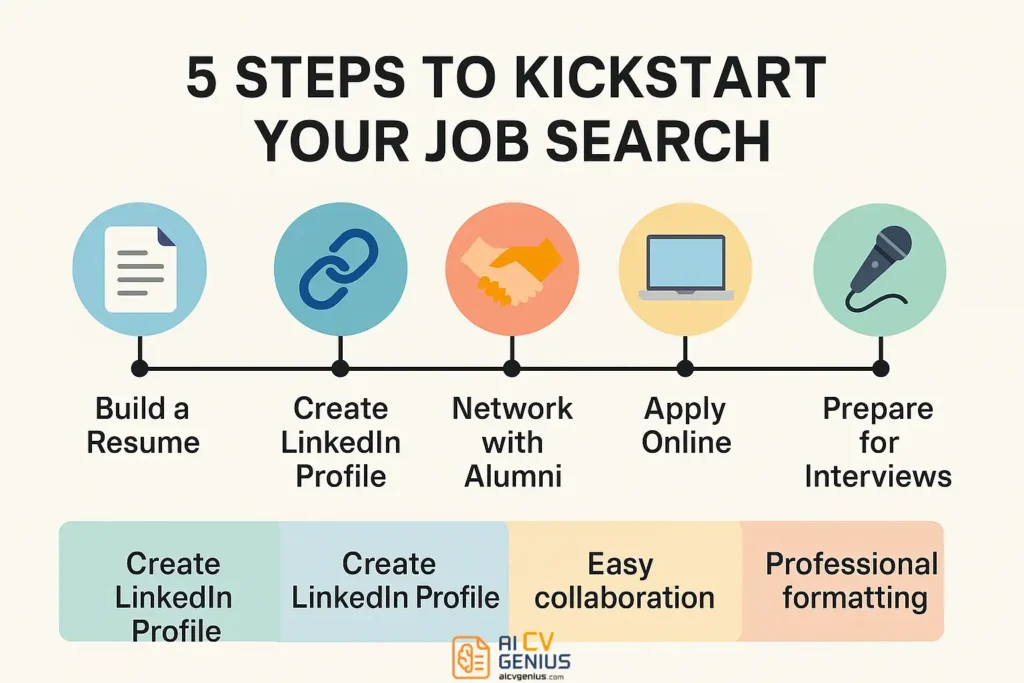
Step 1: Build a Compelling, Skills-Focused Resume
Your resume serves as your essential passport into the professional world. Even without extensive formal work experience, you possess valuable assets worth showcasing. Recruiters for entry-level roles prioritize potential demonstrated through skills, projects, and relevant education. Focus on highlighting:
- ✅ Key Projects: Detail significant academic assignments, capstone projects, or group work that demonstrate practical application of relevant skills (e.g., data analysis, coding, research, presentation). Use the STAR method (Situation, Task, Action, Result) implicitly to describe your contribution and outcome.
- ✅ Internships & Volunteer Roles: Even unpaid positions are crucial – they provide evidence of applying theoretical knowledge in a real-world setting. Quantify achievements where possible.
- ✅ Part-time Jobs: Roles in retail, food service, or tutoring effectively demonstrate essential soft skills like communication, teamwork, responsibility, and customer service. Frame these skills professionally.
- ✅ Transferable Skills: Explicitly list both technical proficiencies (software, tools, languages) and critical soft skills (problem-solving, adaptability, critical thinking, communication, collaboration) relevant to your target roles.
Key Tip: Keep your resume strictly to one page. Start bullet points with strong action verbs (e.g., “Led,” “Created,” “Analyzed,” “Managed,” “Developed”). Crucially, tailor the content – especially your objective/summary and highlighted skills/projects – to align with the specific requirements listed in each job description.
Step 2: Cultivate a Professional Online Presence
In today’s digital age, recruiters don’t just rely on your resume – they actively scrutinize your digital footprint. Establishing a polished online presence is non-negotiable. Start by creating (or optimizing) a LinkedIn profile that mirrors your resume’s key information but also adds personality and depth. Include:
- A professional, clear headshot (simple background, confident demeanor).
- A concise, keyword-rich headline reflecting your career aspirations. Example: “Recent Finance Graduate | Seeking Entry-Level Analyst Roles | Proficient in Excel & Financial Modeling.”
- Detailed descriptions of projects, certifications, volunteer experiences, and relevant coursework. Request recommendations from professors or internship supervisors.
Pro Tip: Recruiters heavily utilize LinkedIn’s search functionality. Ensure your profile incorporates keywords relevant to your desired field and roles (e.g., “digital marketing,” “data analysis,” “project coordination,” specific software). Engage professionally within relevant LinkedIn groups.
Step 3: Strategically Leverage Your Existing Network
Networking isn’t exclusive to senior executives – it’s arguably even more critical for graduates seeking their first opportunity. Your existing connections are often your strongest allies. Reach out proactively and respectfully to:
- ✅ Alumni from your university working in fields or companies that interest you (use LinkedIn’s alumni tool).
- ✅ Professors, TAs, and university career counselors for advice and potential industry contacts.
- ✅ Friends, family members, and acquaintances working in relevant industries. Informational interviews are invaluable.
- ✅ Members of LinkedIn groups, professional association student chapters, or industry-specific online communities.
Remember, a significant percentage of jobs are filled through referrals and networking before ever being publicly posted. A simple, polite request for an informational interview or career advice via LinkedIn or email can open doors you didn’t even know existed.
Step 4: Apply Strategically, Not Indiscriminately
While it’s tempting to adopt a “spray and pray” approach by sending your resume everywhere, generic applications rarely yield results and can be counterproductive. Instead, focus on quality over sheer quantity:
- ✅ Research each company and role thoroughly before applying. Understand their mission, values, recent achievements, and the specific challenges the role addresses.
- ✅ Meticulously tailor your resume and cover letter for each application. Highlight the 2–3 most relevant skills and experiences from your background that directly match the requirements listed in the job posting. Use their keywords.
- ✅ Write a concise but highly specific cover letter (even if optional) that clearly explains your motivation for applying to *that specific company* and *that specific role*, connecting your qualifications directly to their needs.
Focusing your energy on ten well-researched, thoughtfully tailored applications will almost always generate better results than submitting one hundred generic ones.
Step 5: Prepare Diligently for Interviews
Landing an interview is a significant achievement – but preparation is key to converting that opportunity into an offer. Effective interview preparation involves several stages:
- Thoroughly research the company again: Understand their products/services, target market, competitors, recent news, and company culture.
- Practice answering common behavioral interview questions (“Tell me about yourself,” “What are your strengths/weaknesses?,” “Describe a time you faced a challenge,” “Why are you interested in this role?”).
- Prepare 2–3 specific, compelling stories using the STAR method (Situation, Task, Action, Result) to illustrate your key skills and experiences (draw from projects, internships, coursework, or even part-time jobs).
- Prepare thoughtful questions to ask the interviewer about the role, the team, the company culture, and opportunities for growth. This demonstrates engagement and initiative.
Remember: interviews assess not only your existing skills but also your attitude, potential, problem-solving approach, and cultural fit. Show genuine curiosity, enthusiasm, and confidence – even if you don’t have all the answers yet.
Case Studies: How Graduates Landed Their First Roles
Case Study 1: Maria the Engineer – Leveraging Project Experience
Maria, a recent computer engineering graduate, felt discouraged by her lack of formal internships. She focused her job search strategy on showcasing technical skills through tangible projects.
On her resume, she detailed her final-year capstone project (building and deploying a functional mobile weather app using React Native), included a link to its GitHub repository with clean code, and highlighted her participation in two university hackathons where her teams developed prototypes. She meticulously tailored her resume’s skills section and objective for each application, emphasizing keywords like “React Native,” “API integration,” and “Agile methodologies” when relevant.
Within three months of targeted applications, Maria secured her first role as a Junior Mobile Developer. Lesson: Concrete project work and demonstrated initiative can effectively substitute for traditional experience.
Case Study 2: James the Communications Graduate – Networking Proactively
James graduated with a Communications degree into a highly competitive market for PR and marketing roles. Concerned about standing out, he prioritized building his network and online presence.
He created a polished LinkedIn profile showcasing writing samples from coursework and his personal blog. He actively reached out to alumni working at PR agencies for informational interviews, asking insightful questions about their career paths and industry trends. He also volunteered to manage social media for a local non-profit, gaining practical content creation experience. His proactive networking led to a referral for an unadvertised internship at a boutique PR agency, which eventually converted into a full-time offer.
Lesson: Proactive networking and demonstrating passion through volunteer work can create opportunities beyond online job boards.
Essential Tools & Resources for Graduates
Leverage these platforms to maximize your job search effectiveness:
- LinkedIn: Essential for building your professional network, researching companies and roles, finding job postings, and establishing your online brand.
- Major Job Boards (Indeed, Glassdoor, ZipRecruiter, Google Jobs): Useful for searching a wide range of available positions across various industries and locations. Set up job alerts.
- University Career Services Portal: Often features job postings specifically targeted at recent graduates and alumni from employers who actively recruit from your school. Utilize their resume review and interview coaching services.
- Niche Job Boards: Explore industry-specific job boards (e.g., Dice for tech, Idealist for non-profits, Mediabistro for media) for more targeted opportunities.
- Networking Events (Online & Offline): Participate in virtual or in-person career fairs, industry-specific webinars, alumni meetups, and local professional group events.
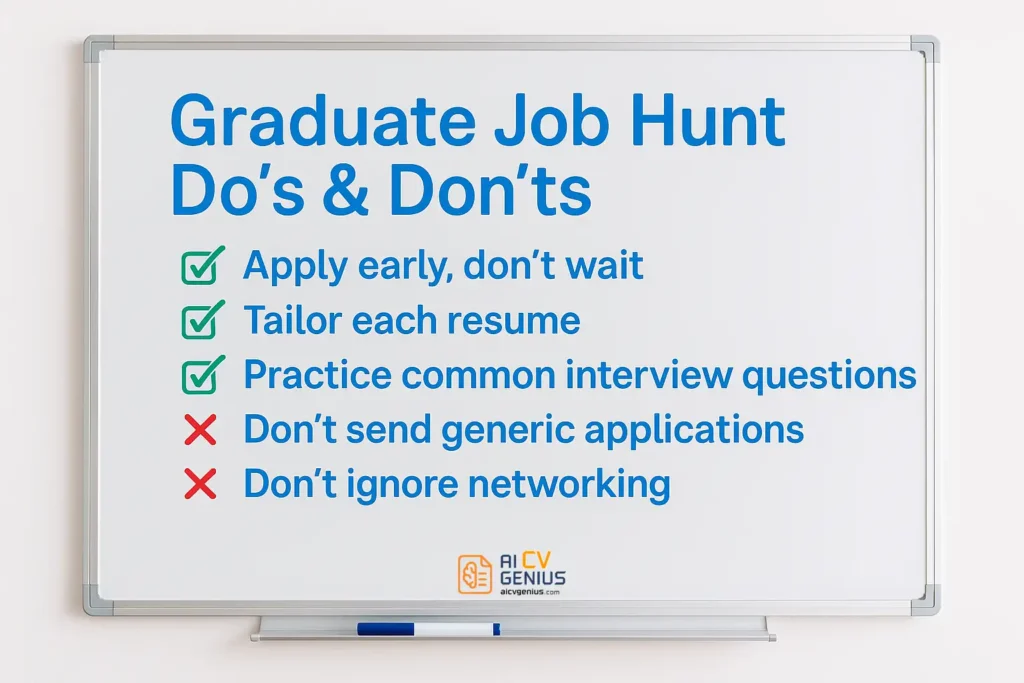
Checklist: Graduate Job Hunt Do’s & Don’ts
Keep these essential guidelines in mind throughout your search:
- ✅ DO start your job search early – ideally several months before graduation. Don’t wait until the last minute as hiring processes can take time.
- ✅ DO meticulously tailor your resume and cover letter for each specific role, highlighting the most relevant skills and experiences.
- ✅ DO follow up professionally (usually via email) after submitting applications (if appropriate) or attending interviews (always send a thank-you note).
- ❌ DON’T send the exact same generic resume and cover letter to hundreds of different job postings. Quality trumps quantity.
- ❌ DON’T neglect your online presence. Ensure your LinkedIn profile is complete, professional, and consistent with your resume. Clean up potentially unprofessional social media content.
- ❌ DON’T get discouraged by rejections – they are an inevitable part of the job search process for everyone, regardless of experience level. View them as learning opportunities.
Table: Comparing Online vs. Offline Job Search Strategies for Graduates
A balanced approach often yields the best results:
| Method | Advantages | Challenges |
|---|---|---|
| Online Applications (Job Boards, Company Careers Pages) | Access to a vast number of opportunities globally; relatively easy and fast application process; allows filtering by specific criteria. | Extremely high volume of competition; resumes may get filtered out by ATS if not optimized; less personal connection. |
| Networking (Alumni, Professors, Industry Contacts, Informational Interviews) | Access to the “hidden job market” (unposted roles); potential for referrals significantly increases interview chances; builds valuable long-term relationships. | Requires proactive effort, strong communication skills, and time investment to build and nurture connections; can feel intimidating initially. |
| Career Fairs & University Events | Opportunity for direct face-to-face interaction with recruiters; learn about multiple companies quickly; chance to make a strong first impression. | Can be crowded and overwhelming; limited time per interaction requires a concise pitch; follow-up is crucial. |
Addressing Common Fears of Fresh Graduates
It’s completely normal to feel anxious about entering the job market. Let’s reframe common concerns:
- ❌ Fear: “I don’t have enough relevant experience.”
✅ Reality: You possess valuable experiences through projects, internships, coursework, and transferable skills developed in various settings. Focus on showcasing *potential* and *relevant capabilities*. - ❌ Fear: “No one wants to hire a candidate straight out of college.”
✅ Reality: Many companies have dedicated graduate recruitment programs and specifically seek entry-level talent for training and development. They value fresh perspectives and eagerness to learn. - ❌ Fear: “Receiving rejections means I’m not qualified or good enough.”
✅ Reality: Rejections are a standard part of the job search for everyone. They often reflect factors beyond your control (e.g., internal candidates, shifting priorities, sheer volume of applicants). Treat each rejection as data, learn from the process, refine your approach, and keep moving forward. Persistence is key.
FAQ: Job Search Tips for Fresh Graduates
Final Thoughts: Embrace the Journey
Graduation marks a significant milestone, but it’s merely the beginning of your professional journey. Finding your first job requires patience, a well-defined strategy, and considerable resilience. Remember that your value lies not just in past accomplishments but significantly in your potential, curiosity, adaptability, and unwavering willingness to learn and contribute.
By diligently following these job search tips for fresh graduates – crafting a compelling resume, building a professional online presence, networking strategically, applying thoughtfully, and preparing thoroughly for interviews – you will not only successfully land your first job but also establish a strong foundation for a career filled with continuous growth and meaningful opportunities. Understand that every rejection is simply data guiding you closer to the right offer. Maintain confidence, persist through challenges, and step boldly into your professional future.