
- Resume vs CV is a strategy difference: A resume is a targeted 1 to 2 page snapshot for a specific job, while a CV is a comprehensive record with no strict page limit.
- Use a resume for most industry roles, especially in the U.S. and Canada: Use a CV for academia, research, medicine, grants, and many international applications where CV is the default term.
- Customization level is the key split: Resumes must be tailored heavily for each posting, while CVs are mostly static and updated over time, not shortened for each application.
- If you need to convert a CV into a resume, do it strategically: Cut irrelevant academic sections, translate jargon into business language, condense publications, add a targeted summary, and reframe work into measurable impact.
- Universal rules still apply to both: Clean fonts, consistent formatting, good white space, PDF unless DOCX is required, avoid photos in North America, proofread, and always follow the posting’s document request.
Have you ever stared at a job posting wondering, “Should I send my resume or my CV?” You’re not alone. The terms are frequently used interchangeably, yet they represent distinct documents serving different strategic purposes. Understanding the fundamental difference between a resume vs cv is critical; sending the incorrect format can inadvertently signal a lack of attention to detail or misunderstanding of professional norms – potentially jeopardizing your chances for the role you desire.
Let’s clarify the distinction concisely. A resume functions as a targeted summary of your most relevant professional qualifications tailored for a specific job opportunity. Conversely, a CV (an abbreviation of the Latin term curriculum vitae, meaning “course of life”) provides a comprehensive, often lengthy, record of your entire academic and professional trajectory. Visualize a resume as a compelling highlight reel designed for immediate impact; view a CV as a detailed documentary chronicling your full journey.
What Is a Resume? The Strategic Snapshot
A resume is a concise marketing document – typically limited to one or two pages – strategically crafted to showcase the specific skills, experiences, and achievements most pertinent to the particular job you are applying for. It is not an exhaustive biography but rather a focused sales pitch designed to persuade the recruiter or hiring manager: “This candidate possesses the qualifications we need; let’s schedule an interview.”
Resumes are the standard application document for the vast majority of positions within business, corporate environments, creative industries, technology sectors, and non-profit organizations, particularly in North America (U.S. and Canada). Effective resumes require significant tailoring for each distinct application, often undergoing numerous revisions throughout a professional’s career to align precisely with varying role requirements.
Example Application:
If you are applying for a Digital Marketing Manager position requiring expertise in SEO and PPC, your resume must prominently feature specific campaigns managed, quantifiable results achieved (e.g., increased organic traffic by X%, improved ROAS by Y%), and proficiency with relevant tools (e.g., Google Analytics, SEMrush). Experiences unrelated to these core requirements, such as early part-time jobs or extensive volunteer work outside the field, should typically be omitted to maintain focus and brevity.
Typical Resume Sections (Order may vary based on experience)
- Header (Contact Information: Name, Phone, Email, LinkedIn, Location)
- Professional Summary or Objective (Concise, targeted pitch)
- Skills (Relevant technical/hard skills and key soft skills)
- Work Experience (Reverse-chronological, focus on achievements)
- Education (Degree, Institution, Graduation Date)
- Optional Sections (Tailored based on relevance): Certifications, Projects, Publications (if highly relevant), Languages, Volunteer Experience
A successful resume prioritizes brevity, sharp focus, and demonstrated alignment with the target role. Every word must contribute directly to building your case as the ideal candidate.
What Is a CV (Curriculum Vitae)? The Comprehensive Record
A Curriculum Vitae provides an exhaustive, detailed account of your academic and professional history. Unlike a resume, a CV has no strict page limit and can often extend from two pages to well over ten or twenty pages, particularly for highly experienced academics or researchers. Its primary purpose is to offer a complete, in-depth overview of your credentials, scholarly contributions, and professional journey.
CVs are the standard and expected format primarily within academia (for faculty positions, research roles, fellowships), scientific research institutions, medical fields (for physicians, researchers), and often for senior-level international job applications, particularly in Europe, the Middle East, Africa, and parts of Asia where the term “CV” is the default for all job applications.
Critically, a CV is generally static and comprehensive, not heavily tailored for each specific application. While you will add new publications, presentations, or experiences as your career progresses, you rarely shorten or significantly reorder a CV to match a particular role, as its core function is completeness.
Example Application:
If applying for a postdoctoral research fellowship in molecular biology, your CV must meticulously detail all relevant academic degrees, dissertation/thesis titles, peer-reviewed publications (including journal names and impact factors), conference presentations (oral and poster), grants received (funding amounts, P.I. status), teaching experience (courses taught, guest lectures), professional affiliations, patents (if any), and potentially references.
Typical CV Sections (Order and emphasis vary by field)
- Header (Full Contact Information, including professional title)
- Education (Detailed: Degrees, Institutions, Dates, Dissertation/Thesis Titles, Advisors)
- Academic Appointments / Professional Experience (Chronological, detailed responsibilities)
- Publications (Peer-reviewed articles, book chapters, books)
- Presentations (Conference talks, posters, invited lectures)
- Grants & Fellowships (Funding source, role, amount, duration)
- Teaching Experience (Courses taught, curriculum development, student supervision)
- Research Experience (Detailed projects, methodologies, labs)
- Awards & Honors
- Professional Licenses & Certifications
- Memberships in Professional Organizations
- References (Often included directly or stated as available upon request)
A CV emphasizes depth, scholarly rigor, and comprehensive documentation. A resume prioritizes focused relevance and immediate impact. One provides the entire forest map; the other highlights your strongest, most relevant trees for a specific purpose.
Resume vs CV: Side-by-Side Comparison
This table clarifies the fundamental distinctions:
| Feature | Resume | CV (Curriculum Vitae) |
|---|---|---|
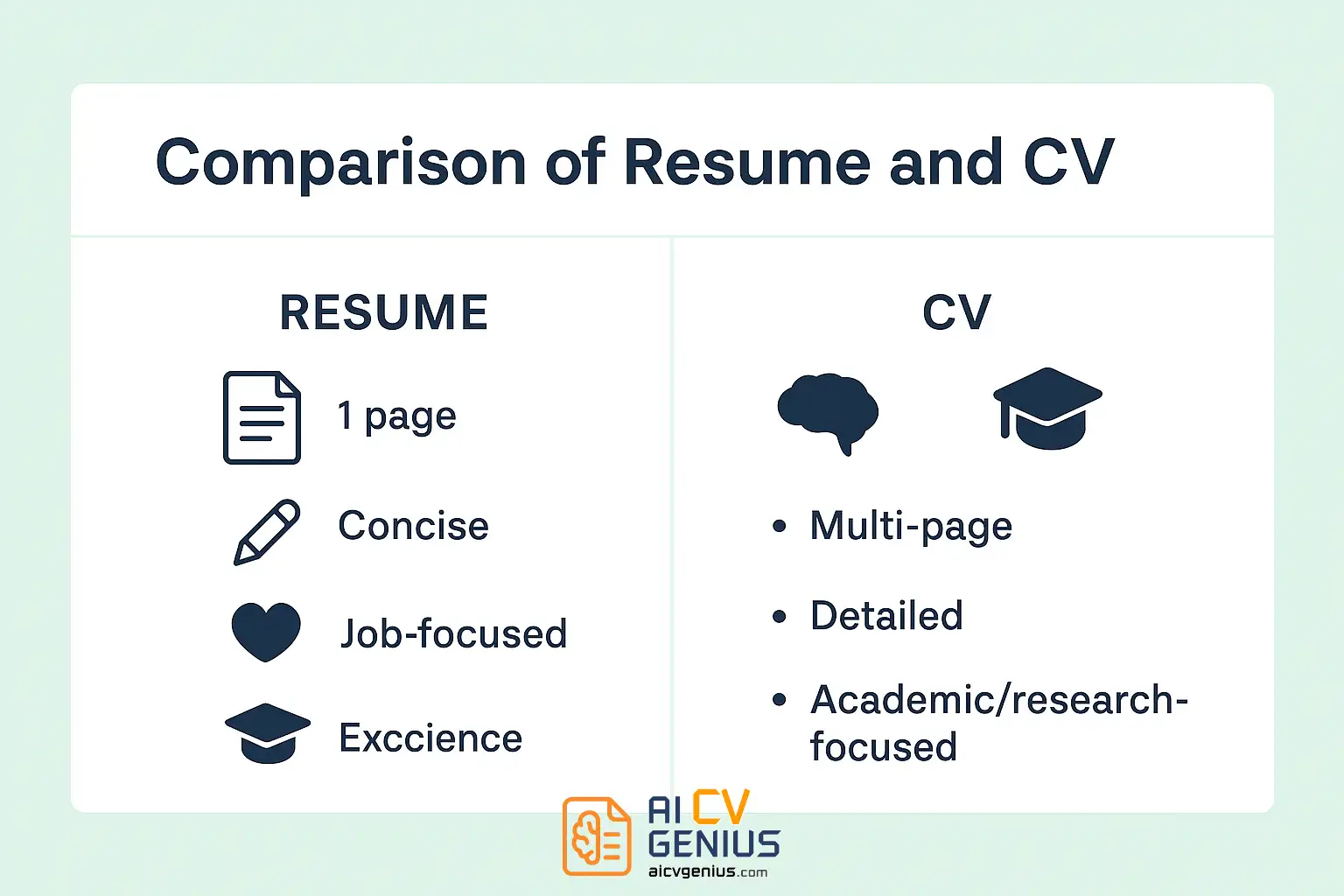
| Length | Concise: Typically 1 page, maximum 2 pages for experienced professionals. | Comprehensive: Often 2+ pages, length varies significantly based on career (can be 10+ pages). |
| Purpose | Secure interviews for specific jobs (business, industry, non-profit). Functions as a targeted marketing tool. | Provide a full academic/professional history. Primarily for academia, research, medicine, grants, international roles. |
| Content Focus | Highlights skills, experiences, and achievements most relevant to a specific job description. Emphasizes quantifiable results. | Detailed listing of education, publications, presentations, research, teaching, grants, affiliations, awards. Emphasizes credentials and contributions. |
| Customization Level | High: Must be tailored significantly for each job application to match keywords and requirements. | Low: Generally static; updated chronologically but rarely shortened or heavily reordered for specific applications. |
| Design & Tone | Concise, results-oriented, professional but can incorporate modern design elements. Focus on scannability. | Formal, detailed, comprehensive, structured according to academic/field conventions. Clarity prioritized over design flair. |
| Primary Geographic Use | North America (U.S., Canada) for most non-academic roles. | Academia/Research globally; standard job application document in many regions outside North America (Europe, UK, Middle East, Asia, Africa). |
This comparison highlights the core strategic difference: a resume aims to sell your specific fit for a role; a CV aims to comprehensively document your entire relevant journey.
When to Use a Resume vs a CV: Making the Right Choice
Navigating which document to submit requires attention to context:
Use a Resume when applying for:
- Most jobs in the private sector (corporate roles in marketing, finance, IT, operations, sales, management, etc.).
- Positions in non-profit organizations (unless research-focused).
- Creative or technical industry roles (design, software development).
- Applications within the United States and Canada where the term “resume” is the standard expectation for non-academic positions.
- Situations where the job posting explicitly requests a “resume.”
Use a CV (Curriculum Vitae) when applying for:
- Faculty positions at universities or colleges (Professor, Lecturer, Instructor).
- Research-focused roles in academia, government labs, or private industry R&D.
- Postdoctoral fellowships, academic grants, or scholarships.
- Medical positions (Physician, Clinical Researcher).
- Jobs located outside North America (e.g., in Europe, the UK, Ireland, Australia, New Zealand, Middle East, Africa, Asia) where “CV” is the standard term for all job applications, regardless of field.
- Situations where the application instructions explicitly request a “CV” or “Curriculum Vitae.”
Key Rule: Always carefully read the job posting and application instructions. If the employer specifies “resume,” submit a concise, tailored resume. If they request a “CV,” provide the comprehensive document. If you remain unsure (e.g., applying internationally without explicit guidance), researching the standard practice for that specific country and industry is advisable. When in doubt for international roles, submitting a comprehensive CV is often safer than submitting a potentially insufficient resume.
Pros & Cons of Resume vs CV Formats
Understanding the strengths and weaknesses helps reinforce appropriate usage:
| Document Type | Pros | Cons |
|---|---|---|
| Resume | ✅ Highly scannable and easy for recruiters to quickly assess relevance. ✅ Forces prioritization, highlighting your most impactful qualifications. ✅ Easily tailored to match specific job requirements and keywords. ✅ Generally performs well with Applicant Tracking Systems (ATS). | ❌ Limited space necessitates omitting potentially valuable details or experiences. ❌ May not adequately represent the full breadth of qualifications for certain complex roles (e.g., senior research). ❌ Can feel overly simplistic for academic or highly credentialed fields. |
| CV (Curriculum Vitae) | ✅ Provides a comprehensive, detailed overview of all relevant qualifications and contributions. ✅ Ideal for showcasing extensive academic records, publications, research, and teaching experience. ✅ Demonstrates long-term professional development and depth of expertise. ✅ Standard format expected in academia, research, medicine, and many international contexts. | ❌ Can become excessively lengthy and difficult for non-academic recruiters to quickly scan for key information. ❌ Less effective for highlighting specific relevance to non-academic roles requiring targeted skills. ❌ Less emphasis on concise, quantifiable achievements compared to resumes. |
The optimal choice depends entirely on the specific audience and purpose of the application.
How to Convert a Comprehensive CV into a Targeted Resume
If you possess a detailed academic or research-focused CV and need to apply for industry or corporate roles, a strategic conversion process is necessary. This involves significant editing and reframing, not just shortening:
- Prioritize Ruthlessly & Aim for Brevity: Target a 1-2 page maximum length. Remove sections common in CVs but irrelevant for industry roles (e.g., exhaustive lists of conference presentations, minor publications, detailed teaching assignments unless applying for L&D roles).
- Shift Focus from Credentials to Impact: Reframe academic achievements and research activities to highlight transferable skills and quantifiable outcomes relevant to business needs. Use strong action verbs.
- Translate Academic Jargon: Replace overly technical or academic terminology with clear, business-friendly language that recruiters outside your specific field will understand. Focus on skills like problem-solving, data analysis, project management, communication.
- Condense Publications & Presentations: Instead of listing everything, create a concise “Selected Publications/Presentations” section highlighting only the most significant or directly relevant contributions, or integrate key findings into achievement bullet points under relevant experience.
- Add a Professional Summary: Include a concise summary at the top that highlights your key transferable skills and career objective relevant to the target industry role.
- Emphasize Relevant Skills: Create a dedicated skills section showcasing technical proficiencies (software, tools), analytical abilities, and soft skills valued in the corporate world (leadership, teamwork, communication).
Example Transformation:
- CV Entry: “Published 5 peer-reviewed articles in high-impact journals (e.g., Nature Communications, JACS) detailing novel methodologies for protein structure analysis using Cryo-EM.”
- Resume Translation (Targeting Data Science role): “Developed and applied advanced data analysis methodologies (utilizing Python and custom algorithms) to interpret complex biological datasets (Cryo-EM), leading to insights published in 5 peer-reviewed articles including Nature Communications.” (Focus shifts to methodology, tools, and applicable skills).
Common Myths Debunked: Resume vs CV
Navigating these terms can be confusing due to regional differences and evolving norms. Let’s clarify common misconceptions:
- ❌ Myth 1: A longer CV always looks more impressive and demonstrates greater expertise than a short resume.
✅ Truth: For most non-academic roles, recruiters overwhelmingly prefer concise, relevant resumes. Excessive length in these contexts often signals a lack of focus or inability to prioritize information. Clarity and impact consistently win over sheer volume. - ❌ Myth 2: Resumes are only suitable for entry-level candidates or those with limited experience.
✅ Truth: Resumes are the standard format across all career levels (including senior executives) for most industry and corporate positions in North America. The content and focus evolve, but the concise format remains preferred. - ❌ Myth 3: CVs are exclusively used by university professors and PhD researchers.
✅ Truth: While prevalent in academia, CVs are also standard for medical professionals, scientists in research institutes, applicants for grants/fellowships, and job seekers in many international markets across various industries. Context is key. - ❌ Myth 4: The terms “CV” and “resume” are completely interchangeable everywhere.
✅ Truth: While usage overlaps in some regions, the fundamental distinction (concise/tailored resume vs. comprehensive CV) holds true in professional contexts, especially between North America and other parts of the world, and between industry and academia. Using the wrong term or format can indicate a lack of awareness.
Universal Formatting Tips for Both Resumes and CVs
Regardless of the document type, maintaining professionalism and readability is paramount:
- ✅ Use Clean, Professional Fonts: Stick to standard, easily readable fonts like Calibri, Arial, Georgia, Garamond, Lato, or Roboto. Avoid overly decorative, script, or condensed fonts. Maintain consistency.
- ✅ Ensure Consistent Formatting: Use uniform font sizes (e.g., 10-12pt for body, 14-18pt for headings), margins (0.5-1 inch), spacing, and alignment throughout the document. Clear visual hierarchy is essential.
- ✅ Employ Strategic White Space: Avoid dense blocks of text. Use adequate spacing between sections and bullet points to enhance scannability and reduce reader fatigue.
- ✅ Save and Submit as PDF: Always save your final document as a PDF to preserve formatting integrity across different devices and operating systems, unless the application specifically requires a different format (like DOCX for some ATS).
- ✅ Omit Photos (Generally): Unless applying in a country/industry where photos are standard practice (e.g., parts of Europe/Asia) or specifically requested, omit headshots from both resumes and CVs, particularly in North America, to avoid potential bias.
- ✅ Proofread Meticulously: Errors in spelling, grammar, punctuation, or consistency undermine credibility. Proofread multiple times and consider asking someone else to review it.
Want to ensure your chosen layout meets these standards without formatting hassles? Browse professional, ATS-friendly templates in our Resume Templates Finder or gain deeper insights from the Resume Templates Guides for layout tips rigorously tested by recruiters.
Real-Life Example Snippets: Resume vs CV
Illustrating the content focus difference for the same individual targeting different roles:
Resume Snippet (Targeting an Industry Marketing Role)
Jane Smith
Marketing & Communications Specialist | jane.smith.pro@email.com | (555) 123-4567 | LinkedIn Profile LinkPROFESSIONAL SUMMARY
Results-driven communications professional with 5+ years of experience developing engaging content and executing multi-channel marketing campaigns. Proven ability to increase audience engagement by over 40% through targeted social media strategies. Seeking to leverage content creation and analytics skills to drive brand awareness at [Target Company Name].EXPERIENCE
Communications Coordinator, Greenfield University, Cityville, State | 2020 – Present
• Developed and managed social media content calendar across 3 platforms (Twitter, Instagram, LinkedIn), resulting in a 40% increase in average post engagement and 2,500+ new followers within 18 months.
• Wrote and edited press releases, website articles, and email newsletters distributed to an audience of 10,000+ students, faculty, and alumni.
• Collaborated with design team to create promotional materials for university events, contributing to a 15% average increase in attendance for key initiatives.
CV Snippet (Targeting an Academic Communications Role or Fellowship)
Jane Smith, M.A.
Communications Coordinator, Office of University Relations, Greenfield University
Contact: jane.smith.pro@email.com | (555) 123-4567 | Full Address | LinkedIn Profile LinkEDUCATION
Master of Arts in Communication Studies, State University, Anytown, State | 2020
Thesis: “The Influence of University Social Media Strategies on Prospective Student Engagement Patterns”
Bachelor of Arts in English Literature, Liberal Arts College, Sometown, State | 2018PROFESSIONAL APPOINTMENTS
Communications Coordinator, Greenfield University, Cityville, State | 2020 – Present
• Manage official university social media channels (Twitter, Instagram, LinkedIn), including content creation, scheduling, analytics tracking, and community engagement.
• Author and edit internal and external communications: press releases, website news articles, feature stories, email newsletters, crisis communications drafts.
• Coordinate with academic departments and administrative units to develop communication plans for events, initiatives, and announcements.
• Supervise one student communications intern per semester.PUBLICATIONS & PRESENTATIONS
Smith, J. (2022). “Leveraging Instagram Stories for Higher Education Recruitment: A Case Study.” Journal of University Marketing & Communications, 15(2), 45-60.
Smith, J. (2023, April). Engaging Gen Z: Effective Social Media Tactics for Universities. Presentation at the Annual Higher Education Communicators Conference, Chicago, IL.AWARDS & HONORS
Excellence in University Communications Award, Greenfield University Staff Awards | 2023
Graduate Teaching Assistantship, State University | 2018 – 2020
The difference is stark: the resume prioritizes concise, quantified achievements relevant to a marketing job. The CV provides a comprehensive, detailed record emphasizing academic credentials, publications, presentations, and broader responsibilities suitable for an academic context.
FAQs: Resume vs CV Clarified
Final Thoughts: Strategy Dictates Format
Understanding the fundamental distinction between a resume vs cv transcends mere terminology – it underpins your entire application strategy. One document serves as a targeted highlight reel designed to showcase immediate relevance; the other functions as a comprehensive archival record demonstrating depth and breadth of expertise. Employing the correct format signals professionalism, cultural awareness, and a clear understanding of the specific audience you are addressing – whether that audience is a corporate recruiter prioritizing rapid assessment or an academic committee valuing exhaustive detail.
Before applying for any opportunity, always verify the expected document type. When used appropriately, both the concise, impact-driven resume and the comprehensive, detailed CV can effectively open doors to your next professional chapter. For access to professionally designed, ATS-friendly templates suitable for crafting impactful resumes, visit our Resume Templates Finder. For broader guidance on tailoring content and navigating career transitions, explore our detailed Career Resources section. Your professional story deserves to be presented accurately – ensure you choose the right format to tell it effectively.