
- Core meaning: Organizational skills are about creating structure and predictable outcomes under pressure, not having a tidy desk.
- What hiring managers want: Proof of ownership, clear communication, smart prioritization, and the ability to anticipate problems before they hit.
- 3 pillars: Show planning and prioritization, show digital systems for information, and show physical organization when relevant to the job.
- How to prove it: Do not claim “organized” in Skills, use achievement bullets with a Problem-Action-Result story plus strong verbs and real outcomes.
- What makes it believable: Quantify time saved, errors reduced, budgets managed, or volume handled, and make sure your resume layout looks clean and structured.
Introduction: The Foundation of Organization
Why Organization Is the Unspoken Foundation of Every Career
When people hear the word “organized,” they often picture tidy desks, color-coded spreadsheets, or perfect planners. But in the professional world, organizational skills represent something far deeper and more powerful: the ability to bring structure to chaos, to manage competing priorities, and to create predictable, high-quality outcomes even when everything feels urgent.
Employers do not just value organized candidates; they are desperate for them. In a world of hybrid work, constant notifications, and competing projects, the person who can create a clear path forward is the most valuable person in the room. They are the calm center of the storm.
If you can prove you are that person, you are no longer just a “doer”; you are a “manager” of tasks, time, and energy – even if “manager” is not in your title. This guide will show you how to prove this skill on your resume, moving it from a vague claim to a core competency.
“Being organized isn’t about perfection or having an empty inbox. It’s about building a system that allows you to make progress on the right things, every single day.”
What “Organizational Skills” Really Mean to a Hiring Manager
Hiring managers do not just want hard workers; they want effective ones. An organized employee is a force multiplier. They make their own job easier, and they make their entire team’s job easier. They are a sign of low risk and high reliability.
When a recruiter scans for this skill, they are really looking for evidence of:
- ✅ Ownership & Accountability: Do you wait to be told what to do, or do you build a system to manage your own workflow?
- ✅ Clarity & Communication: Can you create a plan that other people can understand and follow?
- ✅ Efficiency & Prioritization: Can you tell the difference between “urgent” and “important” and allocate your energy accordingly?
- ✅ Anticipation: Do you just react to problems, or do you build systems that prevent problems from happening in the first place?
It is not about neatness – it is about ownership. Organized people reduce confusion, anticipate bottlenecks, and build trust through sheer consistency.
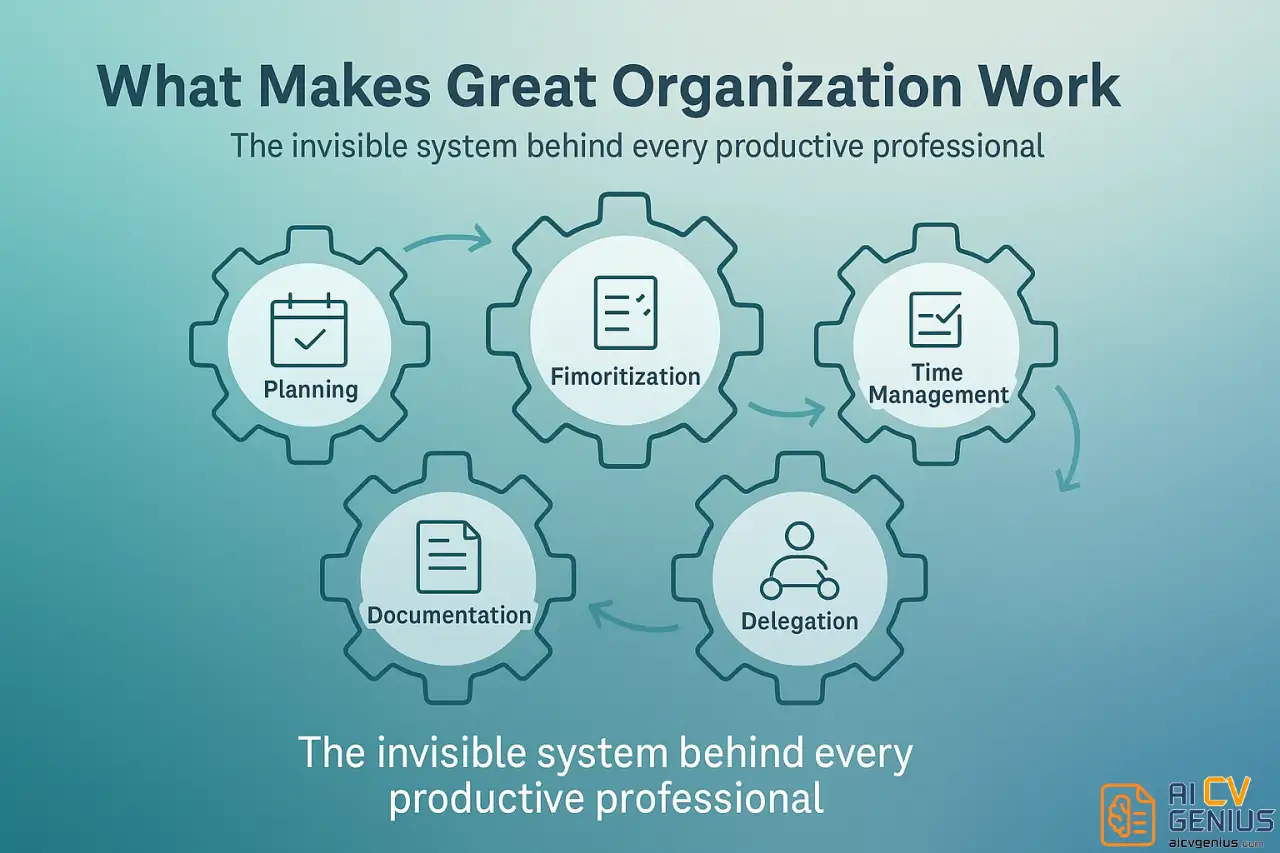
The Three Pillars of Organization: Mental, Physical, and Digital
True organization is not one skill; it is a cluster of habits. To be convincing, your resume should show evidence of all three pillars.
| Pillar | What It Is | How to Prove It on a Resume |
|---|---|---|
| 1. Mental Organization (Planning) | The ability to think strategically, set goals, break down large projects, and prioritize tasks. This is about clarity of thought. | “Planned and executed a 3-month product launch, coordinating 4 departments and meeting all key deadlines.” |
| 2. Digital Organization (Systems) | The ability to manage information. This includes file-naming conventions, database management, and using tools (Asana, Notion, CRM) effectively. | “Implemented a new shared drive structure using Google Workspace, reducing file retrieval time for the team by 30%.” |
| 3. Physical Organization (Environment) | Often overlooked, this is about managing physical assets, inventory, or a workspace for maximum efficiency and safety. | “Reorganized the stockroom layout, improving inventory count accuracy and reducing fulfillment errors by 15%.” |
Your resume must show you can manage not just your tasks (Mental), but also your data (Digital) and your environment (Physical).
How to Demonstrate Organizational Skills
How to Prove Organizational Skills on a Resume: Show, Don’t Tell
This is the golden rule. Do not add “Highly organized” to your skills section. It is a weak claim that no one believes. Instead, prove it with your achievements. Let your accomplishments be the evidence.
Use your experience bullet points to tell mini-stories where organization was the key to your success. Use the PAR (Problem-Action-Result) formula.
The “Before” and “After” of Organizational Bullets
| Before (Weak) | After (Strong) |
|---|---|
| Responsible for managing team calendar. | Implemented a new shared calendar system and scheduling protocol for a 20-person team, eliminating double-bookings and reducing meeting conflicts by 40%. |
| Handled digital files for projects. | Designed and documented a new project filing system in Notion, reducing data retrieval and onboarding time for new hires by an estimated 5 hours per week. |
| Helped plan company events. | Coordinated all logistics for the 300-person annual company summit, managing 15+ vendors, a $50K budget, and timelines, delivering the event 10% under budget. |
The “After” examples are powerful because they show you did not just maintain a system – you created one. This is the difference between a junior employee and a future leader.
Action Verbs That Scream “Organized”
The best resumes show order through verbs and clarity, not adjectives. Replace “organized” with powerful action verbs that demonstrate precision and ownership.
| Planned | Coordinated | Streamlined |
| Scheduled | Monitored | Documented |
| Optimized | Implemented | Standardized |
| Cataloged | Systematized | Reorganized |
| Prioritized | Allocated | Managed |
Using these verbs makes your bullet points sound active and confident.
Organizational Skills in Practice: Examples by Profession
Organization looks different in every role. Tailor your bullets to reflect the specific organizational challenges of your industry.
- Project Management: “Developed standardized project checklists and documentation in Asana, reducing onboarding time for new team members by 50%.”
- Marketing: “Managed the editorial content calendar across 4 social media platforms, coordinating deadlines with 5 writers and 2 designers to ensure 100% on-time delivery.”
- Finance/Admin: “Built a new automated budget tracking tool in Excel, improving reporting accuracy by 30% and reducing month-end closing time by 2 days.”
- Creative/Design: “Created a new digital asset management (DAM) system with clear naming conventions, reducing file search time for the marketing team by over 50%.”
- Customer Service: “Implemented a new CRM tagging system (Zendesk) to prioritize high-urgency support tickets, improving average first-response time by 25%.”
- Operations/Logistics: “Reorganized the warehouse floor plan and standardized inventory labeling, leading to a 20% increase in picking efficiency.”
Making It Quantifiable: The Secret to Being Believable
Numbers tell recruiters you do not just plan – you deliver. Quantify the impact of your organization wherever you can. Metrics are your proof.
| ❌Instead of | ✅Say |
|---|---|
| “Improved efficiency.” | “Improved team response rate by 35% through a new scheduling automation.” |
| “Good at multitasking.” | “Handled 30+ client accounts simultaneously while maintaining a 98% satisfaction rating.” |
Look for numbers related to:
- Time Saved: (e.g., “reduced X by 10 hours/week”)
- Money Saved: (e.g., “delivered 15% under budget”)
- Accuracy Improved: (e.g., “reduced errors by 25%”)
- Volume Managed: (e.g., “coordinated 50+ volunteers”)
Strategy, Analysis, and Improvement
The Resume Structure That Highlights Organization
Ironically, the layout of your resume itself is the first test of your organizational skills. Recruiters notice structure instantly. A resume that is cluttered, inconsistent, or hard to read sends a clear message: “I am disorganized.”
Your document must be a model of clarity:
- Consistent Formatting: Are all your dates aligned? Are your job titles all bolded the same way?
- Clear Hierarchy: Do your section headings stand out? Is it easy to scan?
- Balanced White Space: Does the page feel cramped, or does it feel calm and easy to read?
If your resume looks organized, your claims feel more believable. For inspiration, check our AI Resume Templates – all are built to showcase both design clarity and information flow naturally.
Organizational Skills vs. Time Management vs. Detail-Orientation
These skills are related but not identical. Understanding the difference helps you describe them accurately.
- Organizational Skills (The Architect): This is the macro skill of creating systems, structures, and plans. It is about designing the “container” for the work. (e.g., “Building the project plan.”)
- Time Management (The Pilot): This is the micro skill of executing tasks within that system. It is about prioritizing and managing your own 24 hours. (e.g., “Meeting your deadlines within the plan.”)
- Detail-Orientation (The Inspector): This is the quality control skill of ensuring accuracy and polish within the tasks. (e.g., “Catching a typo in the final report.”)
A great candidate has all three: They build the system (organization), run their schedule (time management), and check their work (detail-orientation).
How to Demonstrate Organization in a Remote-Work World
In a remote or hybrid job, organization is communication. Since a manager cannot “see” you working, your organizational skills are only visible through your digital habits.
Highlight your ability to organize asynchronously.
Example Bullets:
- ✅ “Built and maintained a shared Notion dashboard for remote task tracking, reducing status update meetings and message backlogs by 40%.”
- ✅ “Proactively documented all project changes and standard operating procedures (SOPs), ensuring team alignment across three time zones.”
- ✅ “Managed a complex project entirely via Asana and Slack, coordinating 5 freelancers and delivering the final product two days ahead of schedule.”
These examples prove you can be trusted to work autonomously.
How to Genuinely Practice and Improve Organization
This is a muscle, not a personality trait. You can build it with simple, consistent habits.
- The “End-of-Day” Shutdown: Spend the last 15 minutes of your workday organizing for tomorrow. Clean your desktop, answer final emails, and write your to-do list for the next morning. You will start the day with clarity, not chaos.
- Batch Your Tasks: Group similar tasks together. Do all your emails in two blocks. Do all your creative work in one. Do all your admin in another. Context-switching is the #1 killer of organization.
- Use a Single “Source of Truth”: Do not keep tasks in your email, on sticky notes, and in a notebook. Pick one system (a digital app or a physical notebook) and put everything there.
- Document Your Wins: Keep a “brag file” or “win list.” Every Friday, write down one thing you accomplished. This not only builds your confidence but gives you a pre-built list of achievements for your next resume update.
Conclusion and FAQ
Final Thoughts: Organization is Leadership in Disguise
When your resume demonstrates true organizational skill, it communicates reliability, maturity, and foresight without you having to say a word. Structure, clarity, and measurable results are the quiet signals of competence that hiring managers notice first.
Being organized is not about doing more – it is about making more of what you do matter. It is the ability to see the final goal and build the road to get there. That is not just an administrative skill; it is the very definition of leadership.
In-Depth FAQs on Organizational Skills
- Scope: “Managed all scheduling for a 50-person executive team.”
- Qualitative: “Created a new documentation system that was adopted as the company-wide best practice.”