
- The article explains what behavioral interview questions are and why employers use them: Past behavior is treated as the best predictor of future performance, so they ask “Tell me about a time when…” to see how you think, act, and communicate in real situations.
- It teaches the STAR method as the core structure: Situation and Task set context fast, Action highlights what you personally did, and Result shows impact, ideally with numbers.
- It provides a bank of common behavioral questions with sample STAR answers, covering challenges under pressure, difficult colleagues, leadership without authority, mistakes and learning, and going beyond your role.
- Preparation is framed as building a story portfolio: Identify 5 to 8 strong examples, outline them in STAR, practice aloud to stay within 1 to 2 minutes, and aim for authenticity rather than memorizing scripts.
- The close adds practical performance levers: Tailor stories to the role, prioritize quantifiable outcomes, vary competencies, project calm confidence, run a final readiness checklist, and it includes an FAQ that addresses reuse of stories and how to answer with limited experience.
“Tell me about a time you solved a problem.”
“Describe a situation where you worked under pressure.”
If you’ve navigated the job interview process, you’ve almost certainly encountered questions framed like these. They are known as behavioral interview questions – and they serve a critical function beyond assessing technical skills. They are strategically designed to reveal how you operate, make decisions, and interact within real-world professional contexts, offering insights into your capabilities beyond what a resume alone can convey.
Unlike technical evaluations or hypothetical situational questions (“What would you do if…?”), behavioral questions delve into your past actions as the most reliable predictor of future performance. Recruiters and hiring managers operate under the premise that your documented history of handling specific situations offers the clearest indication of how you will likely respond to similar challenges in their organization.
This comprehensive guide will equip you with the knowledge to anticipate these questions, structure your responses with confidence using the proven STAR method, and deliver answers that feel both authentic and demonstrably results-driven, significantly enhancing your ability to stand out.
What Are Behavioral Interview Questions? Understanding the Intent
Behavioral questions are specifically designed to elicit detailed examples of past experiences that showcase critical competencies such as problem-solving aptitude, teamwork and collaboration effectiveness, leadership potential, adaptability under pressure, and conflict resolution skills. They intentionally move beyond theoretical knowledge by asking “Tell me about a time when you…” rather than posing hypothetical scenarios.
Through these questions, employers aim to evaluate several key dimensions simultaneously:
- ✅ Your thought process and approach to navigating real professional situations.
- ✅ Your ability to communicate experiences clearly, concisely, and reflectively.
- ✅ Concrete evidence of core soft skills essential for success within their team and organizational culture (e.g., collaboration, initiative, resilience).
These questions are particularly prevalent and carry significant weight in industries such as consulting, management, customer service, education, healthcare, and technology – fields where interpersonal effectiveness, critical thinking, and situational judgment are considered equally important as technical proficiency.
The STAR Method: Your Strategic Framework for Compelling Answers
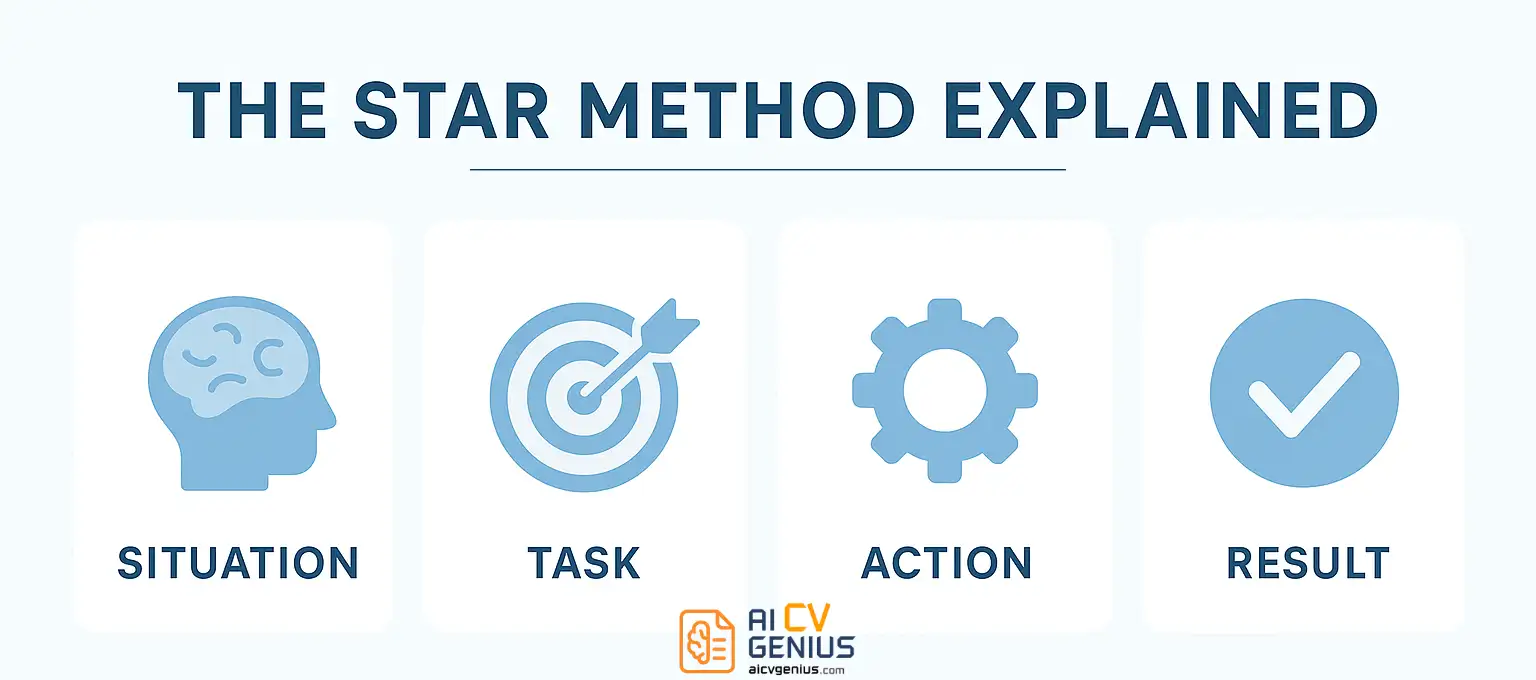
The most effective and widely recommended technique for structuring responses to behavioral interview questions is the STAR method. This simple acronym provides a logical framework ensuring your answers are focused, comprehensive, and easy for the interviewer to follow.
| Letter | Meaning | What to Include |
|---|---|---|
| S | Situation | Concisely describe the specific context, challenge, or background relevant to the question. Set the stage efficiently. |
| T | Task | Clearly explain your specific role, responsibility, or the objective you were tasked with achieving within that situation. What needed to be done? |
| A | Action | Detail the concrete steps you personally took to address the task or challenge. Focus on your specific contributions, decisions, and reasoning. This is the core narrative showcasing your skills. |
| R | Result | Share the positive outcome(s) stemming directly from your actions. Quantify the impact whenever possible (using numbers, percentages, time saved, etc.) and briefly mention key learnings if appropriate. |
Think of the STAR method as strategic storytelling applied to your professional experiences. It transforms potentially rambling anecdotes into focused narratives that demonstrate competence and prevent you from inadvertently underselling your contributions or drifting off-topic.
Common Behavioral Interview Questions (With Sample STAR Answers)
Below are frequently encountered behavioral questions, paired with structured STAR responses illustrating effective application of the method.
1. Tell me about a time you faced a significant challenge at work and how you overcame it.
Situation: In my previous role as Project Coordinator, our team was facing a critical client deadline for a major software deployment, but discovered a significant integration issue just five days before launch.
Task: My primary task was to coordinate the rapid resolution of the technical issue while simultaneously managing client communications to maintain confidence and ensure the project stayed as close to schedule as possible.
Action: I immediately convened an emergency meeting with the lead developers and QA testers to diagnose the root cause. Concurrently, I drafted a transparent communication plan for the client, outlining the challenge and our mitigation strategy. I then re-prioritized testing resources based on the developers’ fix timeline and facilitated daily brief check-ins to monitor progress and address roadblocks swiftly.
Result: Due to the coordinated effort, the critical issue was resolved within 72 hours. We successfully deployed the software only one day behind the original schedule. The client expressed appreciation for our proactive communication and problem-solving, ultimately leading to a contract renewal valued at approximately $150K.
Focus: Demonstrates problem-solving under pressure, communication, and leadership initiative leading to a measurable positive business outcome.
2. Describe a time you had to collaborate effectively with a difficult colleague.
Situation: On a cross-functional marketing campaign project last year, a key colleague from the Sales department consistently missed deadlines for providing crucial input, jeopardizing our overall timeline.
Task: As the project lead, I needed to address the delays constructively to ensure project success without damaging the interdepartmental working relationship.
Action: I scheduled a brief one-on-one meeting with the colleague, focusing on understanding their workload and potential obstacles rather than assigning blame. We collaboratively identified competing priorities on their end. Together, we adjusted our internal check-in schedule for their specific inputs, providing earlier reminders and breaking down requests into smaller, more manageable chunks.
Result: Following our conversation and revised process, the colleague consistently provided input on time for the remainder of the project. The campaign launched successfully, exceeding lead generation targets by 20%. Our working relationship improved significantly, fostering better collaboration on subsequent projects.
Focus: Showcases emotional intelligence, proactive communication, collaborative problem-solving, and achieving results through empathy rather than confrontation.
3. Give an example of a time you demonstrated leadership skills.
Situation: During my final year capstone project, our five-person student team lost momentum and focus midway through, struggling to integrate differing research approaches and facing potential delays.
Task: Although not formally assigned as leader, I recognized the need for clearer direction and took the initiative to help realign the team’s efforts towards our shared objective.
Action: I proposed and facilitated a structured working session where we collectively revisited our project goals and broke down the remaining work into distinct, manageable tasks using a shared Trello board. I helped assign tasks based on individual strengths and interests identified earlier, established clear weekly milestones, and volunteered to consolidate the final report sections to ensure consistency.
Result: The team regained focus and motivation, collaborating more effectively. We successfully submitted a high-quality, cohesive project ahead of the deadline, receiving commendation from our professor for the report’s structure and depth. This experience highlighted my ability to facilitate collaboration and drive progress even without formal authority.
Focus: Highlights initiative, facilitation skills, organizational ability, and influencing peers positively – key leadership traits applicable even without a managerial title.
4. Tell me about a significant mistake you made professionally and what you learned from it.
Situation: Early in my role as a Junior Analyst, I was responsible for compiling data for a critical quarterly financial report. Due to a misunderstanding of one data source’s parameters, I inadvertently included inaccurate figures in my initial draft submitted for review.
Task: My immediate task upon realizing the error was to correct it swiftly, inform my manager transparently, and understand how to prevent recurrence.
Action: I immediately alerted my manager, explaining the source of the error. I then worked diligently over the next few hours to re-pull the correct data, validate it meticulously, and submit a fully corrected report draft. Additionally, I created a detailed checklist documenting the correct parameters and validation steps for that specific data source to ensure future accuracy.
Result: While the initial error caused a minor delay, the corrected report was finalized accurately. My manager appreciated the prompt ownership and the proactive step of creating the checklist, which was subsequently adopted by the team. This experience ingrained in me the critical importance of rigorously verifying data sources and assumptions before incorporating figures into final reports.
Focus: Demonstrates accountability, honesty, proactivity in finding solutions, and, crucially, learning from errors to improve future performance. Avoid blaming others.
5. Describe a time you went above and beyond the requirements of your job.
Situation: While working as a Customer Support Representative, I noticed a recurring technical issue reported by several customers that wasn’t covered in our standard troubleshooting knowledge base.
Task: Although my primary role was issue resolution, I saw an opportunity to proactively address the root cause and improve the overall customer experience.
Action: Beyond resolving the individual tickets, I took the initiative to thoroughly document the steps required to replicate and fix the issue. I then drafted a clear, concise article for our internal knowledge base, including screenshots. I presented this draft solution to my team lead and the Tier 2 support team for validation.
Result: The knowledge base article was approved and published within a week. This enabled Tier 1 representatives to resolve the issue directly, reducing escalations for that specific problem by approximately 60% and decreasing average resolution time significantly, improving overall team efficiency and customer satisfaction.
Focus: Highlights initiative, ownership, problem-solving beyond assigned duties, and contributing positively to team/process improvement – qualities highly valued in proactive employees.
How to Prepare Effectively for Behavioral Interviews
Thorough preparation is the single most effective way to build confidence and excel in behavioral interviews. Success relies on thoughtful reflection and practice before the interview day arrives.
- ✅ Identify Your Core Stories: Review your resume and past experiences (work, academic, volunteer). Brainstorm 5–8 significant situations where you demonstrated key competencies relevant to your target roles (e.g., problem-solving, teamwork, leadership, initiative, handling pressure, communication, dealing with failure).
- ✅ Structure Each Story Using STAR: For each identified situation, meticulously outline the Situation, Task, specific Actions you took, and the measurable Result/Outcome. Write these down briefly.
- ✅ Practice Articulating Your Stories Aloud: Rehearse telling each STAR story concisely and naturally. Practice hitting the key points within approximately 60–120 seconds. This helps solidify the narrative in your mind and improves pacing.
- ✅ Focus on Clarity and Impact: Ensure your language is clear, professional, and directly answers the underlying question. Quantify results whenever possible.
- ✅ Aim for Authenticity, Not Memorization: Practice enough to feel comfortable and confident, but avoid memorizing answers word-for-word, which can sound robotic. Focus on recalling the core elements of each story naturally.
Recruiters easily detect overly scripted or inauthentic responses. Genuine reflection combined with structured practice using the STAR framework yields the most compelling and credible answers.
Pros & Cons of the Behavioral Interview Approach
Understanding the strengths and limitations from both perspectives:
| Pros | Cons |
|---|---|
| ✅ Provides concrete, evidence-based insights into a candidate’s past behavior and competencies relevant to the role. | ❌ Can feel somewhat repetitive or formulaic for candidates if they haven’t prepared diverse examples. |
| ✅ Encourages structured, focused storytelling, making responses easier to follow and evaluate consistently. | ❌ May pose challenges for candidates with limited direct professional experience if they struggle to adapt examples from other contexts (academic, volunteer). |
| ✅ Helps reduce interviewer bias by focusing evaluation on demonstrated actions and results rather than subjective personality assessments alone. | ❌ Effectiveness depends heavily on the interviewer’s skill in asking relevant questions and probing effectively for details. Poorly phrased questions yield weak answers. |
| ✅ Allows candidates ample opportunity to showcase crucial soft skills (communication, problem-solving, resilience) naturally through their narratives. | ❌ Over-rehearsed or inauthentic answers lacking specific detail can undermine credibility and fail to provide genuine insight. |
Strategies to Stand Out in a Behavioral Interview
Beyond simply using the STAR method, elevate your performance:
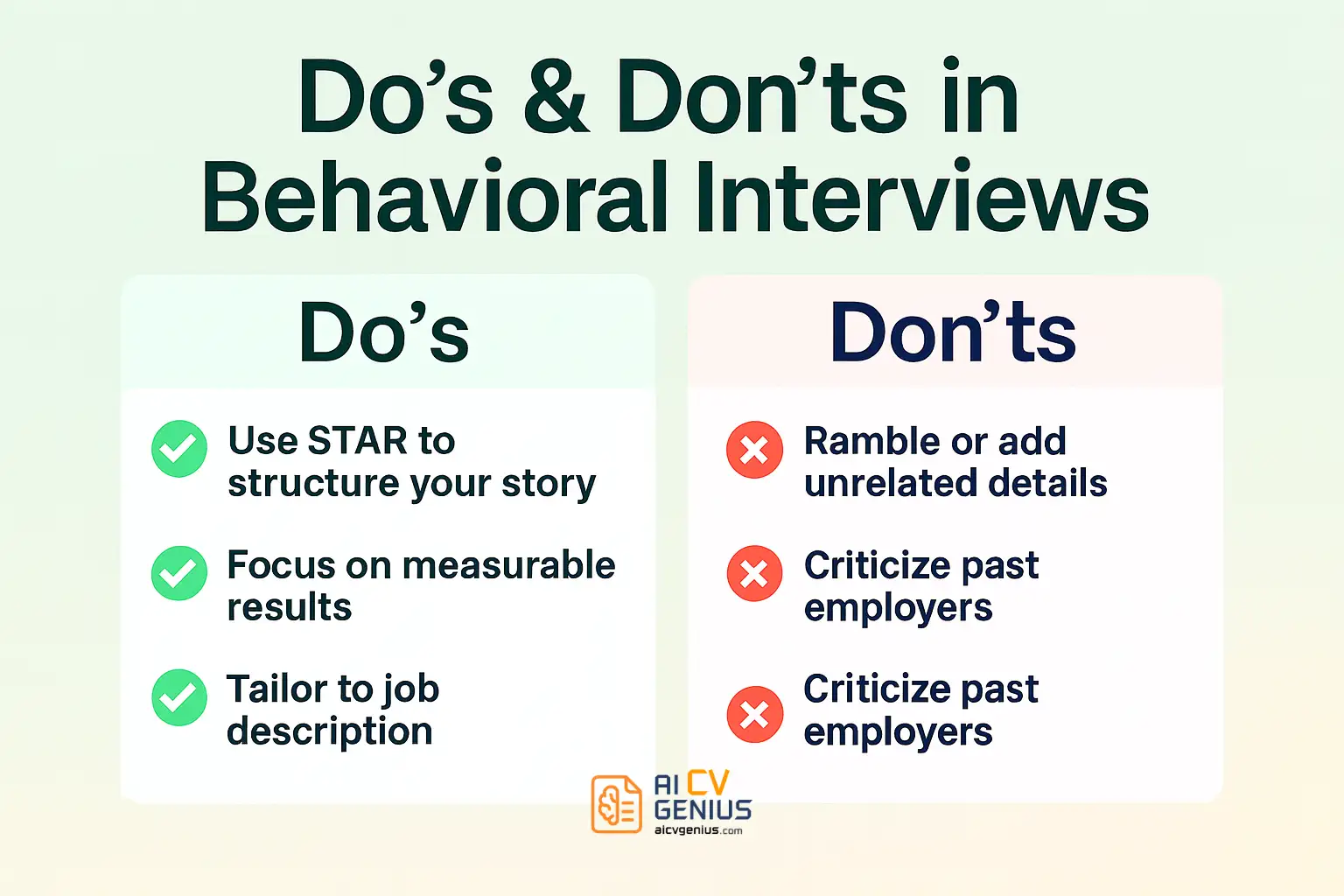
- Tailor Your Stories: Select examples that not only demonstrate the required competency but also align subtly with the specific company’s values, industry challenges, or the nuances mentioned in the job description (research beforehand!).
- Emphasize Quantifiable Results: Numbers resonate powerfully. Make a concerted effort to include metrics demonstrating impact (%, $, #, time saved) whenever credible and possible.
- Showcase a Variety of Competencies: Prepare stories illustrating different key skills (don’t rely on just one type of example, e.g., only teamwork stories). Show breadth.
- Project Confidence and Enthusiasm: Maintain positive body language (eye contact, open posture), speak clearly and calmly, and convey genuine interest in the role and company. Energy is often contagious and memorable.
- Briefly Mention Learnings (Where Appropriate): Concluding a story (especially about mistakes or challenges) with a concise statement about what you learned demonstrates self-awareness and a growth mindset.
Final Preparation Checklist Before Your Behavioral Interview
Run through this list to ensure readiness:
- ✅ Identified and outlined 5–8 specific STAR stories covering key competencies relevant to the role (teamwork, leadership, problem-solving, conflict, failure, initiative, success).
- ✅ Practiced articulating these stories aloud concisely (aiming for 1-2 minutes each) and naturally.
- ✅ Thoroughly researched the company (mission, values, recent news, culture) and the specific role requirements.
- ✅ Prepared 2-3 thoughtful, insightful questions to ask the interviewer(s) at the end, demonstrating engagement.
- ✅ Confirmed interview logistics (time, location/link, interviewer names/titles). Planned professional attire.
- ✅ Allowed adequate time beforehand for calming techniques (deep breathing, positive visualization) to manage nerves.
FAQs: Behavioral Interview Questions
Final Thoughts: Your Stories Define Your Value
Behavioral interviews aren’t designed to test your memory or trip you up – they represent a structured opportunity for you to demonstrate your professional mindset and capabilities through authentic storytelling. Every question serves as an explicit invitation to provide concrete evidence showcasing your self-awareness, adaptability, collaborative spirit, and ability to deliver tangible results under real-world conditions. When you approach these interviews with thorough preparation, leveraging the STAR method to structure your narratives, and focusing on communicating your experiences with honesty and clarity, you transform potentially stressful questions into powerful platforms for proving your unique value.
Practice articulating your key STAR stories until they feel natural, not robotic. Refine your examples, always emphasizing measurable impact where possible. Most importantly, approach each interview not as a performance to be perfected, but as a genuine professional conversation aimed at mutual discovery. Authenticity, combined with structure, consistently builds the trust necessary to turn interviews into job offers.
For additional guidance on interview preparation strategies, explore our comprehensive Career Resources hub. To ensure your resume effectively sets the stage by highlighting the achievements you’ll discuss, utilize professionally designed layouts from our Resume Templates Finder. And if you aim to craft compelling introductory narratives, review effective examples in our Cover Letters section.
Your professional experiences already contain the compelling evidence needed – now it’s simply a matter of learning to present that evidence effectively and confidently.