

- Core idea: A career development plan is not HR paperwork, it is a personal compass that turns drifting into intentional choices.
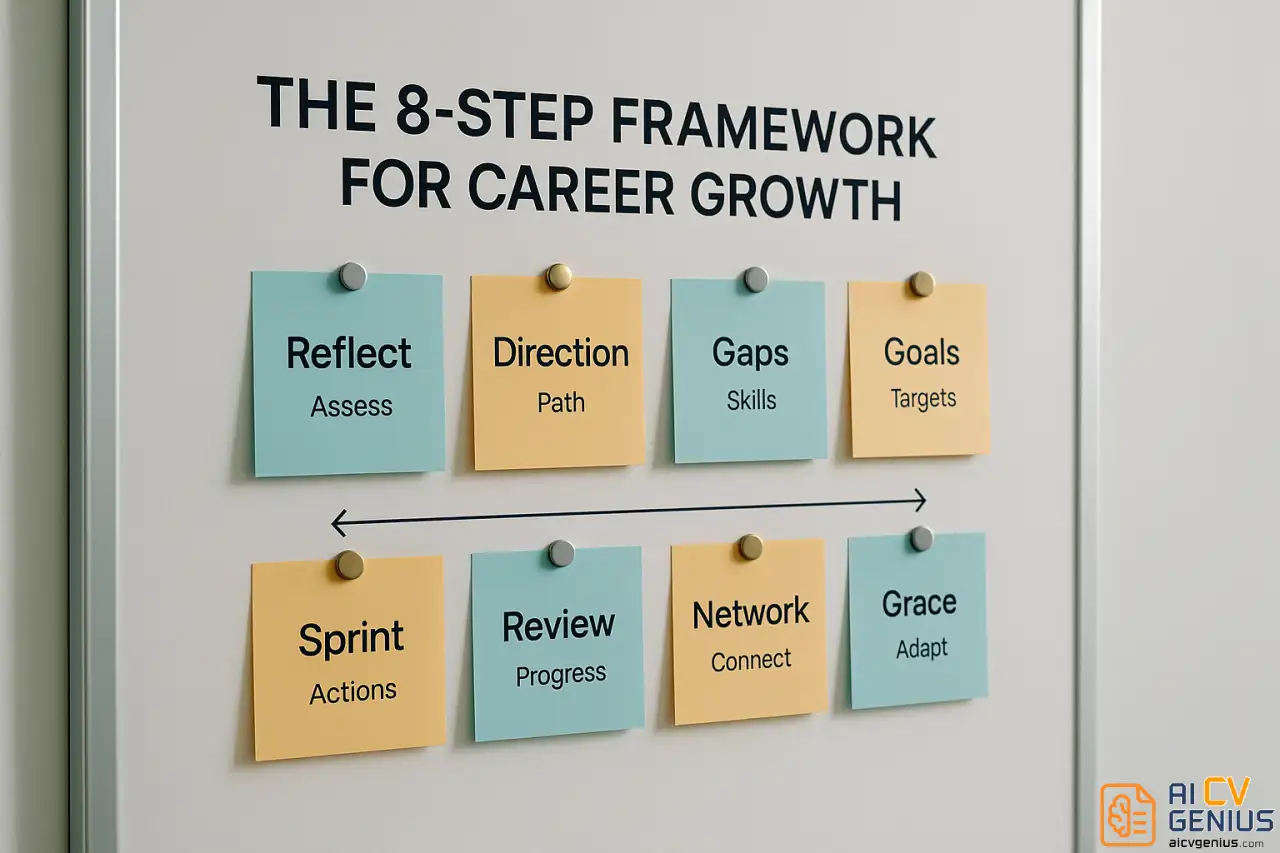
- Step 1 and 2: Start with a career autopsy, then pick a direction that fits you, move up, sideways, out, or deeper into mastery.
- Step 3 and 4: Use the 5 job ad method to find real skill gaps, then set theme based goals that stay motivating, not vague wishes.
- Step 5 and 6: Build a simple 12 week sprint and schedule a quarterly review so the plan stays flexible and updated.
- Step 7 and 8: Create a personal board of mentors and peers, and balance ambition with grace so progress stays sustainable.
The Psychology of the Plan: Beyond the HR Document
When most people hear “career development plan,” they picture a dusty binder on an HR shelf or a mandatory corporate form – something formal, rigid, and completely detached from the reality of their daily work. This is the first myth we need to break. A true career development plan is not paperwork. It is not for them. It is for you.
It is the act of switching from being a passenger in your career to being the driver. It is the conscious decision to stop drifting and start directing. So many professionals are busy, successful, and secretly unfulfilled. They are on a path but are not sure if it is their path. They are climbing a ladder that might be leaning against the wrong wall.
A career development plan is your personal map, your strategic compass. It does not predict the future, but it ensures that every step you take is intentional. It is the tool that transforms your career from a series of random opportunities into a curated, meaningful story. Having a plan does not mean you have all the answers. It means you are finally asking the right questions.
“A career plan doesn’t lock you in. It sets you free – by giving your choices a purpose.”
The 8-Step Framework for a Plan That Actually Works
Forget the complicated templates. A meaningful plan is built on a foundation of honest self-reflection. Follow these steps to build a plan that feels authentic and, more importantly, achievable.
Step 1: The Career Autopsy (Reflect on Where You Are Now)
You cannot map a route to your destination if you do not know your starting coordinates. Most people are afraid to be truly honest here. Do not be. This reflection is not for your boss. It is for you. Grab a notebook and create four quadrants.
- Energizers (What tasks make you feel alive?): What work do you do where time seems to disappear? What projects do you actually look forward to? This is a clue to your “flow state.”
- Drains (What tasks deplete you?): What work do you procrastinate on? What meetings do you dread? Be specific. It is often not the topic but the activity (e.g., “cold calling” or “managing conflicting spreadsheets”).
- Flow (What are your ‘easy’ skills?): What do colleagues consistently come to you for? What feels like common sense to you but seems to impress others? We often devalue what comes naturally to us, but these are your core strengths.
- Friction (What have you avoided learning?): What skills or topics make you feel resistant or insecure? This “friction” is a signpost. It either points to something you should drop entirely or something you must learn to reach the next level.
This “brutal honesty” phase is the most important data you will collect. You must know what you are optimizing for (energy, flow) and what you are designing against (drains, friction).
“You can’t design your next chapter if you’re still pretending to love the current one.”
Step 2: Define Your Direction (What Does “Growth” Mean to You?)
“Growth” is a dangerously vague word. For many, it automatically means “promotion.” But this is a limited, industrial-age view of a career. Growth can move in at least four distinct directions. Be honest about which one you crave right now.
- ⬆️ Move Up (Vertical Growth): This is the traditional path. You want leadership, a bigger title, more strategic responsibility, and to manage people or larger budgets.
- Move Sideways (Lateral Growth): You love your company or field but feel stale. You want to move to a different department, manage a new type of project, or learn a new domain (e.g., a marketer moving into product management).
- ➡️ Move Out (External Growth): You want a fundamental change. This could mean a new industry, a new company, starting your own business, or going freelance. Your plan is focused on building an exit ramp.
- ⬇️ Move Deeper (Mastery Growth): You do not want to manage people; you want to become an undisputed expert. You want to be the “go-to” senior developer, the master craftsperson, the lead researcher. Your goal is autonomy and mastery, not a title.
There is no “right” answer. Knowing your direction (e.g., “My focus for the next two years is ‘Mastery'”) stops you from chasing promotions you do not actually want or from feeling “stuck” when you are actually, intentionally, going deeper.
Step 3: Reverse-Engineer Your Future (Identify the Gaps)
Now that you have a direction, you can identify the skills you need. This is where you stop guessing and start researching.
The 5-Job-Ad Method:
- Go to LinkedIn or your job board of choice.
- Find 5 job descriptions for the role you want 1-2 steps ahead of where you are now (in your chosen direction).
- Copy and paste all the “Requirements” and “Responsibilities” into a single document.
- Now, highlight the patterns. What words, software, or qualifications keep showing up again and again?
This simple exercise gives you a data-driven list of your skill gaps. You will quickly see what the market actually values, not what you think it values. Your list might look like this:
| My Goal | Identified Gaps (from Job Ads) | My Learning Action |
|---|---|---|
| Move into UX Management | “Stakeholder Management” “Team Mentorship” “Budget Forecasting” | Volunteer to lead a small project, mentor a junior designer. |
| Switch to Data Analytics | “SQL” “Tableau” “Data-driven storytelling” | Take an online SQL course, rebuild a past project in Tableau. |
| Grow as a Senior Writer | “SEO Strategy” “Content Audits” “Conversion Metrics” | Get a (cheaper) SEO tool, run an audit on my own blog. |
Now you do not have a vague goal like “get better at data.” You have a specific, market-validated target: “Learn SQL and Tableau.” This makes your plan actionable.
Step 4: Set Theme-Based Goals (Not Just Vague Wishes)
Everyone talks about SMART goals (Specific, Measurable, Achievable, Relevant, Time-bound). They are logical, but they are often emotionally dry and easy to abandon. A more human way to frame your goals is by “theme.”
Choose an overarching theme for the next 6-12 months. This theme becomes your North Star.
- ✅ Example Theme: “The Year of Visibility.”
- SMART Goal 1: Volunteer to present at one all-hands meeting by May.
- SMART Goal 2: Publish one case study of a successful project on LinkedIn by July.
- SMART Goal 3: Set up quarterly “coffee chats” with leaders in two other departments.
- ✅ Example Theme: “The Quarter of Deep Work.”
- SMART Goal 1: Complete the “Advanced Python” certification by March.
- SMART Goal 2: Block 90 minutes of “no-meeting” focus time every morning.
- SMART Goal 3: Decline or delegate two low-impact tasks/meetings per week.
This approach connects your logical goals to an emotional why. When you are tired, “Complete Python cert” feels like a chore. “This is my Quarter of Deep Work” feels like an identity.
Step 5: Create a 12-Week Sprint (Your Action Plan)
A one-year plan is too long. It is easy to procrastinate. A one-week plan is too short; you cannot build momentum. The “12-Week Sprint” (or one quarter) is the perfect balance.
Take your big theme-based goal and break it into a 12-week plan. This makes it real. Your plan should live somewhere you see it daily – a Google Doc, a Notion board, or a physical notebook on your desk.
| Timeframe | Focus Area | Key Action (What I will DO) | Metric (How I’ll know it’s done) |
|---|---|---|---|
| Weeks 1-4 | Skill Building (SQL) | Finish the online SQL course (10 hours total). | Certificate completed. |
| Weeks 5-8 | Application | Find one small project at my current job to apply SQL. | Ran one query that helped my team. |
| Weeks 9-12 | Visibility & Feedback | Show my manager what I learned; add “SQL” to my resume. | Had the conversation; resume updated. |
This is it. This is the entire plan for the quarter. It is simple, it is focused, and it is not overwhelming. This simplicity is what makes you stick to it. You can build on this foundation in career resources to refine your resume as you go.
Step 6: Schedule Your “CEO Meeting” (Review and Adjust Regularly)
A plan is not a “set it and forget it” document. It is a living draft. The most successful professionals treat their career plan like a core business strategy: they review it.
Put a recurring “Quarterly Career Review” in your calendar right now. Make it 60 minutes. This is your non-negotiable meeting with the “CEO of Your Career” (which is you). During this meeting, ask three questions:
- What is working? (What did I accomplish? What felt good?)
- What is stuck? (What did I procrastinate on? Why? Is it still important?)
- ✨ What has changed? (Did I get a new project? Did a new opportunity appear? Does my “Direction” from Step 2 still feel right?)
Based on the answers, you adjust your 12-week sprint for the next quarter. This is how the plan stays relevant. The goal is not to follow the plan perfectly for a year; the goal is to be intentional for 12 weeks at a time.

Step 7: Build Your “Personal Board of Directors”
You cannot execute a career development plan in a vacuum. You need outside perspective. Stop looking for one perfect “mentor” and instead build a “Personal Board of Directors.”
- The Mentor: Someone 2-3 steps ahead of you who can share wisdom and perspective on your direction. You might only talk to them twice a year.
- The Sponsor: Someone senior inside your company who can advocate for you in rooms you are not in. This relationship is built on trust and excellent work.
- The Peer: Someone at your same level (inside or outside your company) who you can be brutally honest with. This is your accountability partner for your 12-week sprints.
Share your plan (or parts of it) with these people. Asking for help is not a weakness; it is a core strategy. Asking “I’m working on my ‘visibility’ this year, do you have any advice?” is a powerful, professional question that leaders love to answer.
Step 8: Balance Ambition with Grace
This is the human step. A career development plan can easily become another tool for self-criticism. It can fuel “productivity poison,” where you feel guilty for resting. This is the plan’s greatest danger.
Your plan must include “grace.” It must account for the fact that you are a human, not a robot. Life will happen. You will get sick, a family member will need help, a big project will derail your timeline. This is not a failure. It is just life.
The goal is not perfection; it is alignment. If you only accomplish 60% of your plan, but you did it with intention and learned from the 40% you missed, you are lapping everyone who is still just drifting. Chase depth, not just promotion. Chase alignment, not just achievement.
Why Most Career Plans Fail (And How to Avoid These Traps)
| The Pitfall | The Psychological Reason It Fails | The Solution |
|---|---|---|
| It is Too Vague | “Get better at communication” is not a goal. It is a wish. The brain cannot act on vague desires. | Be specific. “Record myself practicing a presentation and re-watch it.” (Steps 3 & 4) |
| It is Too Rigid | A 5-year-plan is a fantasy. When a new, unexpected opportunity appears, the plan breaks and you abandon it. | Use 12-Week Sprints. Stay flexible. The plan is a compass, not a GPS. (Step 5) |
| It is Not “You” | The plan is full of “shoulds” from your boss, parents, or LinkedIn. “I should want to be a manager.” | Start with honesty. If you crave “Mastery,” not “Management,” own it. (Steps 1 & 2) |
| It Stays in Your Head | A plan that is not written down is a daydream. It has no teeth and no accountability. | Write it down. Put it somewhere visible. A plan on paper becomes a commitment. (Step 5) |
| You Keep It a Secret | You try to do it all alone. When you get stuck, you have no support system and quietly give up. | Share it selectively. Tell a peer or mentor. Accountability is a powerful motivator. (Step 7) |
In-Depth FAQs: Your Toughest Career Plan Questions
Final Thoughts: Your Career Is Not a Ladder, It Is a Story
A career development plan is not about controlling the future. It is about making conscious, intentional choices in the present. It is the most powerful tool you have for building a career that feels like yours.
You do not need a perfect strategy or a fancy spreadsheet. You just need an hour of honesty, a willingness to ask the hard questions, and the courage to take one small, intentional step. That first step – writing it down – is the moment you stop drifting and start directing.
Your career is not a ladder to be climbed; it is a story to be written. Make sure you are holding the pen.