
- Why a graceful decline matters: It protects your professional brand, shows maturity, and keeps future doors open instead of ending the relationship badly.
- The psychology behind it: Your last interaction creates the strongest memory, so clarity and respect beat delay, vagueness, or ghosting.
- Timing rule: Pause to separate excitement from fit, then respond promptly once decided, ideally within 24 to 48 hours.
- The 4-part email structure: Appreciation first, Clear decision second, Optional brief reason third, Gracious close last.
- How to handle common scenarios: Use tailored templates for another offer, compensation gap, loving the company but not the role, withdrawing after accepting, and declining an internal move.
The Psychology: Why a Graceful Decline Matters More Than You Think
Accepting a job you do not want out of guilt or fear is a short-term fix that creates a long-term disaster. It leads to disengagement, wasted time (for both you and the company), and an inevitable, much more awkward exit later. A thoughtful “no,” on the other hand, protects your energy, your career trajectory, and your professional reputation.
Recruiters and hiring managers are human. They deal with rejection, logistics, and tight deadlines. What they value most is not your acceptance, but your clarity. A prompt, polite, and professional decline is a gift. It gives them the one thing they need most: the ability to move on and find the right candidate without delay.
The “Recency Effect” and Your Professional Brand
In psychology, the “recency effect” is a cognitive bias where people remember the last thing they heard in a series most vividly. Your decline email is the last interaction a hiring manager will have with you. A vague, delayed, or ghosted “no” leaves a final impression of someone who is disorganized, afraid of difficult conversations, or disrespectful. A crisp, kind, and appreciative “no” leaves a final impression of a professional who is decisive, respectful, and self-aware.
Many hiring managers I know keep a “silver medalist” list – a list of candidates who were fantastic but not the final choice, or who impressed them deeply, even by declining. A graceful decline is the single best way to get on that list. You are not just closing a door; you are leaving a future one wide open. Professional rejection, when done right, sends a powerful message: “I am decisive, I am respectful, and I know my value.” Those are the exact qualities companies look for in leaders.
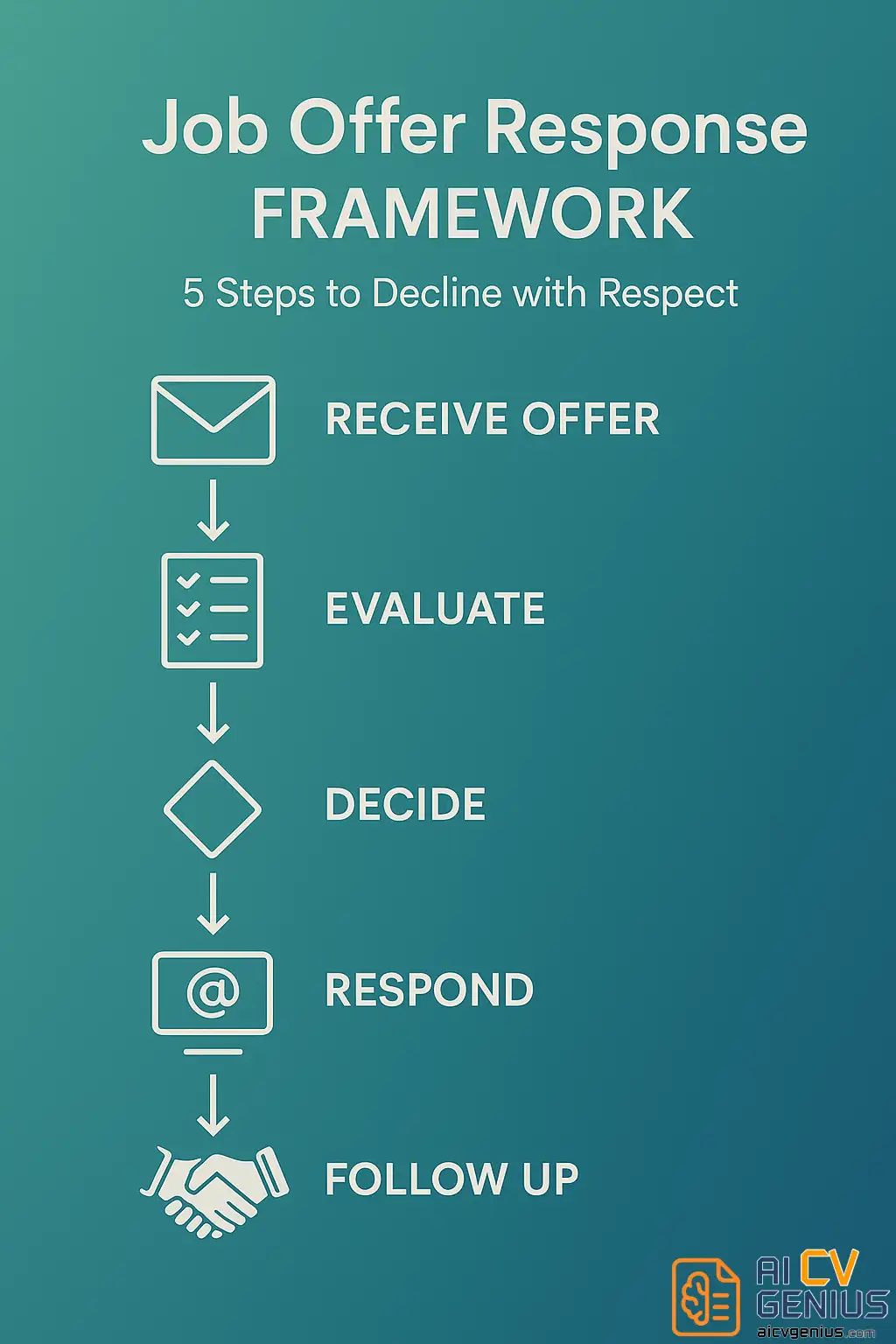
Step One: Take a Pause (But Not Too Long)
When an offer arrives, your emotions can cloud your judgment. You might feel a rush of excitement, a wave of guilt, or a jolt of anxiety. Do not reply immediately. Take a pause – a few hours or an evening – to separate the validation of being wanted from the reality of wanting the job.
Ask yourself three clarifying questions:
- Alignment: Does this role truly align with my long-term career goals, or is it just a comfortable next step?
- Logistics: Is the compensation, commute, timing, or company culture a realistic and positive fit for my life right now?
- Enthusiasm: Am I feeling genuinely excited about this, or am I just relieved to have an offer?
If your honest answers lean toward “no,” then clarity beats delay. Waiting too long makes the decline awkward and unprofessional. The “golden window” is within 24–48 hours of making your final decision. The hiring team will thank you for your promptness.
The Anatomy of a Polite Rejection: A 4-Part Structure
A professional decline is a masterclass in balance. It must be clear but warm. Direct but appreciative. Final but friendly. Use this simple four-part structure for any declining a job offer email template you create. It is short, clear, and has never failed.
| Part | Purpose | Why It Works |
|---|---|---|
| 1. The Appreciation | Start with genuine gratitude. Thank them for their time, the offer, and the opportunity to learn about the company. | It leads with warmth and respect, showing you value their effort. |
| 2. The Clear Decision | State your decision clearly and directly. Do not use weak or vague language like “I don’t think I can” or “I’m leaning away.” | Use a simple, professional line: “After careful consideration, I have decided to decline the offer.” |
| 3. The Brief Reason (Optional) | Optionally, provide a brief, professional reason. This is a courtesy, not an obligation. Keep it simple and positive. | It provides closure. “I’ve accepted another role that aligns more closely with my long-term goals.” |
| 4. The Gracious Close | End on a positive, forward-looking note. Wish them well in their search and express hope to cross paths in the future. | This is how you keep the bridge intact and leave the relationship on a high note. |
That is it. You do not need long, winding explanations, five-paragraph apologies, or defensive justifications. Clarity, combined with kindness, is the formula for professional respect.
Templates & Examples for Every Scenario
Use these templates as a starting point. The most important part is to customize the “appreciation” (Part 1) and “reason” (Part 3) to be genuine to your experience.
Example 1: The Classic Decline (Accepted Another Role)
This is the most common scenario. The tone is appreciative, direct, and professional.
Subject: Job Offer – [Your Name] – [Role Title]
Dear [Hiring Manager Name],
Thank you so much for offering me the [Role Title] position at [Company Name]. I truly appreciate you and the team taking the time to speak with me throughout the interview process, and I was very impressed with [Specific Positive Thing, e.g., “the company’s vision”].
After careful consideration, I have decided to decline the offer. This was a difficult decision, but I have accepted another opportunity that I feel is a closer fit for my long-term career goals at this time.
I wish you and the team all the best in finding the right candidate for the role. I enjoyed our conversations and hope our paths cross again in the future.
Best regards,
[Your Name]
Example 2: When Money Is the Main Reason
This is a delicate situation. You do not want to sound purely transactional, but honesty is often appreciated. It can even, on rare occasions, trigger a counteroffer (though you should never count on this).
Subject: Job Offer – [Your Name]
Dear [Hiring Manager Name],
Thank you again for the generous offer for the [Role Title] position. I have so enjoyed getting to know you and the team and was truly excited about [Specific Project or Aspect of the Role].
After reviewing the complete compensation package, I have decided to decline the offer. While this role is compelling, I am currently seeking a position that offers a compensation level more in line with my skills and the market value for this role.
I am very grateful for your time and consideration. I wish you and [Company Name] all the best.
Sincerely,
[Your Name]
Example 3: When You Loved the Company (But Not the Role)
This is a crucial networking opportunity. Your goal here is to how to reject a job offer gracefully while enthusiastically keeping the door open for a future, better-fitting role.
Subject: Job Offer – [Your Name]
Dear [Hiring Manager Name],
Thank you so much for the offer for the [Role Title] position. I want to express my sincere appreciation for your time and for the insightful conversations I had with the team.
I have been incredibly impressed with [Company Name]’s culture and mission. Because of that, this was a very difficult decision to make. After much thought, I have decided to decline this specific offer as I feel the role is not the perfect fit for my current career trajectory.
However, I remain deeply interested in [Company Name] as a place to work. My passion for [Your Industry/Skill] aligns so well with your work in [Company’s Area].
I would love to stay in touch, and I hope you will keep me in mind for any future opportunities that might be a better match.
Warm regards,
[Your Name]
Example 4: Declining After Accepting (The Most Difficult Scenario)
This is a tough situation that burns bridges if handled poorly. Speed, humility, and a direct apology are essential. This is one of the few times a phone call is often better than an email, but if you must email, it needs to be flawless.
Do not ghost them. Face it directly. You have likely caused them significant inconvenience, as they have stopped their search. Acknowledge this.
Subject: Regarding the [Role Title] Offer
Dear [Hiring Manager Name],
Please accept my sincere apologies. I am writing to inform you that I must, unfortunately, withdraw my acceptance of the [Role Title] position.
This was not an easy decision, and it is one I make with great regret. An unexpected opportunity has arisen that I believe I must pursue for my long-term personal and professional goals.
I am truly sorry for the inconvenience this will cause you and the team. I have nothing but the highest respect for [Company Name] and the opportunity you extended to me.
I wish you all the best in your search.
Sincerely,
[Your Name]
Example 5: Declining an Internal Position
This is all about preserving your internal reputation. You must be exceptionally gracious, as you will be working with these people every day.
Subject: Following up on our [Role Title] conversation
Dear [Internal Hiring Manager Name],
Thank you so much for considering me for the [Role Title] position. I am truly grateful for the confidence you and the team have shown in me.
After giving it a great deal of thought and reviewing my current projects, I have decided to remain in my current role as [Your Current Role]. I am very committed to the [Your Current Project] initiative and feel my immediate focus should remain here to see it through.
I am still very interested in growing within [Company Name] and would love to keep this conversation open for the future. I am a huge supporter of your team’s work and hope we can collaborate in other ways.
Best regards,
[Your Name]
Advanced Strategies: Phone Call vs. Email and Other Nuances
Phone Call vs. Email: Which is Better?
This debate depends on the relationship you built during the interview process.
- Email is the Standard (95% of cases): An email is almost always the preferred method. It is professional, provides a written record, does not put the manager on the spot, and allows them to process the information on their own time. It is clean and respectful.
- A Phone Call is for High-Touch Situations: You should only call to decline if:
- You have built an incredibly strong, personal rapport with the hiring manager (multiple interviews, long conversations).
- You are declining an internal role.
- You are withdrawing after you have already accepted (as discussed in Example 4).
If you do call, be prepared. Have your 2-3 sentence script ready. Be warm, appreciative, and direct. Do not ramble. Follow it up immediately with a brief email confirming the conversation: “Dear [Name], as per our conversation, thank you again for your understanding. I wish you all the best.”
Communication Mistakes to Avoid at All Costs
How you say no is just as important as the “no” itself. Avoid these common, brand-damaging mistakes.
| The Mistake | Why It’s Bad | The Professional Fix |
|---|---|---|
| Ghosting | This is the cardinal sin. It is deeply unprofessional, burns the bridge, and permanently damages your reputation with that company and recruiter. | Always, always send a reply. Any reply is better than no reply. |
| Waiting Too Long | Waiting a week to reply shows disrespect for their time and holds up their entire hiring process. | Reply within 24-48 hours of making your decision. |
| Being Vague (The “Maybe”) | “I’m not sure it’s the right time…” or “I don’t think I can…” This is weak and frustrating. It leaves the door open and forces the manager to guess. | Be direct and final. “I have decided to decline…” or “I am withdrawing my candidacy…” |
| Over-Explaining | Writing a five-paragraph essay about your complex decision-making process. It sounds defensive and self-important. | Keep it to 3-4 sentences. They don’t need your life story, just your decision. |
| Being Too Critical | “The salary was too low,” or “I didn’t like the team’s energy,” or “The benefits were poor.” This is arrogant and burns the bridge. | Frame it positively. Instead of “salary was low,” say “seeking compensation more aligned with the market.” |
| Using It as Leverage | Trying to “bluff” a decline to get a counteroffer. This is a high-risk, low-reward game that can backfire and make you look manipulative. | If you want to negotiate, negotiate. Do not decline unless you are 100% prepared to walk away. |

In-Depth FAQs: Your Toughest Questions Answered
Final Thoughts: Your “No” is Part of Your Brand
Declining a job offer is not a confrontation; it is a communication. It is a moment of alignment – you are aligning with your own goals, and you are respectfully allowing the company to align with theirs. The best professionals know their worth and can communicate it with empathy, whether they are saying “yes” or “no.”
Knowing how to decline a job offer politely proves you can handle difficult conversations with kindness and clarity. It separates impulsive candidates from thoughtful professionals. If you are navigating this process, remember that clarity is your greatest tool. Say no the right way, and you will keep your network strong, your reputation intact, and your confidence high. And if you want to build better communication habits, check why confidence matters more than experience – it will help you trust your decisions.