

- What a mentor is: A guide with experience who helps you avoid mistakes, see options, and get honest feedback.
- Start with clarity: Define the exact goal you need help with, and expect to have multiple mentors for different needs.
- Where to find them: Inside your company first, then alumni networks, professional groups, and thoughtful LinkedIn outreach.
- How to ask correctly: Request one 15 to 20 minute conversation on a specific topic, not an open ended “be my mentor” commitment.
- How to keep it working: Come prepared, respect their time, follow up with outcomes, provide value back, and know mentors advise while sponsors advocate.
Mentors Aren’t Friends – They’re Guides
People confuse mentors with friends or coaches. A mentor isn’t someone who cheers you on unconditionally or holds your hand through every decision. A mentor is someone further along a path you want to travel who shares what they learned getting there.
Good mentors accelerate your career by helping you avoid mistakes they made, introducing you to opportunities and people, and providing honest feedback when you’re off track. They don’t do the work for you – they help you see the path more clearly.
But most people struggle to find mentors because they approach it wrong. They ask strangers “Will you be my mentor?” which feels like a huge commitment. Or they wait passively hoping someone will volunteer to mentor them, which rarely happens.
Here’s how to find mentors strategically and ask in ways that actually get yes responses.
Step 1: Define Your Goal (What Do You Actually Need?)
Before looking for a mentor, clarify what you need help with. Mentors aren’t generalists who solve all career problems – they’re most valuable when focused on specific areas.
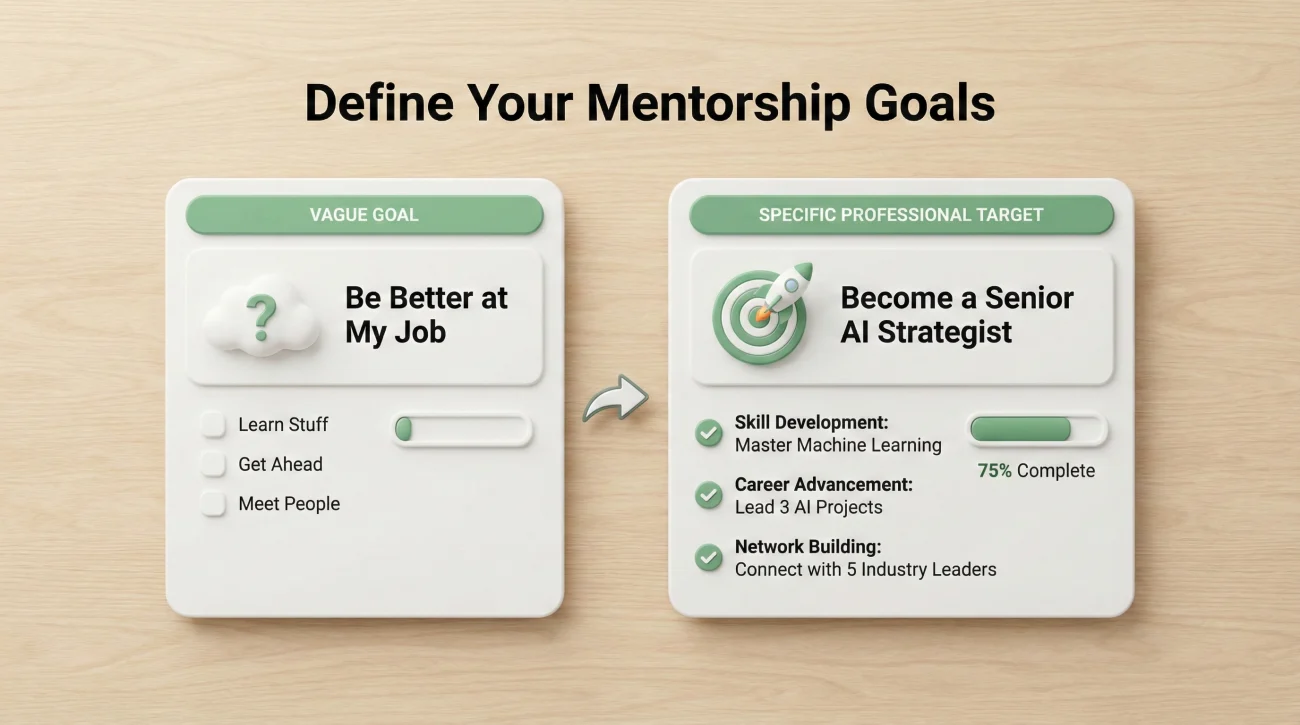
Different Mentorship Needs
- Skill development: Learning specific technical or professional skills
- Career advancement: Understanding how to get promoted or change industries
- Navigation: Learning unwritten rules of your industry or company
- Network building: Getting introduced to people and opportunities
- Specific transitions: Moving into management, changing careers, starting a business
Get Specific
Vague goal:
“I want career guidance”
Specific goal:
“I want to transition from marketing to product management within the next 18 months. I need guidance on what skills to develop and how to position myself for PM roles.”
Specific goals help you identify the right mentor and make your request compelling.
You Can Have Multiple Mentors
One person rarely has all the answers. You might have:
- A technical mentor for skill development
- A career mentor for advancement strategy
- An industry mentor for sector-specific knowledge
- A life mentor for work-life balance and perspective
Don’t expect one person to fulfill all mentorship needs.
For comprehensive career development strategies, see our complete career guide.
Step 2: Where to Look for Mentors
The best mentors are often closer than you think. Start with accessible people before reaching out to strangers.
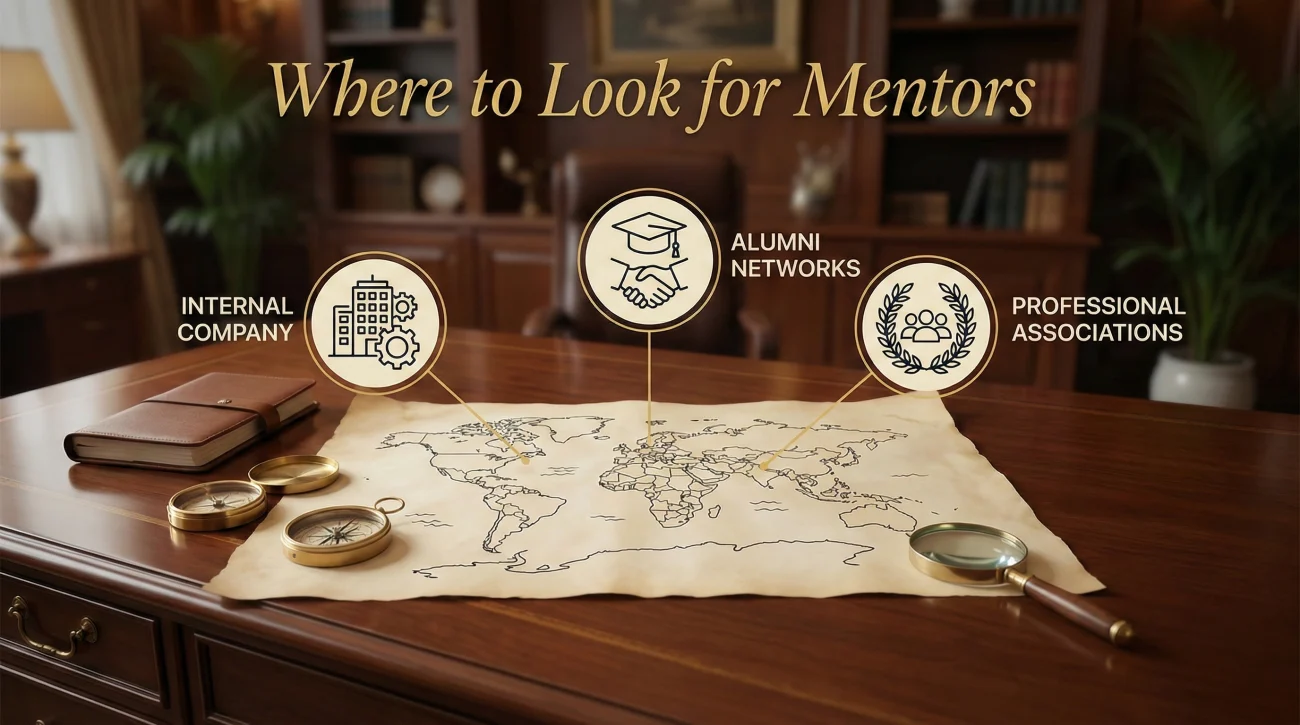
Within Your Company
Look for people 2-3 levels above you who have careers you admire:
- Senior colleagues in your department
- Leaders in adjacent teams
- People who made transitions you want to make
- Former managers or skip-level leaders
Internal mentors understand your company’s culture and can provide specific, actionable advice.
Alumni Networks
Your college or university alumni network is underutilized. Alumni often want to help other graduates:
- Search LinkedIn for alumni in your target industry or role
- Attend alumni networking events
- Join alumni groups focused on your field
The shared educational background creates immediate connection.
Professional Associations
Industry associations, conferences, and meetups connect you with experienced professionals:
- Product management associations
- Marketing professional groups
- Tech community meetups
- Industry-specific conferences
Attend consistently and build relationships before asking for mentorship.
LinkedIn (Strategic Outreach)
Cold LinkedIn outreach can work if done thoughtfully:
- Look for people with career paths similar to your goals
- Focus on people who regularly post or engage (they’re accessible)
- Prioritize 2nd-degree connections (mutual connection = credibility)
- Research their background before reaching out
Success rate is lower than internal mentors, but the potential reach is unlimited.
Formal Mentorship Programs
Some companies and organizations have structured programs:
- Internal company mentorship programs
- Industry organization programs
- Professional development platforms
These provide structure but may lack the organic chemistry of self-selected mentorship.
Step 3: How to Ask (The Right Way)
Never ask “Will you be my mentor?” This sounds like a huge, indefinite commitment. Most people say no or ghost you.
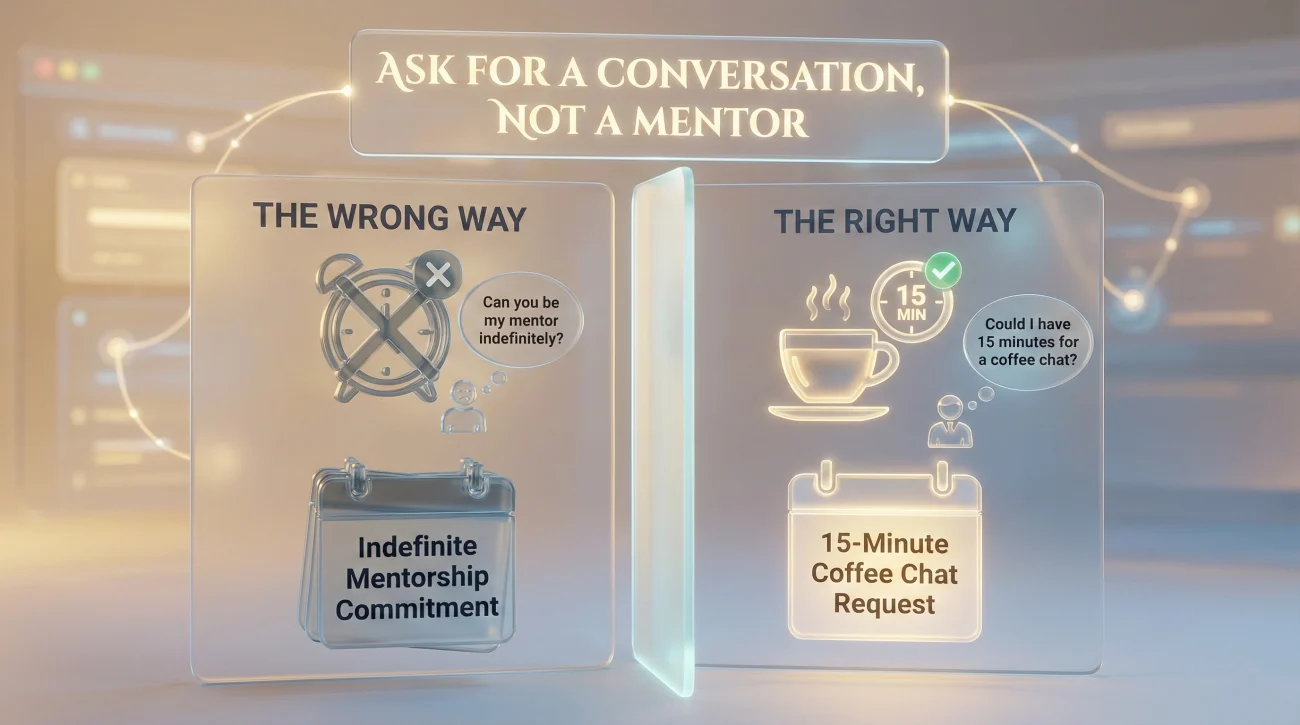
The Wrong Approach
“Hi, I really admire your career. Would you be my mentor?”
Why this fails:
- Undefined time commitment
- Unclear expectations
- Sounds like a big favor from a stranger
- No specific value proposition
The Right Approach: Start Small
Request a single, specific conversation instead of ongoing mentorship:
“I’d love to get your advice on [specific topic] for 15-20 minutes. Would you be open to a brief call or coffee?”
Why this works:
- Clear time commitment (15-20 minutes)
- Specific focus (advice on X, not life guidance)
- Low-pressure ask
- Easy to say yes to
Let Mentorship Develop Organically
After the first conversation goes well, follow up periodically with updates and specific questions. If the relationship is valuable to both of you, it naturally becomes ongoing mentorship without ever using the word “mentor.”
Many successful mentor relationships never formally establish themselves – they’re just people who regularly exchange advice and check-ins.
Email Template: Requesting a Conversation
For Internal Company Mentors
Subject: Quick advice on [specific topic]
Hi [Name],
I’ve been following your career path from [previous role] to [current role], and I’m hoping to make a similar transition in the next year.
I’d love to get your advice on how you made that move and what skills were most important. Would you have 20 minutes for a quick coffee or call in the next few weeks?
I know you’re busy, so I’m happy to work around your schedule.
Thanks for considering,
[Your Name]
For LinkedIn Cold Outreach
Hi [Name],
I came across your profile while researching careers in [industry/role]. Your background in [specific experience] is particularly relevant to what I’m trying to accomplish.
I’m currently [your situation] and working toward [specific goal]. I’d really value 15 minutes of your time to get your perspective on [specific question].
I know this is out of the blue, but would you be open to a brief call? I’m happy to work around your schedule.
Thanks for considering,
[Your Name]
Key Elements
- Specific reason you chose them: Shows you did research
- Clear, limited time ask: 15-20 minutes, not open-ended
- Specific topic: Advice on X, not general life guidance
- Acknowledge they’re busy: Respect for their time
- Make it easy to say yes: Offer flexibility on timing
For more professional networking strategies, explore our career development guide.
How to Manage the Mentorship Relationship
Once you establish a mentor connection, don’t waste it by being unprepared or entitled.

Come Prepared to Every Conversation
Before each meeting:
- Send a brief agenda 24-48 hours ahead
- Prepare specific questions
- Update them on progress since last conversation
- Have pen and paper ready to take notes
Never show up to a mentor conversation asking “So what should we talk about?”
Share Updates and Outcomes
After acting on their advice, follow up with results:
“I wanted to update you – I implemented your suggestion about [X] and it resulted in [Y]. Thank you again for that advice.”
This shows you value their input and actually use it.
Respect Their Time
- Start and end meetings on time
- Don’t meet more frequently than they offer
- Send concise emails, not essays
- Don’t expect instant responses
Mentors are doing you a favor. Make it easy and rewarding for them.
Provide Value Back
Mentorship doesn’t have to be one-way:
- Share articles or resources relevant to their interests
- Introduce them to people in your network
- Offer your skills when appropriate (design help, writing, research)
- Be a source of fresh perspective from your generation or field
The best mentor relationships are mutually beneficial.
End Gracefully When Appropriate
Not all mentor relationships last forever. When you’ve outgrown the advice or the relationship has run its course:
“I wanted to thank you for all your guidance over the past [time period]. Your advice on [specific things] has been incredibly valuable. I’m going to take some time to implement what I’ve learned before our next conversation.”
This gives space without burning the bridge.
Mentor vs. Sponsor: Understanding the Difference
Mentors Give Advice
Mentors provide guidance, perspective, and feedback. They help you think through decisions and develop skills. The relationship is primarily conversational.
Sponsors Take Action
Sponsors actively advocate for you in rooms you’re not in. They recommend you for opportunities, defend you when criticized, and use their political capital to advance your career.
Sponsorship is higher stakes and requires proven trust. You earn sponsors by delivering exceptional results and building credibility.
You Need Both
- Mentors: Multiple people providing different perspectives
- Sponsors: One or two senior leaders with real power who actively advocate for you
Focus on finding mentors first. Sponsorship typically develops after you’ve proven yourself to senior leaders.
FAQ
Mentors Help You – They Don’t Do the Work for You
Finding a mentor isn’t about finding someone to solve your problems or make decisions for you. It’s about finding experienced guides who help you see paths more clearly and avoid mistakes they’ve already made.
The process: define your specific goal first, look for mentors internally before going external, and never ask “Will you be my mentor?” Instead, request a single 15-20 minute conversation about a specific topic. Let the relationship develop organically from there.
Come prepared to every conversation, respect their time, follow up with outcomes, and provide value back when possible. The best mentor relationships are mutually beneficial, not one-way favors.
Remember that mentors give advice – sponsors take action on your behalf. You need both, but mentorship is more accessible to develop early in your career.
Start looking for mentors today. Identify three people whose careers or expertise you admire, craft specific requests for 15-minute conversations, and reach out. The worst they can say is no. The best they can say changes your career trajectory.
For additional career development resources, check out our comprehensive career guide.