
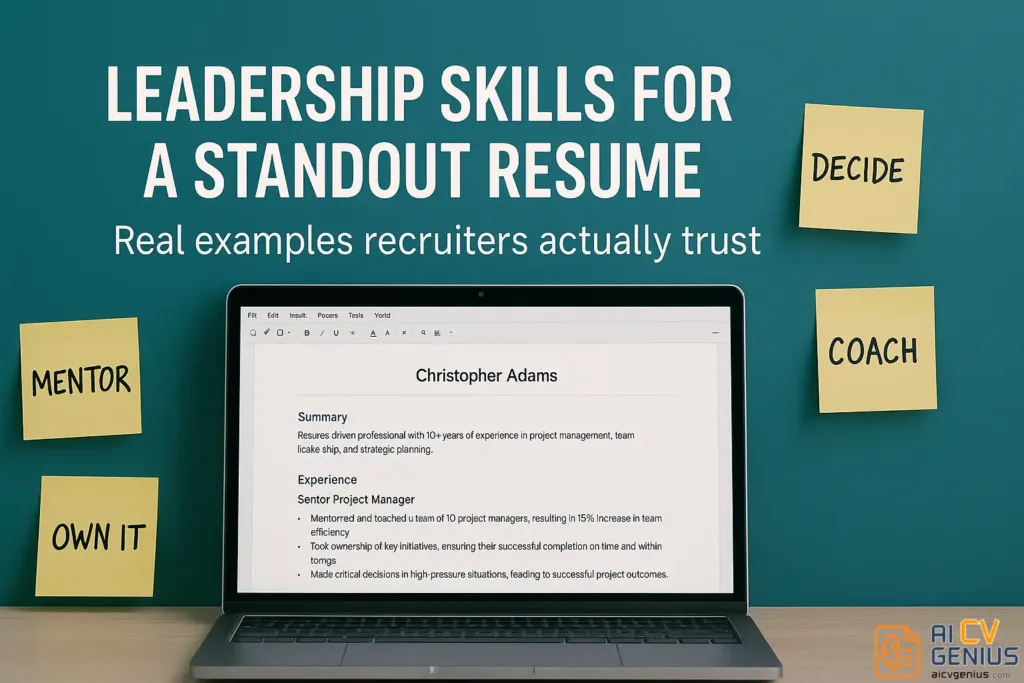
- Meaning: Leadership on a resume is a pattern of actions like setting direction, taking ownership, removing blockers, making decisions, and helping others succeed, not a title.
- Resume placement: Put one leadership claim in your summary, then back it up with 2 to 4 proof bullets per role and a skills list broken into people, strategic, and execution components.
- Bullet formula: Replace vague duties with Action verb, what you did, for whom, and the result, using metrics or proxies like time saved, risk reduced, or process improved.
- Modern examples: Show leadership at any level and in remote teams through clear communication, coaching, digital mentorship, and building connection without forced authority.
- Avoid pitfalls: Skip empty claims, title-only signals, and jargon, use plain English, selective ATS keywords, and one concrete outcome per bullet so the story carries the weight.
When a hiring manager skims your resume, they are not just looking for someone who can do a job. They are hunting for something far rarer: proof that you can move people, projects, and ideas forward. They are looking for leadership skills for resume that are clear, measurable, and relevant.
Leadership is the single most valuable “soft skill” because it is a force multiplier. A candidate with leadership potential does not just add their own output; they elevate the output of the entire team. They reduce risk, solve problems before they escalate, and take ownership, which lowers the cognitive load on their manager. But “leadership” itself is a vague, overused buzzword. How do you prove it?
This is not a guide about manager titles. This is a guide for everyone – from fresh graduates to senior contributors – on how to find the moments of leadership in your history and translate them into crisp, powerful, and undeniable bullet points. We will turn your fuzzy traits into concrete evidence, with examples, metrics, and phrasing that work for both human recruiters and the ATS robots. Bring a recent project to mind – you will learn how to translate it as you read.
What Recruiters Mean by “Leadership” (The Deeper Psychology)
Leadership on a resume has almost nothing to do with a manager title. A title proves you were given responsibility; it does not prove you handled it well.
Recruiters and hiring managers are looking for a pattern of behavior. They are searching for evidence that you:
- ✅ Set Direction: Can you see the “why” behind the “what” and align others to it?
- ✅ Take Ownership: Do you run toward problems or away from them? When something breaks, are you part of the problem or part of the solution?
- ✅ Remove Blockers: Are you the person who spots a bottleneck and works to clear it, or do you wait for permission?
- ✅ Make Decisions: Can you make a sound judgment with incomplete data and keep the project moving?
- ✅ Help Others Succeed: Do you hoard knowledge, or do you share it? Do you mentor, coach, and uplift the people around you?
In short, leadership is not a status – it is a collection of actions that make the team better. Each bullet point on your resume is a chance to prove you are a safe bet, someone who will add value beyond the lines of a job description. You can see how our resume templates are designed to highlight this logic clearly, making your leadership stories stand out at first glance.
Leadership isn’t a status – it’s a pattern of decisions, communication, and outcomes that others can rely on.
The 12 Core Leadership Skills (And How to Prove Them)
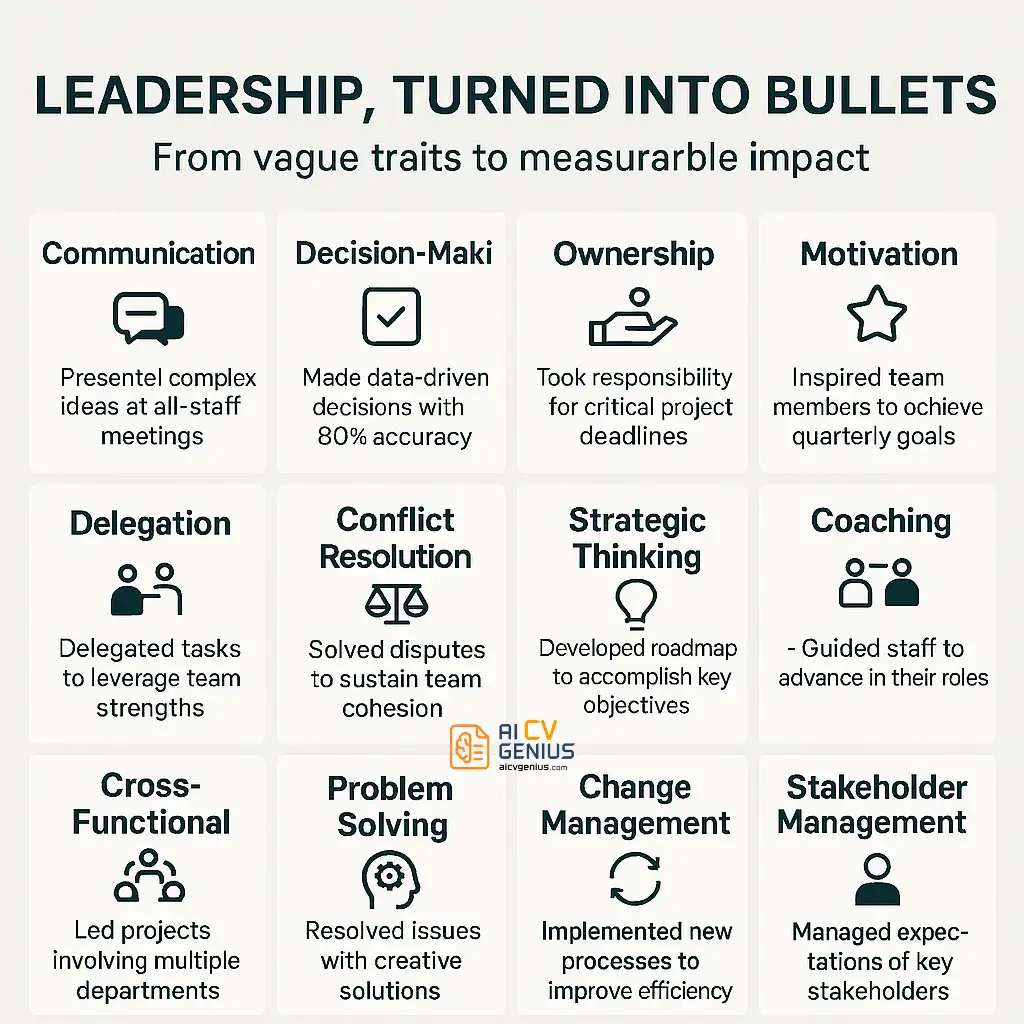
Here is how to turn each of the 12 core leadership skills into strong, believable lines on your resume. We will go beyond just an example – we will explore why it matters and where to find it in your own experience.
- CommunicationWhy it matters: Leadership is communication. It is the tool for casting vision, aligning teams, and ensuring clarity. Poor communication creates chaos; strong communication creates momentum.How to prove it: Show a time you simplified a complex idea, managed expectations, or created a process for information to flow.Example: “Directed weekly standups across three engineering pods, creating a single source of truth that cut status-update churn by 40%.”
- Decision-MakingWhy it matters: Teams get stuck without decisions. Leaders are trusted to make a call, often with imperfect information, to keep the project moving.How to prove it: Find a moment where you had to make a tough choice between two options. What was the logic? What was the outcome?Example: “Chose a phased product rollout over a full launch, which reduced incident risk by 60% while still meeting the primary launch date.”
- Ownership & AccountabilityWhy it matters: This is the #1 trait managers look for. It means “I will see this through to the end.” It is the opposite of “that’s not my job.”How to prove it: Look for a failing project you took over, a problem nobody else wanted to touch, or a time you owned a mistake and fixed it.Example: “Took ownership of a delayed feature with 20+ critical bugs and led the triage effort, delivering it two weeks early.”
- Motivation & InfluenceWhy it matters: This is about influencing without authority. How do you get people bought into an idea? How do you maintain morale during a tough sprint?How to prove it: This is often about culture. Did you start a peer-recognition ritual, a “wins of the week” doc, or a learning group?Example: “Launched a peer-recognition ritual (‘Kudos Friday’) that was adopted by the wider department and raised team engagement scores from 6.8 to 8.2.”
- DelegationWhy it matters: You cannot scale if you do everything yourself. Effective delegation shows you trust others, understand their strengths, and can manage resources efficiently.How to prove it: Show how you broke down a large project and assigned work, leading to a better, faster result.Example: “Split a 10-week monolithic project backlog into 3 parallel streams and delegated ownership, finishing the entire project in 6 weeks at parity quality.”
- Conflict ResolutionWhy it matters: Smart people disagree. A lack of conflict is a bad sign. A leader does not avoid conflict but steps into it to find a productive solution.How to prove it: Think of a time two stakeholders (or teammates) were at a stalemate. How did you get them to a “yes”?Example: “Mediated a design-engineering debate over feature scope; facilitated a compromise that aligned priorities and shipped the MVP in 18 days.”
- Strategic ThinkingWhy it matters: This separates task-doers from leaders. Can you see the 12-month view, not just the 12-hour view? Can you connect your work to the company’s bottom line?How to prove it: Show how you analyzed a situation and proposed a new direction that was more efficient or profitable.Example: “Reframed the team’s product roadmap by potential ROI, leading to a reallocation of 15% engineering capacity to high-growth features.”
- Coaching & MentoringWhy it matters: True leaders create more leaders. They do not hoard knowledge; they share it. This shows you are a multiplier, not just a contributor.How to prove it: Did you onboard a new hire? Did you teach a junior person a new skill? Did you create documentation that helped everyone?Example: “Coached two junior developers in test-driven development, helping them ship features independently and dropping their code-review cycle time from 9 to 5 days.”
- Cross-Functional CollaborationWhy it matters: No team works in a vacuum. This proves you can speak the language of other departments (like marketing, sales, or design) and be the “glue” that holds a project together.How to prove it: Find any project that involved 2+ departments. What was your role in keeping them aligned?Example: “Coordinated marketing, operations, and data teams to launch a new user acquisition funnel that boosted qualified leads by 27%.”
- Problem SolvingWhy it matters: This is leadership under pressure. When things inevitably break, do you panic or do you create a plan?How to prove it: Think of a crisis. A server went down. A client was angry. A deadline was missed. What was the process you used to fix it?Example: “Introduced a triage playbook during a critical site-outage; cut incident resolution time from 11 hours to 4 hours.”
- Change ManagementWhy it matters: People naturally resist change. Leaders know how to manage the “human side” of a new tool, process, or strategy.How to prove it: Show a time you rolled out something new. How did you get buy-in? How did you train people? How did you measure success?Example: “Led the migration to a new CRM; personally trained 40 users in workshops and maintained 99.5% data integrity during the 3-month transition.”
- Stakeholder ManagementWhy it matters: This is about managing “up” and “out.” Can you keep executives and other senior leaders informed, aligned, and confident in your team’s work?How to prove it: Show how you created a communication ritual (like a review or a report) that reduced “ad-hoc requests” and built trust.Example: “Created and ran monthly OKR reviews with executive leadership; reduced ad-hoc status requests by 35% and secured buy-in for all Q3 roadmap items.”
How to Show Leadership on Your Resume
Leadership Skills Examples for Resume: By Seniority Level
Swap in your own project, metric, and timeframe. Notice how the scope of the impact (team, department, company) grows with seniority.
For Entry-Level & Fresh Graduates
- ✅ Coordinated a 5-person capstone project; delivered a prototype that won the ‘Best in Show’ department award.
- ✅ Organized a peer-learning circle for 10 classmates that improved exam averages by 12%.
- ✅ Trained 3 new part-time hires on POS and closing procedures, ensuring 100% compliance with store standards.
- ✅ Volunteered to create a new scheduling spreadsheet for the volunteer team, reducing shift-planning time by 50%.
For Mid-Level Professionals (Individual Contributors)
- ✅ Built a cross-team incident response rota that cut mean response time from 30 minutes to 12 minutes.
- ✅ Mentored three interns – two converted to full-time hires after successfully shipping production features.
- ✅ Facilitated a weekly risk review meeting that prevented three critical (P1) issues from reaching customers.
- ✅ Negotiated API limits with a key vendor to keep the product launch on track, saving an estimated $18k in annual overage fees.
- ✅ Championed and built a new documentation-first workflow, trimming the team’s review and approval cycles by three days.
For Senior & Lead Professionals
- ✅ Orchestrated quarterly planning across Sales, Marketing, and Product (11 stakeholders), aligning all teams on 3 core priorities and cutting duplicated work by 22%.
- ✅ Coached four mid-level peers in strategic negotiation, leading to a 15% average reduction in vendor contract costs.
- ✅ Led the architectural design and adoption of a new microservices pattern, improving system deploy time from 45 minutes to 5 minutes.
- ✅ Restructured the $5M department budget, reallocating funds from low-ROI projects to fund two new strategic R&D hires.
Where Leadership Fits on Your Resume: A 3-Part Strategy
Do not just throw leadership skills in a list. Weave them strategically into three key areas for maximum impact.
1. The Professional Summary (Your Headline)
Your summary is your 6-second pitch. It must blend your core function, your biggest impact, and your leadership pattern. This sets the theme for the entire document.
Formula: [Your Role] + [Your Core Function] + [Proof of Leadership Impact]
- Instead of: “Experienced data analyst skilled in Python and SQL.”
- Try: “Senior Data Analyst who turns messy datasets into decisions. Led cross-functional experiments that lifted user conversion by 19%.”
- Instead of: “Motivated project manager with PMP certification.”
- Try: “PMP-certified Project Manager who delivers complex projects on time. Specialized in unifying global stakeholders and mitigating risk.”
2. The Experience Bullets (Your Proof)
This is where you prove the claim from your summary. As shown in the examples above, every bullet point should be a mini-story of leadership. Use strong, leadership-focused verbs like Led, Orchestrated, Coached, Negotiated, Simplified, or Owned. Aim for at least two to four leadership-flavored bullets per role.
3. The Skills Section (Your Keywords)
Do not just list “Leadership.” It is a meaningless keyword. Instead, break it down into the specific components of leadership that you possess. This is far more credible and ATS-friendly.
Instead of this:
Skills: Leadership, Communication, Problem-Solving, Microsoft Office.
Try grouping them strategically:
Core Competencies:
- People Leadership: Coaching & Mentoring, Conflict Resolution, Team Building
- Strategic Leadership: Stakeholder Management, Strategic Planning, Change Management
- Execution Leadership: Project Management, Risk Mitigation, Process Optimization
How to Describe Leadership Skills on a Resume (Without Buzzwords)
The “Before & After” transformation is simple: trade vague responsibilities for concrete, impactful actions. Use this frame: Action verb → What you did → For whom → Result (metric).
If you cannot share a numeric KPI, describe time saved, risk reduced, or process improved. You can find examples of this phrasing pattern in our career resources section – it helps you translate experience into impact more naturally.
| Before (Vague Responsibility) | After (Clear Leadership Action) |
|---|---|
| Responsible for inter-departmental meetings. | Orchestrated a weekly design-engineering sync to land a shared MVP spec in five days. |
| Wrote documentation for the team. | Championed a “doc-first” workflow for the engineering team, trimming review cycles by three days. |
| Helped solve customer issues. | Unblocked a critical vendor SSO issue by coordinating with their tech support, restoring access for 120 internal users. |
| Trained new hires. | Mentored two new hires through their first full release train, helping them both ship features independently. |
| Involved in talks with marketing. | Negotiated project scope with marketing leadership to focus on two high-priority, revenue-tied metrics. |
Leadership Without the Title: Leadership Skills for Fresh Graduates
You do not need a manager title to show leadership. For students or early-career professionals, leadership means initiative, ownership, and follow-through. Recruiters are not looking for you to have managed a 10-person team; they are looking for the potential and the mindset.
Find leadership in these places:
- Academic Projects: Were you the one who set the timeline? Who organized the final presentation? Who mediated a disagreement about the project’s direction?Example: “Led a five-person capstone team to develop a full-stack application; coordinated all sprints and delivered a final prototype that won a department award.”
- Part-Time Jobs: Were you trusted to train new staff? Did you create a “cheat sheet” to help coworkers? Were you the one who handled difficult customers?Example: “Promoted to Shift Lead; trained and mentored 4 new baristas on service standards and closing procedures, resulting in zero register errors for my shifts.”
- Volunteer & Club Work: Did you organize an event? Manage a budget? Recruit new members?Example: “Coordinated sponsors and logistics for a campus charity event with 300+ attendees, successfully raising over $5,000 for the local food bank.”
List these under “Projects” or “Experience.” Titles do not matter – results do. You can also look at our student resume templates for clean layouts that fit academic projects and early career roles.

Tailor Leadership by Role: Examples for PM, Tech, and Sales
Leadership language changes. A project manager shows leadership through process and risk-mitigation, while an engineer shows it through technical vision and mentorship. Tailor your bullets to the role.
Leadership Skills for Project Manager Resume
Project managers are expected leaders. Go deeper. Show how you led. Focus on planning, risk, and stakeholder alignment.
- ✅ Established and maintained RAID (Risks, Assumptions, Issues, Dependencies) logs for all projects, reducing surprise issues by 40% quarter-over-quarter.
- ✅ Ran critical path analysis on a delayed project, re-sequenced 10 key tasks, and successfully recovered a three-week delay.
- ✅ Facilitated executive steering committee reviews that secured on-time approvals and C-level buy-in for each project gate.
Leadership Skills for Software Engineers
Technical leadership is about more than code. It is about architecture, quality, and making the team faster and better.
- ✅ Championed the adoption of a new testing library and personally coached 6 junior engineers on its use, increasing team test coverage from 65% to 85%.
- ✅ Designed and led the implementation of a new caching strategy, reducing API response times by 70% (from 800ms to 240ms).
- ✅ Volunteered to create and manage the on-call rota and playbook, improving team morale and reducing mean time to resolution (MTTR) for P1 incidents.
Leadership Skills for Sales & Account Executives
Leadership in sales is about ownership, strategy, and collaboration. It is about more than your quota; it is about how you manage your territory and help your team.
- ✅ Mentored two new Sales Development Reps (SDRs) on objection handling, helping them both achieve 100%+ of their quota within their first quarter.
- ✅ Collaborated with the marketing team to refine lead-scoring criteria, increasing the sales-accepted-lead (SAL) rate by 20%.
- ✅ Took ownership of a complex, at-risk enterprise account, rebuilt trust with the client, and successfully negotiated a 3-year, $750k renewal.
For a visual reference, check how our professional templates emphasize measurable outcomes over buzzwords.
Remote, Hybrid, and Asynchronous Leadership
Modern leadership often happens across time zones, without face-to-face interaction, and without formal authority. This is harder, and proving you can do it is a massive advantage.
Show how you create clarity and build culture, even from a distance:
- Asynchronous Clarity: “Pioneered a ‘doc-first’ culture for project briefs, reducing discovery meetings by 5 hours per week and ensuring clarity for global teams.”
- Intentional Communication: “Established and ran a bi-weekly ‘wins and blockers’ async checkpoint, keeping a 15-person remote team aligned without adding meeting fatigue.”
- Digital Mentorship: “Created a ‘Loom library’ of video walkthroughs for common technical issues, which became the standard onboarding tool for new remote engineers.”
- Virtual Culture: “Organized and facilitated virtual ‘coffee-roulette’ pairings that connected 50+ employees across departments, improving self-reported feelings of connection.”
Common Pitfalls and Pro-Tips
Common Mistakes – and Quick Fixes
Avoid these common traps that dilute your leadership message.
| Don’t (The Mistake) | Do Instead (The Fix) |
|---|---|
| “Strong leadership skills.” (The empty claim) | “Coached four peers to ship independently; cycle time −36%.” (The proof) |
| Listing titles only (e.g., “Team Lead”) | Show the decisions you made and risks you retired as the lead. |
| All verbs, no numbers. (e.g., “Led team projects”) | Add metrics: time saved, quality lift, revenue or cost impact. |
| Jargon soup. (e.g., “Synergized core competencies”) | Plain English and one concrete outcome per bullet. |
Mini-Workshop: Turn Responsibilities Into Wins
Try this formula on any recent task. It forces you to find the leadership story.
[Verb] + [Scope of Project] + [Who Benefited] + [What Improved] + [By How Much]
Here it is in action:
- ✅ [Coordinated] [quarterly planning] + [with sales, marketing, and ops] + [aligning 11 owners on 3 priorities] + [and cutting duplicated work by 22%].
- ✅ [Coached] [new support agents] + [through a live-shadow program] + [improving their first-reply time] + [from 2h to 45m].
ATS-Friendly Leadership Keywords (Use Sparingly)
| Theme | ATS Keywords | Where to Place |
|---|---|---|
| People | Coaching, Mentoring, Stakeholder Management, Team Leadership, Conflict Resolution | Skills Section + relevant bullets |
| Execution | Project Planning, Risk Management, Change Management, Delegation, Operations | Experience Section |
| Strategy | Cross-Functional Collaboration, Strategic Planning, Roadmap, OKR Alignment | Summary + bullets |
| Delivery | On-Time Delivery, Within Budget, Incident Reduction, Process Improvement | Experience (as metrics) |
Final Thoughts: Lead Where You Are
The best resumes do not just claim leadership – they prove it with clarity, momentum, and measurable impact. Leadership is not a title you are given; it is a choice you make. It is the choice to take ownership when others are confused, to communicate when there is silence, to mentor when someone is stuck, and to make a decision when the team is stalled.
Use the verbs, structures, and examples in this guide to find those moments in your own story and tell them with confidence. Mention your leadership pattern once in your summary, reinforce it with 2–4 powerful bullets per role, and let your measurable results carry the weight. If you are polishing your layout next, our Resume Templates Finder makes it easy to present these stories visually. That is how you make leadership skills for resume your most powerful asset.
In-Depth FAQs About Leadership Skills
They want to see:
- Initiative: Did you just do what you were told, or did you ever suggest a better way?
- Ownership: When you saw a problem (e.g., a messy spreadsheet, a confusing process), did you fix it or just complain about it?
- Reliability: Did you deliver your part of the group project on time, every time?
Use your academic projects, part-time jobs, or volunteer work to prove this. “Coordinated a 4-person group project” is leadership. “Trained a new barista” is leadership.
- Management is about process and execution. It is tactical. (e.g., “Managed a $50k budget,” “Scheduled a 10-person team,” “Tracked project milestones.”)
- Leadership is about people and vision. It is strategic. (e.g., “Coached a junior engineer,” “Aligned stakeholders on a new vision,” “Motivated a team during a difficult project.”)
A great resume shows both. A manager administers complexity; a leader inspires action. You can be a leader without being a manager (e.g., a senior engineer who mentors everyone), and unfortunately, you can be a manager without being a leader.
- Time: “Reduced meeting time by 30%,” “Cut incident response time in half,” “Delivered the project 2 weeks early.”
- Efficiency/Process: “Automated a manual report, saving 10 hours per week,” “Created a template that was adopted by 3 other teams.”
- Quality: “Reduced bug reports by 25%,” “Improved customer satisfaction scores from 8.0 to 9.5.”
- Adoption: “Trained 40 users on a new tool with 100% adoption,” “My new process was adopted by the entire department.”
- Risk: “Prevented 3 critical issues from reaching customers,” “Reduced data errors by 90%.”
- Good: “Led the design and execution of the new marketing campaign.” (You led the project).
- Good: “Led a 3-person working group to evaluate new software.” (You led the initiative).
- Good: “Led the team’s migration to TypeScript.” (You led the technical effort).
- Misleading: “Led the marketing team.” (This implies you were their manager).
Use verbs like “Coordinated,” “Orchestrated,” “Facilitated,” and “Championed” if “Led” feels too strong.
- “Thought Leader”
- “Synergy” / “Synergized”
- “Results-Driven” (Show the results instead)
- “Go-getter”
- “Dynamic”
- “Visionary”
- “Transformational Leader”
Stick to strong verbs (Coached, Built, Simplified, Delivered) and hard numbers.
- Strategic Thinking: “Analyzed 3 competing strategies and presented a data-backed recommendation that was adopted by leadership.”
- Writing & Clarity: “Authored the new ‘single source of truth’ project documentation, which cut onboarding time for new members by 50%.”
- Active Listening: “Facilitated a customer feedback session, synthesized 50+ comments into 3 core themes, and presented the findings to the product team.”
- Mentorship: “Provided 1-on-1 code reviews and mentorship for a junior developer, helping them gain confidence and ship their first solo feature.”
This is quiet, effective, and extremely valuable leadership.