

- “What are your strengths?” is not a trap: It is your best chance to sell value through self-awareness and relevance.
- Recruiters are really testing three things: Self-awareness, relevance, and credibility.
- Use a simple structure: Claim, proof, relevance.
- Pick strengths that match the job description: Treat the JD as your cheat sheet and map your strength to their needs.
- Avoid empty clichés and prove impact with evidence: Use numbers, keep the tone confident (not arrogant), and aim for 60 to 90 seconds.
There’s a moment in almost every interview. The rapport is good, the conversation is flowing, and then the recruiter leans in and asks:
“So, what are your strengths?”
It feels like a simple question, but your mind races. Should you be humble? Impressive? Technical? Do you sound arrogant if you say you are a “strong leader”?
Here is the truth: this question is not a trap. It is the single best opportunity you have to sell yourself. It is a direct test of self-awareness and, more importantly, relevance. Employers want to know if you truly understand your own value and how that specific value solves their problem.
This guide will help you move past the clichés and craft a “strengths” answer that is authentic, confident, and compelling.
Why Recruiters Ask This Question
Hiring managers are not fishing for compliments. They are trying to find the best fit and mitigate risk. When they ask, “What are your strengths?”, they are really asking three deeper questions:
- ✅ Do you know what you are good at? (This shows self-awareness.)
- ✅ Is what you are good at what we need? (This shows relevance.)
- ✅ Can you prove it? (This shows credibility.)
Answering well is not about ego; it is about drawing a clear line from your abilities to the company’s needs.
The Formula for a Great Answer
A memorable answer is a miniature story. It needs more than just an adjective.
- ✅ 1. The Claim: State your strength clearly. (e.g., “I’m extremely adaptable.”)
- ✅ 2. The Proof: Give a concise, powerful example that shows this strength in action.
- ✅ 3. The Relevance: Briefly connect that strength to the specific role you are interviewing for.
This structure is a simplified version of the STAR method, which is a powerful tool for all behavioral questions. You can check the full STAR method guide here for deeper storytelling practice.
Strength Examples: How to Frame and Tailor Your Answer
Common Strengths (and How to Frame Them)
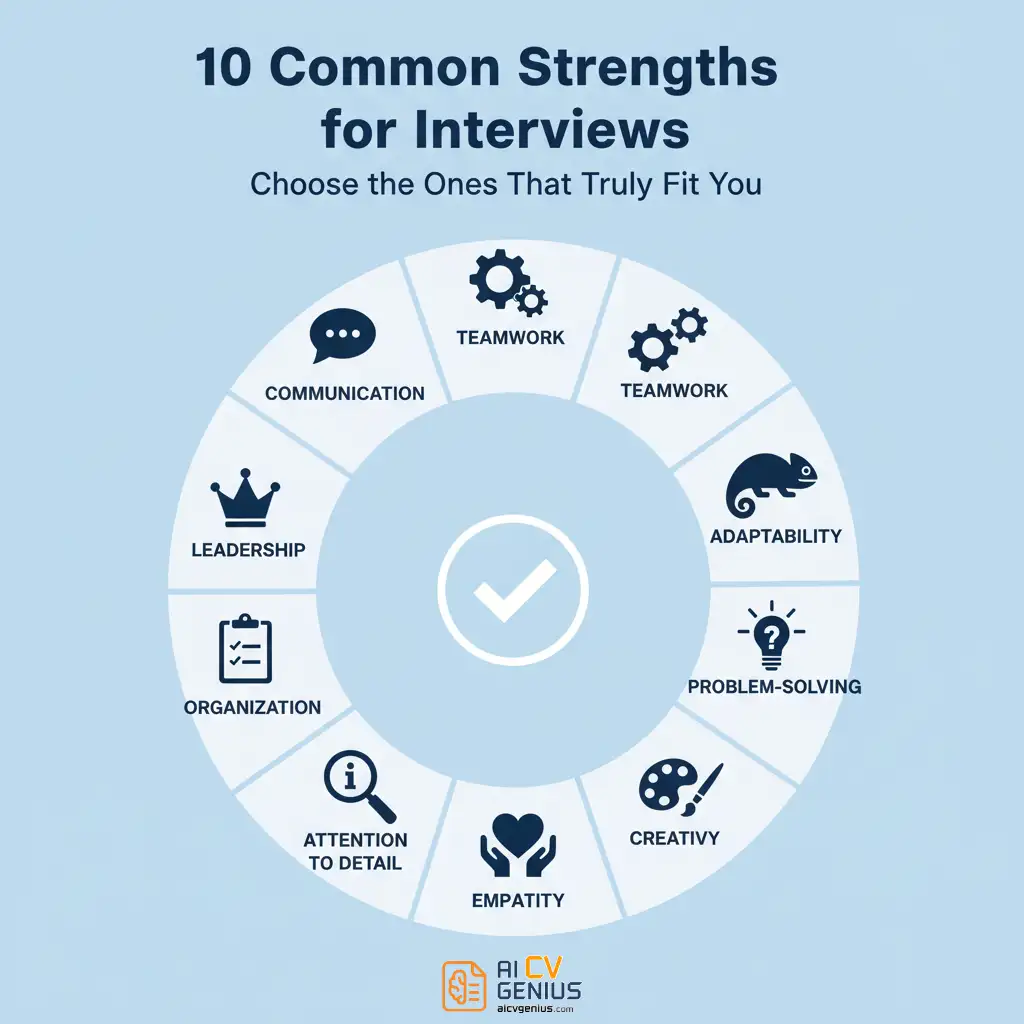
Here are 10 popular strengths, elevated with stronger examples:
- Communication: “I have a strength in clear communication. I can translate complex, technical ideas for non-technical stakeholders. In my last role, I created a weekly one-page summary of our engineering progress, which our sales team used to keep clients informed and confident.”
- Problem-solving: “I’m a natural problem-solver. I enjoy the process of digging into an issue to find its root cause. For instance, I noticed our customer complaint tickets for a specific bug had risen 30%. I traced it back to a recent update, documented the issue, and my team had a patch deployed in 24 hours.”
- ️ Organization (or Time Management): “I am highly organized and methodical. I live by my digital to-do list and time-blocking. This system allowed me to manage three overlapping project deadlines last quarter, delivering all of them on or ahead of schedule.”
- Teamwork (or Collaboration): “I thrive in a collaborative setting. I believe the best ideas come from diverse perspectives. I make a point to actively solicit feedback from quieter team members, which often uncovers risks or ideas the rest of us missed.”
- Initiative (or Proactiveness): “I’m proactive. I prefer to fix a small problem before it becomes a big one. I recently saw our onboarding documents were outdated, so I took an afternoon to update them. It’s now a resource our entire team uses.”
- Adaptability: “I’m very adaptable. In my last role, our main client changed their project scope two weeks before launch. Instead of getting frustrated, I led the meeting to re-prioritize our ‘must-haves’ and we successfully launched the core product on time.”
- ❤️ Empathy: “I lead with empathy, especially in customer-facing roles. I’m skilled at de-escalating tension. I often took calls from our most frustrated clients, and by listening first and validating their concerns, I was able to retain 90% of those at-risk accounts.”
- Analytical thinking: “My mind is very analytical. I’m comfortable in data. I recently analyzed our marketing funnel and discovered that we were losing 40% of users at a single step. My insights led to a UX change that improved our conversion rate by 10%.”
- Creativity: “I’m a creative thinker. When our ad budget was cut, I proposed a low-cost guerilla marketing campaign using community partnerships. That campaign ended up generating more qualified leads than the expensive ad spend it replaced.”
- ⭐ Reliability (or Work Ethic): “I am extremely reliable. My team knows me as the person who always delivers. I’ve never missed a deadline, and I take personal pride in ensuring my work is polished and correct the first time.”
How to Pick Strengths That Fit the Job
Your “best” strength is the one they need most. The job description is your cheat sheet.
Go through it with a highlighter. Look for action verbs and key adjectives under “Responsibilities” and “Requirements.”
- If it says “fast-paced environment,” they need adaptability and organization.
- If it says “manage multiple stakeholders,” they need communication and empathy.
- If it says “identify new opportunities,” they need initiative and creativity.
Choose the strength from your personal inventory that directly maps to their stated need.
Here’s a quick match table:
| Job Type | Best Strengths to Highlight |
|---|---|
| Administrative / Office | Organization, reliability, attention to detail, proactiveness |
| Sales / Marketing | Communication, persuasion, creativity, resilience, empathy |
| Tech / IT | Analytical thinking, problem-solving, adaptability, continuous learning |
| Customer Service | Empathy, patience, positivity, problem-solving, communication |
| Design / Creative | Creativity, collaboration, initiative, communication, adaptability |
| Management | Leadership, communication, delegation, strategic vision, empathy |
Sample Answers by Role
Example 1 – Entry-Level Graduate
“One of my biggest strengths is my adaptability. Throughout university, I often balanced a full course load, a part-time job, and a leadership role in a student club. It taught me how to switch contexts quickly and manage my time effectively. I’m comfortable juggling multiple priorities and I know that’s a key part of this role.”
Example 2 – Administrative Assistant
“I’d say my greatest strength is my proactive organization. I don’t just manage calendars; I anticipate needs. In my last internship, I supported two executives. I made a habit of preparing their meeting agendas the day before and flagging any conflicts. They told me it made their weeks run significantly smoother.”
Example 3 – Designer
“My main strength is creative problem-solving. I believe design is not just about looks; it’s about solving a user’s problem. When a recent project concept wasn’t landing with the test users, I ran a quick feedback session, identified the core confusion, and re-imagined the layout. The new version was approved on the next revision.”
Example 4 – Project Manager
“My strength is clear and consistent communication. I believe you can’t over-communicate on a complex project. I ensure every stakeholder knows what’s happening, even when the news is bad. That transparency builds trust and keeps the team aligned, which is how I’ve kept my last five projects on budget and on time.”
Example 5 – Career Switcher
“My greatest strength is my ability to learn complex systems quickly. When I transitioned from teaching to marketing, I had to learn an entire suite of analytics tools. I dedicated my evenings to tutorials, became certified in two of them within six weeks, and was pulling my own campaign data by month three. I am driven by curiosity.”
Advanced Tips & Common Pitfalls
Words to Avoid
Recruiters hear the same clichés daily. These words sound empty without strong evidence.
- ❌ “I’m a perfectionist.” (This is a classic non-answer. It can imply you get stuck on small details or can’t delegate.)
- ❌ “I work too hard.” (Another cliché. It suggests a lack of work-life boundaries, which can lead to burnout.)
- ❌ “I’m a people person.” (Too generic. Show it instead. “I build strong client relationships” is better.)
- ❌ “I’m passionate.” (This word is overused. Let your energy and examples show your passion.)
Keep Balance: Confidence vs. Arrogance
The line between confidence and arrogance is simple:
Confidence is built on evidence. Arrogance is built on claims.
Let your examples do the talking.
Instead of: “I’m an amazing communicator, the best on my team.” (Arrogance)
Say: “I’m a strong communicator. In my last role, I was chosen to present our team’s findings to the VP, and they adopted our proposal.” (Confidence)
Link Strengths to Results
Numbers make your strength undeniable. Quantify your impact whenever possible.
- ✅ “My organizational system reduced our team’s reporting errors by 30%.”
- ✅ “My empathy and problem-solving skills helped me maintain a 95% customer satisfaction rating.”
- ✅ “My initiative in training new hires helped our department onboard three people 20% faster than average.”
Quantifying your strength turns a simple adjective into a credible, high-impact asset.

Practice Out Loud
Rehearse your answer until it feels conversational, not memorized. Record yourself on your phone and listen back. Do you sound genuine? Are you rushing?
The goal is calm enthusiasm – a tone that shows you genuinely believe in the value you bring.
Add a Human Touch
A great answer can show a little vulnerability. This makes you memorable and human.
“I’ve learned that my strength in empathy used to be a challenge. I would get too invested in a client’s frustration. I’ve had to learn how to balance that empathy with firm, clear boundaries to be both supportive and effective.”
This shows profound self-awareness, which is a strength in itself.
Final Analysis & FAQs
Pros & Cons of Discussing Strengths
| Pros | Cons |
|---|---|
| ✅ Lets you directly address the job requirements. | ❌ Can sound rehearsed or robotic if over-practiced. |
| ✅ Builds confidence and sets a positive tone. | ❌ Risk of choosing a strength that isn’t relevant to the role. |
| ✅ Demonstrates high self-awareness and maturity. | ❌ Easy to sound arrogant without concrete evidence. |
Final Thoughts
The “What are your strengths?” question is not a trap; it is an invitation. It is your chance to tell the interviewer exactly why you are the right person for the job.
Know what they need. Know what you offer. And connect those two points with a short, powerful story.
For more confidence-building resources, explore:
- STAR Method Interview Examples – learn to structure all your behavioral answers.
- Career Resources – guides for mastering interviews and self-presentation.
- Blog – tips on confidence, mindset, and storytelling at work.