
- Core shift: NGOs screen for mission alignment and real impact, so a corporate style resume often reads like the wrong language.
- Open strong: Use a mission driven summary that states your cause fit, your core skills, and 1 to 2 impact proofs with numbers.
- Show NGO competencies: Highlight fundraising or grants, program design and M&E, community outreach, stakeholder work, and resourcefulness, translating corporate wins into mission outcomes.
- Elevate volunteer work: Treat substantial volunteer and board roles as real experience, give them full bullets, and use functional titles when needed.
- Prove impact with NGO metrics: Quantify people served, funds raised, volunteers managed, partnerships built, and outcomes improved, using an ATS friendly template and tailored keywords.
Here’s the fundamental distinction that separates applications destined for the nonprofit sector from their corporate counterparts: NGOs don’t just screen for competence – they actively seek profound mission alignment. Your ngo resume template, therefore, transcends a mere skills inventory. It must serve as compelling evidence that you not only possess the requisite abilities to perform the job effectively but also harbor a genuine, demonstrable commitment to the cause it serves. Submitting a standard corporate resume, even one showcasing impressive achievements, often falls flat in this context. It speaks the wrong language.
The core challenge lies in a common applicant oversight: approaching NGO applications with a corporate mindset. Many default to listing job duties, sprinkling in generic buzzwords (“results-oriented,” “passionate”), and assuming their qualifications will suffice. However, NGO recruiters operate with a distinct lens. They are searching for specific signals – irrefutable proof that you deeply understand their unique operational realities, share their core values, and, critically, can generate tangible impact within often resource-constrained environments. They’re looking for partners in their mission, not just employees.
This comprehensive guide provides more than just a free downloadable NGO resume template; it offers a strategic roadmap. We will dissect precisely how to frame your experience, translate skills from other sectors, and articulate your commitment in a way that resonates with mission-driven organizations. Whether you are navigating a career transition from the private sector or meticulously crafting your very first NGO resume, the principles and tactics detailed here are designed to position you as the purpose-driven, impact-focused candidate they are actively seeking. Let’s build a resume that truly speaks their language.
The NGO Paradigm Shift: Understanding What Makes These Resumes Unique
An NGO resume pivots away from the profit-centric narrative of corporate success. Its effectiveness hinges on articulating why your work matters in a social context and quantifying the impact you’ve generated for communities or causes, not just shareholders. While a corporate resume might trumpet increased market share or quarterly revenue gains, a successful NGO resume must translate those underlying skills – strategic planning, resource management, stakeholder communication – into the currency of social change.
Core Distinctions: Corporate vs. NGO Resume Focus
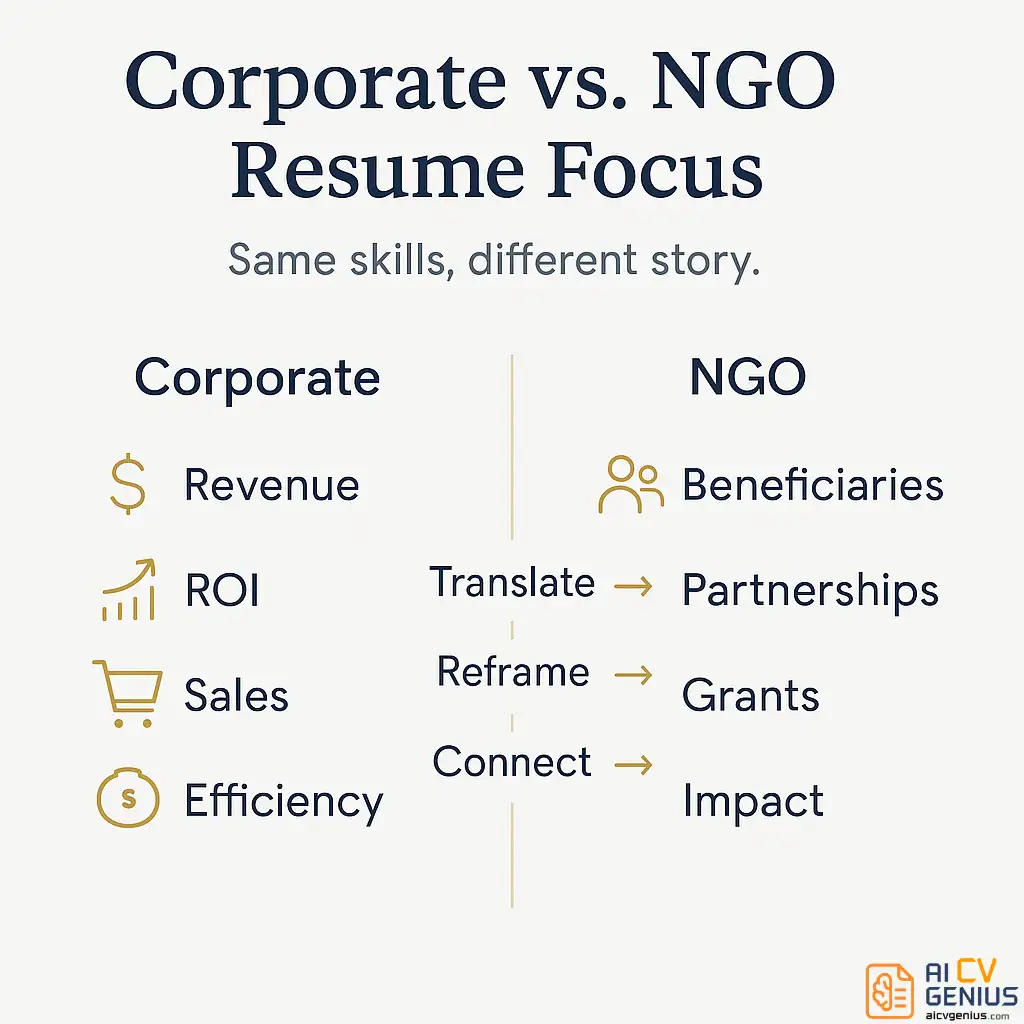
Understanding these fundamental differences is crucial for effective framing:
| Attribute | Typical Corporate Resume Focus | Effective NGO Resume Focus |
|---|---|---|
| Primary Goal | Maximize revenue, profit margins, market share, shareholder value. | Achieve mission objectives, create social/environmental impact, serve beneficiaries, drive systemic change. |
| Key Skills Emphasis | Sales, negotiation, product development, financial modeling, competitive analysis, ROI optimization. | Grant writing, fundraising, volunteer management, program design & evaluation, community organizing, advocacy, stakeholder engagement, cross-cultural communication. |
| Metrics of Success | $ increased revenue, % cost reduction, units sold, market share gained, efficiency improvements leading to profit. | # people served, % increase in program reach, $ funds raised/grants secured, # volunteers mobilized, policy changes influenced, measurable improvement in beneficiary outcomes (e.g., literacy rates, health indicators). |
| Language & Tone | Often competitive, results-driven (financial), data-heavy (business metrics), uses corporate jargon. | Mission-focused, collaborative, community-centric, empathetic, impact-oriented, uses sector-specific terminology (e.g., M&E, capacity building). |
| Role of Volunteer Work | Often supplementary, listed briefly or omitted. | Frequently considered core professional experience, demonstrating commitment and relevant skills. Deserves detailed description. |
| Resource Context | Assumes access to significant resources, focus on scaling profitable operations. | Highlights ability to achieve results with limited budgets, resourcefulness, sustainability focus. |
This isn’t about diminishing your corporate achievements; it’s about strategic translation. The skill of managing a multi-million dollar marketing budget is impressive. For an NGO, reframing it as “Successfully managed a $500K program budget, ensuring 95% of funds directly supported beneficiary services through meticulous resource allocation” is far more resonant.
Decoding the NGO Recruiter’s Mindset: Beyond the Job Description
Based on extensive analysis of NGO job postings and direct conversations with nonprofit hiring leaders, several core attributes consistently emerge as critical evaluation criteria, often outweighing traditional corporate metrics:
- Authentic Mission Resonance: They need to believe you genuinely connect with their specific cause. Vague statements like “I want to help people” or “I’m passionate about making a difference” are insufficient. Why this NGO? What personal experience, volunteer work, or deep-seated value drives your interest in their specific area (e.g., environmental conservation, refugee resettlement, public health)? Articulating this “why” is non-negotiable.
- Demonstrated Resourcefulness & Adaptability: The NGO sector often operates under significant financial and operational constraints. Recruiters actively look for evidence that you can thrive in such environments. Have you achieved significant results with a shoestring budget? Navigated complex bureaucratic hurdles? Successfully managed projects with shifting priorities or limited staff? Highlight instances where you demonstrated ingenuity, efficiency, and resilience.
- Collaborative & Inclusive Orientation: NGOs are ecosystems built on partnerships – with beneficiaries, volunteers, board members, donors, government agencies, and other organizations. Success rarely happens in isolation. Your resume needs to showcase your ability to build consensus, manage diverse stakeholder relationships, work effectively in teams, and foster an inclusive environment. Highlight cross-functional projects, community partnerships, and experiences working with diverse populations.
- Impact Orientation (Qualitative & Quantitative): While quantifiable metrics are valuable (see Tip 5), NGOs also value qualitative impact. Can you articulate how your work improved lives, strengthened communities, or advanced the cause in meaningful, albeit sometimes less tangible, ways? Frame achievements in terms of both numbers and narrative.
It’s telling that research, like the cited Johns Hopkins study, often shows NGO leadership prioritizes field experience and demonstrated commitment over traditional business credentials. Your resume must tell a story that aligns with these priorities.
Tip 1: Craft a Compelling Mission-Driven Summary
Your resume summary (or profile/objective section) is prime real estate. In the NGO context, it must immediately communicate not just your core competence, but your fundamental alignment with the world of social impact. This is your 3-4 sentence elevator pitch establishing you as a candidate who gets it.
The Contrast: Generic vs. Mission-Focused Summaries
Generic Corporate-Style Summary (Ineffective for NGOs):
Highly motivated and results-oriented professional with 8 years of experience in strategic planning and operations management. Proven ability to lead teams, optimize processes, and achieve organizational goals. Seeking a challenging leadership role within a dynamic company offering opportunities for professional development and advancement.
❓Why it fails for NGOs: It’s entirely self-focused (“seeking opportunities,” “professional development”). It uses corporate jargon (“optimize processes,” “dynamic company”). It lacks any mention of mission, community, or social impact. It provides no reason why this candidate is interested in this specific NGO.
Mission-Driven NGO Summary (Effective):
Dedicated public health advocate with 8 years designing and managing community-based health initiatives focused on maternal and child wellness in resource-limited settings. Proven success in securing grant funding ($1.5M+ secured from foundations and government agencies), building cross-sector partnerships, and implementing M&E frameworks that demonstrated a 30% improvement in key health indicators for 10,000+ beneficiaries. Passionately committed to health equity, seeking to leverage program leadership and strategic planning skills to advance [Target NGO Name]’s mission of improving health outcomes for vulnerable populations.
Why it works: Establishes immediate mission alignment (“public health advocate,” “health equity”). Highlights relevant NGO-specific skills (“grant funding,” “M&E frameworks,” “cross-sector partnerships”). Quantifies impact clearly (“$1.5M+ secured,” “10,000+ beneficiaries,” “30% improvement”). Explicitly connects expertise to the target NGO’s mission. Uses appropriate sector language.
A Replicable Formula for Your NGO Summary
Adapt this structure to create a powerful opening statement:
- Sentence 1: [Your Core Identity/Role] + [Years Experience] + [Primary Area of Impact/Focus] + [Brief Mention of Mission Passion]: Example: “Seasoned nonprofit leader with 12+ years directing youth development programs, deeply committed to fostering educational equity for first-generation students.”
- Sentence 2-3: [Highlight 1-2 Major Quantifiable Achievements/Skills Directly Relevant to NGO work]: Example: “Successfully scaled mentorship program reach by 400% across three cities through strategic school partnerships and volunteer recruitment initiatives. Secured and managed a $2M annual program budget, consistently meeting or exceeding outcome targets.”
- Sentence 4: [State Your Goal – Linking Your Expertise to Their Mission]: Example: “Seeking to apply expertise in program scaling and stakeholder engagement to support [Target NGO Name]’s vital work in closing the achievement gap.”
This structure ensures you cover identity, impact, relevant skills, and specific motivation concisely. Tailor the specific cause and skills mentioned to align precisely with the target organization and role.
Tip 2: Showcase Essential NGO Competencies (and Translate Others)
While passion is crucial, NGOs are practical organizations that need specific operational skills to function and thrive. Your resume must clearly demonstrate proficiency in areas critical to the nonprofit sector. If you’re transitioning from another field, strategically reframing your existing skills is key.
[Image illustrating skill translation from corporate to NGO context]Core Competencies Valued Across the NGO Sector
Ensure your resume provides concrete evidence (through experience bullets) of skills like:
- ✅ Grant Writing & Fundraising: Detail specific grants secured ($ amount, funder type), fundraising campaigns managed ($ raised, donor numbers), donor cultivation strategies implemented, experience with fundraising databases (e.g., Salesforce NPSP, Raiser’s Edge). Even if you haven’t held a “fundraiser” title, persuasive writing, proposal development, or relationship management skills are highly transferable.
- ✅ Program Design, Management & Evaluation (M&E): Describe programs you’ve developed, implemented, or overseen. Highlight your experience with logic models, needs assessments, budget management, activity tracking, reporting, and using data (qualitative and quantitative) to measure outcomes and improve program effectiveness.
- ✅ Volunteer Recruitment, Training & Management: Quantify the number of volunteers managed, hours coordinated, retention rates improved, or training programs developed. Emphasize your ability to motivate and support unpaid team members.
- ✅ Community Outreach & Engagement: Detail experience building relationships with community members, beneficiaries, local leaders, and partner organizations. Mention specific outreach strategies, events organized, or partnerships formed.
- ✅ Advocacy & Policy Influence: If relevant, describe experience researching policy issues, drafting position papers, organizing advocacy campaigns, or engaging with policymakers.
- ✅ Financial Management & Budgeting (Nonprofit Context): Showcase experience managing program or organizational budgets, grant financial reporting, ensuring compliance, and demonstrating efficient resource allocation (doing more with less).
- ✅ Stakeholder Communication & Relationship Building: Provide examples of effectively communicating with diverse groups – board members, donors, beneficiaries, government officials, media.
- ✅ Cross-Cultural Competency & Adaptability: Especially important for international NGOs or those working with diverse local populations. Highlight relevant language skills, international experience, or work in multicultural settings.
Integrate these skills directly into your achievement-oriented bullet points rather than just listing them generically in a skills section.
Strategic Translation: Reframing Corporate Experience for NGO Impact
Don’t discard your corporate experience; re-lens it. Focus on the underlying competency and articulate its relevance in a mission-driven context:
- Corporate Skill: Managed $5M marketing budget driving 20% sales growth.
- NGO Translation: “Oversaw $500K program budget, strategically allocating resources to maximize beneficiary reach by 30% while staying 10% under budget.” (Focus shifts to efficient resource use and impact)
- Corporate Skill: Led cross-functional team to launch new software product.
- NGO Translation: “Led collaborative development of a new community resource portal, coordinating input from program staff, volunteers, and beneficiary representatives, resulting in a 40% increase in service inquiries.” (Focus shifts to collaboration and community benefit)
- Corporate Skill: Negotiated key supplier contracts reducing procurement costs by 15%.
- NGO Translation: “Built strategic partnerships with 5 local businesses to secure in-kind donations valued at $50K annually, directly supporting program expansion without increasing cash expenditure.” (Focus shifts to resourcefulness and partnerships)
- Corporate Skill: Presented quarterly business reviews to C-suite executives.
- NGO Translation: “Developed and presented comprehensive program impact reports to the Board of Directors and major foundation funders, securing continued multi-year support.” (Focus shifts to accountability and funder relations)
Think about the function of your corporate skills and how that function serves the mission of the NGO.
Tip 3: Elevate Volunteer Experience – It’s Not Just a Footnote
This is arguably the most significant structural difference between corporate and NGO resumes. In the nonprofit sector, substantive volunteer work is often viewed as equivalent to paid professional experience, particularly if it demonstrates relevant skills and commitment to the mission. Failing to give it appropriate prominence is a major missed opportunity.
Strategic Placement: Integrating Volunteer Roles Effectively
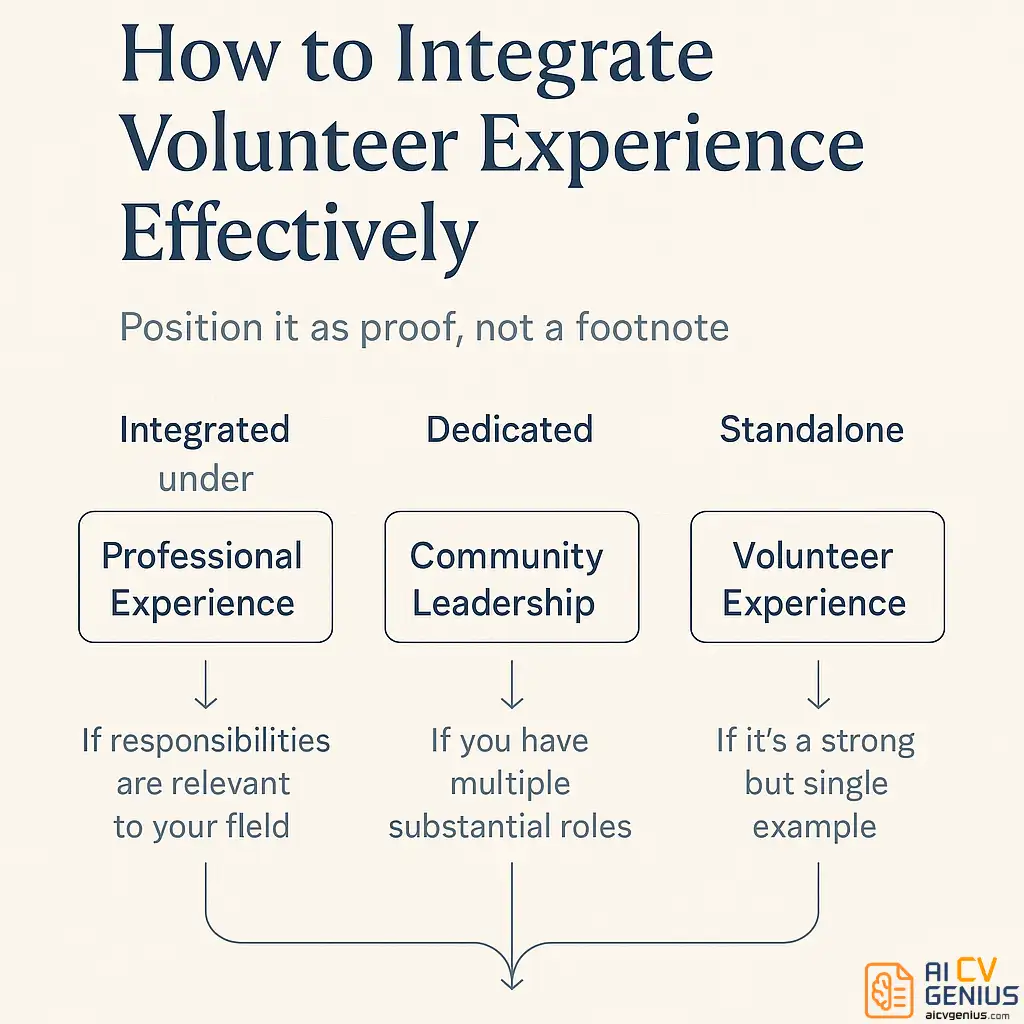
Consider these options for showcasing significant volunteer contributions:
Option 1 (Ideal for Strong Alignment): Integrate Chronologically within “Professional Experience”
If your volunteer role was substantial (e.g., consistent weekly hours over months/years, significant responsibilities, direct relevance to the target job), list it chronologically alongside your paid positions within the main “Professional Experience” section. Use the identical format: Title, Organization Name (clearly indicating it was volunteer), Dates, and achievement-focused bullet points.
Example:
PROFESSIONAL EXPERIENCE
Grant Writing Consultant (Volunteer) | Global Relief Fund | March 2023 – Present
• Researched and identified 20+ potential foundation funding opportunities aligned with GRF’s disaster response programs.
• Co-authored 5 grant proposals requesting over $500K; secured initial $75K grant from the Community Resilience Foundation.
• Developed standardized templates for grant reporting, improving efficiency for program staff.
Marketing Manager | Tech Solutions Inc. | June 2020 – February 2023
• [Corporate achievements reframed for NGO context…]
Benefit: This positions your volunteer work as core, relevant experience, viewed with equal weight by the recruiter.
Option 2: Create a Dedicated “Relevant Experience” or “Community Leadership” Section
If you have a mix of less-relevant paid work and highly relevant volunteer/board experience, create a dedicated section near the top (after the summary) titled “Relevant Experience,” “Community Leadership,” or “Nonprofit Experience.” Detail your volunteer roles here using the same robust format, then follow with a section for “Additional Professional Experience” covering other roles.
Benefit: This prioritizes the experience most crucial for the NGO role, ensuring recruiters see it immediately.
Option 3 (For Less Substantial Roles): Dedicated “Volunteer Experience” Section
If your volunteer work was more sporadic, short-term, or less directly related to the target role’s core functions, a separate section towards the end of the resume is appropriate. Even here, use bullet points to describe accomplishments, not just list organizations.
Key Principle: Regardless of placement, describe volunteer achievements with the same rigor and focus on impact as paid work.
No Formal Title? No Problem. Define Your Role by Function.
Many valuable volunteer contributions occur without formal titles. Don’t let that stop you. Create a functional title that accurately reflects your responsibilities and contributions.
- If you helped organize fundraising events: Event Logistics Volunteer or Fundraising Event Support
- If you tutored students: Youth Literacy Tutor (Volunteer)
- If you served meals at a shelter: Meal Service Team Member (Volunteer)
- If you helped manage social media: Social Media Assistant (Volunteer)
Focus on what you did and the impact you had. A descriptive functional title is perfectly acceptable and often more informative than a generic “Volunteer” label.
Highlighting Board Service
Serving on a nonprofit board is significant experience. List it under “Community Leadership” or “Board Experience.” Highlight your committee work (e.g., fundraising, governance, finance), strategic contributions, and any specific achievements during your term.
Tip 4: Leverage a Tailored NGO Resume Template
Starting with a structure designed specifically for the nonprofit sector can save time and ensure you’re highlighting the right elements. We offer a free, downloadable ngo resume template optimized for mission-driven roles and ATS compatibility.
Key Features of Our NGO Template
Our template is crafted based on feedback from nonprofit hiring managers and incorporates best practices:
- Prominent Mission-Driven Summary: Guides you to articulate your “why” upfront.
- Integrated Skills Section: Includes common NGO competencies (customizable) for easy ATS parsing and reader scanning.
- Impact-Focused Experience Sections: Formatted to encourage the use of metrics related to beneficiaries, funding, and program outcomes.
- Flexible Volunteer Experience Placement: Includes guidance and options for integrating or separating volunteer roles strategically.
- Dedicated Sections for Relevant Credentials: Clear space for certifications (CNP, CFRE, etc.), languages, and technical skills often required by NGOs (e.g., specific donor databases, M&E software).
- Clean, Professional, ATS-Friendly Design: Ensures readability for both human eyes and scanning software. Avoids complex graphics or columns that can confuse ATS.
Available in Microsoft Word and Google Docs formats for easy editing.
Access the Template: Download your free copy directly from our resume templates library. Select the “NGO/Nonprofit Focused Resume” option.
Beyond the Template: Essential Customization
A template is a starting point, not a finished product. Effective customization is crucial:
- Mirror Job Description Language: Identify keywords and core competencies in the specific job posting. Weave this exact language (naturally) into your summary, skills, and experience sections.
- Prioritize Relevance: For each application, reorder bullet points within job descriptions to highlight the achievements most relevant to that specific role first. Omit less relevant details if space is tight.
- Tailor the Summary: Rewrite your summary for each application to explicitly mention the target organization’s mission or a specific program that excites you.
- Adjust Section Emphasis: Applying for a grant-heavy role? Expand on your grant writing bullets. Applying for a community organizer position? Emphasize outreach and partnership examples.
- Consider NGO Sub-Sectors: An environmental advocacy group values different nuances than a humanitarian aid organization or an arts nonprofit. Adjust your language and highlighted experiences accordingly.
Think of the template as the scaffolding; your tailored content is the building itself.
Tip 5: Quantify Your Impact with NGO-Centric Metrics
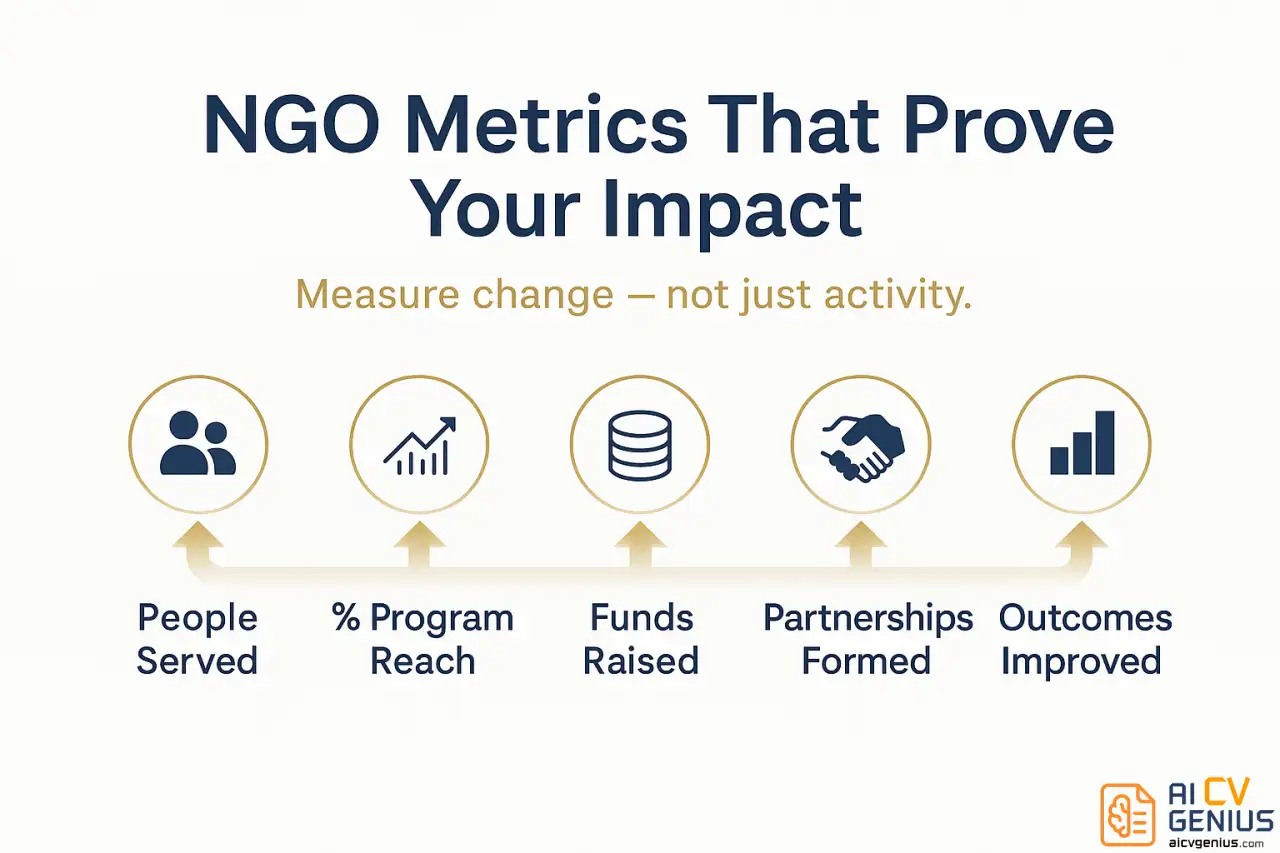
Quantifying achievements is essential for demonstrating concrete value, just as in the corporate world. However, the types of metrics that resonate most strongly with NGOs often differ, focusing on mission delivery and social return on investment rather than purely financial gains.
Examples of Powerful NGO-Relevant Metrics
Brainstorm how you can quantify your contributions using metrics like these:
- Beneficiary Reach & Outcomes:
- Number of individuals/families/communities served (e.g., “Provided essential services to 1,200 homeless individuals annually”).
- Percentage increase in program participation or reach (e.g., “Expanded after-school program enrollment by 40%”).
- Measurable improvement in beneficiary status (e.g., “% increase in literacy scores,” “% reduction in recidivism rates,” “# individuals placed in stable housing/jobs”).
- Geographic expansion of services (e.g., “Launched services in 3 new regions”).
- Resource Mobilization & Management:
- Total grant funding secured ($ amount, # grants, funder types).
- Individual donations raised ($ amount, % increase, # new donors acquired).
- Value of in-kind donations secured ($ equivalent).
- Budget managed ($ amount) and efficiency gains (% cost reduction while maintaining/improving services, % of budget allocated directly to programs).
- Volunteer Engagement:
- Number of volunteers recruited, trained, or managed.
- Total volunteer hours coordinated or contributed.
- Percentage improvement in volunteer retention rates.
- Partnerships & Collaboration:
- Number of new strategic partnerships established (with NGOs, government agencies, corporations, community groups).
- Quantifiable outcomes resulting from partnerships (e.g., “Co-hosted event reaching 500 attendees through partnership with X”).
- Advocacy & Awareness:
- Number of people engaged through campaigns (# petition signatures, # event attendees, social media reach/engagement metrics).
- Media placements secured (# articles, interviews).
- Specific policy changes influenced (if applicable).
- Operational Efficiency:
- Percentage reduction in administrative overhead.
- Time saved through process improvements (e.g., “Implemented new reporting system reducing staff time spent by 15%”).
Even seemingly qualitative work often has quantifiable elements. Think creatively about how to measure the scale, efficiency, or outcomes of your efforts.
Transforming Vague Responsibilities into Impactful Achievements
Let’s illustrate the power of quantification:
Before (Weak, Duty-Oriented):
- Responsible for managing social media accounts.
- Helped coordinate fundraising events.
- Worked on program reporting.
- Interacted with community partners.
After (Strong, Impact-Oriented with Metrics):
- Grew organization’s Instagram following by 300% (from 1K to 4K) in one year through targeted content strategy, resulting in a 50% increase in online donations attributed to social media.
- Co-managed annual fundraising gala for 3 consecutive years, exceeding revenue goals each year and raising a total of $450K+ for operational costs.
- Developed and implemented a streamlined quarterly program reporting process using [Software Tool], reducing staff reporting time by 25% and improving data accuracy for grant compliance.
- Established and maintained collaborative relationships with 15+ community partner organizations, leading to joint programming that expanded service delivery to 2 previously unreached neighborhoods.
The “After” examples provide concrete evidence of capability and impact, making your contributions tangible and compelling to the reader.
Your NGO Resume: A Testament to Purposeful Impact
Ultimately, crafting a compelling ngo resume template goes beyond simply listing jobs and duties; it’s about constructing a narrative that proves your professional capabilities are intrinsically linked to a commitment to social good. It must convince the reader – whether human or AI – that you possess not only the necessary skills but also the understanding, resourcefulness, and dedication required to thrive within the unique ecosystem of a mission-driven organization.
By implementing the five core strategies detailed – leading with a mission-driven summary, showcasing relevant NGO skills (and adeptly translating others), elevating volunteer work to its deserved prominence, utilizing a tailored template, and quantifying your contributions with impact-centric metrics – you transform your resume from a generic application document into a powerful testament to your potential contribution.
Remember, NGOs aren’t merely filling vacancies; they are seeking dedicated individuals to advance critical missions, often under challenging circumstances. Your resume is your primary opportunity to demonstrate that you are not just qualified for the tasks, but deeply aligned with the purpose. It needs to articulate clearly that you understand the work is about fostering meaningful change, not just accumulating personal achievements.
Invest the time to tailor each application. Reframe your past through the lens of social impact. Quantify your contributions in terms of lives touched, communities strengthened, or progress made towards the cause. Show, unequivocally, that your skills and your passion converge on their mission. When you do that, your resume ceases to be just a document; it becomes a compelling invitation for them to partner with you in making a difference.
Ready to craft an NGO resume that truly resonates? Download our specialized template via the resume templates page and consult our extensive career resources for further insights and guidance on navigating your impactful career journey in the nonprofit sector.