
- Why it matters: A strong cover letter separates you when resumes look identical and proves motivation plus communication.
- What chiefs screen for: Trainable mindset, Culture fit, And genuine service driven intent.
- Simple structure: Hook with department specific research, Prove fit by translating your background into job skills, Close with a confident interview ask.
- What to highlight: Certifications and training, Physical readiness, Teamwork, Calm under pressure, Community service, And hands on or leadership skills.
- What kills applications: Generic copy paste, Writing about what you want instead of what you offer, Apologizing for experience, Sloppy errors, And a long two page story.
You’ve pushed your body to its limit and passed the CPAT. You’ve earned your EMT certification. You’ve spent sleepless nights studying fire science. You know you have the discipline, the heart, and the grit. But now, staring at a blank screen, you’re paralyzed by a single question: How do you write a firefighter cover letter with no experience that a Fire Chief will actually read?
Here is the unvarnished truth: Fire departments are not just hiring a set of certifications. They are hiring a human being. They are hiring character, drive, and a deep-seated dedication that simply cannot be quantified on a resume. Your resume proves you are qualified. Your cover letter is your one chance to prove you are the right person for the job.
Why Your Firefighter Cover Letter Matters More Than You Think
Think from the Fire Chief’s perspective. They have a stack of 100 applications. After the initial HR filter, they are left with 50 resumes that all look identical: Firefighter I & II, EMT-Basic, CPAT pass, CPR certified. All qualified. All checking the same boxes.
What separates the “interview” pile from the “reject” pile? It’s the cover letter.
The cover letter is your opportunity to answer the “why.” Why you? Why this department? Why this demanding, exhausting, and rewarding career? It reveals your true motivation. It demonstrates your understanding of the department’s specific values and challenges. Most importantly, it’s a test of your ability to communicate clearly, maturely, and professionally. While your resume shows what you’ve done, your cover letter shows who you are. And in the fire service – a profession built on trust, teamwork, and family – who you are is everything.
A well-written cover letter, even with limited experience, can catapult you ahead of candidates with more impressive resumes but a weaker personal statement. It can position you as a serious, prepared, and passionate candidate who is ready to learn and worthy of investment.
The Chief’s Mindset: What They Are Really Looking For
A Chief isn’t just filling a slot; they are adding a member to their family. A firehouse is a home. Firefighters live, eat, train, and face trauma together. A bad hire isn’t just an inconvenience; it’s a direct threat to the crew’s morale, safety, and effectiveness.
When they read your letter, they are subconsciously asking three questions:
- Is this person trainable? (Do they show humility, a willingness to learn, and respect for the chain of command?)
- Will this person fit our culture? (Do they demonstrate integrity, a strong work ethic, and a team-first attitude?)
- Is this person genuinely motivated? (Are they here for the right reasons – to serve the community – or just for a pension and a cool t-shirt?)
Your entire letter must be engineered to answer these three questions with a definitive “Yes.”
The 3-Paragraph Formula: A Deeper Dive
Before we dissect the examples, you must internalize this proven structure. It’s not just three paragraphs; it’s a three-act story that presents a compelling case for hiring you.
Paragraph 1: The Hook (Why Them, Specifically)
This is where 90% of candidates fail. They open with a generic, self-centered line: “I am writing to apply for the firefighter position I saw on…” This is a waste of precious space.
Your first paragraph must prove you’ve done your homework and are applying to this department for a specific reason. This immediately separates you from the crowd. Your research needs to be deeper than “you have a great reputation.”
- Good: “I am writing to express my strong interest in the Firefighter position with the Austin Fire Department.”
- Excellent: “I am writing to express my profound interest in the Firefighter position with the Austin Fire Department, as I have followed your department’s innovative approach to community paramedicine and your commitment to public education.”
- Excellent: “Having lived in Boulder for ten years, I’ve seen firsthand how Boulder Fire-Rescue handles the unique challenges of the Wildland-Urban Interface (WUI), and I am eager to contribute to that specific mission.”
Mention a specific program, a unique challenge (WUI, high-rise, industrial), a recent noteworthy call, or a community initiative. This shows respect and genuine interest.
Paragraph 2: The Proof (Why You Are the Solution)
This is the heart of your letter. This is where you connect your background directly to the department’s needs. Do not just list your certifications; they already saw those on the resume. Instead, you must show, not tell.
Even with “no experience,” you have a wealth of transferable skills. This paragraph is where you translate them.
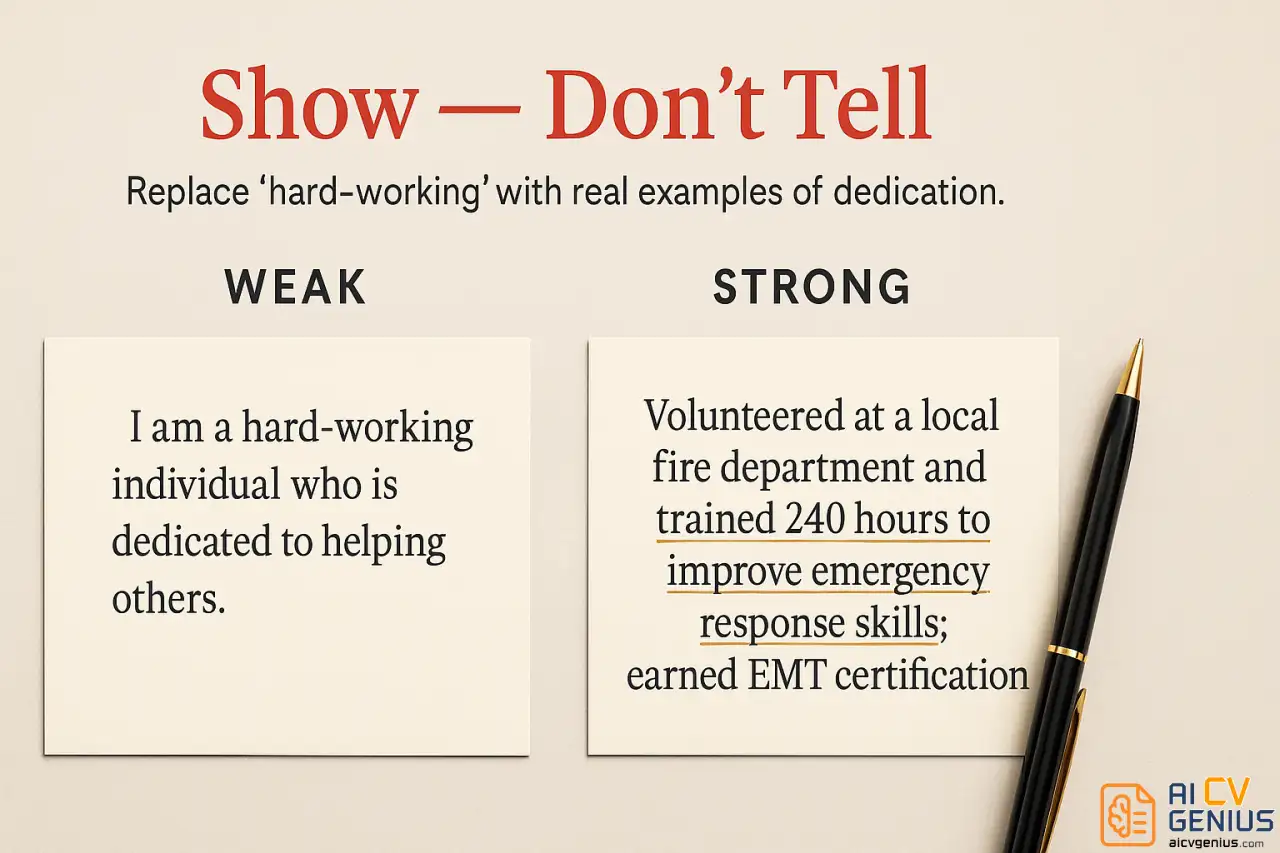
- Don’t say: “I am a hard worker and a great team player.” (This is a weak, unproven claim).
- Do say: “Working for three years in commercial construction taught me to perform strenuous labor in extreme weather, adhere to complex safety protocols, and function as part of a team where one person’s mistake could injure everyone.”
Connect your certifications to your motivation.
- Don’t say: “I have my Firefighter I/II and EMT.”
- Do say: “To prepare for this career, I put myself through the [Your Academy Name] 240-hour fire academy while working full-time, a challenge that solidified my time management skills and dedication. I also earned my EMT-Basic, as I understand that the vast majority of calls are medical, and I am driven by a genuine desire for patient care.”
Focus on Character, Competence, and Commitment.
Paragraph 3: The Close (The Confident Call to Action)
End with professional confidence, not desperation. You are not begging for a job; you are offering your skills and dedication to their mission.
- Weak Close: “I hope you will consider me for this position. Please call me at any time. Thank you for your time.”
- ✅Strong Close: “I am eager to discuss how my specific training, background in [Your Skill], and unwavering commitment to public service align with the values of the [Department Name]. I am available for an interview at your earliest convenience and can be reached at (555) 123-4567. Thank you for your consideration.”
This paragraph is brief, respectful, direct, and purposeful.
5 Firefighter Cover Letter Examples That Actually Work
Here are five examples for common “no experience” scenarios. Pay close attention to the “Why it Works” analysis, as it breaks down the specific psychological strategy behind the words.
Example 1: Entry-Level with Recent Academy Training
Best for: Recent fire academy graduates with no paid department experience.
Dear Chief Martinez,
I am writing to express my strong interest in the Firefighter position with the Austin Fire Department. As someone who has lived in Austin for eight years, I have witnessed firsthand your department’s exceptional professionalism, particularly your swift response during the 2023 wildfire season and your ongoing commitment to community fire safety education, which I have personally attended.
I recently graduated with honors from the Texas Fire Academy, completing over 240 hours of intensive training in fire suppression, emergency medical response, and rescue operations. To prove my dedication, I volunteered 60 hours with Station 12’s community outreach program during my training, where I assisted with smoke detector installations. I also earned my NREMT-Basic certification and hold current CPR credentials. My background as a four-year high school varsity athlete prepared me for the physical demands of this career, and my three years in retail management taught me how to remain calm, communicate clearly, and make quick decisions in stressful situations.
I am not looking for just any job; I am seeking a career with a department I respect, in the city I call home. I would welcome the opportunity to discuss how my training and commitment to public service align with AFD’s mission. I am available for an interview at your convenience and can be reached at (555) 123-4567 or john.doe@email.com. Thank you for considering my application.
Respectfully,
John Doe
Why it Works (In-Depth):
- The Hook: John immediately establishes a local connection (“lived in Austin for eight years”) and specific knowledge (“2023 wildfire season,” “community education”). This tells the Chief he isn’t just spamming applications; he wants to work for this department.
- The Proof: He doesn’t just list certs. He frames them with “with honors” (trainable, high-achiever) and “volunteered 60 hours… during my training” (proves commitment and work ethic beyond the minimum).
- Transferable Skills: He brilliantly translates “retail management” (a seemingly unrelated job) into “remain calm, communicate clearly, and make quick decisions in stressful situations” – the core soft skills of a firefighter.
- The “Why”: The line “I am not looking for just any job; I am seeking a career with a department I respect” is a powerful statement of intent and loyalty.
Example 2: EMT Transitioning to Firefighting
Best for: Emergency medical technicians seeking to become dual-role firefighter/EMTs or paramedics.
Dear Hiring Manager,
I am excited to apply for the Firefighter/Paramedic position with Denver Fire Rescue. Having served as an EMT with Denver Health’s EMS Division for the past two years, I have had the privilege of responding to over 800 emergency calls alongside your firefighter crews. I have consistently been impressed by DFR’s professionalism, seamless teamwork, and community-focused approach at every scene.
My EMS experience has seasoned me for the realities of emergency response. I have performed patient assessments in chaotic environments, communicated effectively with diverse teams, and made critical decisions that directly impacted patient outcomes. Understanding that EMS is a core function of the fire service, I recently completed my Firefighter I and II certifications through Red Rocks Community College – while maintaining my full-time EMT role – to demonstrate my commitment to becoming a dual-role provider. Furthermore, I have participated in three joint training exercises with Station 8, gaining hands-on experience with ladder operations and vehicle extrication.
I am eager to bring my proven medical expertise and deep respect for DFR’s operations to a full-time firefighting role. I would appreciate the opportunity to meet with you to discuss how my background can strengthen your team from day one. Please feel free to contact me at (555) 234-5678 or sarah.johnson@email.com.
Sincerely,
Sarah Johnson
Why it Works (In-Depth):
- The Hook: Sarah leads from a position of strength. She has already worked with the department. She quantifies her experience (“800+ emergency calls”) and pays a specific compliment (“seamless teamwork”). This shows she is a known quantity who already understands their system.
- The Proof: She frames her EMS experience as preparation for the entire job (“seasoned me for the realities,” “chaotic environments”).
- Proving Commitment: The line “while maintaining my full-time EMT role” is critical. It proves her work ethic and seriousness. She isn’t just looking for a new schedule; she is purposefully expanding her skills.
- The “Fit”: “Joint training exercises” and “deep respect for DFR’s operations” tells the Chief that she is humble, trainable, and already aligned with their culture.
Example 3: Career Changer (e.g., Tech, Corporate)
Best for: Professionals transitioning from completely different industries.
Dear Captain Williams,
I am writing to apply for the Firefighter position with the Seattle Fire Department. After a successful seven-year career as a project manager in the tech industry, I am making a deliberate and prepared transition to pursue my long-held passion for public service and emergency response.
While my background may seem unconventional, my professional experience has equipped me with a unique skill set directly applicable to the fire service. As a project manager, I was responsible for leading cross-functional teams of 10-15 people through high-stakes, time-sensitive deadlines. This role required absolute clarity in communication, rapid problem-solving under pressure, and the ability to maintain composure when complex systems failed. Over the past 18 months, I have systematically prepared for this career change by earning my NREMT-Basic certification, completing the Firefighter I and II academy at North Seattle College, and volunteering 120 hours with the Medic One Foundation’s community CPR training program. I have also maintained a rigorous physical fitness routine, consistently scoring in the top 10% on practice CPAT assessments.
This is not a rash decision; it is a purposeful career pivot toward work that aligns with my core values of service, teamwork, and discipline. I would be honored to discuss how my unique combination of leadership experience and new firefighting qualifications can be an asset to SFD. I am available at (555) 345-6789 or michael.chen@email.com.
Respectfully,
Michael Chen
Why it Works (In-Depth):
- Addresses the “Why”: Michael immediately tackles the “elephant in the room” (the career change). He frames it as a “deliberate and prepared transition,” not a “midlife crisis.”
- Masterful Translation: He translates “project manager” into firefighting language: “leading…teams,” “high-stakes, time-sensitive deadlines,” “rapid problem-solving under pressure,” “maintain composure when complex systems failed.” This is brilliant.
- Proving Commitment: He proves this isn’t a whim by listing 18 months of actions: EMT, FF I/II, and 120 volunteer hours. He showed his dedication long before he applied.
- The Close: The line “work that aligns with my core values” is the perfect, mature-minded reason for the change. If you’re changing careers, our guide on a career change resume is essential reading.
Example 4: Volunteer Moving to Career Position
Best for: Experienced volunteer firefighters seeking their first full-time career position.
Dear Chief Anderson,
I am submitting my application for the Career Firefighter position with Portland Fire & Rescue. For the past three years, I have proudly served as a volunteer firefighter with Station 24 in suburban Portland, responding to approximately 150 calls annually while maintaining my full-time job as a construction foreman.
My volunteer experience has provided me with practical, hands-on skills that many entry-level candidates lack. I have participated in structure fire suppression, vehicle extrication using hydraulic tools, and wildland fire response. I am proficient in operating as both interior attack and exterior support, have used SCBA in live-fire conditions, and have assisted on hundreds of medical calls requiring BLS. Last year, I was honored as Volunteer Firefighter of the Year for my consistent availability and contributions to our station’s training program. I hold current certifications in Firefighter I/II, Hazmat Operations, and EMT-Basic.
Transitioning to a career position with PF&R would allow me to dedicate myself fully to the profession I am already committed to. I understand the demands of 24-hour shifts, the critical importance of station maintenance, and the reality that firefighting is 90% preparation and 10% action. I would welcome the chance to discuss how my proven track record and strong work ethic can benefit your department. You can reach me at (555) 456-7890 or david.martinez@email.com.
Sincerely,
David Martinez
Why it Works (In-Depth):
- Leads with Experience: David’s hook is his proven experience. “150 calls annually” and “construction foreman” immediately establish him as a hardworking, experienced, and physically capable candidate.
- Specific Skills: He lists concrete skills, not just certs: “vehicle extrication using hydraulic tools,” “SCBA in live-fire conditions.” This proves his volunteer experience was real.
- Proving Excellence: “Volunteer Firefighter of the Year” is a powerful third-party endorsement of his character and dedication.
- Understanding the Job: The final line in paragraph two (“I understand the demands…”) is perfect. It tells the Chief he isn’t a rookie with stars in his eyes; he knows the whole job, including the unglamorous parts like “station maintenance.”
Example 5: Military Veteran Transitioning to Firefighting
Best for: Veterans with or without direct emergency response (e.g., Damage Control, Corpsman) experience.
Dear Hiring Committee,
I am writing to express my strong interest in the Firefighter position with the Phoenix Fire Department. As a recently honorably discharged U.S. Marine Corps Sergeant with six years of service, I am seeking to continue my commitment to public service in a career that demands teamwork, discipline, and performance under pressure.
During my service, I served as a team leader responsible for the safety, coordination, and performance of a 12-person squad in high-stress, dynamic environments. I received extensive training in emergency response protocols, hazardous materials handling, and provided emergency medical care as a Combat Lifesaver. My experience includes responding to vehicle fires, conducting damage control, and participating in disaster relief efforts. Since my discharge four months ago, I have proactively translated my skills by earning my Arizona Firefighter I certification and NREMT-Basic license through the Veterans Fire Corps program. I have also completed 40 hours of ride-along time with Station 7 to familiarize myself with civilian firefighting SOGs.
My military background has instilled in me the discipline, physical fitness, and team-first mindset essential for a successful career in the fire service. I am prepared for the demands of this profession and am eager to serve the Phoenix community with the same dedication I brought to serving my country. I would appreciate the opportunity to discuss my qualifications further and can be contacted at (555) 567-8901 or james.rodriguez@email.com.
Respectfully,
James Rodriguez
Why it Works (In-Depth):
- Translates the Skills: James perfectly translates his military experience. He uses key phrases: “team leader,” “safety…of a 12-person squad,” “high-stress, dynamic environments,” “emergency response protocols,” and “damage control.”
- Shows Proactive Effort: He didn’t just assume his military service was enough. He shows initiative: “Since my discharge four months ago…” he got his FF cert, EMT cert, and did 40 hours of ride-alongs. This proves he is humble and trainable.
- The “Why”: His opening and closing (“continue my commitment to public service,” “serve the Phoenix community”) are strong, mission-oriented statements that align perfectly with the fire service ethos.
Essential Skills to Weave Into Your Cover Letter
Even with no direct experience, you possess transferable skills. Your job is to be a “translator” for the hiring chief. Use this table as a guide.
| Skill Category | What to Highlight | Example Phrasing (Show, Don’t Tell) |
|---|---|---|
| Certifications | Firefighter I/II, EMT-Basic/Paramedic, CPR, Hazmat Awareness/Operations | “I earned my NREMT-Basic certification to ensure I am prepared for the high volume of medical calls…” |
| Training Hours | Fire academy completion, specialized training, ride-along hours | “Completed a 240-hour fire academy, graduating in the top 10% of my class.” |
| Physical Fitness | CPAT scores, athletics, demanding physical jobs (construction, labor) | “My four years as a collegiate athlete, combined with a CPAT pass time of 8:45, have prepared me for the physical demands…” |
| Teamwork | Team sports, military service, collaborative work, kitchen/restaurant work | “My four years as a [Team Captain / Crew Member] taught me to prioritize the team’s success over personal ego…” |
| Calm Under Pressure | EMS, military, food service, retail management, customer service | “Managed crisis situations during three years as a hospital ER technician, learning to communicate clearly in chaotic environments.” |
| Community Service | Volunteer work, coaching, community outreach | “Volunteered 80 hours teaching fire safety, demonstrating my commitment to public education.” |
| Mechanical Aptitude | Auto repair, construction, hobbies involving tools | “My experience as a carpenter gives me a strong understanding of building construction and hands-on tool operation.” |
| Communication | Customer service, teaching, public speaking, leadership roles | “Five years in hospitality management developed my ability to de-escalate conflict and communicate clearly with diverse populations.” |
The 5 ‘Red Flag’ Mistakes That Kill Your Cover Letter
A cover letter can get you hired, or it can get you thrown in the “no” pile faster than any other document. Avoid these critical, common errors.
- ❌ Mistake 1: The Generic “To Whom It May Concern” Letter.
- The Chief’s Thought: “This person spammed 20 departments. They don’t care about us. They just want a job. They lack genuine interest. Pass.”
- ❌ Mistake 2: Focusing Only on What You’ll Gain.
- The Chief’s Thought: “They write, ‘This position would be a great opportunity for me to learn…’ Of course it would. They’re focused on what we can do for them. I need people who are focused on what they can do for our community. Pass.”
- ❌ Mistake 3: Apologizing for Lack of Experience.
- The Chief’s Thought: “They wrote, ‘Although I don’t have any real firefighting experience…’ This person lacks confidence. If they’re this insecure on paper, how will they act on a high-stress fire scene? I can’t risk it. Pass.”
- ❌ Mistake 4: Typos, Grammar Errors, or Sloppy Formatting.
- The Chief’s Thought: “This letter has two typos and the formatting is messy. Firefighting is about 100% accuracy, 100% of the time. If they can’t get a one-page letter right, they’ll miss a critical step on an SOP. They lack attention to detail. Pass.”
- ❌ Mistake 5: Writing a Two-Page Autobiography.
- The Chief’s Thought: “This letter is two pages long. This person either can’t be concise or thinks they’re more important than they are. Both are bad traits in a rookie. I have 50 more to read. Pass.”
Frequently Asked Questions (From the Expert’s Desk)
Your Next Steps
Writing a strong firefighter cover letter with no experience is not about apologizing for what you lack; it’s about confidently translating what you have. The five examples above prove that fire departments value diverse backgrounds – from EMS to military, from construction to corporate – as long as you can prove your commitment, character, and trainability.
Remember these key principles:
1. Be Specific: Research the department and explain why you want to serve their community.
2. Be a Translator: Convert your unique background into relevant, in-demand firefighting skills.
3. Show, Don’t Tell: Prove your work ethic, integrity, and passion through actions (e.g., “completed academy while working full-time”), not empty claims (e.g., “I am a hard worker”).
Your cover letter is your first handshake. It’s your first test of communication and professionalism. Proofread it twice, then have someone else read it. Make it clean, concise, and compelling. Show them the person behind the resume – the person they will be proud to call “Probie.”
Ready to build the complete application? Explore more cover letter examples and tips for every career stage.