
- Why a construction cover letter matters: It shows reliability, safety mindset, and professionalism beyond a project list.
- What hiring managers are really screening for: Dependability, Safety consciousness, Teamwork, And clear communication under pressure.
- Structure that works for any role: Header and greeting, Targeted opening, 1 to 2 proof paragraphs, And a confident close.
- What makes it credible: Specific examples with numbers like crew size, budget, schedule wins, And safety record.
- How to tailor and polish fast: Match your examples to the role level, Keep it one page, Use a clean PDF, And avoid generic claims or typos.
Introduction: The Construction Cover Letter
Why Construction Jobs Deserve More Than Just a Resume
In construction, your reputation is built project by project, brick by brick. While your resume lists the projects you’ve completed, a dedicated construction cover letter does something equally crucial: it reveals the character behind the craft. It’s where you articulate your commitment to reliability, your unwavering focus on safety, and the professional pride you invest in your work. In an industry founded on precision, accountability, and mutual trust, the way you introduce yourself carries significant weight.
Think of your cover letter as the preliminary site inspection before the real work begins. It’s your first opportunity to demonstrate professionalism and clear communication – skills as vital on a job site as technical proficiency. Whether you are applying for a role as a skilled laborer, a meticulous foreman, a strategic supervisor, or a comprehensive site manager, a well-structured, thoughtfully written letter signals that you approach communication with the same diligence you apply to construction itself. It’s your professional handshake, extended long before you step onto the site.
Decoding the Blueprint: Understanding What Construction Hiring Managers Really Look For
Construction hiring managers – be they site superintendents, project managers, or HR specialists in contracting firms – operate under immense pressure. They juggle tight deadlines, stringent budgets, complex logistics, and, above all, the critical responsibility of site safety. When they review applications, they aren’t just looking for skills; they’re conducting a rapid risk assessment. They need absolute confidence that you possess not only the technical ability but also the dependability, safety consciousness, and collaborative spirit essential for a high-functioning, high-stakes environment. Your how to write a construction cover letter must proactively address these core concerns, providing concrete evidence – not just vague claims – drawn from your real-world experience.
“Construction work builds more than structures – it builds reputation. Your cover letter is where that reputation starts.”
Consider your cover letter the foundational element of your application. If it’s solid, demonstrating clear thinking, relevant experience, and professional integrity, the rest of your application – your resume, your interview performance – stands on much stronger ground. It sets the tone, establishing you as a candidate who understands the gravity and demands of the industry.
Crafting Your Letter: Core Strategy and Structure
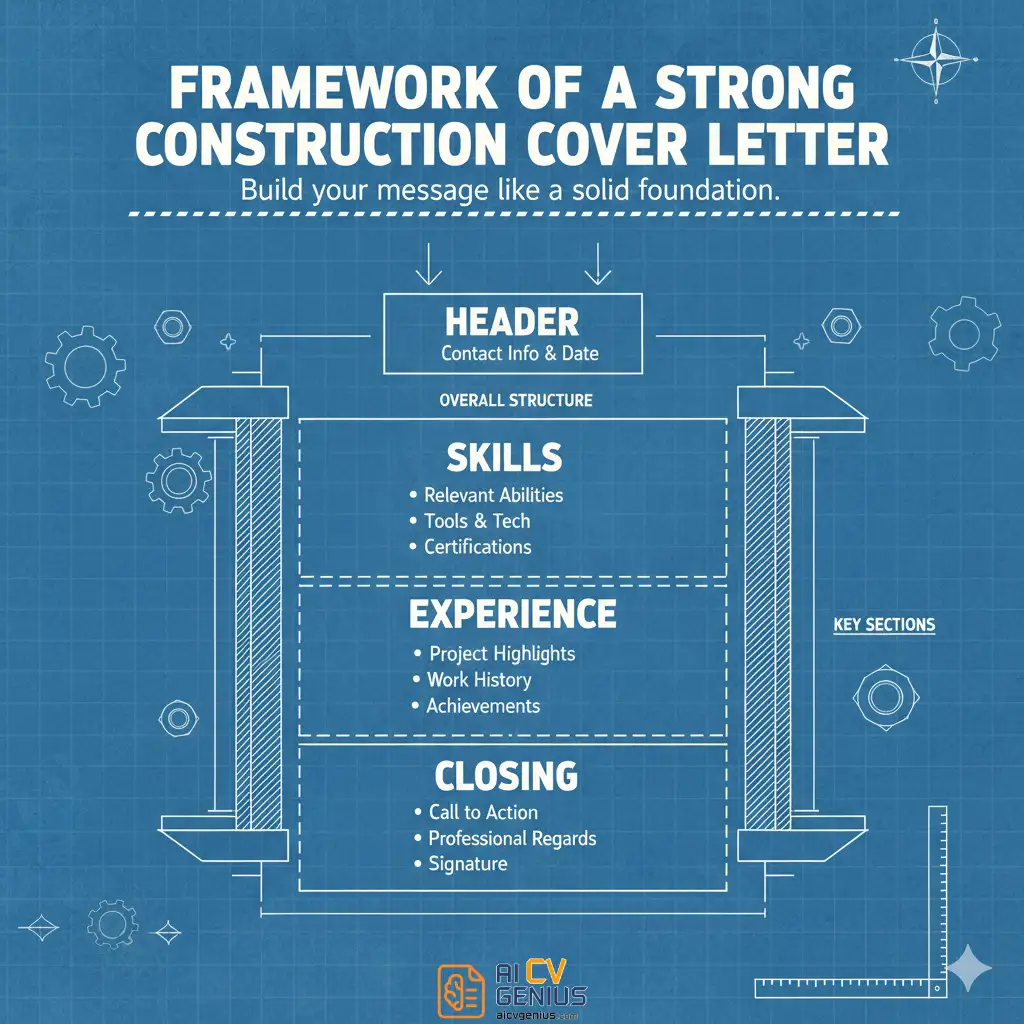
Architecting Your Message: A Basic Structure That Works for Any Role
Just like a well-designed building, every effective cover letter follows a logical and robust structure. This framework ensures clarity, professionalism, and makes it easy for the reader to grasp your key qualifications quickly. Adapt this architecture to fit any trade, role, or level of experience within the construction industry.
1. Header and Greeting: Professional Introduction
Start with your contact information (Name, Phone, Email, City/State, relevant certifications like OSHA#). Follow with the date and the recipient’s details (Hiring Manager Name/Title, Company Name, Address). A personalized greeting significantly outperforms generic ones. Invest time to find the hiring manager’s name via LinkedIn or the company website.
| Section | Purpose | Example Line |
|---|---|---|
| Greeting | Address the hiring manager if known | “Dear Ms. Thompson,” or “Dear Construction Hiring Team,” |
2. Opening Paragraph: State Your Intent and Enthusiasm
Clearly state the specific position you are applying for and where you saw the advertisement. Immediately follow with a strong opening statement expressing your genuine enthusiasm for the role and connecting a key strength or experience directly to the company or project.
| Section | Purpose | Example Line |
|---|---|---|
| Opening | State the position and express enthusiasm | “I’m excited to apply for the Construction Supervisor role at Skyline Builders, bringing over 8 years of experience in leading safe and efficient commercial projects.” |
3. Body Paragraphs (1-2): Provide Concrete Evidence
This is where you substantiate your claims. Select 2-3 key qualifications from the job description (e.g., safety record, technical skills, teamwork, project completion). For each, provide a specific example or accomplishment from your past roles that demonstrates your proficiency. Quantify results whenever possible (e.g., project size, budget managed, safety metrics, deadlines met).
| Section | Purpose | Example Line |
|---|---|---|
| Body | Show your technical skills, teamwork, and reliability | “In my previous role at [Company], I consistently ensured 100% compliance with OSHA standards on projects valued up to $5M, contributing to a zero lost-time injury record for two consecutive years.” |
4. Closing Paragraph: Reiterate Interest and Call to Action
Briefly reiterate your strong interest in the position and the company. Summarize why you believe you are an excellent fit, perhaps mentioning one key qualification again. Express enthusiasm for the opportunity to contribute. Politely request an interview to discuss your qualifications further and thank them for their time and consideration.
| Section | Purpose | Example Line |
|---|---|---|
| Closing | Thank them and invite discussion | “My hands-on experience and commitment to safety align well with your company’s values, and I’d appreciate the opportunity to discuss how I can contribute to your upcoming developments.” |
To refine layout and tone, review similar examples in AI CV Genius cover letter tips. This structured approach ensures your message is clear, compelling, and professional from start to finish.
Building Credibility: The Power of Specificity and Quantification
In construction, ambiguity leads to errors; in a cover letter, it leads to skepticism. Vague statements like “I am hardworking” or “I have good teamwork skills” are easily dismissed. Trust is built on tangible evidence. Use concrete details, specific examples, and measurable results to make your experience real, verifiable, and impactful.
Numbers resonate powerfully in construction, an industry driven by budgets, timelines, and safety metrics. Quantify your accomplishments whenever possible:
| Weak (Vague Duty) | Strong (Specific Achievement) |
|---|---|
| Worked on residential sites. | Completed foundation pours for 12+ single-family homes, consistently meeting project timelines and passing all quality inspections. |
| Good teamwork. | Collaborated effectively within a 15-member framing crew to deliver a 50,000 sq. ft. mixed-use complex six weeks ahead of the original schedule. |
| Handled equipment. | Operated excavators and backhoes for site preparation on projects up to $2M, maintaining a zero-incident safety record over 3+ years. |
| Followed safety protocols. | Actively participated in daily toolbox talks and site safety audits, contributing to a 25% reduction in minor safety incidents within my team over one year. |
When hiring managers can clearly visualize the scale, scope, and impact of your work through specific details and numbers, your credibility skyrockets, and your application becomes significantly more memorable.
Tailoring Your Blueprint: Adapting Your Letter to the Specific Role
“Construction” encompasses a vast range of roles, each requiring a distinct emphasis in your cover letter. A general laborer needs to project reliability and diligence, while a site manager must demonstrate strategic oversight and leadership. Always tailor your language, examples, and focus to align precisely with the requirements and responsibilities of the position you’re targeting.
For General Laborers & Apprentices:
Focus: Emphasize unwavering reliability, punctuality, physical stamina, adherence to safety protocols, ability to follow instructions precisely, and eagerness to learn and support skilled tradespeople. Highlight any basic tool proficiency or site maintenance experience.
Example Emphasis:
“Proven ability to consistently arrive on time, maintain a clean and safe work environment, and efficiently assist multiple trades, contributing to overall site productivity.”
For Foremen & Supervisors:
Focus: Highlight leadership capabilities (managing crews, delegating tasks), expertise in scheduling and coordinating workflow, deep understanding of specific trades, enforcement of safety regulations, quality control, and problem-solving on site. Mention crew size managed and project scope.
Example Emphasis:
“Successfully led crews of up to 15 carpenters, ensuring adherence to blueprints and project timelines while maintaining a zero lost-time injury record through proactive safety oversight.”
For Site Managers & Project Managers:
Focus: Emphasize strategic planning, budget management, resource allocation, subcontractor coordination, client communication, risk assessment, regulatory compliance, and overall project delivery from inception to completion. Highlight project values, timelines met, and cost savings achieved.
Example Emphasis:
“Managed end-to-end site operations for commercial projects valued at over $10M, consistently delivering within budget and schedule parameters through meticulous planning and cross-functional team coordination.”
Highlighting High-Value Skills: What to Emphasize
The best construction cover letter examples strategically weave in skills that directly address the core demands of the industry. Don’t just list them; demonstrate them through your examples:
Technical Proficiency & Blueprint Reading
Show you understand the language of construction. Example: “Accurately interpreted complex blueprints and schematics to execute precise framework installations for multi-story residential buildings.”
Safety Compliance & Certifications
Safety is non-negotiable. Mention specific certifications (OSHA 10/30, First Aid/CPR) and how you apply safety protocols daily. Example: “OSHA 30 certified with a consistent record of adhering to all site safety protocols, including daily equipment checks and PPE usage, contributing to team-wide safety goals.”
Equipment Operation & Maintenance
Specify the types of machinery you handle (forklifts, excavators, cranes) and your commitment to proper use and basic maintenance. Example: “Safely operated heavy machinery, including Caterpillar excavators and loaders, for site grading and material transport, performing routine maintenance checks to ensure operational readiness.”
Project Coordination & Time Management
Demonstrate your ability to work within schedules and coordinate with others. Example: “Effectively coordinated with plumbing and electrical subcontractors to ensure timely completion of rough-ins, preventing potential project delays.”
Communication & Teamwork
Show you can collaborate effectively. Example: “Communicated clearly with a crew of 10+ laborers and supervisors to ensure tasks were understood and executed according to plan.”
Leadership & Problem-Solving (for Supervisors/Managers)
Highlight your ability to guide teams and resolve issues. Example: “Proactively identified and resolved an on-site logistical challenge regarding material delivery, preventing a potential one-day work stoppage.”
Weave 3–4 of these skill demonstrations naturally into your body paragraphs, always linking them back to tangible actions and positive outcomes.
Template, Examples & Best Practices
Example Construction Cover Letter Template (Adaptable)
[Your Name]
[Your Phone Number] | [Your Email Address] | [City, State]
[Optional: OSHA Certification Level, e.g., OSHA 30 Certified][Date]
[Hiring Manager’s Name] (If known, otherwise use title)
[Hiring Manager’s Title]
[Company Name]
[Company Address]Dear [Mr./Ms./Mx. Last Name or Hiring Team],
I am writing to express my strong interest in the [Position Title] position at [Company Name], as advertised on [Platform where you saw the ad]. With [X years] of hands-on experience in [mention specific area, e.g., commercial framing, site supervision, heavy equipment operation], I possess a proven track record of contributing to project success through a steadfast commitment to safety, efficiency, and quality workmanship.
In my previous role as a [Your Previous Title] at [Previous Company], I was instrumental in [describe a key accomplishment relevant to the new role]. For example, I [use an action verb: led, managed, operated, assisted] [describe the task specifically] on a project involving [describe project type/scale], which resulted in [quantify the positive outcome, e.g., completing the phase 10% ahead of schedule, reducing material waste by 5%, maintaining a zero-incident record for 12 months]. My expertise includes [mention 1-2 key technical skills, e.g., blueprint interpretation, operating specific machinery like excavators] and proficiency in collaborating effectively within diverse teams to meet demanding project deadlines.
I am particularly drawn to [Company Name]’s reputation for [mention something specific you admire, e.g., high-quality sustainable building practices, strong safety culture, involvement in community projects] – values that deeply resonate with my own professional principles. I am confident that my technical skills, proactive approach to problem-solving, and unwavering reliability make me an excellent candidate to contribute significantly to your team.
Thank you for considering my application. My attached resume provides further detail on my qualifications and experience. I am eager to discuss how my background can benefit [Company Name] and welcome the opportunity for an interview at your convenience.
Sincerely,
[Your Typed Name]
Polishing Your Presentation: Formatting and Tone Tips
Your cover letter’s appearance should reflect the precision and order valued in construction. Keep the language direct, professional, and free of unnecessary jargon or overly casual phrasing.
Formatting Essentials:
- ✅ Length: Strictly one page, single-spaced. Aim for 3-4 concise paragraphs.
- ✅ Font: Choose a clean, readable, professional font like Arial, Inter, Calibri, or Roboto in 10.5–12 pt size.
- ✅ Margins: Use standard 1-inch margins on all sides for ample white space.
- ✅ File Format: Always save and send as a PDF to preserve formatting perfectly across all devices. Name the file professionally (e.g.,
YourName_CoverLetter_CompanyName.pdf). - ✅ Spacing: Use consistent single spacing within paragraphs and a double space between paragraphs and sections.
Tone and Language:
- ✅ Professional yet Direct: Avoid overly formal language (“It is with great honor…”) but maintain respect. Get straight to the point.
- ✅ Confident but Humble: Showcase your skills and achievements confidently, but avoid arrogance. Acknowledge teamwork.
- ✅ Action-Oriented: Start sentences with strong action verbs (Managed, Coordinated, Operated, Built, Ensured, Resolved).
- ✅ Error-Free: Proofread meticulously. Typos or grammatical errors suggest carelessness – a critical flaw in construction. Read it aloud or ask someone else to review it.
For design alignment with your resume, browse AI CV Genius resume templates built for skilled and technical industries. A clean, consistent look across your application documents reinforces your professionalism.
Avoiding Pitfalls: Common Mistakes in Construction Cover Letters
Even small errors can undermine your credibility. Steer clear of these common missteps:
| ❌ Mistake | ✅ Solution |
|---|---|
| Using a Generic Template | Customize every letter. Mention the specific company, project types they handle, or align with their stated values (e.g., safety, sustainability). |
| Focusing Only on Duties, Not Results | Translate responsibilities into achievements. Instead of “Handled site cleanup,” write “Maintained site cleanliness across a 50,000 sq ft project, improving safety and efficiency.” |
| Ignoring Safety | Explicitly mention safety protocols, certifications (OSHA), and your personal commitment to a safe work environment. It’s a top priority for employers. |
| Overly Casual or Informal Tone | Maintain professionalism. Avoid slang, overly familiar language, or complaining about previous employers. |
| Listing Skills Without Examples | Back up every skill claim with a brief, concrete example or quantifiable result from your experience. “Show, don’t just tell.” |
| Typos and Grammatical Errors | Proofread multiple times. Errors suggest a lack of attention to detail, which is critical in construction. |
Crafting Impactful Sentences: Example Achievement Lines
Strong cover letters use concise, powerful sentences that demonstrate impact. Here are examples hiring managers respond well to:
- “Supervised daily site operations for a crew of 8, consistently ensuring 100% compliance with OSHA safety standards.”
- “Operated heavy machinery, including excavators and bulldozers, with a zero-incident safety record maintained over 3 consecutive years.”
- “Led a 10-person crew in completing the structural framing phase of a municipal bridge repair project two weeks ahead of schedule and under budget.”
- “Assisted foremen in meticulously coordinating material deliveries and optimizing waste management, resulting in a 5% reduction in material costs.”
- “Collaborated effectively with electrical and plumbing teams during rough-ins, proactively identifying and resolving 3 potential conflicts to prevent delays.”
- “Maintained meticulous project documentation, including daily logs and safety reports, ensuring accurate record-keeping for regulatory compliance.”
Integrating Soft Skills Naturally: Strength Beyond the Technical
Construction demands physical toughness, but success also relies heavily on soft skills like communication, teamwork, problem-solving, and dependability. Avoid simply listing these traits. Instead, weave them into your achievement statements to show them in action:
| Instead of | Try |
|---|---|
| “Good communication skills.” | “Clearly communicated project updates and safety concerns during daily crew huddles, ensuring alignment across all team members.” (Communication + leadership) |
| “Team player.” | “Collaborated seamlessly with carpenters and electricians to troubleshoot and resolve an unexpected structural issue, minimizing downtime.” (Teamwork + problem-solving) |
| “Reliable.” | “Maintained a perfect attendance record over 24 months and consistently volunteered for overtime shifts during critical project phases.” (Dependability + initiative) |
Framing soft skills within the context of real work situations makes them sound authentic and impactful, not like generic buzzwords.
Concluding with Confidence: How to Close Professionally
Your closing paragraph is the final structural element – it should be clean, strong, and leave a positive, lasting impression. Avoid generic phrases or passive language. Reiterate your value proposition briefly and state your call to action clearly.
“I am confident that my hands-on experience in [Your Key Skill Area], proven commitment to safety, and strong leadership potential make me an excellent fit for the [Position Title] position and a valuable asset to your team. I have attached my resume for your detailed review and look forward to discussing how I can contribute to [Company Name]’s upcoming projects in an interview.”
End with a professional closing (“Sincerely,” or “Best regards,”) and your typed name. This ending feels respectful, confident, and action-oriented.
Demonstrating Fit: Aligning With Company Values
Top construction firms often emphasize specific values – safety culture, innovation, sustainability, community involvement, or quality craftsmanship. Research the company’s website, mission statement, or recent projects. Briefly referencing these values in your cover letter demonstrates that you’ve done your homework and that your professional principles align with theirs. This small touch can significantly enhance your perceived fit.
Example:
“Your company’s commitment to implementing sustainable building practices, as seen in the recent [Project Name] development, aligns perfectly with my personal interest and recent certification in green building techniques. I am eager to contribute to projects that prioritize both quality and environmental responsibility.”
For more inspiration on tone, phrasing, and demonstrating cultural fit, see the career resources section, focusing on writing with confidence and precision.
Conclusion & FAQ
Frequently Asked Questions
Final Thoughts: Building Your Career, One Letter at a Time
A construction cover letter should feel as solid, reliable, and well-structured as the projects you aim to build. It’s not about using elaborate language; it’s about demonstrating work ethic, precision, safety consciousness, and professionalism through clear, factual communication. When you effectively combine evidence of your skills with genuine sincerity and respect for the reader’s time, your application stands significantly taller than a résumé alone.
Remember, every great structure begins with a meticulously planned foundation. Consider this letter yours – build it with care, attention to detail, and professional pride, and it will effectively support your career advancement in the demanding yet rewarding world of construction.