
- What this cover letter is: Your opening statement that proves persuasive writing, legal judgment, and fit beyond the resume.
- Why legal hiring still cares: Similar credentials are common, so the letter becomes proof of clarity, structure, tailoring, and attention to detail.
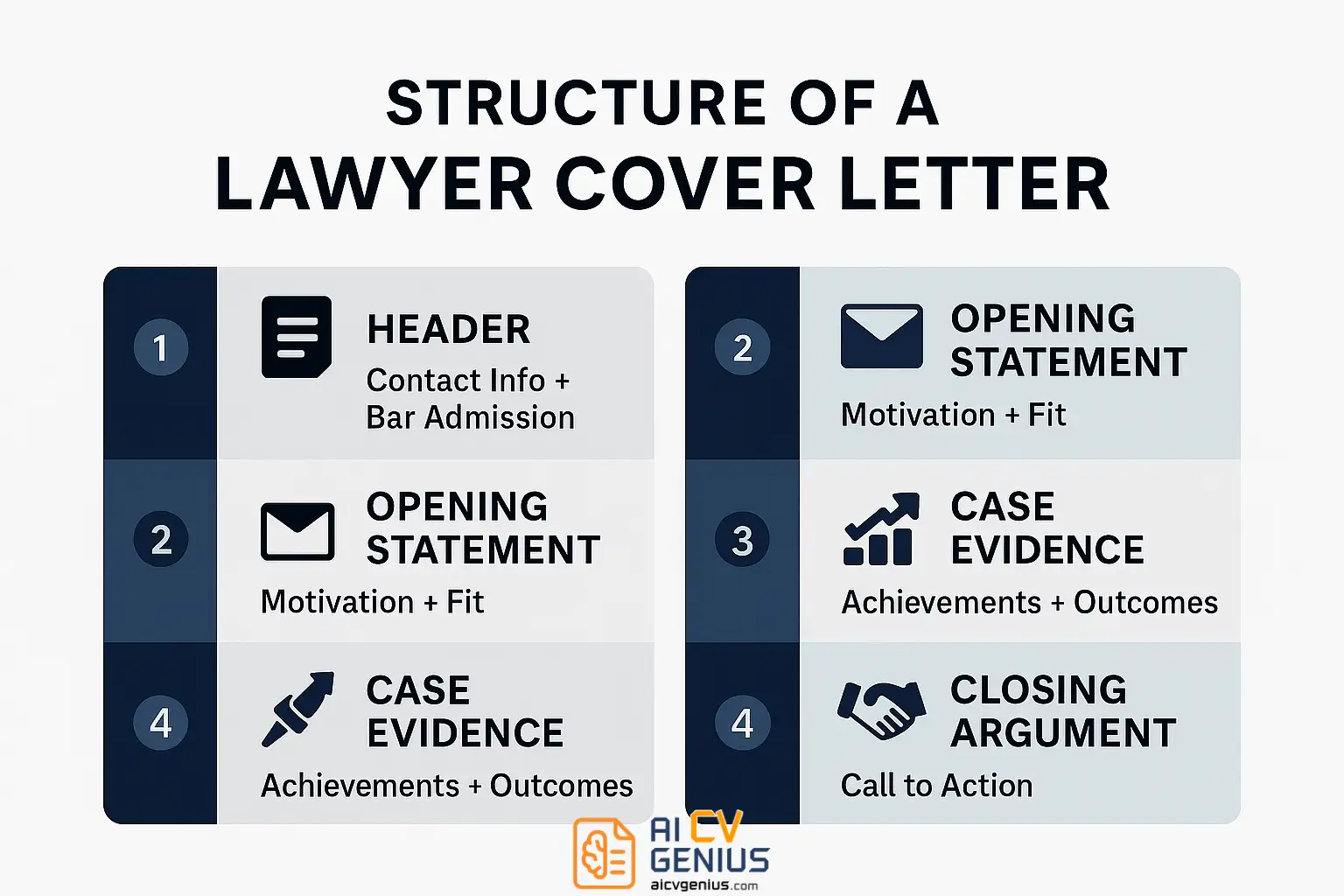
- Winning structure: Header with bar admission, Named salutation, Role-specific hook, Evidence paragraphs with measurable impact, Confident close that asks for the interview.
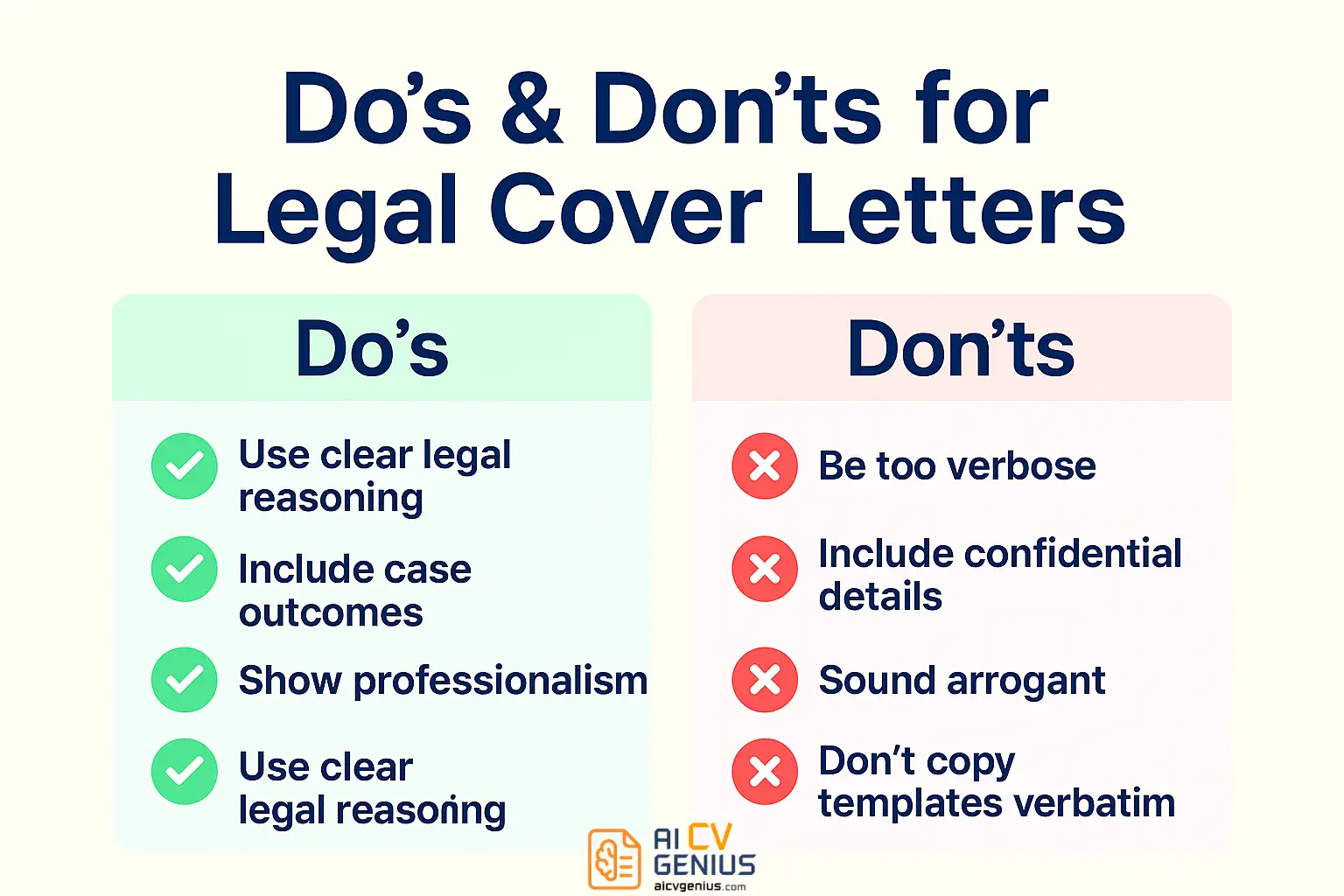
- How to tailor and sound right: Match your proof to the practice area, Stay formal but human, Use active verbs, And protect confidentiality at all times.
- What to avoid and key rule: Do not copy the resume, do not use dense jargon walls, do not include typos, and keep it strictly one page around 350 to 450 words.
The First Argument: Why Your Lawyer Cover Letter is Your Opening Statement
In the meticulous world of law, every argument demands precision, conciseness, and persuasive clarity. The exact same standard applies rigorously to your cover letter. A compelling lawyer cover letter example transcends mere formality – it functions as your critical first argument presented directly to the hiring committee or recruiting partner. Consider it your indispensable opening statement: strategically brief, undeniably compelling, and meticulously supported by tangible evidence drawn from your experience. While your resume chronologically lists your cases and credentials, your cover letter weaves the narrative, revealing the character, strategic thinking, and persuasive capabilities of the advocate behind the qualifications.
This document is your initial opportunity to demonstrate the analytical rigor and communication finesse that define exceptional legal practice, setting the stage long before any formal interview.
The Rationale: Why Cover Letters Remain Crucial in Legal Hiring
Prestigious law firms and in-house legal departments routinely receive hundreds, sometimes thousands, of applications for each open position. A significant portion of these applicants present remarkably similar, often stellar, credentials – comparable GPAs from top-tier law schools, relevant internships or clerkships, and matching bar admissions. In this highly competitive landscape, what truly distinguishes the candidate who secures an interview from the extensive stack isn’t solely the J.D. or the list of publications; it’s the demonstrated power of persuasion and strategic communication.
A thoughtfully constructed cover letter serves as immediate, tangible proof of your ability to:
- Argue with clarity and conciseness.
- Structure complex information logically and compellingly.
- Connect factual background (your experience) to desired outcomes (the firm’s needs).
- Demonstrate meticulous attention to detail (flawless grammar, formatting, and personalization).
Essentially, your cover letter operates as your preliminary case presentation, with the recruiter or hiring partner acting as the judge. Your objective is to persuasively demonstrate – before they even delve into the specifics of your resume – that you possess a nuanced understanding of their clients’ industries, their specific practice areas, their firm’s culture and values, and how your unique skill set aligns with their strategic objectives. It’s your chance to argue for your candidacy proactively.
Building the Perfect Legal Argument: The Anatomy of a Lawyer Cover Letter
Structure your cover letter like a meticulously prepared legal brief: logical, evidence-based, and focused on the key issues relevant to the “judge” – the hiring manager.
1. The Header: Establishing Credentials Immediately
Include your full name, professional contact information (phone, email), LinkedIn profile URL (ensure it’s updated), and crucially, your Bar admission details clearly stated (e.g., “Admitted to the New York State Bar, 2021” or “California Bar No. XXXXXX”). Placing this information prominently establishes your fundamental qualifications and credibility right away. Ensure the formatting matches your resume header for a cohesive application package.
2. The Salutation: Precision and Personalization
Whenever feasible, address the letter to the specific recruiting partner, hiring manager, or HR representative by name. Research the firm’s website, LinkedIn, or make a polite inquiry if necessary. “Dear Ms. Johnson,” or “Dear Mr. Chen,” carries significantly more weight and demonstrates diligence compared to the impersonal “To Whom It May Concern.” In the legal profession, meticulous attention to detail begins with addressing the right person correctly. If a name is genuinely unobtainable, use a formal title like “Dear Hiring Partner,” or “Dear Recruiting Committee,”.
3. The Opening Statement: Hooking the Reader with Relevance
Your introductory paragraph must function like the opening lines of a compelling legal argument: confident, sharply focused, and explicitly tailored to the specific firm and role. State the position you’re applying for and immediately connect your core expertise or specialization to the firm’s known strengths or needs.
Example:
“I am writing with strong interest regarding the Litigation Associate position advertised on [Platform]. As a third-year associate specializing in complex commercial litigation with a proven record in motion practice and deposition strategy, I was particularly drawn to [Firm Name]’s recognized excellence in representing technology sector clients, an area where my background in intellectual property disputes aligns closely.”
This approach immediately establishes your relevant niche and demonstrates you’ve researched the firm, creating a compelling reason for them to read further. Avoid generic introductions.
4. The Evidence Section (Body Paragraphs): Substantiating Your Claims
This is the core of your argument, where you provide concrete evidence to support your assertion of being a strong candidate. Don’t just list skills; illustrate them with specific, quantifiable achievements or significant case involvements (while maintaining confidentiality). Focus on results and impact. Use the STAR method (Situation, Task, Action, Result) implicitly.
| Instead of (Duty) | Try (Achievement) |
|---|---|
| “Involved in contract negotiation.” | “Drafted and negotiated over 50 commercial lease agreements for retail clients, consistently achieving terms reducing client liability exposure by an average of 15% compared to initial offers.” |
| “Assisted with M&A deals.” | “Played a key role in the due diligence process for a $100M cross-border acquisition in the pharmaceutical sector, identifying critical regulatory compliance risks that informed final deal structuring.” |
| “Handled arbitration cases.” | “Successfully represented clients in 10+ binding arbitration hearings concerning breach of contract disputes, achieving favorable settlements or awards in over 90% of cases, saving clients an estimated average of $50,000 per case compared to projected litigation costs.” |
Quantify whenever possible ($, %, # of cases). Numbers translate legal activity into measurable business value. Focus on how you improved efficiency, reduced risk, saved costs, or contributed to successful outcomes. Connect these achievements directly to the requirements mentioned in the job description.
5. The Closing Argument: A Confident Call to Action
Conclude your letter with the same confidence and purpose as a closing argument. Avoid passive or cliché phrases like “Thank you for your time and consideration” or “I look forward to hearing from you.” Instead, reiterate your value proposition and express your proactive interest in discussing the fit further.
Example:
“My proven ability to manage complex caseloads and craft persuasive legal arguments aligns well with the demands of the Senior Associate role and [Firm Name]’s reputation for strategic litigation. I am eager to discuss how my specific experience in [mention a key practice area again] can contribute to your team’s continued success and would welcome the opportunity for an interview at your earliest convenience.”
This ending is professional, assertive, specific, and clearly signals your next desired step.
Lawyer Cover Letter Example (Full Text)
[Your Name]
[Your Address] | [Your Phone] | [Your Email] | [Your LinkedIn URL]
[Bar Admission Details, e.g., Admitted to the California Bar, 2020][Date]
Ms. Eleanor Carter
Recruiting Partner
Sterling & Rowe LLP
[Firm Address]Dear Ms. Carter,
I am writing with keen interest to apply for the Associate Attorney position within the Corporate Law practice group at Sterling & Rowe LLP, as advertised on [Platform]. My experience encompasses corporate governance, regulatory compliance analysis, and transactional support, providing me with a balanced perspective that values both meticulous legal precision and pragmatic business strategy. Sterling & Rowe’s established commitment to providing strategic, client-focused advocacy deeply resonates with my professional philosophy and approach to practice.
During my tenure at BrightLegal Associates, I was primarily responsible for managing comprehensive contract reviews and conducting risk assessments for a portfolio of mid-size technology companies. By implementing a revised compliance checklist I developed, our team reduced contractual compliance errors by 15% within the first year. Furthermore, through meticulous negotiation of key supplier agreements, I contributed to achieving estimated cost savings of approximately $2.1 million for clients over a two-year period. These outcomes underscore my conviction that effective legal counsel involves not only interpreting statutes but actively functioning as a strategic problem-solver for clients.
Prior to my associate role, I had the privilege of clerking for the Honorable Dana Richards in the [Court Name]. This experience was invaluable in honing my legal research and writing skills, particularly through drafting judicial memoranda on complex civil procedure issues and supporting rulings that demanded nuanced statutory interpretation. This clerkship reinforced the critical importance of clarity, analytical rigor, and procedural fairness – principles I integrate into every matter I handle.
I am confident that my dedication to thorough preparation and my proven ability to manage complex transactions would enable me to make a significant contribution to your esteemed corporate division. I would be honored to discuss how my specific skills and proactive approach can support Sterling & Rowe LLP’s objectives and strengthen your legal team. My resume, attached for your review, provides further detail on my qualifications.
Sincerely,
Daniel Nguyen
Deconstructing the Strategy: Why This Cover Letter Works
This letter effectively persuades because it mirrors the logical structure and evidence-based approach inherent in legal argumentation:
- ✅ Establishes Authority & Relevance Immediately: The opening clearly states the role, specialization, and directly connects the candidate’s philosophy to the firm’s known reputation.
- ✅ Supports Claims with Concrete Evidence: It moves beyond simply listing skills by providing specific, quantified examples of impact (15% error reduction, $2.1M savings).
- ✅ Demonstrates a Professional Voice: The tone is confident yet respectful, avoiding arrogance or excessive self-promotion. It focuses on contribution, not just qualification.
- ✅ Maintains Logical Structure and Flow: Each paragraph builds upon the last, moving from introduction to evidence to alignment, mirroring the structure of a well-reasoned brief or argument.
- ✅ Highlights Both Technical Skill and Judgment: It showcases legal acumen (contract review, compliance) alongside strategic thinking (problem-solving, risk assessment).
In the legal field, clarity equates to credibility. Recruiters subconsciously assess your potential ability to draft precise legal documents and communicate effectively based on the quality and structure of your cover letter itself.
Tailoring Your Argument: Customizing by Practice Area
A generic cover letter rarely succeeds in law. Tailor your focus and examples based on the specific practice area:
Corporate Law (Transactional)
Focus: Contracts, mergers & acquisitions (M&A), corporate governance, securities, due diligence, business negotiation. Emphasize your understanding of both the legal intricacies and the underlying commercial objectives. Highlight outcomes using financial metrics: deal value, cost savings achieved, risk mitigation quantified, transaction speed. Mention specific industries you’ve served (e.g., tech, finance, healthcare).
Litigation
Focus: Analytical skills, legal research (Westlaw, LexisNexis), persuasive writing (motions, briefs), deposition strategy, discovery management, courtroom preparation, negotiation/settlement skills. Provide examples of successful motion practice, favorable case outcomes (quantify if possible, e.g., settlement amount vs. initial demand), or experience in specific courts or jurisdictions. Mention specific types of litigation (e.g., commercial, IP, employment).
Compliance & Regulatory
Focus: Deep familiarity with relevant regulatory frameworks (e.g., SOX, GDPR, HIPAA, AML, SEC regulations). Emphasize meticulous accuracy, rigorous documentation discipline, risk assessment methodologies, internal audit experience, and policy development. Highlight instances where you improved compliance processes, reduced violations, or successfully navigated regulatory inquiries.
Public Interest Law / Non-Profit / Government
Focus: Allow your underlying motivation and passion for justice, advocacy, or public service to shine through, alongside your technical expertise. Discuss your commitment to the organization’s specific mission. Highlight relevant volunteer work, pro bono cases, community involvement, or experience working with specific vulnerable populations. Emphasize empathy, cross-cultural communication, and resourcefulness.
Finding the Right Tone: Professional Formality with Human Insight
While formality is expected in legal correspondence, avoid sounding robotic, detached, or overly academic. The most effective legal professionals build trust not just through intellect, but through relatable communication. Inject subtle elements of your professional philosophy or perspective to add depth without losing decorum. Replace overused, passive corporate phrases with active, engaging statements that reveal insight:
| Instead of | Try |
|---|---|
| “I am confident that my skills meet your requirements.” | “My experience in complex arbitration proceedings has reinforced my belief that effective advocacy begins with meticulous preparation and active listening.” |
| “I possess strong analytical abilities.” | “Every challenging case presents an opportunity to dissect complexity and construct a clear, logical path towards resolution – an approach I bring to my practice daily.” |
| “Seeking a role where I can utilize my legal knowledge.” | “I view the practice of law not merely as interpreting statutes, but as employing legal frameworks to facilitate progress and fairness for clients.” |
This nuanced approach demonstrates intellectual maturity and emotional intelligence – qualities highly valued in collaborative legal environments.
Common Mistakes That Undermine Legal Cover Letters
Avoid these frequent errors that can instantly damage your credibility:
- ❌ Writing Like a Court Brief: Overly dense paragraphs, excessive legal jargon, footnotes, or an overly formal, impersonal tone can alienate the reader. Aim for clarity and professional warmth.
- ❌ Simply Repeating Resume Points Verbatim: The cover letter should add context, narrative, and specific connections to the firm – not just rehash bullet points without elaboration.
- ❌ Over-Reliance on Passive Voice: Phrases like “was involved in,” “was responsible for,” or “experience was gained in” weaken your impact. Use strong, active verbs: “Managed,” “Negotiated,” “Drafted,” “Advised,” “Resolved.”
- ❌ Breaching Confidentiality: Never include specific confidential client names, identifiable case details, or sensitive settlement figures unless the information is already public record and used judiciously. Protect privilege always.
- ❌ Sounding Arrogant or Entitled: While confidence is crucial, avoid overly self-promotional language, hyperbole, or downplaying the contributions of others. Focus on collaborative achievements and measurable results.
- ❌ Typos, Grammatical Errors, or Formatting Inconsistencies: In a profession demanding precision, even minor errors signal carelessness and undermine your claim to meticulousness. Proofread rigorously.
Remember, confidence is persuasive; arrogance is off-putting. Your cover letter should build a compelling argument for your competence and fit, not simply demand approval based on credentials alone.
Weighing the Effort: Pros & Cons of Investing Time in a Cover Letter
While highly recommended, especially in law, understand the trade-offs:
| Pros ✅ | Cons ❌ |
|---|---|
| Demonstrates essential written advocacy and communication skills upfront. | Requires significant time and research to tailor effectively for each specific firm and role. |
| Allows inclusion of quantifiable results (cost savings, success rates) that add depth beyond resume bullets. | Even minor mistakes (typos, incorrect names, formatting errors) can disproportionately damage credibility in the legal field. |
| Showcases professionalism, understanding of legal ethics (confidentiality), and alignment with firm culture. | Striking the right balance between professional formality and authentic personal tone can be challenging. |
| Builds personal rapport and conveys genuine, specific interest in the particular firm or practice group. | Risk of sounding generic or using clichés if the letter is rushed or relies too heavily on templates without personalization. |
Despite the effort required, the potential return on investment for a meticulously crafted, tailored cover letter in the legal profession is substantial, often serving as the key differentiator in securing interviews.
Concluding with Impact: Ending Your Cover Letter Like a Lawyer
The most effective conclusions are calm, confident, and decisive, leaving a lasting impression of professionalism and proactive interest. Think of it as your final summation – briefly reinforcing why you are the right advocate for their needs, not just why you want the job.
- “I am eager to discuss how my strategic approach to complex litigation and proven track record in successful motion practice align with [Firm Name]’s current needs in the [Practice Area] group.”
- “Thank you for your time and consideration. I am confident that my precision in regulatory analysis and commitment to client advocacy would be a valuable asset to your team, and I welcome the opportunity for an interview.”
- “I look forward to the possibility of contributing my transactional expertise and collaborative spirit to furthering [Firm Name]’s reputation for excellence in corporate law.”
End with a standard professional closing (“Sincerely,” or “Respectfully,”) followed by your typed name.
FAQs: Lawyer Cover Letter Specifics
Final Verdict: Your First Case Begins Now
A legal career commences long before you step into your first courtroom or client meeting – it initiates with your very first written argument: your cover letter. An exceptional lawyer cover letter example skillfully balances compelling evidence with professional empathy, and formal structure with authentic human insight. It persuades through irrefutable logic and clarity, not excessive length or jargon. It serves as your primary opportunity to demonstrate that you think like a seasoned advocate, write with meticulous professionalism, and operate with unwavering integrity.
For additional templates tailored to legal professionals and effective writing strategies, explore our curated Cover Letters collection or browse the Resume Templates Guides to ensure your entire application package presents a consistent and polished narrative. If you are preparing for interviews or seeking to advance your career, our Career Resources hub provides valuable guidance on interview preparation, negotiation tactics, and professional development specific to the legal field.
Every accomplished lawyer understands that strategically chosen words win cases. Allow yours to persuasively open the door to your next significant professional opportunity.