
- Core goal: Show you can deliver calm, accurate service and protect the guest experience in a fast-paced room.
- Opening hook: Name the restaurant, reference something specific about them, and lead with real enthusiasm instead of a generic intro.
- Body proof: Turn duties into outcomes with numbers plus examples of teamwork, POS confidence, upselling, and clean problem resolution.
- Common mistakes: Avoid stiff wording, generic templates, duty-only lists, missing teamwork, and any typos.
- Finishing touches: Keep it one page in a clean layout, use strong action verbs, tailor focus by experience level, and submit as a well-named PDF.
Introduction: The Waiter’s First Impression
The First Impression: Why a Great Waiter Cover Letter is Your Initial Act of Service
In the dynamic world of hospitality, your first interaction with a potential employer isn’t when you greet a guest – it’s when they open your application. A waiter cover letter isn’t just a formality or a mere supplement to your resume; it’s your very first demonstration of service aptitude. Before you meticulously arrange a table setting or anticipate a diner’s needs, this letter sets the stage, signaling to discerning restaurant managers that you inherently understand the core tenets of exceptional hospitality: keen awareness, unwavering attention to detail, and profound respect for the guest experience.
Whether your ambition lies within the refined atmosphere of a fine-dining establishment, the bustling energy of a high-volume brasserie, or the welcoming embrace of a neighborhood café, your cover letter must harmonize with the establishment’s unique ambiance. It should project warmth without sacrificing professionalism, confidence without bordering on arrogance. The most effective letters transcend a simple list of duties; they artfully convey your ability not merely to serve food, but to curate memorable experiences, transforming a meal into a moment.
Decoding the Manager’s Mind: Why This Letter Carries Significant Weight
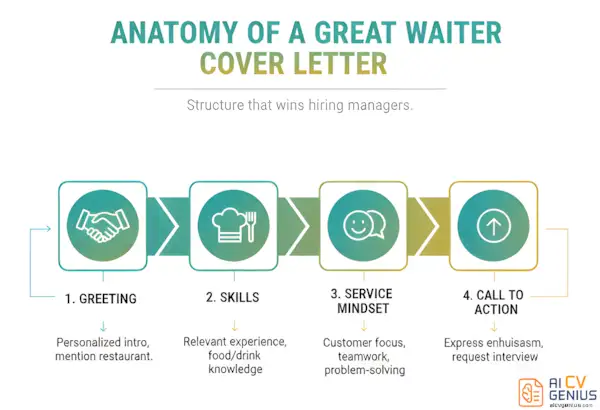
Imagine the daily reality of a restaurant manager or hiring lead: a relentless flood of applications washes onto their desk or into their inbox. Amidst this deluge, they aren’t meticulously scrutinizing every word searching for flawless prose. Instead, they are rapidly scanning, seeking vital signals – indicators of genuine personality, unwavering reliability, and an innate understanding of service dynamics. A thoughtfully constructed guide on how to write a waiter cover letter emphasizes mirroring the natural rhythm of outstanding service: you initiate contact warmly (the greeting), establish a connection (demonstrating understanding of their needs), deliver tangible value (highlighting relevant skills and experience), and conclude with professional courtesy (a polite closing and call to action).
“Hospitality doesn’t begin when the guest arrives – it begins with the first word you write. Your cover letter sets the tone for the entire interaction.”
This endeavor isn’t about deploying elaborate vocabulary or complex sentence structures. It’s fundamentally about authentic communication. It’s about projecting professionalism, radiating warmth, and conveying a sincere, demonstrable commitment to guest well-being and team success. Your letter is a proxy for your presence; make it count.
Crafting Your Letter: Strategy and Structure
Architecting Your Message: The Essential Structure of a Waiter Cover Letter
Much like a thoughtfully curated menu guides a diner through their culinary journey, a well-structured cover letter directs the hiring manager seamlessly through your professional narrative. Adhering to a logical framework ensures clarity, maintains professionalism, and allows your key qualifications to shine. This structure is adaptable and effective for virtually any restaurant position.
1. Header and Greeting: Setting the Stage Professionally
Begin with your complete contact information: Full Name, Phone Number, Professional Email Address, and City/State. Include the date, followed by the recipient’s details: Hiring Manager’s Name (if known), Title, Restaurant Name, and Address. Personalization is paramount; invest the effort to identify the specific hiring manager via LinkedIn, the restaurant’s website, or even a polite phone call. A direct address (“Dear Ms. Dubois,”) carries far more impact than a generic opening.
| Section | Purpose | Example Line |
|---|---|---|
| Greeting | Address the specific hiring manager or team lead | “Dear Mr. Nguyen,” or “Dear Hiring Manager,” |
2. Opening Paragraph: The Appetizer – Hooking Their Interest
Your opening lines must immediately capture attention and establish relevance. Clearly state the specific position you are applying for (e.g., “Lead Server,” “Part-Time Waiter”) and mention where you discovered the opening. Crucially, follow this with a compelling statement expressing genuine enthusiasm. Connect a core strength, a relevant past achievement, or your admiration for a specific aspect of their establishment (e.g., their farm-to-table philosophy, their reputation for exceptional service, a recent positive review you read) directly to the role.
| Section | Purpose | Example Line |
|---|---|---|
| Opening | Show immediate enthusiasm and relevance | “I am writing with great excitement to apply for the Waiter position at OceanView Bistro, eager to bring my [X years] of experience in high-volume settings and passion for creating memorable guest experiences to your esteemed team.” |
3. Body Paragraphs (1-2): The Main Course – Serving Up Your Value
This is the heart of your letter, where you substantiate your claims with tangible evidence. Select 2-3 key skills or experiences directly relevant to the job description (e.g., customer service excellence, upselling ability, teamwork under pressure, POS system proficiency). For each, provide a concise, specific example or accomplishment from your past roles. Quantify whenever possible (“Managed 15+ tables during peak dinner service,” “Consistently exceeded upselling targets by 10%,” “Trained 3 new team members on service protocols”). Focus on demonstrating impact, not just listing duties.
| Section | Purpose | Example Line |
|---|---|---|
| Body | Highlight service experience, teamwork, and quantifiable impact | “During my two years at Luna Café, I consistently received positive guest feedback for my attentive service and efficiency, contributing to a 15% increase in repeat customer visits noted by management.” |
4. Closing Paragraph: The Digestif – Reaffirming Interest and Call to Action
Conclude with confidence and clarity. Briefly reiterate your strong interest in the specific role and the restaurant. Summarize your key value proposition in one sentence (e.g., “My commitment to exceptional service and proven ability to thrive in fast-paced environments align perfectly with [Restaurant Name]’s standards.”). Politely express your desire for an interview to discuss your qualifications further and thank the reader for their time and consideration. Maintain a proactive yet respectful tone.
| Section | Purpose | Example Line |
|---|---|---|
| Closing | Thank them, reiterate fit, and invite discussion | “I am confident I possess the skills and dedication necessary to excel in this role and would welcome the chance to discuss how I can contribute to your team’s continued success.” |
For further inspiration on refining layout nuances and adjusting tone for different types of establishments, exploring additional resources like cover letter writing tips can provide valuable context and comparative examples.
Crafting a Compelling Opening: Beyond the Generic Introduction
Your opening paragraph is your handshake; make it firm, confident, and memorable. Avoid tired phrases like “I am writing to apply…” Instead, lead with genuine enthusiasm and demonstrate you’ve done your research. Mentioning something specific about the restaurant – a unique menu item you admire, their commitment to local sourcing, a recent positive review you read, or their overall ambiance – instantly elevates your application from generic to genuinely interested. This small effort proves you aren’t just applying everywhere; you specifically want to contribute here.
Weak Opening:
“I am applying for the Waiter position I saw on Indeed.”
Strong Opening:
“Having personally enjoyed the vibrant atmosphere and exceptional service during a recent visit to The Green Garden, I was thrilled to see the opening for a Waiter position. I deeply admire your team’s dedication to locally sourced ingredients and believe my passion for creating positive guest experiences aligns perfectly with your philosophy.”
This approach immediately establishes a connection and signals a higher level of engagement and professionalism.
Substantiating Your Claims: Highlighting Key Skills in the Body Paragraphs
The body of your cover letter is where you move from introduction to evidence. This is your service demonstration on paper. Focus strategically on the skills and experiences that prove you are valuable not just to guests, but crucially, to the smooth functioning of the entire team. Avoid generic skill lists; instead, illustrate your capabilities through concise, impactful examples. The most effective waiter cover letter examples skillfully emphasize:
- ✅ Exceptional Communication & Active Listening: Demonstrate your ability to understand guest needs accurately, handle special requests gracefully, and communicate effectively with kitchen and bar staff. Example: “Clearly communicated complex dietary restrictions to the kitchen, resulting in 100% order accuracy for guests with allergies.”
- ✅ Multitasking & Grace Under Pressure: Provide evidence of your ability to manage multiple tables, prioritize tasks, and maintain composure during peak service hours without sacrificing service quality. Example: “Efficiently managed a 7-table section during sold-out weekend shifts, consistently exceeding guest expectations for attentiveness.”
- ✅ Team Collaboration & Support: Showcase your willingness and ability to work seamlessly with colleagues, assist others during busy periods, and contribute to a positive, efficient team dynamic. Example: “Proactively assisted bussers and hosts during peak times, contributing to faster table turnover and smoother service flow.”
- ✅ Positive Guest Feedback & Service Recovery: Mention specific instances of receiving positive feedback or successfully resolving guest complaints, turning potentially negative experiences into positive outcomes. Example: “Received frequent commendations from guests for personalized service, specifically mentioned in 5+ positive online reviews.”
- ✅ Technical Proficiency & Operational Skills: Detail your experience with relevant POS systems (e.g., Toast, Aloha, Square), accurate order taking, efficient cash handling, and adherence to health/safety standards. Example: “Proficient in Toast POS, consistently processing payments accurately and efficiently, maintaining a zero-error cash handling record.”
Remember the power of storytelling over simple listing. Instead of stating “good multitasking,” vividly describe a situation: “Successfully handled simultaneous requests from three tables during a busy Saturday brunch service while ensuring all orders were delivered accurately and promptly” paints a far more compelling picture of your capability.
Infusing Personality: Adding a Personal Touch and Showcasing Your Service Mindset
Exceptional hospitality is fundamentally about emotional intelligence manifested through action. Hiring managers are adept at reading tone; if your written communication feels genuinely warm, attentive, and considerate, they are more likely to believe your in-person service reflects the same qualities. Your cover letter should convey professionalism, but not at the expense of personality.
“Professionalism in hospitality isn’t about robotic stiffness – it’s about consistent warmth, reliability, and genuine care delivered with polish.”
Here’s how to strike that delicate balance, sounding both confident and approachable:
- ✅ Use Natural, Polite Phrasing: Opt for language that feels authentic yet respectful. Instead of overly casual phrases like “I’d love to contribute,” elevate slightly to “I would be delighted to bring my service skills and positive attitude to your team.” Avoid clichés (“team player,” “hard worker”) and opt for specific descriptions.
- ✅ Employ Active Voice and Concise Sentences: Keep your sentences relatively short, clear, and direct. Use active voice (“I managed,” “I assisted,” “I resolved”) to convey energy and ownership, rather than passive constructions (“Responsibilities included…”).
- ✅ Replace Generic Statements with Sincere Expressions: Instead of simply stating “I enjoy helping people,” articulate the why or how. For example: “I find genuine satisfaction in ensuring guests feel comfortable and well-cared for throughout their dining experience.” This adds depth and authenticity.
- ✅ Subtly Mirror the Restaurant’s Tone: Research the restaurant’s brand voice (website, social media). If they are casual and quirky, a slightly more relaxed tone might fit. If they are formal and upscale, maintain a more polished, sophisticated voice.
Your goal is to sound like a capable, considerate human being – someone colleagues would enjoy working alongside and guests would appreciate serving them.
Templates & Best Practices
Adaptable Template: A Foundational Example Waiter Cover Letter
Use this template as a starting point, always customizing it with your specific experiences and tailoring it to the target restaurant.
[Your Name]
[Your Phone Number] | [Your Email Address] | [City, State][Date]
[Hiring Manager’s Name] (If known, otherwise use title)
[Hiring Manager’s Title]
[Restaurant Name]
[Restaurant Address]Dear [Mr./Ms./Mx. Last Name or Hiring Manager],
I am writing to express my enthusiastic interest in the Waiter position at [Restaurant Name], as advertised on [Platform]. With [X years] of experience in dynamic hospitality settings, I have cultivated a strong ability to anticipate guest needs, work effectively within a fast-paced team, and consistently contribute to a positive and memorable dining atmosphere.
During my time at [Previous Restaurant], I regularly managed [mention specific responsibility, e.g., a high-volume section of 10+ tables] while ensuring order accuracy and prompt service. My supervisors frequently commended my composure during peak hours and my skill in [mention a specific skill, e.g., recommending wine pairings or handling dietary restrictions]. I take genuine pride in remembering repeat guests’ preferences and making every diner feel personally welcomed and valued – contributions that led to [mention quantifiable result, e.g., a 15% increase in positive online mentions for service].
Your restaurant’s well-regarded focus on [mention specific aspect you admire, e.g., exceptional guest experience, innovative seasonal menu, commitment to sustainability] resonates deeply with my own professional values. I am confident that my proactive attitude, meticulous attention to detail, and dedication to seamless teamwork align perfectly with the high standards upheld by your team.
I would welcome the opportunity to bring my skills, positive energy, and passion for service excellence to [Restaurant Name]. Thank you sincerely for considering my application. My resume, attached for your review, provides further detail on my qualifications.
Sincerely,
[Your Name]
Sidestepping Service Errors: Common Cover Letter Mistakes to Avoid
Just as a small misstep can mar a dining experience, minor errors in your cover letter can detract from your professionalism. Avoid these frequent pitfalls:
| ❌ Mistake | ✅ Better Approach |
|---|---|
| Writing Too Formally or Stiffly: Using overly corporate jargon or complex sentences that sound unnatural. | Adopt a natural, polite, and professional voice. Imagine speaking confidently yet warmly to a respected manager. Write clearly and directly. |
| Listing Duties Instead of Results/Impact: Focusing only on tasks (“Took orders,” “Served food”) without showing the outcome or value. | Frame responsibilities as achievements. Quantify impact whenever possible (“Increased average check size by 15% through suggestive selling techniques”). Show how you made a difference. |
| Forgetting to Mention Teamwork: Neglecting to highlight collaboration, support for colleagues, or communication with BOH/FOH staff. | Weave in specific examples of collaboration. Restaurants thrive on teamwork; show you understand and contribute to that dynamic (“Assisted colleagues during peak rushes to ensure smooth service flow”). |
| Failing to Personalize/Mention the Restaurant Name: Sending a generic letter that could apply to any establishment. | Always customize. Mention the specific restaurant name multiple times. Reference something unique about them (menu, values, atmosphere) to demonstrate genuine interest. |
| Typos and Grammatical Errors: Submitting a letter with spelling mistakes or poor grammar. | Proofread meticulously. Use spell-check and grammar tools, then read it aloud or ask a friend to review. Errors signal carelessness – fatal in hospitality. |
Setting the Table: Essential Formatting Tips
A section dedicated to restaurant cover letter tips is incomplete without emphasizing the importance of visual presentation. Your layout should be as clean, organized, and inviting as a perfectly set table. Prioritize clarity and readability:
- ✅ Strictly One Page: Brevity is key. Respect the manager’s time by keeping your letter concise and focused.
- ✅ Standard Business Format: Use left-alignment for all text. Ensure consistent spacing between paragraphs and sections.
- ✅ Professional Font: Choose a clean, easily readable font like Inter, Lato, Calibri, or Arial in a size between 10.5–12 points. Avoid overly decorative or script fonts.
- ✅ Adequate Margins: Use standard 1-inch margins on all sides to create sufficient white space, making the letter feel less cluttered and easier to scan.
- ✅ Save as PDF: Always save and submit your cover letter as a PDF file. This preserves your formatting perfectly across all devices and operating systems. Name the file professionally: “FirstName_LastName_WaiterCoverLetter_[RestaurantName].pdf.”
For inspiration on creating a visually cohesive application package, consider browsing hospitality-focused templates available through resources like AI CV Genius Resume Templates. A consistent design between your cover letter and resume reinforces your professionalism.
Elevating Your Language: Examples of Strong, Professional Phrasing
Choosing impactful yet natural language can subtly elevate the tone of your cover letter without sounding arrogant or rehearsed. Opt for active verbs and specific descriptors that convey confidence and competence. Use these selectively to add polish:
- Instead of “handled customer needs,” try “anticipated guest requirements proactively.”
- Instead of “improved service,” consider “enhanced the dining experience through attentive service.”
- Instead of “worked with the kitchen team,” use “collaborated effectively with kitchen staff to ensure timely order delivery.”
- Instead of “stayed calm during busy times,” opt for “maintained composure and efficiency during high-volume dinner services.”
- Instead of “helped solve problems,” try “resolved guest concerns promptly and courteously.”
The distinction is subtle but significant. Stronger verbs convey a greater sense of ownership, capability, and professionalism, leaving a more lasting positive impression.
Tailoring by Tenure: Adapting Your Letter for Different Experience Levels
Your cover letter’s focus should shift depending on your career stage:
For Entry-Level Candidates (Little to No Direct Experience):
Focus: Emphasize enthusiasm, willingness to learn, reliability, and transferable skills gained from school, volunteering, or other part-time roles (e.g., communication from retail, teamwork from sports, attention to detail from academic projects). Highlight punctuality and a positive attitude. Use an objective statement if helpful.
For Mid-Level Waitstaff (1-5 Years Experience):
Focus: Showcase specific accomplishments, quantifiable results (upselling percentages, positive reviews), proficiency with POS systems, experience in similar dining environments (casual vs. fine dining), and strong teamwork examples. Demonstrate growing expertise and reliability.
For Experienced Servers / Lead Waiters (5+ Years Experience):
Focus: Highlight leadership potential or experience (training new staff, handling complex guest issues, assisting management), deep menu/wine knowledge, ability to mentor junior staff, contributions to improving service efficiency, and consistent high performance. Position yourself as a potential asset beyond just table service.
Conclusion and FAQ
Beyond the Buzzwords: What Hiring Managers Truly Notice
Restaurant managers are pragmatic. They care less about where you’ve worked previously and far more about how you approach the work itself. They scan for signals of reliability, composure, and genuine care for the guest experience. A cover letter that reflects humility (“eager to contribute and learn”) combined with pride in service (“committed to ensuring every guest feels valued”) consistently stands out.
Hospitality is fundamentally built on trust – trust between team members, trust between server and guest, trust between staff and management. Your tone, your attention to detail (no typos!), and your focus on collaboration should mirror and reinforce that essential element of trust.
For broader context on crafting compelling narratives across different industries, exploring resources like collections of other cover letter examples can offer valuable comparative insights and phrasing alternatives.
The Final Polish: Ensuring Perfection Before Sending
Before you submit your application, perform these crucial final checks:
- Read Aloud: Read your entire cover letter out loud. Does it flow naturally? Does it sound friendly yet confident? Reading aloud helps catch awkward phrasing or sentences that are too long.
- Proofread Meticulously: Check carefully for any spelling errors, grammatical mistakes, or typos. Use a grammar checker tool, but also rely on a careful manual review. Errors suggest carelessness.
- Verify Names and Titles: Double-check the spelling of the hiring manager’s name, their title, and the restaurant’s name. Getting these details wrong shows a lack of attention.
- Confirm Consistency: Ensure the formatting (font, size, spacing) is consistent throughout the document and ideally matches the style of your resume.
- Check File Format and Naming: Confirm you’ve saved the document as a PDF with a professional file name.
This final review ensures your first impression is polished and professional, reflecting the high standards expected in hospitality.
Frequently Asked Questions (FAQs)
Final Thoughts: Serving Your Story with Authenticity
A waiter cover letter serves as your initial handshake – it must feel genuine, confident, and considerate. This isn’t an exercise in using sophisticated vocabulary or overly complex sentence structures. It’s about demonstrating your capacity for grace under pressure, your inherent pride in the craft of service, and your unwavering respect for the guests you aim to serve and the team you hope to join.
If your written words can effectively convey a sense of welcome, attentiveness, and reliability, a hiring manager is far more likely to trust that you can replicate that same positive experience at their tables. That remains the fundamental secret to crafting every truly great cover letter within the hospitality industry – professionalism seamlessly wrapped in genuine warmth.