
- Why a cover letter matters: It shows your personality, purpose, and fit for the school beyond resume bullet points.
- How to tailor it fast: Research the school’s mission, student needs, and teaching style, then mirror the job keywords naturally.
- Best structure to follow: Use a clear header, targeted hook, 1 to 2 evidence paragraphs with impact, then a confident close.
- How to prove skills: Write mini-stories that show patience, communication, adaptability, and classroom support with concrete outcomes.
- Final polish and submission: Keep it one page, clean formatting, warm professional tone, and submit a named PDF after proofreading.
Why Your Cover Letter Matters as Much as Your Resume
In education, compassion matters as much as competence. A thoughtful teacher assistant cover letter helps principals and hiring committees see both – your personality and your purpose. It bridges the gap between your resume’s bullet points and your motivation to serve students.
Teaching assistants aren’t just classroom helpers – they’re emotional anchors, instructional supports, and logistical coordinators. Your cover letter should reflect this multifaceted role by demonstrating patience, teamwork, initiative, and genuine care for learning. It’s not about sounding perfect or overly formal; it’s about sounding human, capable, and aligned with the school’s mission.
Understanding the Role & Tailoring Your Message
Research the School or Institution
Before writing a single word, invest time in understanding the specific environment you’re applying to. Explore the school’s website, read their mission statement, look at recent news or initiatives, and understand their student demographic. This research allows you to tailor your cover letter authentically.
Consider:
- Teaching Philosophy: Does the school follow a specific model like Montessori, Reggio Emilia, project-based learning, or a traditional approach? Align your language accordingly (e.g., emphasizing “independence” for Montessori, “collaboration” for project-based).
- Student Population: Are they serving a diverse community, students with special needs, gifted learners, or a specific age group? Mentioning relevant experience or understanding shows you’re prepared for their unique context.
- School Values: Do they emphasize community involvement, technology integration, arts education, or social-emotional learning? Weave these themes into your letter to show alignment.
For instance, applying to a tech-focused school requires highlighting digital literacy, while a school known for inclusion needs examples of supporting diverse learners.
Analyze the Job Description Keywords
The job description is your cheat sheet. Print it out or copy it into a document and highlight the key responsibilities, required skills (both hard and soft), and qualifications. These are the exact terms the hiring committee (and potentially an Applicant Tracking System – ATS) will be looking for.
Common keywords for Teacher Assistants include: classroom management support, student supervision, individualized instruction, lesson plan assistance, communication with parents, behavior management techniques, special needs support (IEP/504 plans), educational technology (Google Classroom, Smartboard), patience, collaboration, adaptability, organization, CPR/First Aid certified.
Integrate these keywords naturally throughout your cover letter, especially when describing your skills and experiences. Don’t just list them; show how you’ve applied them.
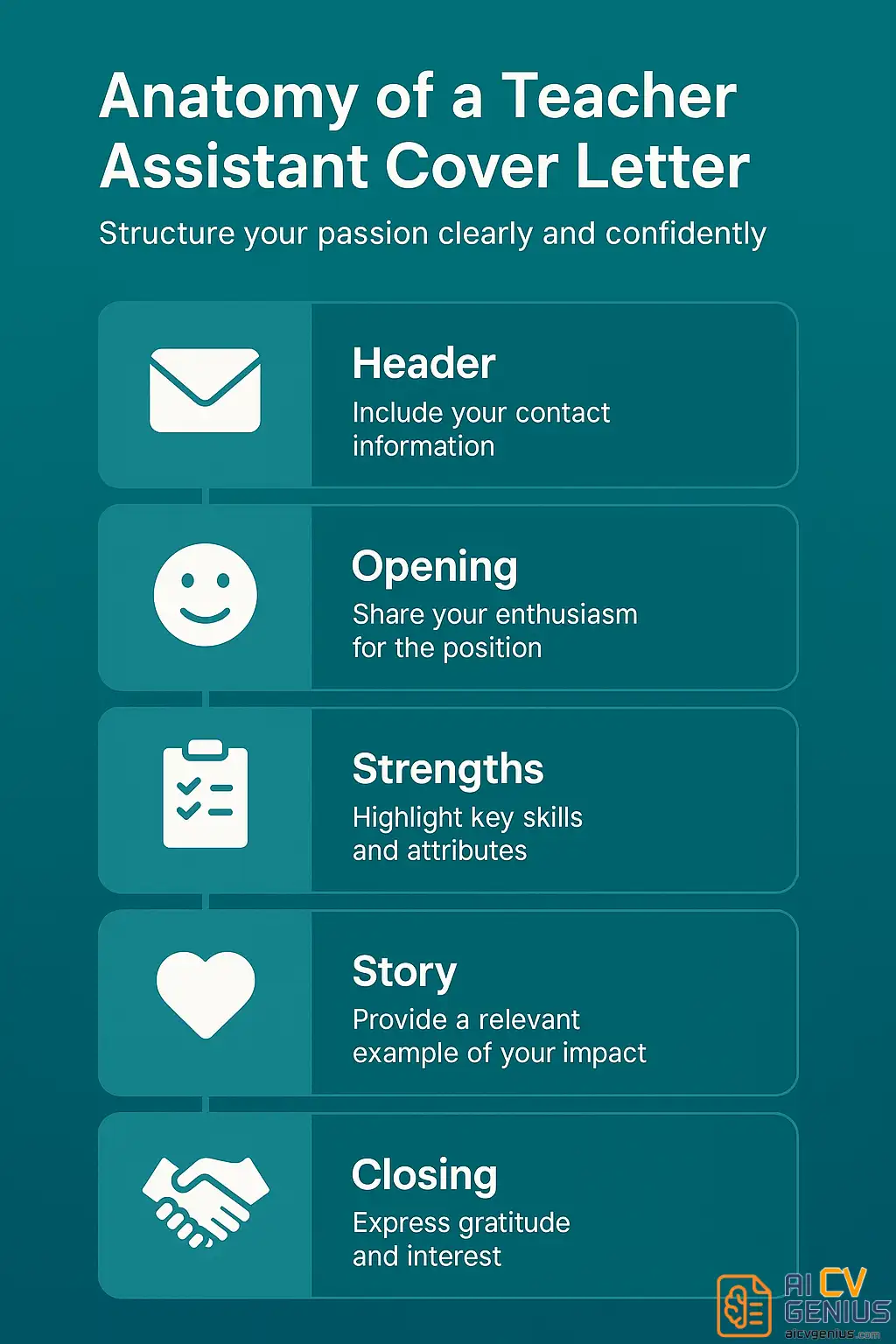
Structure of a Great Teacher Assistant Cover Letter
An effective cover letter follows a clear, logical flow, guiding the reader from introduction to conclusion smoothly. Aim for conciseness and impact in each section.
| Section | Purpose & Key Content |
|---|---|
| Header | Your full name, phone number, professional email, city/state. Below, include the date and the recipient’s details (Principal/Hiring Manager Name, Title, School Name, Address). Accuracy demonstrates attention to detail. |
| Greeting | Personalize whenever possible (e.g., “Dear Principal Peterson,” or “Dear Ms. Evans,”). If the name isn’t available after research, use a specific title like “Dear Hiring Committee,” or “Dear [Grade Level] Team Lead,”. Avoid the generic “To Whom It May Concern.” |
| Opening Paragraph (The Hook) | State the specific Teacher Assistant position you’re applying for and where you saw the opening. Immediately express genuine enthusiasm for the role and this specific school. Briefly mention your core relevant qualification (e.g., background in child development, experience supporting diverse learners) and connect it to the school’s mission or values discovered during research. |
| Body Paragraph(s) (The Evidence) | This is the core of your letter (1-2 paragraphs). Select 2-3 key skills or experiences that directly align with the job description. Provide specific, concise examples demonstrating these skills in action. Focus on impact – how did your actions benefit students, support the lead teacher, or improve the classroom environment? Use action verbs and quantify results if possible (e.g., “Assisted 5 students daily with reading comprehension,” “Helped manage classroom transitions, reducing disruption by 15%”). Connect these examples back to the school’s needs or values. |
| Closing Paragraph (The Clincher) | Reiterate your strong interest in the position and the school. Briefly summarize your key strengths and enthusiasm for contributing to their team. Express gratitude for their time and consideration. End with a polite call to action, indicating your interest in discussing your qualifications further in an interview. |
| Professional Closing | Use a standard closing like “Sincerely,” or “Respectfully,” followed by your typed full name. |
Sample Cover Letter Introduction
Here’s an example of how to start with warmth, focus, and demonstrated research:
“Dear Mrs. Peterson,
I am writing with genuine excitement to apply for the Teacher Assistant position at Maple Grove Elementary, as advertised on [Platform, e.g., the school district website]. Having followed Maple Grove’s innovative approach to project-based learning and its commitment to fostering student collaboration, I am eager to contribute my background in child development and my passion for creating engaging, supportive learning environments to your dedicated team.”
This opening effectively blends enthusiasm with specific knowledge about the school, immediately signaling a tailored application.
Highlighting Your Skills and Experience
Balancing Soft and Technical Skills
Principals and hiring committees look for classroom support staff who combine essential soft skills (patience, empathy, communication) with practical technical and organizational abilities. Your cover letter is the ideal place to showcase this blend.
Soft Skills Examples (Show, don’t just tell):
- Patience & Empathy: Instead of saying “I am patient,” describe a situation: “Supported a student struggling with math concepts by breaking down problems into smaller steps and offering consistent encouragement, leading to improved confidence and understanding.”
- Communication: “Maintained open and positive communication with the lead teacher regarding student progress and behavioral observations, ensuring a consistent approach.” or “Clearly explained instructions for activities to small groups, adapting language for diverse learning needs.”
- Adaptability: “Quickly adjusted support strategies based on real-time classroom needs, seamlessly transitioning between individual tutoring and whole-group supervision.”
Technical/Organizational Skills Examples:
- Classroom Support: “Assisted the lead teacher in preparing daily lesson materials, organizing classroom resources, and setting up learning stations, saving approximately 30 minutes of prep time daily.”
- Technology Use: “Proficiently utilized Google Classroom to post assignments and track student submissions, and employed educational apps like Kahoot to reinforce learning concepts interactively.”
- Record Keeping: “Accurately maintained student attendance records and documented behavioral observations according to school protocols.”
Tie every skill mentioned back to a benefit for the students, the lead teacher, or the overall classroom environment.
For Newcomers: Writing a Teacher Assistant Cover Letter With No Formal Experience
If you’re crafting a teacher assistant cover letter with no experience in a formal classroom setting, shift the focus to transferable skills, relevant volunteer work or informal experiences, and your demonstrable passion for education and child development. Hiring managers for entry-level roles often prioritize attitude, reliability, and eagerness to learn.
Strategies:
- Lead with Enthusiasm and Alignment: Start your letter by expressing genuine interest in the school’s mission and explaining why you are drawn to supporting students, even without formal TA experience.
- Highlight Transferable Skills: Think about experiences from other areas of your life:
- Mentoring/Tutoring: “Tutored high school students in algebra, developing patience and the ability to explain complex concepts clearly.”
- Childcare/Babysitting: “Provided responsible childcare for families, demonstrating reliability, patience, and skills in managing children’s activities and routines.”
- Volunteer Work: “Volunteered at the local library’s summer reading program, assisting librarians with organizing activities and engaging young readers.”
- Customer Service: “Developed strong communication and problem-solving skills while assisting diverse customers in a fast-paced retail environment.”
- Team Roles (Sports/Clubs): “Collaborated effectively within a university debate team, requiring strong listening skills and coordinated effort towards shared goals.”
- Show Initiative in Learning: Mention relevant coursework (Child Psychology, Intro to Education), workshops attended, or certifications obtained (like First Aid/CPR) that show your commitment.
- Emphasize Soft Skills: Focus heavily on your patience, adaptability, organizational skills, communication abilities, and eagerness to learn from experienced educators.
Example phrasing:
“Although my professional background is in [Previous Field], my volunteer experience coaching youth soccer has significantly strengthened my ability to motivate children, manage group dynamics, and communicate effectively with parents. I am eager to translate this passion for mentorship and structured guidance into supporting the learning environment at [School Name].”
Show, Don’t Just Tell: The Power of Mini-Stories
Avoid generic claims like “I’m passionate about helping students” or “I possess strong classroom management skills.” Instead, illustrate these qualities with brief, specific examples or mini-stories. These anecdotes make your application memorable and provide concrete evidence of your abilities.
Example Story Paragraph:
“During my time assisting in a third-grade reading group at [Previous School/Program], one student consistently struggled with reading aloud due to lack of confidence. By implementing short, achievable daily reading goals and providing consistent, positive feedback focused on effort rather than perfection, I watched her progress from a hesitant participant to an enthusiastic volunteer reader by the end of the semester. This experience reinforced my belief in the power of patience, individualized support, and creating a safe space for students to take risks and grow.”
This short story demonstrates patience, observational skills, strategy implementation, and a focus on student growth much more effectively than simply listing those skills.
Formatting, Tone, and Final Polish
Formatting Your Cover Letter for Readability
Keep the visual presentation clean, professional, and easy to scan. Education hiring committees value clarity and structure over excessive creativity.
- Length: Strictly one page. Aim for 3-4 concise paragraphs, totaling around 250–400 words.
- Font: Use a standard, professional font like Inter, Lato, Calibri, Arial, or Times New Roman, size 11–12pt. Ensure consistency with your resume font.
- Spacing: Single-space within paragraphs, with a double space between paragraphs and sections. Use standard 1-inch margins. Ample white space improves readability.
- Alignment: Left-align all text (standard business letter format).
- File Format: Always save and submit as a PDF to preserve formatting. Use a clear file name (e.g.,
YourName_TeacherAssistant_CoverLetter_[SchoolName].pdf).
Setting the Right Tone: Professional Warmth
Your tone should be professional yet warm and approachable. Avoid overly casual language, slang, or negativity. At the same time, don’t sound robotic or overly formal. Let your genuine passion for education and supporting students come through.
- Be Positive and Enthusiastic: Express genuine excitement for the role and the school.
- Be Respectful: Use formal salutations and closings.
- Be Confident but Humble: Highlight your strengths without bragging; acknowledge you are there to support the lead teacher and learn.
- Be Student-Centered: Frame your skills and experiences around how they benefit student learning and well-being.
Emphasizing Collaboration: The Team Player Aspect
Teacher assistants are integral members of the classroom and school team. Explicitly mention your ability and willingness to collaborate effectively.
Examples:
- ✅ “Eager to collaborate closely with the lead teacher to implement lesson plans and support classroom routines.”
- ✅ “Experienced in communicating daily progress updates and observations to ensure seamless teamwork.”
- ✅ “Committed to coordinating with special education staff and parents to support students’ individualized learning plans.”
Highlighting collaboration demonstrates crucial emotional intelligence and understanding of the interdependent nature of school environments.
Common Mistakes to Avoid
- ❌ Generic Language: Using clichés or phrases copied directly from templates without personalization.
- ❌ Focusing Only on Yourself: Making the letter about your goals instead of how you meet the school’s needs and benefit students.
- ❌ Repeating Your Resume Verbatim: The cover letter should complement, not duplicate, your resume by adding context and personality.
- ❌ Typos and Grammatical Errors: Errors signal carelessness – a major red flag in education where attention to detail is critical. Proofread meticulously!
- ❌ Negative Comments: Never speak poorly about previous employers, colleagues, or experiences. Maintain a positive focus.
Sample Closing Paragraph and Sign-off
End your letter with a clear reiteration of interest and a polite call to action.
“I am confident that my patience, organizational skills, and dedication to fostering positive learning experiences align well with the values at Maple Grove Elementary. I would be honored to contribute to your team’s mission of nurturing each child’s academic and personal growth. Thank you for considering my application – I have attached my resume for your review and welcome the opportunity to discuss my qualifications further.”
Sincerely,
[Your Full Name] [Phone Number] [Email Address] [LinkedIn Profile URL (optional)]
Tailoring and Submission Best Practices
The Power of Personalization
Submitting the exact same cover letter to multiple schools significantly reduces your chances. Personalization demonstrates genuine interest and effort.
- Reference Specific Programs: Mention unique programs, clubs, or initiatives at the school that excite you (e.g., “I was particularly impressed by your school’s ‘Reading Buddies’ program…”).
- Connect to Values: Explicitly link your skills or philosophy to the school’s stated mission or values (e.g., “My commitment to fostering inclusivity aligns perfectly with [School Name]’s dedication to diverse learners.”).
- Use Their Language: Mirror keywords and phrases from the school’s website or job description.
Tailoring signals that you’ve done your homework and are genuinely invested in this specific opportunity.
Using Cover Letter Templates Wisely
Templates provide a helpful structure but should never replace your authentic voice. Use them as a starting point, not a final script. Choose clean, professional templates like those found in Cover Letters on FreeResumeHub, which prioritize readability and offer space for personalization.
Pros & Cons of Using a Template:
| Pros ✅ | Cons ❌ |
|---|---|
| Ensures professional structure and formatting. | Can sound impersonal or generic if not heavily customized. |
| Saves time, especially when applying to multiple jobs. | Overuse of template phrases reduces authenticity. |
| Helps maintain consistent formatting with your resume. | Some creative templates may not be ATS-friendly. |
The key is to adapt the template’s framework to tell your unique story, using your own words and examples.
Submission Checklist
- ✅ Save the final version as a PDF with a clear file name.
- ✅ If submitting via email, attach the PDF (don’t paste into the email body unless instructed). Write a brief, polite email introducing the attachment.
- ✅ Double-check the recipient’s name and title spelling.
- ✅ Ensure you’ve attached the correct, tailored version for this specific school.
- ✅ Proofread one last time before hitting send!
FAQ: Teacher Assistant Cover Letter Questions
Final Thoughts: Your Handshake on Paper
A teacher assistant cover letter isn’t just a formality – it’s your first opportunity to demonstrate the qualities that make a great classroom support professional: care, clarity, organization, and enthusiasm. It’s your handshake on paper.
Lead with empathy, support your claims with specific examples, structure your message clearly, and close with confidence. Remember to tailor your tone and content to the specific school culture. Education is fundamentally built on connection, and your well-crafted words can be the first spark that builds that bridge between you and your potential new team.