
- The real advantage: Your 30s read as proof, you bring de risked soft skills like resilience, communication, and conflict handling.
- The core fix: Translation, Reframe old work into target role language so recruiters do not have to connect the dots.
- The best format: Hybrid, Lead with a sharp summary and skills, then use translated bullets so your last title does not sink you.
- How to build it: Summary brands the new role, skills section mirrors the job post, experience shows measurable outcomes, education and certifications prove intent.
- What to avoid and do next: Skip functional resumes and generic responsibility bullets, then align LinkedIn, prepare a career change cover letter, network, and rehearse your why.
You’re in your 30s. You have a decade of good, solid experience. You know how to manage a project, lead a team, and handle a crisis. And yet, you’re staring at a blank resume document, feeling like a total imposter. You want to pivot to something new, something that feels more aligned with who you are now, but every job posting seems to demand a linear path you didn’t take.
You send out twenty applications for this new field. You get zero responses. The silence is deafening, and it starts to feed a quiet fear: Did I wait too long? Am I “un-hirable” in this new space?
Here’s the truth most career changers don’t realize: Your ten years of experience isn’t the problem. It’s a massive advantage. The problem is how you’re presenting it. A career change resume in your 30s is not a standard resume. It’s a strategic document, a translation guide, and a high-stakes marketing campaign all in one. You’re not hiding your past – you’re reframing it to prove how every skill you’ve built makes you a better, more reliable, and more resilient hire than a candidate starting from scratch.
The Recruiter’s View: Why Your 30s Are a Strategic Advantage
Let’s address the fear head-on. You’re worried you’re “too old” or “too late.” That employers will see your experience in an unrelated field and assume you’re inflexible, too expensive, or just having a mid-life crisis. You fear that fresh graduates have the advantage because they’re cheaper and more “moldable.”
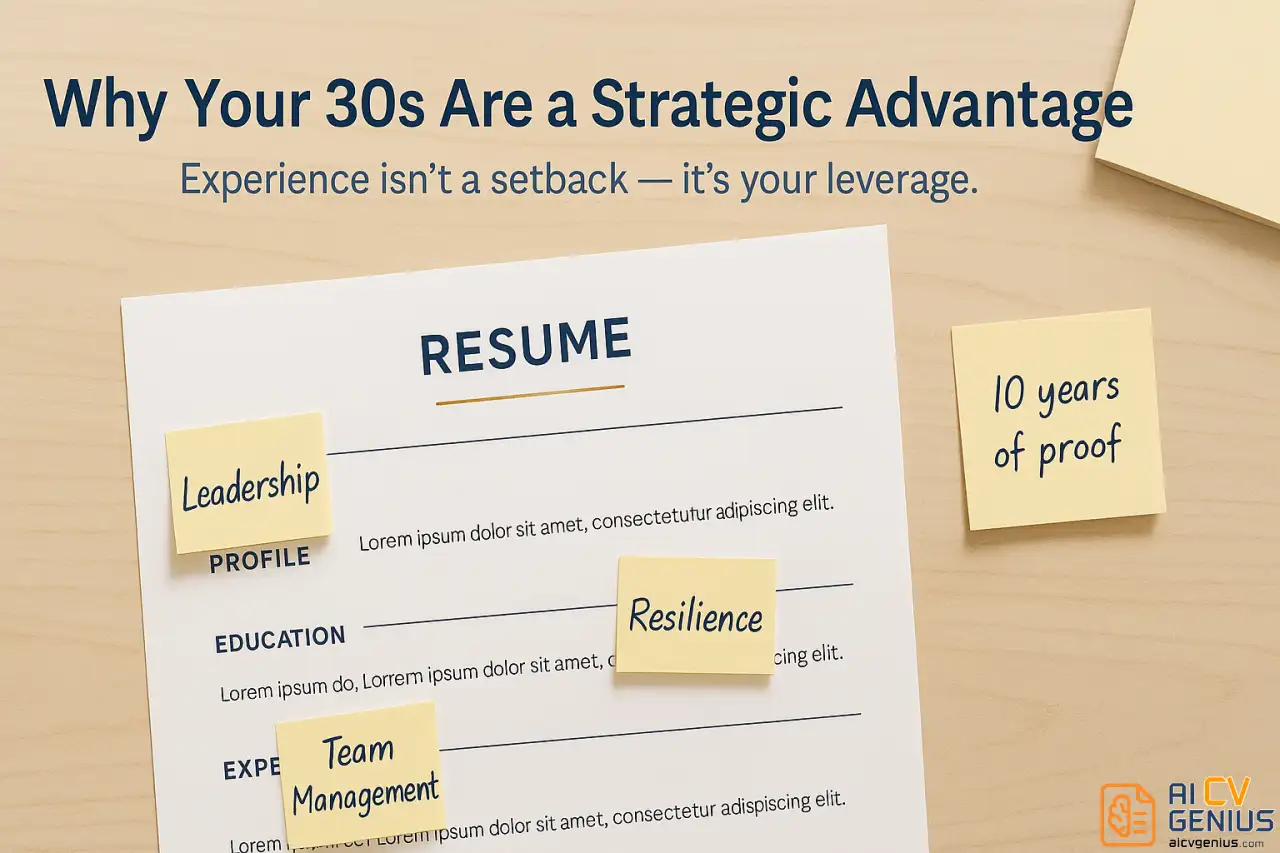
This is not how experienced hiring managers think. When they see a 22-year-old, they see potential, but they also see risk. They don’t know if this person can handle stress, manage a difficult colleague, or even show up on time for a year. When they see a candidate in their 30s, they see proof.
You have something entry-level candidates and even 20-somethings do not: a decade of demonstrated soft skills. You’ve already proven you can:
- Handle Conflict: You didn’t quit the first time a manager gave you negative feedback.
- Manage Time: You’ve juggled multiple high-stakes projects and met real-world deadlines.
- Collaborate: You know how to navigate complex team dynamics and work with difficult personalities.
- Communicate: You can write a professional email and present an idea to stakeholders.
- Be Resilient: You’ve seen projects fail and learned from them. You have grit.
These are the skills that cause 90% of new-hire failures, and they are the hardest to teach. You’re not a risk. You are de-risked. The challenge isn’t convincing employers you’re capable of learning new skills – it’s showing them how the invaluable skills you’ve already mastered apply directly to their needs.
The Core Challenge: Translation, Not Experience
Here’s where most career changers fail. They write an honest resume instead of a strategic one. They list what they did in their old job and hope the recruiter will magically connect the dots. The recruiter won’t.
A recruiter’s brain works on pattern recognition. They see “Retail Manager” at the top of your resume and their brain files you under “Retail,” not “Project Management Candidate.” They aren’t paid to be creative; they are paid to find the closest match in the shortest amount of time. Your job is to make your resume the match.
The solution isn’t to lie or hide your retail experience. It’s to translate it into the language of your target industry. Same skills. Different vocabulary.
How “The Translation Method” Actually Works
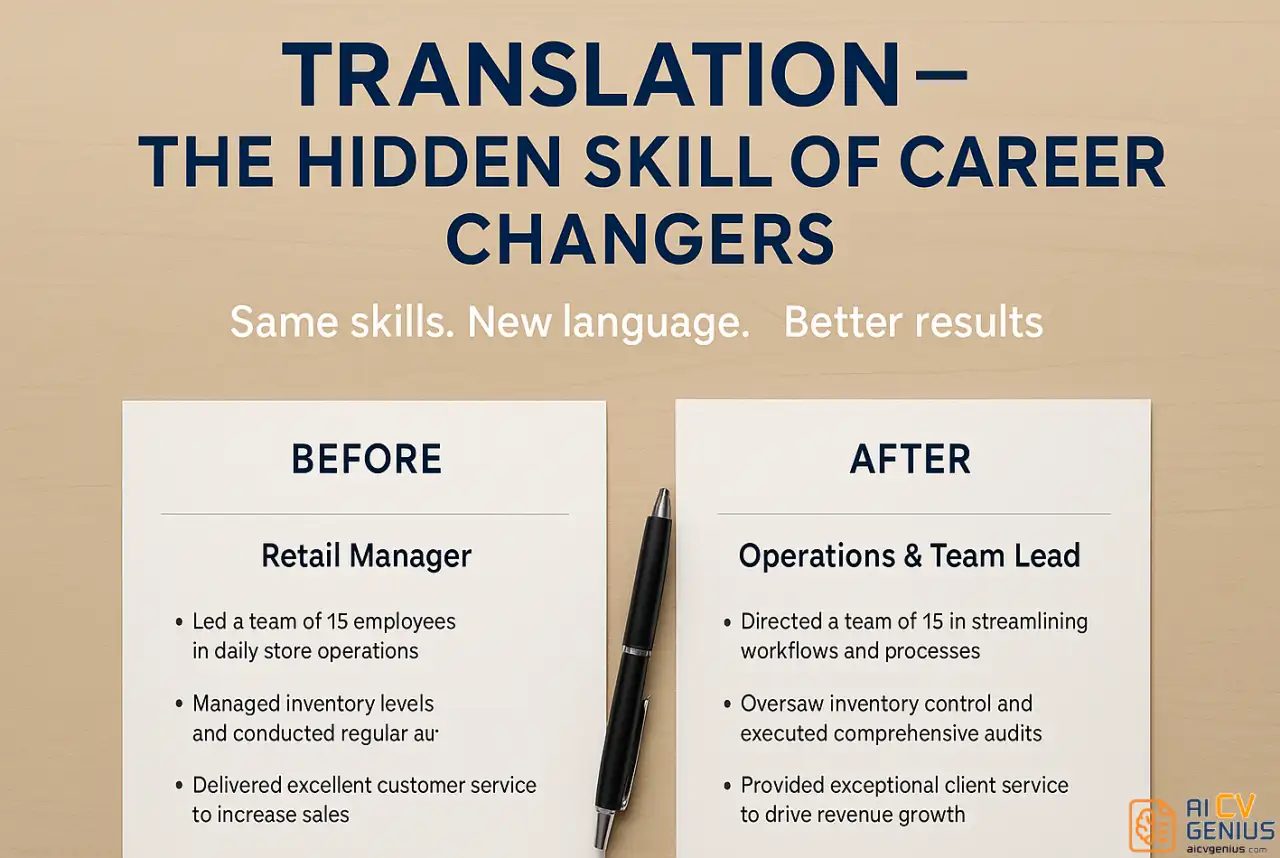
Let’s say you’ve been managing a busy retail store for ten years, and now you want to work in tech as a Project Coordinator or Manager. Here’s the “before” and “after” of your resume’s experience section.
BEFORE (The “Honest” Version):
Retail Store Manager | 2015 – 2025
- – Managed daily operations of a retail store with $2M annual revenue.
- – Supervised a team of 15 employees.
- – Handled all inventory management and ordering.
- – Dealt with customer complaints.
- – Responsible for scheduling and payroll.
What the recruiter reads: “This person works in retail. They have no tech or project experience. Pass.”
Now, here’s the same experience, translated for a Project Management role.
AFTER (The “Translated” Version):
Operations & Team Lead (Store Manager) | 2015 – 2025
- – Led a cross-functional team of 15 to execute all operational initiatives, reducing process inefficiencies by 30% through new workflow implementation.
- – Managed stakeholder expectations across sales, inventory, and customer success functions while coordinating multiple project timelines (e.g., new product rollouts, seasonal resets).
- – Oversaw the full lifecycle of inventory logistics, from vendor negotiation to final delivery, ensuring 100% on-time project execution for seasonal campaigns.
- – Acted as the primary point of contact for all client escalations, resolving complex issues and improving customer satisfaction scores by 20%.
- – Managed all resource planning, scheduling, and budget allocation for a $500K annual payroll.
What the recruiter reads: “This person has project management experience. They understand stakeholder management, process optimization, timelines, logistics, and budgeting. Worth interviewing.”
This is the single most important skill you must master. You didn’t lie. You just stopped using retail jargon (“customer complaints”) and started using the universal language of business (“client escalations”). You focused on the underlying skills – leadership, stakeholder management, process improvement – that exist in both fields.
The Format That Actually Works for Career Changers
If you’re using a standard chronological resume format, stop. Right now. A chronological resume is designed to show a perfect, linear career path in one field. That is the opposite of what you need to do.
When a recruiter opens a chronological resume, the first thing they see is your last job title. If that title is “Middle School Teacher” and they are hiring for a “Corporate Trainer,” you’ve already lost. They’re not going to read far enough down to discover your transferable skills.
Why the Hybrid (or Combination) Format Is Your Solution
The Hybrid Format flips the script. Instead of leading with your work history, you lead with your skills. It front-loads your resume with all the keywords and qualifications for the new job, forcing the recruiter to see your potential before they ever see your old job title.
Here’s what that structure looks like:
- Professional Summary: Three to four lines that immediately position you for the new role. (More on this below).
- Key Skills Summary: This is the most critical section. It’s a categorized list of your most relevant capabilities, pulled from the job description.
- Work Experience: Still chronological, but every bullet point is “translated” (like we did above) to emphasize transferable skills.
- Education & Certifications: This section is vital for showing your commitment to the new field.
This format forces recruiters to evaluate you based on what you can do, not just where you have been. That’s exactly what you need.
A Critical Warning: Avoid the “Functional” Format
You might be tempted to use a functional resume, which eliminates the work history section almost entirely and focuses only on skills. This seems perfect for career changers, right? Wrong.
⚠️ Here’s the problem: Recruiters are trained to be deeply suspicious of functional resumes. They know this format is used to hide major red flags – long employment gaps, a history of job-hopping, or a total lack of relevant experience. When they see one, their first instinct is, “What are they hiding?”
The Hybrid format is superior because it gives you the benefits of a functional resume (skills first) without raising red flags. You aren’t hiding your work history; you’re just contextualizing it first.
Building Your Career Change Resume: A Section-by-Section Guide
Let’s apply these strategies to build your document from the top down.
1. The Professional Summary: Your 4-Line “Elevator Pitch”
Your summary must immediately brand you for the role you want, not the one you had. It must answer the recruiter’s core questions: “Who are you?” “What do you offer?” and “Why are you here?”
Weak Summary (Retail Manager):
“Dedicated and experienced retail manager with 10 years of experience in store operations and team supervision. Seeking a new and challenging opportunity to grow.” (Tells them you’re a retail manager).
Strong Summary (Pivoting to Project Management):
“Strategic operations professional with 10+ years of experience leading cross-functional teams and managing complex projects from conception to completion. Proven ability to optimize processes, manage stakeholders, and deliver initiatives on time. Seeking to leverage extensive leadership and logistics expertise as a Project Coordinator at [Target Company].” (Tells them you’re a project manager).
2. The Key Skills Section: Your “Keyword” Goldmine
This is where you directly mirror the job description. Do not list generic soft skills like “hard-working.” Group your skills into logical, professional categories.
Example for a Project Coordinator Role:
| Project Management | Project Lifecycle, Timeline Management, Risk Assessment, Resource Allocation, Agile & Scrum (Basic) |
| Stakeholder & Team Leadership | Cross-Functional Collaboration, Vendor Negotiation, Team Leadership & Mentoring, Client Escalation |
| Operations & Process | Process Optimization, Logistics Management, Budgeting & P&L, Inventory Control |
| Technical Skills | Asana, Trello, Microsoft Project, MS Office Suite, Slack, Google Workspace |
3. Education & Certifications: Proving You’re Serious
This section is your proof that this career change isn’t a whim. It’s a dedicated, intentional move. Even one small, relevant certification can make all the difference. It shows you are proactively up-skilling on your own time.
Education & Professional Development
- Certified Associate in Project Management (CAPM) – Project Management Institute (PMI) (2024)
- Google Project Management Professional Certificate – Coursera (2024)
- Bachelor of Arts, Communications – [Your University] (2014)
7 Real Career Change Resume Examples (Strategies & Summaries)
Here are seven common career transitions and the specific strategy for each.
Example 1: Middle School Teacher to Corporate Trainer / Instructional Designer
The Challenge: Recruiters see “teacher” and think “kids,” not “corporate.” You need to reframe your experience in business and L&D (Learning & Development) terms.
The Translation Strategy: “Lesson plans” become “curriculum design.” “Students” become “diverse audiences” or “learners.” “Classroom management” becomes “facilitation” or “workshop leadership.” “Student outcomes” become “learning metrics” and “performance improvement.”
Resume Summary Example:
“Learning and Development professional with 8+ years designing and delivering engaging training programs for diverse audiences. Proven track record of assessing learning needs, developing structured curricula, and measuring outcomes to improve performance. Skilled in facilitation, instructional design (ADDIE model), and adapting content for multiple learning styles and business contexts.”
Example 2: B2B Sales Rep to Account Manager (Customer Success)
The Challenge: Your resume screams “hunter” (new business), but the new role is a “farmer” (retention and relationships).
The Translation Strategy: De-emphasize your “new logo” quota. Highlight everything you did after the sale: relationship management, upselling, contract renewals, and acting as a strategic advisor. Reframe “closing deals” as “building long-term partnerships.”
Before Bullet: “Closed $500K in new business annually, exceeding quota by 25%.”
After Bullet: “Managed a portfolio of 25+ enterprise accounts, driving a 98% retention rate and generating $300K in annual upsell revenue through consultative relationship management and proactive QBRs (Quarterly Business Reviews).”
Example 3: Restaurant Manager to Corporate Operations Manager
The Challenge: “Restaurant” screams hospitality, not corporate. Recruiters will assume you can’t handle a B2B environment.
The Translation Strategy: Strip out all hospitality jargon (“front of house,” “food cost”). Focus entirely on the universal business skills: P&L management, team leadership (hiring, firing, training), vendor negotiations, process optimization, and budget control. These are identical skills.
Skills Summary Example:
- P&L Management: Managed a $3M annual budget with full profit and loss responsibility, increasing profitability by 22% over three years through strategic cost controls and revenue optimization.
- Team Leadership: Led a cross-functional team of 20+ across multiple departments (sales, operations, service). Reduced turnover by 30% through structured onboarding and clear performance metrics.
Example 4: Executive Assistant to Project Coordinator
The Challenge: “Assistant” sounds like admin work, not leadership. You need to show you were managing, not just supporting.
The Translation Strategy: Reframe your work through a project management lens. “Managing calendars” becomes “coordinating stakeholder schedules.” “Planning an event” becomes “managing the full project lifecycle for a $2M company conference, from vendor selection to post-event analysis.”
Resume Summary Example:
“Strategic operations professional with 7+ years coordinating complex, high-stakes projects for C-level executives. Expert in timeline management, resource allocation, and stakeholder communication across multiple departments. Proven ability to manage competing priorities and maintain project momentum under pressure. Proficient in Asana and MS Project.”
Example 5: Marketing Manager to Product Manager
The Challenge: Marketing is seen as “fluffy” (campaigns), while Product is “technical” (roadmap). You need to bridge that gap.
The Translation Strategy: Highlight the parts of your marketing job that are actually product work: customer research, data analysis (A/B testing), user interviews, and cross-functional collaboration with engineering for a feature launch. “Go-to-market strategy” is the perfect bridge.
| Marketing Experience | Product Management Equivalent |
| Customer research & persona development | User research & customer discovery |
| A/B testing campaigns and landing pages | Product experimentation & iteration |
| Analyzing campaign dashboards (KPIs) | Product metrics & data-driven decisions |
| Feature launch planning | Go-to-market strategy & product roadmap |
Example 6: Software Engineer to Technical Sales Engineer
The Challenge: Your resume is 100% technical (“backend code”), but the new role is 50% customer-facing (“communication”).
The Translation Strategy: Dig up every single customer-facing interaction you’ve had. Did you ever help the support team with a tough ticket? Did you present a demo to another team? Did you help write technical documentation? These are all pre-sales and communication skills.
Resume Summary Example:
“Software engineer with 8 years building enterprise solutions and 3 years presenting technical architectures to stakeholders. Proven ability to translate complex technical concepts into clear business value. Skilled in customer discovery, solution design, and cross-functional collaboration between engineering and business teams. Seeking to apply deep technical expertise to a customer-facing Solutions Engineer role.”
Example 7: Financial Analyst to Data Analyst
The Challenge: Your job title screams “Finance,” but you want a pure “Data” role.
The Translation Strategy: This is an easy translation. De-emphasize the context (finance) and emphasize the tools and skills. Your “Skills” section is your best friend. Then, in your experience, highlight the technical aspect of your work.
Skills Summary Example:
- Data Analysis & Visualization: Built interactive dashboards in Tableau and Power BI to track KPIs. Wrote complex SQL queries to extract and transform data.
- Statistical Analysis: Performed regression and trend analysis using Python (Pandas, NumPy) to forecast business outcomes with 92% accuracy.
- Technical Skills: SQL, Python, Excel (VBA, Power Query), Tableau, Power BI.
The Universal Transferable Skills Every Career Changer Should Highlight
No matter your field, these skills transfer everywhere. Your resume must prove you have them with specific, quantified examples.
- ✅ Project Management: Prove it with: “Planned and executed a 3-month project, coordinating 5 team members and delivering on time.”
- ✅ Leadership & Team Management: Prove it with: “Trained and mentored 3 new hires, leading to a 50% reduction in onboarding time.”
- ✅ Stakeholder Communication: Prove it with: “Presented weekly progress reports to senior leadership, aligning technical and non-technical teams.”
- ✅ Problem-Solving: Prove it with: “Identified a critical workflow bottleneck and designed a new process, saving 10 hours of manual work per week.”
- ✅ Data Analysis: Prove it with: “Analyzed customer feedback data to identify key pain points, leading to a 15% increase in satisfaction scores.”
- ✅ Budget Management: Prove it with: “Managed a $50K project budget, negotiating with vendors to reduce costs by 10%.”
- ✅ Process Optimization: Prove it with: “Streamlined the monthly reporting process, reducing errors by 40%.”
Want more detailed strategies? Check out our comprehensive guide on 20+ transferable skills examples for career changers.
The Five Mistakes That Kill Career Change Resumes
I’ve reviewed hundreds of career change resumes. These are the mistakes I see over and over again.
- ❌ Using a Chronological Format: This highlights your old, “irrelevant” job title. Use the Hybrid format to lead with skills.
- ❌ A Generic, Passive Summary: “Motivated professional seeking new opportunities…” tells them nothing. Be specific. Brand yourself for the new role.
- ❌ Listing Responsibilities, Not Achievements: “Responsible for managing team…” is passive. “Led team of 10 to…” is active. Always quantify your impact (%, $, #).
- ❌ Skipping the Cover Letter: The cover letter is crucial for career changers. It’s where you get to tell your “why.” Why this change? Why now? Why are you the perfect fit?
- ❌ Not Addressing the Change: Don’t make recruiters guess. Your summary and cover letter should confidently state your intention to pivot and explain why your past experience makes you a stronger hire.
For more resume mistakes, read our article on why “responsible for” kills your resume.
What to Do After You Update Your Resume
Your resume is the foundation, but it’s not enough on its own. Here’s what else you need to do.
- Update your LinkedIn Profile: Your LinkedIn headline and “About” section must match your new resume’s summary. Inconsistency is a major red flag.
- ✍️ Write a “Career Change” Cover Letter Template: Create a strong, 3-paragraph template that explains your “why.” (1. Why this company, 2. Why you’re the perfect fit, 3. Confident closing).
- Network Strategically: 70% of jobs are filled through referrals. Find people in your target role on LinkedIn. Send a message: “Hi [Name], I’m a [Old Role] pivoting to [New Role] and deeply admire your work at [Company]. Would you be open to a 15-minute chat about your experience?”
- Practice Your Story: You will be asked “Why are you changing careers?” in every interview. Have a clear, confident, 60-second answer ready. Don’t be defensive. Be excited.
For more networking strategies, read our guide on 10 networking tips that don’t feel awkward.
Frequently Asked Questions

Final Thoughts: Your Past is Your Power
Your career change resume in your 30s isn’t about hiding where you’ve been. It’s about strategically illuminating how your past makes you uniquely qualified for the future you want. You have ten years of real-world problem-solving. That is incredibly valuable. The challenge is making sure recruiters see it.
Use the hybrid format. Translate your achievements. Quantify your impact. And most importantly, be confident. You’ve already proven you can succeed in a demanding field. You can absolutely do it again. The hardest part wasn’t learning the new skill; it was making the decision to change. You’ve already done that. Now, it’s just execution.
Ready to write your summary? Learn how to write a resume summary that gets you interviewed in our complete guide.