

- What this guide solves: How to ask for a raise without sounding greedy by framing it as a calm, data-backed business conversation.
- Mindset shift that changes the outcome: Understand your manager’s budget and equity limits, and replace fear with professional self-advocacy.
- Preparation that wins the yes: Build a brag document with measurable wins, save proof, and research a realistic market pay range.
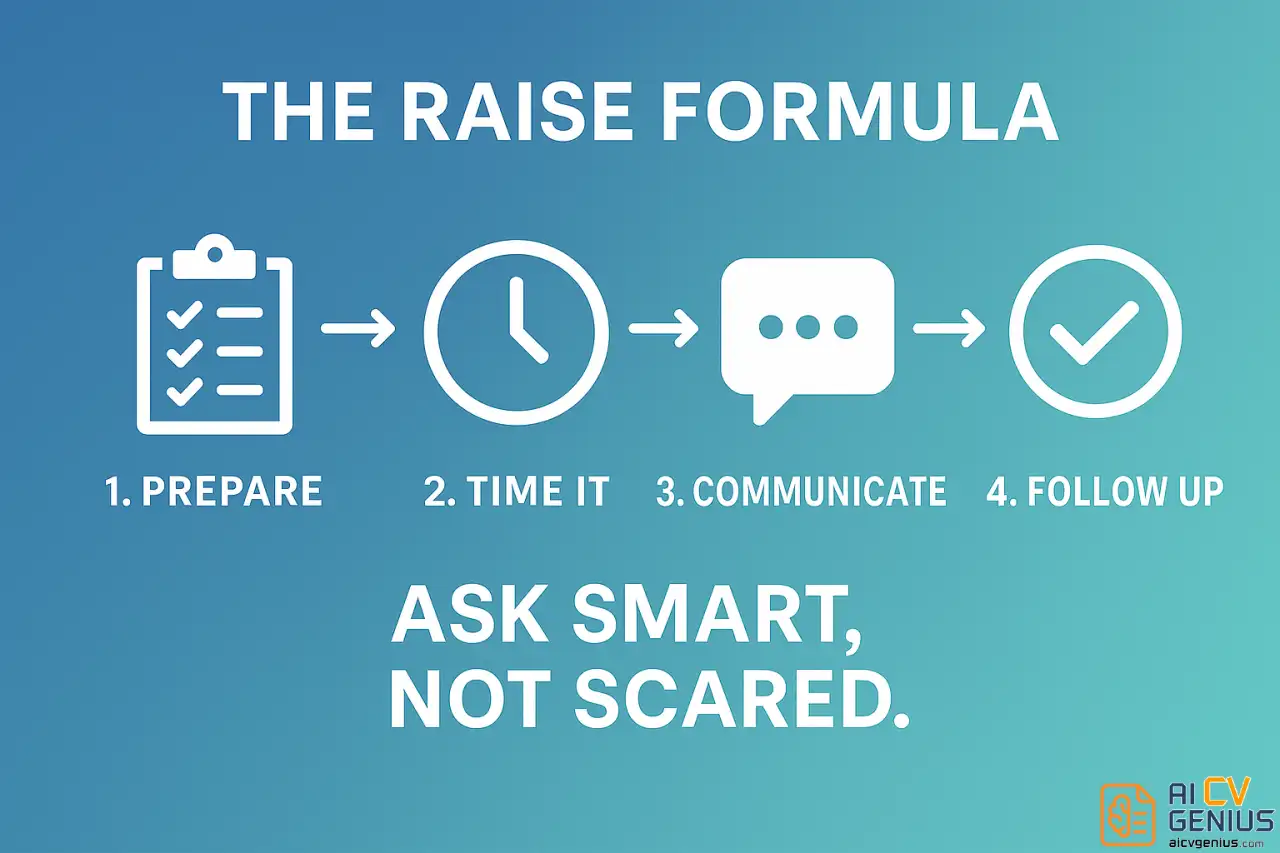
- The conversation framework: Schedule a formal meeting, open with appreciation, present evidence, share market data, request a specific new salary, then stop talking.
- If they push back or say no: Stay composed, ask what would earn the next level, lock a follow-up date, negotiate alternatives like title, PTO, flexibility, budget, or bonus, and send a short recap email.
Why Asking for a Raise Isn’t Greedy – It’s Professional Self-Advocacy
Money is, without question, the most emotionally loaded and taboo topic in the workplace. The very idea of how to ask for a raise can make even the most confident professional feel anxious, greedy, or ungrateful. We are often taught to believe that good work should “speak for itself” and that we should be grateful just to have a job.
This mindset is a career-limiting trap. The truth is, companies do not, and cannot, automatically adjust your pay to match your evolving value. Budgets, internal equity, and market rates are complex variables. Your manager is not a mind reader. Advocating for yourself is not an act of confrontation; it is a necessary act of professional communication. It is a sign of maturity, confidence, and a clear understanding of the value you deliver.
Most people wait for a magical “right time,” or worse, they wait until they are so frustrated, burnt out, and underpaid that they ask from a place of anger. Preparation, evidence, and strategic timing are what transform an awkward, emotional conversation into a collaborative, data-driven business case. This guide will show you how to build that case, manage the conversation, and handle any outcome with grace.
“A raise is not a gift. It is a recognition that your value has outgrown your compensation. Your job is to prove it.”
The Psychology of “The Ask”: Understanding Your Manager and Yourself
Before you build your case, you must understand the human dynamics at play. This is not just a transaction; it’s a negotiation between two people, each with their own pressures.
Understanding Your Manager’s Perspective
Your manager is not your adversary. In most cases, they want to keep you and see you succeed. However, they are constrained by factors you may not see:
- Fixed Budgets: Your manager likely has a fixed “merit pool” for their entire team, allocated annually. A raise for you might mean less for someone else.
- Internal Equity: They must ensure your pay is fair relative to your peers. Giving you a 20% raise could create massive HR issues if others with similar experience make less.
- The “Flight Risk” Factor: A good manager’s job is retention. They know that underpaying high performers makes them a “flight risk.” Your job is to signal your value, not your intention to leave.
- The “Easy Yes”: Your manager needs to justify their decision to their boss. By providing clear, quantifiable evidence, you are not just asking for a raise; you are giving your manager the data they need to advocate on your behalf.
Understanding Your Own Psychology
Your biggest obstacle is rarely your manager; it’s your own mindset. You must overcome:
- Imposter Syndrome: The feeling that you are “lucky” to be in your role and that asking for more is “pushing your luck.” This is false. Your presence is based on merit.
- Fear of Conflict: The belief that asking for money will damage your relationship with your manager. A professional, data-backed request strengthens the relationship by showing you are a mature, business-minded employee.
- Confusing Loyalty with Silence: You can be deeply loyal to your company and team while still expecting fair compensation. True loyalty is a two-way street.
Phase 1: Before You Ask (The Preparation That Makes or Breaks It)
Getting a “yes” is 90% preparation and 10% conversation. Do not walk into this meeting without an undeniable case. Your feelings do not matter here; your evidence does. You must build what is often called a “brag document” or “hype doc.”
1. Quantify Your Impact (Your “Brag Document”)
This is your most important task. For the past 6-12 months, list your concrete achievements. Numbers speak louder than adjectives. “I worked hard” is a feeling. “I automated a weekly report, saving the team 8 hours of manual work per month” is a fact.
| Vague Statement (Don’t Say This) | Quantified Impact (Say This) |
|---|---|
| “I’m a good team player.” | “I onboarded and mentored two new hires, helping them both become fully productive within 30 days, 2 weeks ahead of schedule.” |
| “I worked hard on the big project.” | “I led the ‘Project Alpha’ launch, coordinating three departments and delivering the final product on time and 10% under budget.” |
| “I improved our processes.” | “I identified and implemented a new documentation workflow in Confluence, reducing internal support tickets by 25%.” |
| “I have more responsibilities.” | “Since [Month], I have taken on all of [Specific Task] for the team, which was previously a manager-level responsibility.” |
Keep a running document of these “wins” throughout the year. When you get a positive email from a stakeholder, save it. When you complete a project, log the metrics. This makes your preparation an easy 30-minute review, not a 3-day scramble.
2. Research Your Market Value (Data is Your Shield)
You need an objective number. Use tools like Glassdoor, Levels.fyi, and LinkedIn Salary to find a realistic range for your role, in your city, with your years of experience. This is not about demanding an exact match; it’s about grounding your request in market reality, not personal feelings.
There are two key numbers:
- Market Rate: What would another company pay you to do this exact job?
- Value to Company: Are you delivering value beyond your job description? This is where you justify being at the top of that market range.
And remember, as explained in why confidence matters more than experience, negotiation is less about the number itself and more about the presence and data you bring to back it up. If you calmly and logically believe in your worth, others are far more likely to agree with you.
3. Choose the Right Timing (Strategy Over Emotion)
The best time to ask for a raise is when your value is most visible and when the company is most able to act. Do not ask when you are feeling emotional or frustrated.
- The Best Times:
- After a major win: Directly after you’ve successfully launched a project, closed a big deal, or received public praise.
- During performance review season: This is when managers have compensation on their minds. Get your request in before the final budgets are locked.
- When the company is doing well: After a positive quarterly earnings call or a big company announcement.
- The Worst Times:
- During a round of layoffs or budget cuts.
- When your manager is visibly stressed or overwhelmed.
- On a Friday afternoon.
- When you have just made a mistake.
Timing isn’t manipulation; it’s strategic awareness. You are making it easy for your manager to say “yes.”
Phase 2: Building Your Case (What to Say When Asking for a Raise)
Once you have your data, you need to package it. This meeting should be scheduled formally. Do not try to “ambush” your manager in a hallway. Send a meeting invite titled “Discussion about my role and performance” or “Career growth conversation.”
The Conversation Script: A 4-Part Framework
Your script should be simple, confident, and clear. Practice it out loud so you don’t sound robotic. Aim for conversational confidence.
- The Opener (Gratitude & Purpose): Start with appreciation.“Thank you for making the time. I really enjoy working here and am proud of what I’ve been able to accomplish over the past year. I’d like to discuss my performance and how my compensation aligns with my contributions.”
- The Evidence (Your Brag Document): This is the core of your case. Be specific.“Over the past 12 months, my focus has been on driving efficiency and taking on more leadership. Specifically, I led the ‘Project Alpha’ launch which came in under budget, I automated the weekly report that saves the team 8 hours a month, and I’ve been mentoring our two new hires. I’ve effectively taken on the responsibilities of a Senior [Role Title].”
- The Research (Your Anchor): State your research calmly.“Based on my research for the Senior [Role Title] in [Your City], the market rate is between [Range Low] and [Range High]. Given my performance and the expanded scope of my work…”
- The “Ask” (The Specific Number): State your desired new salary. Do not ask for a “raise.”“…I would like to request that my new salary be set at [Specific Number].”
After you state your number, stop talking. Do not fidget. Do not apologize. Do not fill the silence. Let your manager be the next one to speak. This is the most critical moment of the negotiation.
Language That Works (and Language That Doesn’t)
| Use This Confident Language ✅ | Avoid This Emotional Language ❌ |
|---|---|
| “I’d like to discuss my compensation.” | “I think I deserve more money.” |
| “Based on my contributions and market data…” | “I need a raise because my rent went up.” |
| “My new responsibilities include…” | “I feel like I’m doing more work than…” |
| “I am requesting a new salary of [Number].” | “I was hoping for a 10% raise.” |
| “I am confident I can deliver even more value.” | “If I don’t get this, I’ll have to look elsewhere.” (Never threaten) |
Your phrasing frames the entire conversation. You are a professional discussing a business case, not a child asking for an allowance. Your tone should be collaborative, calm, and factual.
Examples of Asking for a Raise (Good vs Bad)
Context is everything. Here is how the conversation should (and should not) sound.
| Approach | Example | Why It Works (or Doesn’t) |
|---|---|---|
| Good (Data-Driven) | “Over the past quarter, I led three client projects that exceeded targets by an average of 15%. I’d like to review my compensation based on that contribution.” | Specific, calm, data-based, and undeniable. |
| Bad (Time-Based) | “I’ve been here a year and haven’t had a raise yet.” | Focuses on tenure, not impact. This sounds entitled. |
| Good (Growth-Focused) | “I really value this team and the projects we’ve built. I’m excited to take on more. I’d love to discuss how my compensation can evolve to reflect my new responsibilities in [Project X].” | Future-oriented and positive. It frames the raise as an investment. |
| Bad (Threat-Based) | “If I don’t get a raise, I’ll have to look elsewhere.” | This is an ultimatum. It instantly kills trust and makes your manager defensive. Even if it works, it damages the relationship. |
| Bad (Personal) | “My car broke down and my rent just went up. I really need this.” | Your personal finances are not your company’s responsibility. This is unprofessional and makes the conversation awkward. |
Phase 3: Handling Pushback with Grace (What to Do When They Say “No”)
Prepare for a “no” or a “not now.” Do not get defensive. Your reaction in this moment defines your maturity. A “no” is not the end; it is the beginning of a new negotiation. Stay calm, listen, and pivot.
Scenario 1: The “Hard No” (e.g., “There’s just no budget.”)
Your Response:
“I understand that the budget is tight right now. I appreciate you looking into it. Since a salary adjustment isn’t possible at this moment, could we explore other forms of compensation? I’m particularly interested in [Option A] or [Option B]. Could we also set a concrete date to revisit this conversation, perhaps in [3 or 6 months]?”
This pivots the conversation from salary to other valuable benefits. You are also locking in a future date, which creates accountability.
Scenario 2: The “Stall” (e.g., “It’s not a good time,” or “I need to think about it.”)
Your Response:
“Thank you, I understand. Could we set a follow-up meeting for next week to discuss this further once you’ve had time to consider it? I’m happy to provide any more data you might need.”
This is polite, professional, and prevents your request from disappearing into a “black hole.”
Scenario 3: The “Performance No” (e.g., “You’re doing great, but you’re not at that level yet.”)
Your Response:
“That is very helpful feedback, thank you. Could we define what that next level looks like? I’d like to create a plan with you to set 2-3 specific, measurable goals for me to hit over the next quarter. If I can successfully demonstrate those results, can we agree to revisit my compensation at that time?”
This is the most powerful response. You turn a rejection into a clear, actionable career plan, with your manager as your partner. You get a roadmap to your promotion, and they get a motivated employee. This is a win-win.
The Follow-Up Email (Regardless of Outcome)
No matter what happens, send a follow-up email within 24 hours.
“Hi [Manager Name], thank you for taking the time to discuss my compensation today. I appreciate your feedback and I’m excited to focus on [Agreed-upon goals]. I look forward to continuing to contribute to the team’s success.”
This creates a professional paper trail and reinforces your maturity.

Alternative Rewards to Consider (If Salary is Off the Table)
If a salary increase isn’t possible right now, be prepared to negotiate for non-monetary benefits. These can be just as valuable for your career and well-being.
- A Title Change: A “Senior” title, even with no pay bump, makes you more marketable and sets you up for a much larger salary increase at your next job.
- Professional Development Budget: Ask for a specific certification, conference, or course (e.g., “Would the company sponsor my [Specific Certification] which costs $2,000?”).
- Flexible Work: Ask for permanent remote work, a 4-day work week, or flexible hours.
- Extra Vacation Days: More paid time off can be more valuable than a small pay bump.
- A High-Profile Project: Ask to lead the next big project. The visibility can be a stepping stone to a promotion.
- A “Retention Bonus” or Stock Options: A one-time bonus (if the merit budget is frozen) or additional equity can bridge the gap.
Want to make sure your growth aligns with your larger ambitions? Read Professional Goals Examples for clarity on how to link money with meaning.
Timing, Confidence, and Follow-Up
Confidence without timing feels pushy; timing without confidence feels timid. The balance of both creates persuasion. After your conversation, send a short thank-you note summarizing appreciation for their time and enthusiasm about continuing your impact.
A thoughtful follow-up reinforces maturity – just like sending a thank-you email after an interview strengthens your impression post-meeting. It’s the final signal of your professionalism.
In-Depth FAQ: Your Toughest Questions Answered
Final Thoughts
Learning how to ask for a raise is less about finding the perfect words and more about cultivating a steady, data-backed confidence. The goal isn’t to demand – it’s to demonstrate. You are starting a collaborative conversation to align your proven value with fair recognition. You have already done the hard work; you have already earned the right to ask. Your only remaining task is to articulate it well.
Every raise conversation is a skill-building moment. Whether you get a “yes” today or a clear roadmap for a “yes” tomorrow, you will walk away from the conversation sharper, clearer, and more respected by your manager. And that, in itself, is a reward.