
- A marketing resume must balance creativity and data-driven proof: Recruiters want clear positioning plus measurable outcomes tied to business goals.
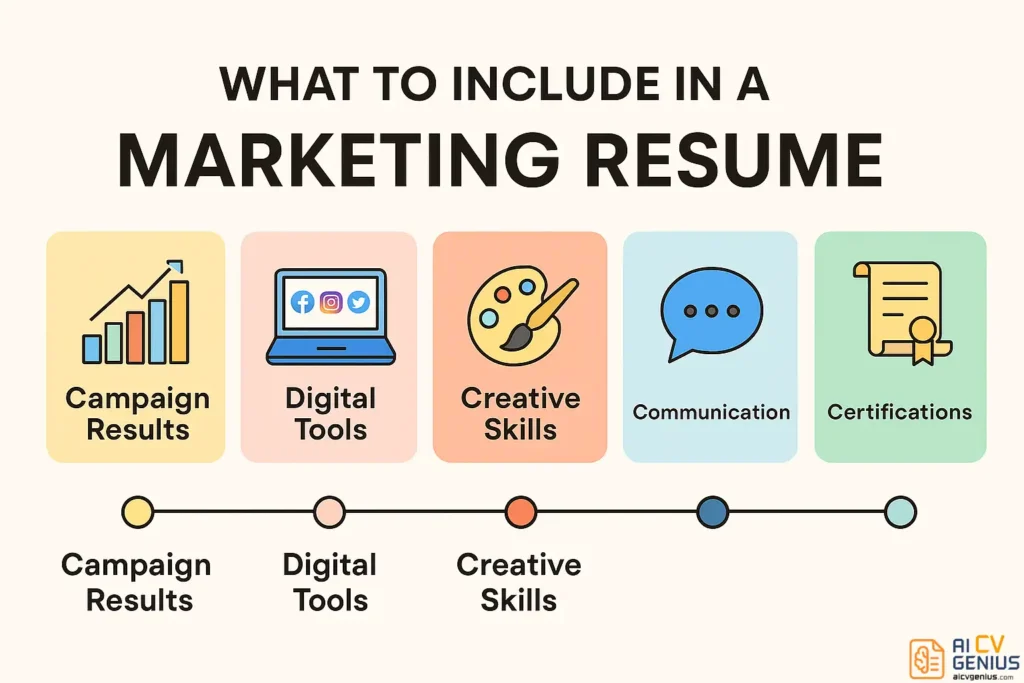
- Hiring managers scan for four things fast: A sharp headline summary, campaign strategy and execution, tool proficiency, and results shown with metrics like leads, ROI, CTR, CPA, and revenue impact.
- The template structure that works is consistent: Tailored summary or objective, reverse-chron experience with 3 to 5 impact bullets per role, a categorized skills and tools section, education, and certifications placed where they are easy to find.
- Case studies show how the focus shifts by level: Entry-level highlights projects and volunteer work with concrete outputs, mid-level emphasizes multi-channel wins and budgets, senior levels lead with leadership, strategy, and large-scale impact.
- Advanced tailoring is non-negotiable: Big brands reward process, specialization, and ROI, startups reward versatility and visible work, remote roles need collaboration signals, and the final checklist confirms clarity, metrics, ATS safety, links, and proofread quality.
When a hiring manager in marketing opens your resume, they don’t just scan for job titles and dates. They analyze your resume like they would scrutinize an advertising campaign: Is the message clear? Does it capture attention effectively? Does it demonstrate quantifiable results? In essence, your resume serves as your initial campaign pitch – a failure here means the conversation often ends before it begins.
This critical first impression is why leveraging a specialized marketing resume template provides such a distinct advantage. Instead of wrestling with a blank document, you utilize a pre-defined structure optimized to showcase both your creative flair and your strategic business impact.
An effective template organizes your career narrative like a successful product launch: compelling headline (summary), strategic approach (experience), flawless execution (skills & tools), and measurable outcomes (results). The objective extends beyond merely stating you’ve worked in marketing; it’s about proving you achieved specific, valuable outcomes.
Recruiters prioritize tangible metrics: percentage growth in engagement, improved conversion rates, demonstrable ROI. Simultaneously, they seek evidence of creative thinking: the innovative campaigns you spearheaded, the compelling brand stories you crafted, the target audiences you successfully engaged.
Why Marketing Resumes Need a Different Approach
Unlike a finance resume focused squarely on analytical precision, or a software engineering resume detailing technical stacks, a marketing resume demands a unique equilibrium between creativity and data-driven strategy.
Employers seek multifaceted professionals capable of brainstorming unconventional campaign ideas while also rigorously analyzing Google Analytics reports to optimize performance. This inherent duality must be evident throughout your resume.
- ✅ Effectively highlight creative contributions: showcase specific campaigns, innovative branding concepts, compelling copy, or design contributions.
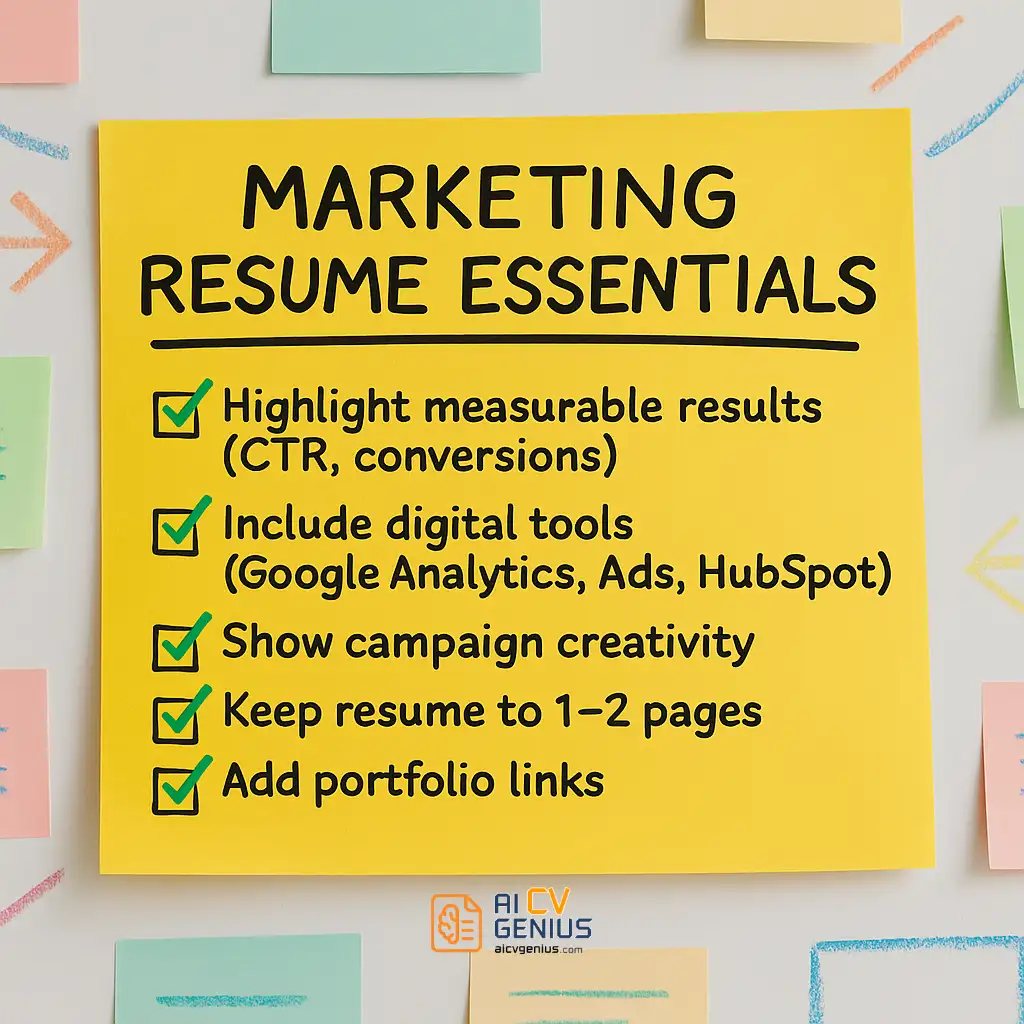
- ✅ Substantiate claims with concrete results: quantify impact using metrics like engagement rate increases, click-through rate (CTR) improvements, qualified leads generated, or direct revenue impact attributable to your efforts.
- ✅ Demonstrate proficiency with relevant tools: explicitly list mastery of essential platforms like HubSpot, Salesforce, Google Ads, Meta Business Suite, SEMrush, Ahrefs, and analytics tools.
- ✅ Ensure clarity and logical flow: a disorganized or confusing resume inadvertently signals poor communication skills – a critical flaw for any marketer.
Conceptualize your resume as a high-converting landing page. It requires a compelling hook (your summary), easily scannable sections detailing value propositions (experience/skills), and a clear implicit call-to-action: “Interview me to learn more.”
What Recruiters Really Want to See
Let’s adopt the mindset of a marketing director tasked with reviewing 100+ resumes for a single opening. Their evaluation process mirrors assessing campaign proposals, focusing on efficiency and potential ROI:
- Headline (Summary/Objective): Does this candidate clearly articulate their core value proposition and career focus? Can they position themselves effectively?
- Strategy & Execution (Experience Section): What specific types of campaigns or initiatives have they managed (e.g., SEO, PPC, Content, Social)? What was their precise role and level of responsibility within those projects?
- Technical Proficiency (Skills & Tools Section): Do they possess hands-on experience with the platforms, software, and methodologies crucial for this specific role? (Keywords matter here!)
- Measurable Impact (Results/Metrics): Crucially, did their efforts generate tangible, positive outcomes? Can they quantify success in terms relevant to business goals (leads, sales, engagement, efficiency)?
If your resume swiftly and convincingly answers these core questions, you significantly increase your chances of advancing to the interview stage. If the answers are buried, vague, or missing, your application risks being lost in the competitive shuffle.
Key Sections of an Effective Marketing Resume Template
Compelling Resume Summary or Objective
This is your 2–3 sentence elevator pitch, tailored to the specific role. For experienced marketers, a Summary should highlight years of experience, key specializations (e.g., performance marketing, brand strategy), and 1-2 significant, quantifiable achievements. Example: “Results-driven Digital Marketing Manager with 6+ years specializing in B2B SaaS growth. Proven ability to increase qualified leads by over 150% through integrated SEO and PPC strategies. Expert in HubSpot, Google Analytics, and A/B testing methodologies.” For entry-level candidates, an Objective should state the desired role and emphasize relevant skills and enthusiasm.
Detailed Work Experience (with Quantified Achievements)
Use the reverse-chronological format. For each role, include Job Title, Company Name, Location, and Dates of Employment. Under each position, use 3-5 bullet points starting with strong action verbs. Crucially, focus on accomplishments, not just responsibilities. Apply the STAR method (Situation, Task, Action, Result) implicitly to frame your achievements. Always include metrics whenever possible. Examples:
- “Developed and executed a multi-channel content marketing strategy (Action) targeting SMBs (Situation), resulting in a 40% increase in organic search traffic and 25% growth in qualified leads within 12 months (Result).”
- “Managed a $100K quarterly Google Ads budget (Task), optimizing campaigns based on performance data (Action), which reduced average cost-per-acquisition (CPA) by 18% while maintaining lead volume (Result).”
- “Spearheaded the launch of a new product line’s social media presence across Instagram and TikTok (Action), growing followership from 0 to 15K and achieving an average engagement rate of 5.5% within the first 6 months (Result).”
Targeted Skills & Tools Section
Categorize skills for clarity and ATS optimization. Tailor this section heavily based on keywords from the job description.
- ✅ Digital Marketing Core: Search Engine Optimization (SEO), Search Engine Marketing (SEM/PPC), Content Marketing Strategy, Email Marketing Automation, Social Media Marketing (Organic & Paid), Affiliate Marketing, Mobile Marketing
- ✅ Marketing Tools & Platforms: Google Analytics (GA4), Google Ads, Meta Business Suite (Facebook/Instagram Ads), LinkedIn Campaign Manager, HubSpot, Salesforce Marketing Cloud, Marketo, SEMrush, Ahrefs, Moz, Hootsuite, Buffer, Mailchimp, Canva, Adobe Creative Suite (Photoshop, Illustrator)
- ✅ Social Media Platforms: Proficient in strategy and advertising across platforms like LinkedIn, Instagram, Facebook, Twitter (X), TikTok, Pinterest, YouTube
- ✅ Data Analysis & Optimization: A/B Testing, Conversion Rate Optimization (CRO), Marketing Analytics & Reporting, Customer Segmentation, Excel (Pivot Tables, Advanced Functions)
- ✅ Soft Skills: Strategic Planning, Campaign Management, Communication (Written & Verbal), Creativity, Collaboration, Project Management, Adaptability
Education & Relevant Coursework
List your degree(s), major(s), university name, location, and graduation date. Include relevant coursework only if you are a recent graduate or it directly applies to specialized roles (e.g., Consumer Behavior, Market Research Methods, Statistical Analysis, Digital Advertising Strategy). Include GPA only if it’s exceptionally high (3.5+).
Professional Certifications
Highlight relevant, industry-recognized certifications. These demonstrate ongoing learning and specific expertise. Examples: Google Ads Certifications (Search, Display, Video), HubSpot Certifications (Content Marketing, Inbound Marketing, Email Marketing), Meta Certified Digital Marketing Associate/Professional, Hootsuite Social Media Marketing Certification, SEMrush SEO Toolkit Certification. Position these prominently, perhaps in their own section or combined with Skills.
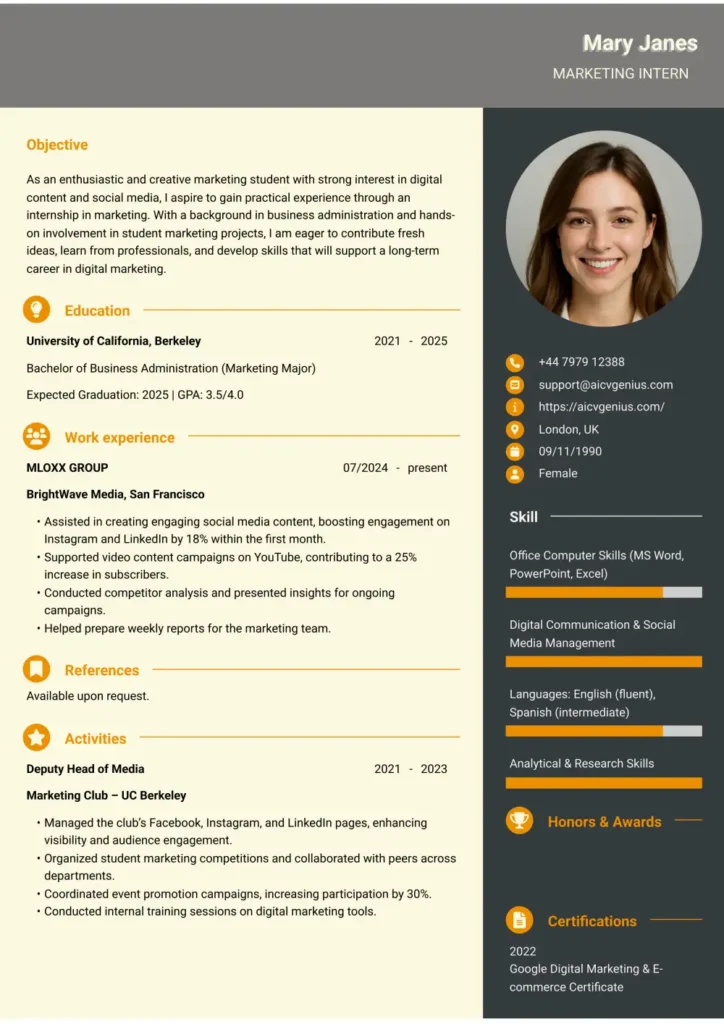
Complete Marketing Resume Example (Digital Specialist)
This full, ATS-friendly resume example applies the core principles discussed, focusing on a clear summary, a categorized skills section, and quantifiable achievements in the work experience.
JULIA K. DANIELS
(555) 123-4567 | julia.daniels.mktg@email.com | LinkedIn.com/in/juliakdaniels
Professional Summary
Results-driven Digital Marketing Specialist with 4+ years of experience in the e-commerce sector. Proven ability to drive revenue growth and enhance brand presence through integrated PPC, SEO, and social media strategies. Successfully managed $50k+ monthly ad budgets, improving ROAS by 35% year-over-year. Seeking to leverage expertise in campaign optimization and data analysis to drive growth at [Target Company].
Skills & Technical Proficiencies
Digital Channels: SEO/SEM (PPC), Social Media Marketing (Organic & Paid), Content Marketing, Email Automation
Platforms & Tools: Google Ads (Certified), Google Analytics (GA4), Meta Business Suite, HubSpot (Certified), SEMrush, Ahrefs, Asana, Mailchimp
Data & Optimization: A/B Testing, Conversion Rate Optimization (CRO), Data Analysis & Reporting
Professional Experience
Digital Marketing Specialist | E-Com Innovators Ltd. | Chicago, IL | July 2021 – Present
- Managed a $50,000 monthly Google Ads budget, implementing campaign optimizations (keyword refinement, ad copy A/B testing, bid adjustments) that improved ROAS by 35% and decreased CPA by 20% year-over-year.
- Developed and executed organic social media strategy across Instagram and Pinterest, growing follower base by 60% (from 10K to 16K) and driving a 25% increase in referral traffic to the website over 18 months.
- Conceptualized and managed a micro-influencer collaboration campaign on TikTok for a new product launch, resulting in 200,000+ organic views and exceeding initial sales targets by 15% within the first quarter.
- Collaborated with the content team to optimize 50+ blog posts and landing pages based on SEMrush data, contributing to a 40% increase in organic search traffic for key terms.
Marketing Coordinator | Local Goods Co. | Chicago, IL | June 2019 – July 2021
- Supported the Marketing Manager in executing weekly email marketing campaigns (Mailchimp), achieving an average open rate of 28% (5% above industry average).
- Managed the company’s Facebook and Instagram accounts, creating daily content and responding to customer inquiries, which grew engagement by 20%.
- Assisted in coordinating 5 major seasonal product photoshoots and campaigns.
Education & Certifications
Bachelor of Science in Marketing
University of Illinois at Urbana-Champaign, Champaign, IL
Google Ads Search Certification (Issued 2024)
HubSpot Inbound Marketing Certification (Issued 2023)
Marketing Resume Case Studies (By Career Level)
Case Study: The Entry-Level Marketing Intern/Graduate
Meet Daniel, a recent marketing graduate applying for his first full-time role with limited formal internship experience. Instead of submitting a sparse resume, he strategically highlights transferable experiences and academic achievements using a clean, well-organized template:
- ✅ University Projects: Detailed a capstone project where his team developed a social media marketing plan for a local non-profit, outlining specific strategies proposed and projected engagement increases. Mentioned tools used like Canva and basic analytics.
- ✅ Volunteer Marketing: Described managing the Facebook page for a student organization, including creating event posts that led to a measurable 30% increase in attendance for key meetings.
- ✅ Relevant Skills: Listed proficiency gained through coursework in Google Analytics (including completing the free beginner course), basic SEO principles, social media scheduling (Hootsuite free tier), and content creation using Canva and Microsoft Office Suite.
- ✅ Relevant Coursework: Included titles like “Digital Advertising Fundamentals,” “Content Marketing Principles,” and “Market Research Analysis” to align with entry-level job requirements.
Daniel’s resume effectively showcases potential, initiative, and foundational knowledge. Recruiters reviewing it understand he’s entry-level but can see concrete evidence of applied skills and a proactive approach, making him a viable candidate for interviews.
Case Study: The Mid-Level Marketing Specialist (3-5 Years Experience)
Now meet Julia, with 4 years specializing in digital marketing for e-commerce. Her resume needs to demonstrate clear progression and quantifiable impact. She uses a modern, ATS-friendly template emphasizing:
- Work Experience with Measurable Results: Instead of “Managed social media,” she writes: “Developed and executed organic social media strategy across Instagram and Pinterest, growing follower base by 60% (from 10K to 16K) and driving a 25% increase in referral traffic to the website over 18 months.”
- Specific Platform Expertise & Budget Management: “Managed a $50,000 monthly Google Ads budget, implementing campaign optimizations (keyword refinement, ad copy A/B testing, bid adjustments) that improved ROAS by 35% and decreased CPA by 20% year-over-year.”
- Campaign Creativity & Execution: “Conceptualized and managed a micro-influencer collaboration campaign on TikTok for a new product launch, resulting in 200,000+ organic views and exceeding initial sales targets by 15% within the first quarter.”
- Tool Proficiency: Clearly lists key tools used daily, like HubSpot, Google Analytics (GA4), SEMrush, and specific project management software (e.g., Asana).
Julia’s resume template positions her as a results-driven specialist with proven experience across multiple digital channels and platforms. The focus on quantifiable achievements makes her stand out.
Case Study: The Marketing Manager (7+ Years Experience)
Finally, Robert, a Marketing Manager with 10+ years’ experience aiming for a Director role. His resume must emphasize strategic leadership and broader business impact:
- Leadership & Team Management: “Led and mentored a high-performing team of 8 marketing specialists across digital, content, product marketing, and events, fostering a collaborative environment and achieving departmental KPIs consistently.”
- Strategic Planning & Execution: “Developed and implemented a comprehensive multi-channel marketing strategy for a new SaaS product launch, aligning Marketing, Sales, and Product teams. Strategy resulted in exceeding first-year revenue targets by 22% and securing a 15% market share.”
- High-Level Tool Implementation & Process Improvement: “Oversaw the selection and successful integration of HubSpot Marketing Hub and CRM for a 30-person Sales and Marketing organization, resulting in a 40% improvement in lead nurturing efficiency and enhanced reporting capabilities.”
- Budget Oversight & ROI Focus: “Managed an annual marketing budget of $1.5M, consistently delivering positive ROI on major campaigns and optimizing spend allocation based on performance data.”
Robert’s resume reads less like a list of tasks and more like a portfolio of strategic business contributions. The emphasis is on leadership, strategy execution, and measurable impact on key business metrics like revenue and efficiency.
Advanced Guidance: Tailoring, Myths, and FAQs
Myths and Realities in Marketing Resumes
Let’s debunk common misconceptions about crafting effective marketing resumes:
| Myth | Reality |
|---|---|
| ❌ Marketing resumes must look like highly creative graphic design posters to stand out. | ✅ While visually appealing is good, clarity and ATS-compatibility are paramount. Overly complex graphics, unusual fonts, or multi-column layouts often get rejected by ATS. Opt for clean, professional designs with subtle creative touches (e.g., a well-chosen accent color). |
| ❌ Simply listing soft skills like “Good communicator” or “Team player” is sufficient. | ✅ Show, don’t just tell. Prove communication via successful campaign collaborations or presentations. Demonstrate teamwork by highlighting contributions to group projects with specific goals and outcomes. |
| ❌ Only experience working with big, well-known brands matters to recruiters. | ✅ Impact matters more than brand name. Startup, non-profit, or side-project experience is valuable if you demonstrate creativity, resourcefulness, and measurable results. |
| ❌ Listing responsibilities is enough; results aren’t always necessary or easy to find. | ✅ Metrics are the language of marketing impact. Include quantifiable results (or well-reasoned estimates) tied to growth, engagement, conversions, efficiency, or cost savings. |
Tailoring Your Resume: Big Brand vs. Startup Environments
The emphasis in your marketing resume should shift depending on whether you’re targeting a large corporation or a dynamic startup.
For Large Corporations / Established Brands:
- Highlight experience managing significant marketing budgets and demonstrating clear ROI.
- Showcase experience coordinating large-scale, potentially global campaigns involving multiple stakeholders.
- Emphasize process adherence, experience with enterprise-level marketing automation platforms (e.g., Marketo, Salesforce Marketing Cloud), and relevant industry certifications.
- Focus on specialization within a specific marketing function (e.g., SEO expert, Performance Marketing Lead).
For Startups & Smaller Companies:
- Demonstrate versatility and a “roll-up-your-sleeves” attitude – highlight experience across multiple marketing disciplines (e.g., managing SEO, social media, email campaigns simultaneously).
- Emphasize tangible projects and campaigns you executed with limited resources, showcasing creativity and initiative. Pedigree often matters less than proven execution ability.
- Include links to portfolios, personal blogs, or social media accounts you’ve managed successfully, as startups often value direct evidence of your work.
- Highlight adaptability, ability to learn quickly, and experience working in fast-paced, Agile environments.
Optimizing for Global & Remote Marketing Jobs
The rise of remote work means marketing roles are increasingly global. Recruiters hiring for these positions specifically look for evidence that you can thrive independently and collaborate effectively across distances and cultures:
- ✅ Explicitly mention successful collaboration experience across different time zones or with international teams.
- ✅ Include proficiency with essential remote work and project management tools: Slack, Microsoft Teams, Trello, Asana, Notion, Zoom, Miro.
- ✅ Highlight experience managing cross-cultural campaigns or adapting marketing messages for diverse international audiences (e.g., “Managed localized Google Ads campaigns for EMEA and APAC regions”).
- ✅ Clearly state language proficiencies beyond English, specifying fluency level (e.g., “Spanish: Professional Working Proficiency”).
- ✅ Emphasize strong written communication skills, crucial for asynchronous collaboration.
Resume Evolution: Tailoring Through Your Marketing Career Stages
Your resume should mature as your career progresses, shifting focus from potential to proven impact and leadership:
- ✅ Intern/Entry-Level (0-2 years): Focus heavily on education, relevant projects (academic/personal), coursework demonstrating foundational knowledge, internships/volunteer work, and transferable skills like communication and organization. Use a Resume Objective.
- ✅ Marketing Specialist/Coordinator (2-5 years): Emphasize hands-on execution, quantifiable campaign outcomes (metrics!), mastery of specific marketing tools and platforms, and growing responsibilities within campaigns. Use a concise Resume Summary.
- ✅ Marketing Manager (5-10 years): Highlight leadership experience (managing projects or people), strategic planning and execution of multi-channel campaigns, budget management experience, cross-functional collaboration, and significant impact on key business goals (leads, revenue).
- ✅ Marketing Director/VP (10+ years): Focus shifts almost entirely to strategic leadership, driving overall marketing vision, significant business impact (P&L responsibility, market share growth, major ROI achievements), team building and development, and executive-level collaboration.
Final Checklist Before Sending Your Marketing Resume
Before hitting ‘submit’, perform this final quality check:
- ✅ Is the Summary/Objective concise, impactful, and specifically tailored to the target marketing role and company?
- ✅ Does the Work Experience section include specific, quantifiable results (%, $, #) for key achievements?
- ✅ Are relevant marketing tools, platforms, and technical skills listed clearly and categorized logically?
- ✅ Have you included links to your portfolio, LinkedIn profile, or relevant campaign examples (if applicable and appropriate)?
- ✅ Is the resume saved in both ATS-friendly DOCX and visually consistent PDF formats, as recommended by best practices?
- ✅ Is the template clean, professional, easy to scan (good use of white space), and free of excessive graphics or columns that hinder ATS parsing?
- ✅ Has the resume been meticulously proofread for any typos, grammatical errors, or inconsistencies? (Ask a friend or use a tool!)
Extended FAQs for Marketing Resumes
Not necessarily, and often it’s counterproductive. Clarity and ATS compatibility are more important. A clean, professional design with subtle, tasteful creative elements (like a well-chosen accent color or modern font) is usually best. Overly graphic-heavy resumes risk being unreadable by ATS and perceived as unprofessional by some hiring managers. Focus on strong content first.
Yes, absolutely. Quantifiable results, even modest ones, are always more impactful than vague statements. Metrics demonstrate your focus on outcomes and provide concrete evidence of your contributions. Frame them effectively (e.g., “Increased email open rates by 15% through subject line A/B testing” sounds better than just “Improved email performance”).
Focus on transferable skills and relevant experiences. Showcase academic projects (detail your role, strategy, tools used, and results/learnings), volunteer work where you handled marketing tasks (e.g., social media for a club), relevant coursework, personal projects (like running a blog or personal brand social media account), and certifications. Emphasize skills like writing, analysis, creativity, and project management gained from any context.
It’s highly recommended, especially for digital marketing, content creation, social media, and graphic design-focused roles. A portfolio provides tangible proof of your work (e.g., ad creatives, blog posts, campaign landing pages, social media profiles managed). If you don’t have a formal portfolio website, a curated LinkedIn profile featuring project examples or a link to specific work samples (e.g., published articles) can suffice.
This depends on the specialization, but generally recognized ones include: Google Ads Certifications (Search, Display, Analytics), HubSpot Academy Certifications (Inbound, Content, Email Marketing), Meta Blueprint Certifications (Facebook/Instagram Ads), LinkedIn Marketing Solutions Fundamentals, and potentially platform-specific certs like SEMrush or Hootsuite depending on the role requirements.
Yes, absolutely essential for maximizing your chances. While your core experience remains the same, you should tailor your Resume Summary/Objective, highlighted Skills, and the specific achievements you emphasize in your Work Experience section to directly match the keywords and requirements listed in each job description. Generic resumes rarely stand out.
One page is strongly preferred for interns, entry-level candidates, and professionals with less than ~7-10 years of experience. Conciseness is key. Two pages are acceptable (and sometimes necessary) for Marketing Managers, Directors, VPs, or specialists with extensive, highly relevant experience, significant leadership roles, numerous high-impact campaigns, or publications that cannot be effectively summarized on one page. Never exceed two pages for standard industry roles. Prioritize relevance and impact.
Final Thoughts: Your Resume IS Your First Campaign
Ultimately, your resume is not merely a static historical record of your employment – it’s your most crucial personal marketing campaign. Applying the right marketing resume template allows you to strategically position your skills as valuable products, frame your past campaigns as compelling case studies, and present your quantified results as undeniable proof of value and potential ROI.
Always remember that the recruiter and hiring manager constitute your primary target audience. Your task is to craft a resume that immediately grabs their attention, communicates a clear and persuasive narrative, and leaves them thoroughly convinced that you possess the skills and strategic mindset to elevate their brand and achieve their business objectives. That’s precisely how you transform a simple document into your most successful campaign yet – the one that lands the interview.