
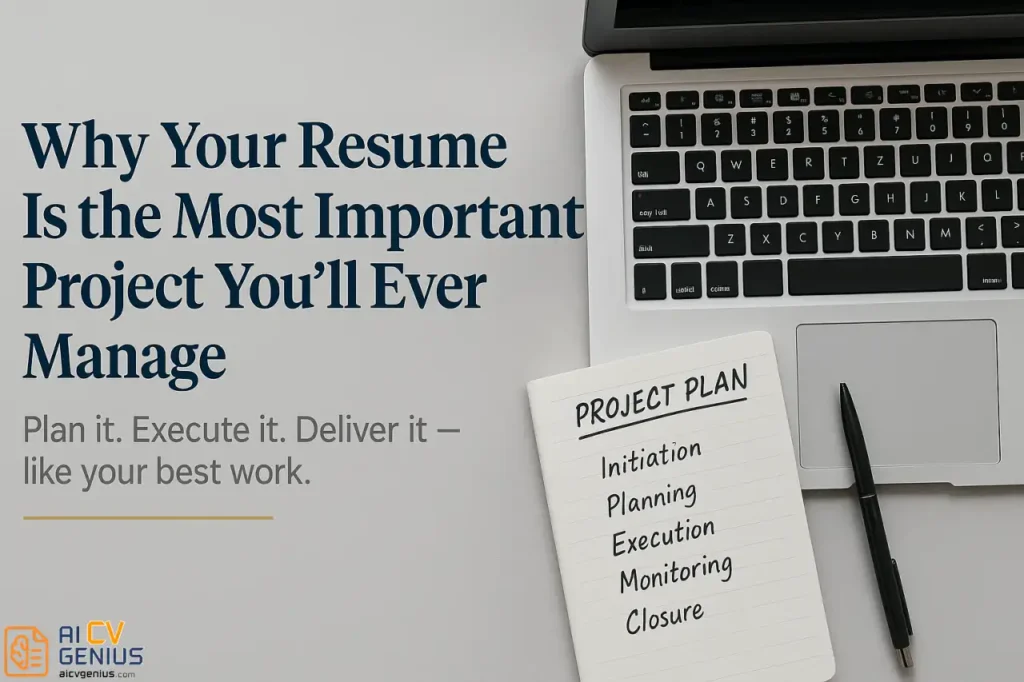
- The article’s core framing: Treat your resume like a project deliverable. Hiring managers run a risk assessment in a six-second scan, so vague duty lines fail. A strong project manager resume template must read like a dashboard of outcomes, not intentions.
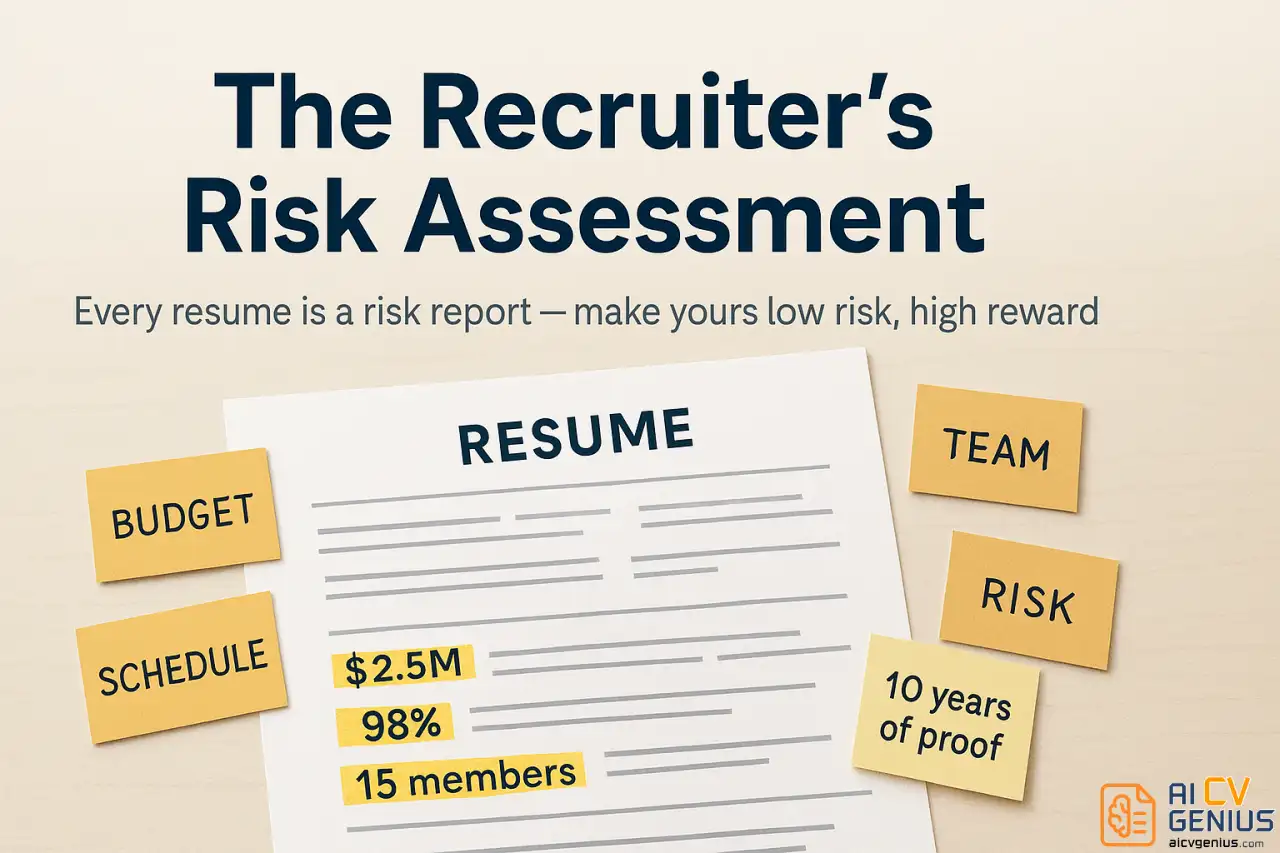
- What recruiters scan for first: Budget, Schedule, Stakeholders, Risk. Your bullets must show money handled, on-time delivery, team size and exec communication, and risk prevention. Use clear numbers and concrete proof so you look low-risk, high-reward.
- Layout and section order that wins: Use a clean one-column, ATS-safe structure with predictable blocks. Recommended order is Professional Summary, Skills and Methodologies, Professional Experience, Key Projects (Optional but strongly recommended), Certifications and Education. One page under 10 years, two pages only for senior roles.
- How to write each section: Summary is a 3 to 4 line value statement packed with keywords plus metrics. Skills should be split into Leadership and Methodologies and Tools and Systems. Experience bullets should follow PAR thinking, but the final bullet should show Action plus Result. Replace “Responsible for” with specific changes and measurable impact.
- The “stand out” additions and final checks: Add a Key Projects section using Objective, Action, Result to tell 2 to 3 mini-stories with scope and results. List certifications prominently (PMP, Scrum, PMI-ACP, PRINCE2). Avoid common pitfalls like two-column layouts, missing metrics, keyword stuffing, and typos. Finish with one “Project Philosophy” line and review your resume like a post-mortem, version it, and iterate.
Why Your Resume Is the Most Important Project You’ll Ever Manage
Every project manager knows the five phases: initiation, planning, execution, monitoring, and closure. Your resume must do the same for your career. But when it’s time to summarize years of complex deliveries, budgets, and stakeholder management onto a single page, many PMs fail their first test. They list duties – “managed cross-functional teams,” “led multiple projects” – lines that are vague, passive, and mean nothing without evidence.
A project manager resume template is more than a layout; it’s a strategic framework. It must function like the projects you lead: it must be clear, data-driven, and designed to communicate outcomes, not just intentions. It is your primary deliverable in the project of getting a new job.
“Your resume is your first project – plan, execute, and deliver it with the same discipline you bring to your work.”
Hiring managers are not just reading your resume; they are conducting a risk assessment. Their entire job is to find someone who can reduce chaos, not create it. A cluttered, vague, or disorganized resume signals a cluttered, vague, and disorganized project manager. This guide will deconstruct how to build a professional resume that serves as a high-level dashboard, proving to recruiters that you are a low-risk, high-reward investment.
The Recruiter’s View: The PM Risk Assessment & Layout Strategy
When a hiring manager or a Director of a PMO (Project Management Office) scans your resume, they have one goal: to mitigate risk. A bad PM hire can cost millions, destroy team morale, and derail strategic goals. In their six-second scan, they are looking for immediate answers to four critical questions.
1. Can You Manage Money? (The Budget)
This is non-negotiable. Can you be trusted with the company’s resources? They are scanning for dollar signs.
What they look for: “Managed a $2.5M project portfolio,” “Delivered project 10% under-budget,” “Identified $150K in cost-saving efficiencies.”
2. Can You Manage Time? (The Schedule)
Time is the one resource you cannot get back. Can you deliver on schedule?
What they look for: “Delivered 98% of projects on or ahead of schedule,” “Reduced average project lifecycle by 3 weeks,” “Coordinated a 12-month product roadmap.”
3. Can You Manage People? (The Stakeholders)
A PM is a communication hub. Can you align executives, motivate teams, and manage expectations?
What they look for: “Managed a cross-functional team of 15 engineers, designers, and marketers,” “Presented weekly status reports to C-level stakeholders.”
4. Can You Manage Chaos? (The Risk)
Projects never go perfectly. Do you anticipate problems or just react to them?
What they look for: “Identified and mitigated 3 major project risks, preventing scope creep,” “Developed a new QA workflow that reduced defects by 22%.”
Start With a Clear, Professional Layout (The Project Plan)
Good project management thrives on structure. Your resume must do the same. The best layout is clean, minimal, and instantly skimmable – like a perfect Gantt chart or a clean dashboard. It demonstrates at a glance that you value organization.
Stick to one page if you have under 10 years of experience. Two pages is acceptable only if you are a senior PM or Director with a long, relevant history of complex projects. Avoid decorative borders, background colors, or fancy fonts. For a PM, clarity is the only design trend that matters.
Every strong PM resume includes these sections in this order:
- ✅ Professional Summary: Your 3-line executive summary.
- ✅ Skills & Methodologies: A quick-scan list of your tools (Jira, Asana) and frameworks (Agile, Scrum, PMP).
- ✅ Professional Experience: The core of your resume, filled with quantified achievements.
- ✅ Key Projects (Optional but Recommended): A deeper dive into 1-2 major projects.
- ✅ Certifications & Education: Your credentials (PMP, Agile, PRINCE2).
This structure is predictable, which is what recruiters want. It’s also highly ATS-friendly. Choose a template that aligns information into these predictable blocks. A recruiter should know exactly where to look for your budget experience without thinking. Templates inside our Resume Templates Finder are all optimized for this specific, readable, and ATS-safe structure.
Building Your PM Resume: Section by Section
Open With a Strong Professional Summary
Your summary is not an objective. It’s a value statement. It’s the “Project Charter” for the resume. In 3-4 lines, it must summarize your experience, your core specialty, and your biggest quantifiable impact. It must be factual, not flashy.
Weak Summary:
“Experienced project manager with a history of managing teams and leading multiple projects. Looking for a challenging new role in a fast-paced company.”
Strong Summary:
“PMP-certified Senior Project Manager with 9+ years leading cross-functional teams to deliver complex SaaS and fintech projects. Specializes in Agile transformation and stakeholder alignment, successfully managing a $2M project portfolio and delivering 95% of projects on or ahead of schedule.”
The strong summary is packed with keywords (PMP, Agile) and metrics ($2M, 95%) that directly answer the recruiter’s core questions.
Highlight Your Technical & Leadership Balance
Project managers are translators between the technical world and the business world. Your skills section must show you speak both languages fluently. Create two mini-sections to demonstrate this balance:
- Leadership & Methodologies: Stakeholder Management, Agile/Scrum Methodologies, Risk Mitigation, Budget Forecasting, Waterfall, PMP, Change Management, Negotiation, Cross-Functional Leadership.
- ⚙️ Tools & Systems: Jira, Confluence, Asana, Trello, Notion, Smartsheet, MS Project, Slack Integrations, Power BI (for reporting).
This demonstrates you’re both organized and empathetic, a systems-thinker and a people-leader – a rare and valuable combination.
Focus on Achievements, Not Tasks
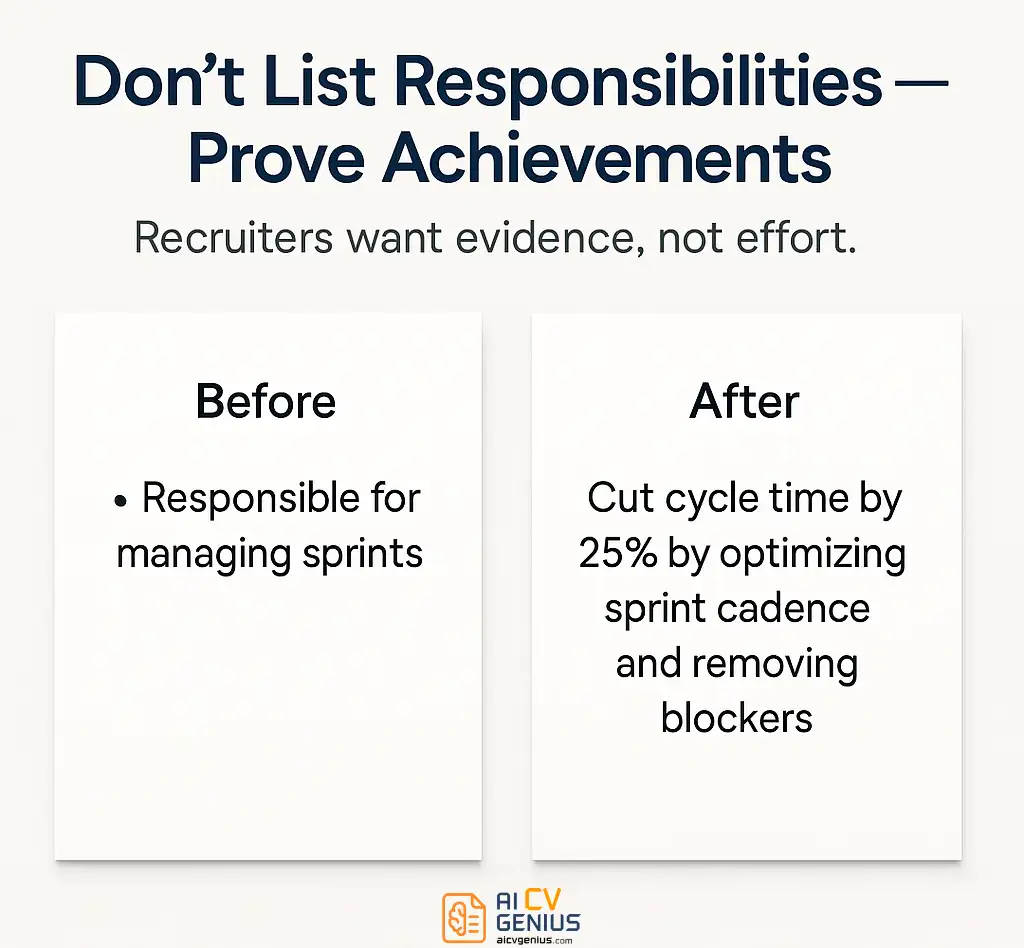
This is the single biggest mistake PMs make. Recruiters know you were “responsible for managing projects.” That is the definition of the job. They want to know if you were good at it. You prove that by showing results, not responsibilities.
Transform every bullet point from a passive duty into an active achievement. Use the Problem-Action-Result (PAR) formula:
- Problem: What was the issue? (e.g., “High defect rate…”)
- Action: What did you do? (e.g., “Implemented new QA workflow…”)
- Result: What was the outcome? (e.g., “…reducing defects by 22%.”)
Your resume bullet should just be the Action + Result.
| Before (Duty) | After (Achievement) |
|---|---|
| “Responsible for managing sprints.” | “Implemented Agile sprints and velocity tracking, cutting average cycle time from 4 weeks to 3.” |
| “Handled vendor contracts.” | “Oversaw vendor contract renegotiations, saving $180K annually while improving service-level agreements.” |
| “Led cross-team communication.” | “Designed and deployed new Notion dashboards, improving cross-team communication efficiency by 30%.” |
More examples that stand out:
- ✅ Delivered 12 concurrent enterprise projects totaling $1.4M, with 11 delivered on or before schedule.
- ✅ Managed a $3.2M annual project portfolio with a 96% on-time completion rate.
- ✅ Achieved 20% higher sprint throughput by introducing velocity tracking KPIs and refining backlog grooming.
- ✅ Mentored 3 junior project managers, improving the team’s overall delivery metrics and certification rates.
Add a Dedicated “Key Projects” Section
Instead of burying your best work in your experience list, pull 2-3 signature projects into their own section. This is your chance to tell a mini-story. This section proves scope, scale, and your personal impact. Use a clear, simple format:
Key Projects
Cloud Migration Project | FinServe Group (2023)
- Objective: Migrated 50+ enterprise clients from on-premise servers to a new AWS environment within an 8-month deadline.
- Action: Led a 15-member cross-functional team (DevOps, Eng, Support). Developed and managed the full project plan, risk register, and stakeholder communication cadence.
- Result: Completed migration 2 weeks ahead of schedule, reduced infrastructure costs by 18%, and achieved 99.8% uptime at launch.
E-commerce Platform Relaunch | RetailCo (2022)
- Objective: Relaunch the company’s primary e-commerce site to improve mobile conversion rates and site speed.
- Action: Managed the $1.2M budget and coordinated 4 external vendor teams. Implemented a Scrum framework for the internal dev team for the first time.
- Result: Increased mobile conversion by 35% and improved average page load speed by 2 seconds, leading to a $4M revenue lift in the first quarter post-launch.
This storytelling format shows the challenge, the process, and the impact – everything a recruiter needs to judge your leadership maturity.
Include Certifications & Continuous Learning
Certifications instantly boost credibility. They are standardized proof that you understand and respect process. Put them in their own clear section or right after your name in the header: “John Lee, PMP, CSM.”
The most in-demand certifications include:
- PMP (Project Management Professional)
- CSM (Certified ScrumMaster) or PSM (Professional Scrum Master)
- PMI-ACP (Agile Certified Practitioner)
- PRINCE2 (Common in Europe and for government projects)
Recruiters value curiosity and upskilling. Listing these shows you are invested in your craft.
Case Study: Elena’s Resume Transformation
Elena, a senior PM in logistics, had a 3-page resume overloaded with technical jargon and responsibilities. It read like a user manual. We restructured it entirely around outcomes. Each section became a project summary. She replaced passive text (“was responsible for…”) with active, quantified achievements (“Cut shipping delays by 28% by redesigning the carrier-matching workflow”). We added a “Key Metrics” table to her summary with her best numbers. Within three weeks, she landed interviews at two international firms.
“When your results speak clearly, you don’t have to over-explain your role.”
The Complete Project Manager Resume Example (Putting It All Together)
Theory is one thing; practice is another. Let’s apply every strategy we’ve discussed to build a complete resume for a fictional candidate, Elena Rodriguez, a PMP-certified IT Project Manager.
ELENA RODRIGUEZ, PMP, CSM
Senior IT Project Manager | Agile & SaaS Delivery
Austin, TX 78701 | (555) 876-5432 | e.rodriguez.pm@email.com | linkedin.com/in/elenarodriguezpm
PROFESSIONAL SUMMARY
PMP-certified Senior Project Manager with 9+ years leading cross-functional teams to deliver complex SaaS and fintech projects. Specializes in Agile transformation and C-level stakeholder alignment, successfully managing a $2M project portfolio and delivering 95% of projects on or ahead of schedule. Proven expert in risk mitigation and process improvement, cutting QA defects by 22%.
SKILLS & METHODOLOGIES
LEADERSHIP & METHODOLOGIES
| TOOLS & SYSTEMS
|
PROFESSIONAL EXPERIENCE
Senior Project Manager | Salesforce | Austin, TX (2020 – Present)
- Manage a $2M project portfolio of 5-7 concurrent SaaS implementation projects for enterprise clients, maintaining a 95% on-time delivery rate.
- Lead cross-functional teams of 15+ (engineers, consultants, data analysts) in a hybrid-Agile environment, improving sprint velocity by 20%.
- Present weekly project status, risk registers, and budget forecasts directly to C-level stakeholders and client VPs.
- Mentored 3 junior project managers, all of whom achieved PMP certification and promotion to PM II.
Project Manager | Oracle | Austin, TX (2017 – 2020)
- Managed the full lifecycle of a $1.2M fintech software launch, coordinating 4 vendor teams and delivering the product 3 weeks ahead of schedule.
- Developed a new QA workflow and risk register, identifying 3 critical pre-launch risks and reducing software defects by 22%.
- Renegotiated 3 vendor contracts, saving the project $150K in licensing fees while improving service level agreements (SLAs).
KEY PROJECTS
AWS Cloud Migration Project | Salesforce (2023)
- Objective: Migrated 50+ enterprise clients from on-premise servers to a new AWS environment within an 8-month deadline.
- Action: Led a 15-member cross-functional team (DevOps, Eng, Support). Developed and managed the full project plan, risk register, and stakeholder communication cadence.
- Result: Completed migration 2 weeks ahead of schedule, reduced infrastructure costs by 18%, and achieved 99.8% uptime at launch.
CERTIFICATIONS & EDUCATION
- Project Management Professional (PMP) | Project Management Institute (PMI)
- Certified ScrumMaster (CSM) | Scrum Alliance
- Bachelor of Business Administration (BBA), Management Info Systems | University of Texas at Austin
Design, Pitfalls, and Final Touches
Design Tips for Project Manager Resumes
Your resume’s design should enhance clarity, not distract from it. Spacing is leadership in visual form – it shows control, organization, and restraint.
- Fonts: Use one professional sans-serif font like Inter, Lato, or Roboto.
- Colors: Stick to neutral tones (black, grey). Use one single accent color (like a muted teal or navy) only for section headers or your name.
- Margins: Keep margins generous (at least 0.75 inches) for readability. White space is your friend.
| ✅ Pros (of a Good Template) | ❌ Cons (of a Bad Template) |
|---|---|
| Simple, structured design = professional impression | Overuse of color or icons confuses recruiters |
| ATS-friendly layout passes automated screening | Using text in images or tables breaks parsing |
| Highlights data and metrics clearly | Dense text blocks look overwhelming on mobile |
Common Mistakes to Avoid
A single mistake can signal “high risk” to a recruiter.
- ❌ Using a 2-Column Layout: Many ATS scanners read 2-column layouts incorrectly, jumbling your data. Stick to a single column.
- ❌ Listing Responsibilities Instead of Achievements: The cardinal sin of PM resumes.
- ❌ Forgetting to Include Metrics: A PM resume without numbers is just a list of opinions.
- ❌ Overstuffing Keywords: Don’t just list “Agile, Agile, Agile.” Show how you used Agile to “increase sprint velocity.”
- ❌ Typos: For a PM, a typo isn’t just a typo – it’s a failure in quality control.
Add a “Project Philosophy” Line
This is a subtle but powerful detail. End your resume summary with one sentence that defines your management approach. It humanizes you without wasting space.
“My project philosophy: I believe every successful project balances disciplined structure with human flexibility and transparent communication.”
Review Like a Project Post-Mortem
Before sending, read your resume like a project report. Ask: “What went well? What could be improved? Would I approve this deliverable if my name was on it?” Fix weak verbs, vague outcomes, and inconsistent spacing. Save a version number (e.g., “Resume_PM_Tech_v1.2.pdf”) and iterate – treat it like agile documentation.
FAQs & Final Thoughts
FAQs About Project Manager Resume Templates
Final Thoughts
A project manager resume template should be functional – not flashy. It is a technical document designed for a specific purpose: to prove you understand structure, communication, and accountability. When recruiters can read your results clearly and quickly, they already see the kind of leader you are.
“Don’t just manage projects – manage how your story is told.”
Treat your resume as your most important project. Plan it, execute it with precision, and deliver a result that speaks for itself.